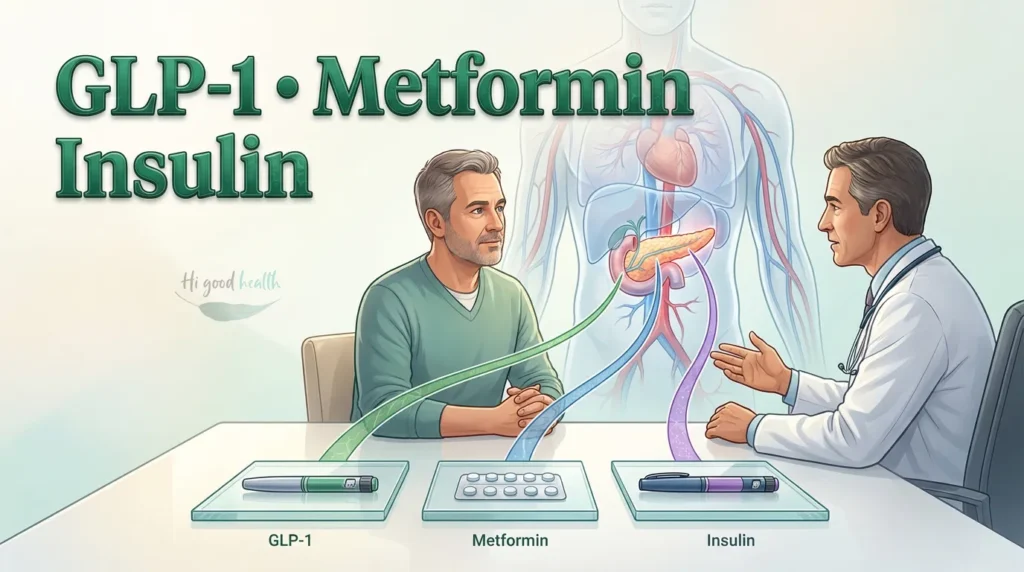
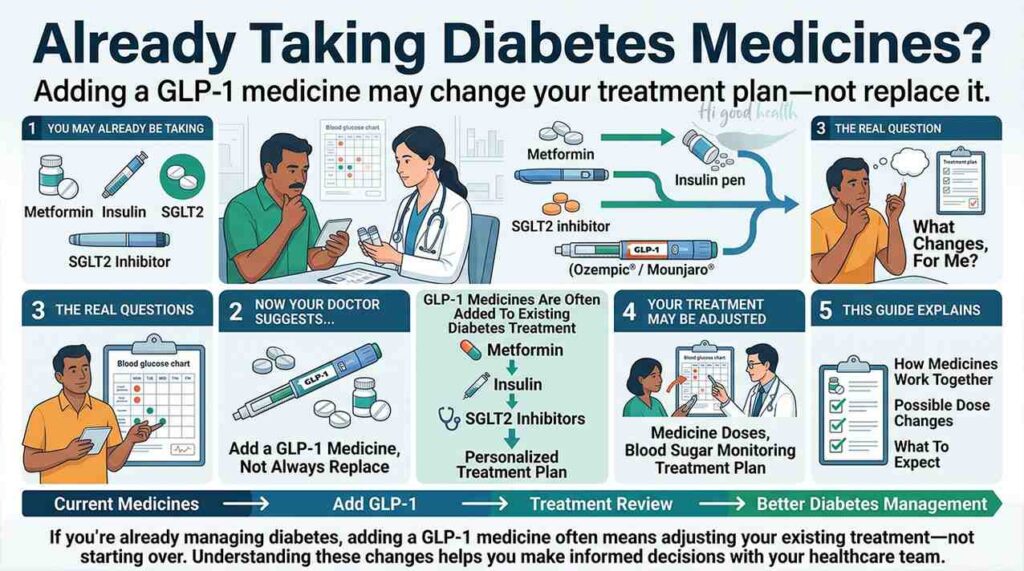
If you are already managing diabetes with metformin, insulin, or an SGLT2 inhibitor, and your doctor has now mentioned Ozempic for type 2 diabetes — or Rybelsus, Mounjaro, or one of the new generic semaglutide injections — you are not alone, and you deserve a clear, honest answer about what happens next.
Most articles about GLP-1 drugs are written for newcomers, people still wondering what these injections even are. But if you have been living with diabetes for years, juggling metformin tablets, insulin pens, and a strip-testing routine, your question is different. It is not ‘what is a GLP-1 drug?’ It is ‘what changes for me?’
This piece — Part 6 of our GLP-1 series for India — answers exactly that, using Indian treatment patterns, Indian real-world data, and the practical realities of adjusting medicines you have likely been taking for a long time.
At a glance
In Indian practice, Ozempic for type 2 diabetes is almost always added on top of metformin, not used instead of it. Metformin usually continues unchanged. Sulfonylureas such as glimepiride are often reduced or stopped, and insulin doses are usually lowered step by step, because a GLP-1 drug sitting on top of insulin or a sulfonylurea raises the risk of low blood sugar. An SGLT2 inhibitor is frequently kept alongside the GLP-1 for combined heart and kidney protection. Every one of these changes belongs to your doctor, guided by your HbA1c, your home glucose readings, and your history of hypoglycemia — never to self-adjustment.
Why This Stage Of Diabetes Treatment Matters
Type 2 diabetes is a progressive condition. The pancreas produces less insulin over time, and a single medicine that worked well at diagnosis often stops being enough after a few years. This is not a personal failure. It is the natural biology of the disease, and it is exactly why treatment ladders exist in the first place. India now has an estimated 101 million people living with diabetes and a further 136 million with prediabetes, according to the ICMR-INDIAB national study [9] — which means a very large number of people reach this precise decision point every year. It is also why questions about Ozempic for type 2 diabetes in India now come up in clinic after clinic.
Our earlier article, Part 1: GLP-1 Drugs Explained, is a good starting point if you want the full basics on how these medicines work before reading on.
When Do Indian Doctors Add Ozempic For Type 2 Diabetes?
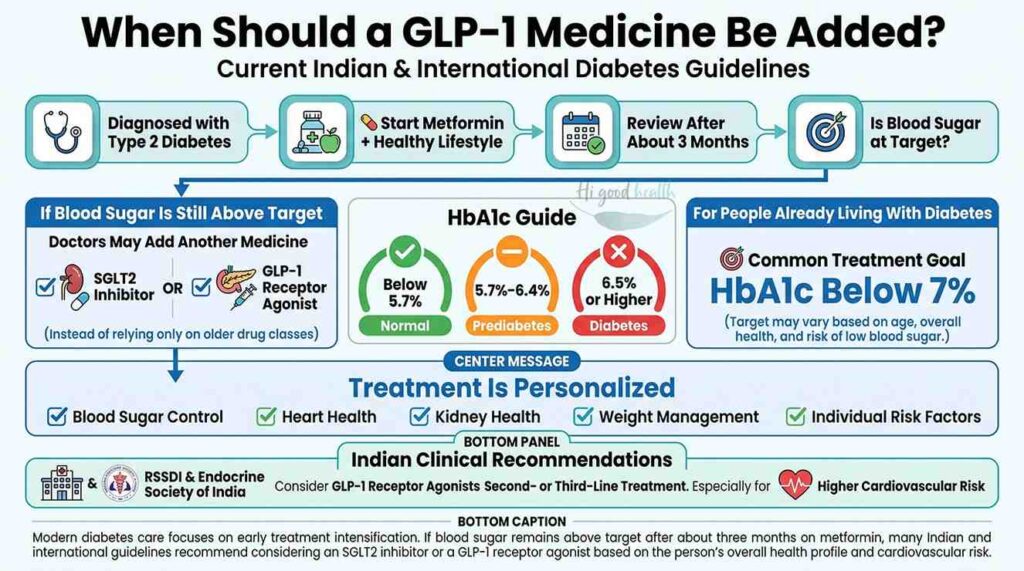
Indian and international guidance is converging on a similar message. If blood sugar targets are not met roughly three months after starting metformin, doctors should not wait. They should add a second agent, and current recommendations prioritise an SGLT2 inhibitor or a GLP-1 receptor agonist over older drug classes [1].
An HbA1c below 5.7% is considered normal, and 6.5% or higher indicates diabetes. For people already living with diabetes, treatment aims at an individualised HbA1c target — commonly below 7% for many adults, though this is adjusted for age, overall health, and the risk of low blood sugar [8]. Doctors do not reach for Ozempic for type 2 diabetes at the moment of diagnosis; it enters the picture when the first line of treatment is no longer holding, or when your heart, kidney, or weight profile makes it the smarter second step.
The Research Society for the Study of Diabetes in India (RSSDI), together with the Endocrine Society of India, recommends that GLP-1 analogues with proven cardiovascular benefit be considered as a viable second- or third-line option, especially in people at elevated cardiovascular risk [1]. The RSSDI 2022 update keeps the same direction of travel [2].
The RSSDI Treatment Ladder, In Plain Language
- Step one: lifestyle change plus metformin for most newly diagnosed adults [1]
- Step two: if HbA1c is still above target after about three months, a second medicine is added rather than delayed
- Step three: the choice of that second medicine depends on your risk profile — heart disease, kidney disease, or obesity push the decision towards a GLP-1 receptor agonist or an SGLT2 inhibitor [2]
- Step four: insulin is brought in when oral and injectable non-insulin options are not enough, and it can later be reduced if a GLP-1 drug is added
Who Is Most Likely To Benefit From Adding A GLP-1?
- HbA1c staying above target despite metformin
- Overweight or obesity, especially the abdominal fat pattern common in Indians
- Existing cardiovascular disease or high cardiac risk — a topic we cover in depth in Part 8: GLP-1, Heart and Kidney Benefits
- Chronic kidney disease, where GLP-1 drugs have shown protective signals [7]
- A need to avoid hypoglycemia or further weight gain, which older drugs like sulfonylureas often cause
- DPP-4 inhibitors such as teneligliptin, sitagliptin, vildagliptin, and linagliptin are widely prescribed in India and lower blood glucose with a low risk of hypoglycemia. But for people who need a bigger HbA1c reduction, carry excess weight, or already have heart or kidney disease, guidelines increasingly favour GLP-1 receptor agonists [1]
This explains the why before we get into the how. Your doctor is not randomly adding another medicine. They are usually responding to a specific gap in your control or your risk profile.
Ozempic, Rybelsus, Mounjaro, Wegovy: What Each Name Means In India
Four brand names dominate the questions people bring to their doctors, and they are not interchangeable. Getting them straight matters, because the medicine you are handed at an Indian pharmacy may not carry the name you searched for.
- Ozempic is the best-known brand name worldwide for once-weekly injectable semaglutide, licensed as a glucose-lowering medicine. When Indians search for Ozempic for type 2 diabetes, the medicine actually dispensed is usually semaglutide under a different brand — since the semaglutide patent expired in India in March 2026, a growing list of Indian generic semaglutide injections has entered the market
- Rybelsus is the same molecule, semaglutide, in a daily tablet. People searching Rybelsus for type 2 diabetes are usually looking for a way to avoid needles. It must be taken on an empty stomach with a small sip of water, and food or other tablets too soon afterwards blunt its absorption. Part 3 compares oral and injectable semaglutide in detail
- Mounjaro is tirzepatide, not semaglutide. Searches for Mounjaro for type 2 diabetes are really asking about a once-weekly injection that acts on two gut-hormone receptors, GIP and GLP-1, rather than one. Strictly speaking it is a dual agonist rather than a pure GLP-1 drug
- Wegovy is where precision matters most. People type Wegovy for type 2 diabetes into search engines every day, but Wegovy is higher-dose semaglutide licensed for weight management, not as a diabetes glucose-lowering treatment. Someone with both type 2 diabetes and obesity may be prescribed it for weight, but it is not a swap for a diabetes medicine
All of these are prescription-only medicines in India, approved and regulated by the Central Drugs Standard Control Organisation, or CDSCO [10]. A weekly type 2 diabetes injection in India has become a realistic option for many more people than it was two years ago, but none of them should ever be bought online, borrowed from a relative, or started without a prescription.
Add-On Or Switch: The Two Real Paths
There are really only two things that can happen when a GLP-1 drug enters your treatment plan. It gets added on top of what you are already taking, or it replaces something.
Can I Take GLP-1 With Metformin? The Combination Explained
Yes, and this is by far the most common way a GLP-1 drug is introduced. The GLP-1 and metformin combination works because the two medicines act through completely different routes. Metformin reduces the glucose your liver releases and improves insulin sensitivity, while the GLP-1 drug stimulates glucose-dependent insulin release, slows gastric emptying, and dampens appetite.
Studied together, the pairing has shown meaningful improvements in HbA1c, in insulin resistance markers such as HOMA-IR, and in fat mass over roughly 52 weeks of therapy, which makes it one of the best-established and lowest-risk combinations in modern diabetes care [4]. Because metformin on its own carries very little hypoglycemia risk, this pairing rarely calls for any change to your existing metformin dose.
Switching From Insulin To Ozempic In India: What Actually Happens
This is where things get more nuanced, and where Indian-specific data becomes genuinely useful. People asking about switching from insulin to Ozempic in India are often hoping to leave injections behind altogether, and that is worth being honest about: a GLP-1 drug is itself an injection in most cases, and for long-standing insulin users it usually reduces the insulin dose rather than removing it.
Is taking Ozempic and insulin together safe? Under medical supervision, yes — the two are commonly prescribed together and the combination is well recognised in treatment guidance [8]. The risk does not come from the pairing itself. It comes from leaving the insulin dose untouched. Sulfonylureas such as glimepiride and gliclazide, and insulin itself, both carry a meaningful risk of low blood sugar, and that risk rises sharply once appetite drops after a GLP-1 drug is started. For a full breakdown of how GLP-1 side effects interact with other medicines, see Part 5: GLP-1 Side Effects for Indians.
Which Diabetes Medicines Are Usually Continued, Reduced, Or Stopped?
Medicine | Typical adjustment when GLP-1 is added |
Metformin | Usually continued unchanged |
Sulfonylureas (glimepiride, gliclazide) | Often reduced or stopped to avoid low sugar |
Insulin | Dose often reduced gradually, sometimes tapered over weeks |
SGLT2 inhibitors | Often continued together for combined heart and kidney benefit |
An Indian real-world study following 7,058 patients on fixed-dose glimepiride-metformin combinations found that starting insulin was common in a majority of cases, underlining how frequently Indian patients cycle through drug combinations as diabetes progresses [3]. That is exactly the population in which a GLP-1 add-on or substitution becomes relevant.
Separately, Indian clinical reviews of GLP-1 analogues such as exenatide and liraglutide found effects on HbA1c, fasting glucose, and post-meal glucose broadly comparable to global data, along with a genuinely low rate of hypoglycemia [4]. In short, Indian bodies respond to these combination strategies much as patients studied elsewhere do.
SGLT2 And GLP-1 Combination Therapy In India
Prescribing GLP-1 agonists and SGLT2 inhibitors together is one of the more interesting shifts in Indian diabetes care. The two classes protect different organs by different mechanisms: SGLT2 inhibitors push glucose out through the urine and have strong heart-failure and kidney data behind them, while GLP-1 drugs work on insulin release, appetite, and the arteries. SGLT2 and GLP-1 combination therapy in India is therefore used most often in people carrying both cardiovascular and kidney risk, which describes a very large share of Indian patients with long-standing diabetes [2].
Neither class forces insulin out of the pancreas regardless of blood sugar, so the pair does not usually add hypoglycemia risk on its own [8]. SGLT2 inhibitors do bring their own cautions, particularly dehydration and genital or urinary infections, and both matter more in India’s hot months. Drinking enough water and reporting any burning or discomfort early are simple, practical safeguards.
How Long Does The Transition Take?
- The GLP-1 drug is typically started at the lowest dose, whatever else you are already taking
- Dose escalation happens gradually, usually every four weeks, to limit nausea and other gut side effects — Part 5 covers managing these in full
- Insulin or sulfonylurea adjustments generally happen over days to a few weeks, guided by your home glucose readings
- A formal HbA1c recheck is usually done around the three-month mark to see how well the combination is working
- Improvements in blood glucose may become noticeable within the first few weeks, although individual responses vary
- Weight loss typically develops gradually over several weeks to months rather than immediately
What Indian Studies Say About GLP-1 Combination Therapy
Dr. Rajiv Kovil, a Mumbai-based diabetologist, has noted that nearly half of his patients could clinically benefit from GLP-1 therapy, though historically only a small fraction actually used these medicines because of cost — a gap that is closing fast as generics reach the Indian market. Cost, not clinical suitability, has long been the single biggest barrier to Ozempic for type 2 diabetes in India.
Since semaglutide’s patent expired in India in March 2026, generic prices have fallen by roughly 80%, with monthly costs now starting around ₹1,290 to ₹5,000 compared with ₹8,800 to ₹16,400 for older branded options. We cover that shift in detail in Part 7: GLP-1, Cost and Access of Drugs in India.
Who May Not Be A Good Candidate For A GLP-1 Add-On?
- A personal or family history of medullary thyroid carcinoma or MEN2 syndrome
- Pregnancy or breastfeeding
- Previous pancreatitis, which needs an individual risk assessment
- Severe gastroparesis or significant pre-existing gut disease
Hypoglycemia Monitoring When You Add A Type 2 Diabetes Injection In India
Adding Ozempic for type 2 diabetes to an existing insulin or sulfonylurea prescription changes your side-effect profile, and that deserves to be taken seriously rather than brushed off. Part 5: GLP-1 Side Effects for Indians covers the full landscape. Here is the practical monitoring checklist:
- Check your blood sugar more often in the first two to four weeks after any dose change, especially if you are on insulin or a sulfonylurea [8]
- Learn and watch for the signs of hypoglycemia: sweating, tremors, palpitations, sudden intense hunger, confusion, or drowsiness
- Keep a simple log of symptoms alongside meals and injection timing — it helps your doctor fine-tune doses much faster
- Report persistent vomiting, severe abdominal pain, or signs of dehydration immediately, particularly during India’s hot summer months when fluid loss compounds quickly
- Ask your doctor in advance what your personal low-sugar plan is, so you are not improvising during an episode
Why Your Doctor May Reduce Insulin Or Sulfonylurea Doses
GLP-1 drugs by themselves carry a low intrinsic risk of causing hypoglycemia, because they work in a glucose-dependent way — insulin release ramps up only when blood sugar is high. Layered on top of insulin or a sulfonylurea, though, and especially once appetite and food intake fall, the combination can cause dangerous dips if the older doses are not reduced in advance [8]. That dose reduction is a preventive safety step. It is not a sign that your original medicines were unsafe or wrongly prescribed.
The Bigger Picture: Organ Protection, Not Just Sugar Control
If you have existing heart disease or kidney concerns alongside diabetes, this transition carries extra weight. Large outcome trials — LEADER, SUSTAIN-6, REWIND, SELECT, and the more recent SOUL trial, which included 788 Indian patients — have shown that certain GLP-1 drugs meaningfully reduce heart attacks, strokes, and cardiovascular death [5][6], with a 26% reduction in heart attacks among Asian participants in SOUL.
The FLOW trial, the first kidney-outcomes study built specifically around a GLP-1 drug, was stopped early after independent monitors found clear evidence of kidney benefit — a rare and telling signal in clinical research [7]. For a closer look at why doctors increasingly reach for these medicines in patients with heart or kidney risk, Part 8: GLP-1, Heart and Kidney Benefits is worth reading in full.
What If The GLP-1 Does Not Work?
- The dose may be increased if blood sugar stays above target and the medicine is well tolerated
- Your doctor will review adherence, to be sure doses are being taken correctly and consistently
- Lifestyle measures may be revisited, because eating patterns and physical activity still carry a large share of the result — Part 4 covers GLP-1 and Indian diets
- A different GLP-1 receptor agonist may be considered if the first is ineffective or poorly tolerated
- Additional diabetes medicines may be needed if your individual treatment goals are still not met
Key Takeaways
- Ozempic for type 2 diabetes is normally an add-on to metformin, not a replacement for it
- Metformin usually continues unchanged; sulfonylureas are often reduced or stopped; insulin is usually tapered rather than dropped
- Combining a GLP-1 drug with an SGLT2 inhibitor is increasingly common in India when heart or kidney risk is present
- The hypoglycemia risk comes from insulin and sulfonylureas, not from the GLP-1 drug itself — which is exactly why those doses are lowered in advance
- Check your sugar more often for two to four weeks after any dose change, and keep a simple written log
- RSSDI guidance places GLP-1 medicines with proven cardiovascular benefit at second or third line, especially for people at raised cardiac risk
- Ozempic, Rybelsus, Mounjaro, and Wegovy are not interchangeable, and only a doctor can say which, if any, fits your case
- Never start, stop, or adjust any of these medicines on your own
Frequently Asked Questions
Can I take GLP-1 with metformin?
Yes — this is one of the best-studied, lowest-risk combinations, and metformin usually doesn’t need dose changes.
Will I need to stop insulin if I start a GLP-1 drug?
Not necessarily. Many patients stay on a reduced insulin dose rather than stopping entirely; the decision depends on your HbA1c, weight, and hypoglycemia history.
Is combining SGLT2 and GLP-1 safe in India?
Generally yes, and increasingly favored for patients with both cardiovascular and kidney risk, though it should always be doctor-supervised.
Can GLP-1 completely replace insulin?
In some patients with earlier-stage type 2 diabetes, yes, over time — but for those with long-standing insulin dependence, GLP-1 is usually additive rather than a full replacement.
Does combining drug classes cost more?
It can, though falling generic semaglutide prices in India have narrowed this gap significantly since March 2026 — see Part 7: GLP-1, Cost and Access of Drugs in India for a full cost breakdown.
Is taking Ozempic and insulin together safe?
Under a doctor’s supervision, yes. The pairing is common in India. The safety comes from lowering the insulin dose as the GLP-1 drug takes effect, and from checking your blood sugar more often during the first few weeks.
Do I still need metformin after starting a GLP-1 injection?
Usually yes. Metformin is inexpensive, well studied, and works through a different route from GLP-1 drugs, so most Indian doctors keep it going unless there is a specific reason to stop, such as kidney problems or side effects.
Can GLP-1 agonists and SGLT2 inhibitors be taken together in India?
They can, and this pairing is increasingly used when someone carries both heart and kidney risk. It should be started and monitored by your doctor, who will also watch for dehydration during hot weather.
Does a GLP-1 drug cause low blood sugar on its own?
Rarely, because it triggers insulin release mainly when blood sugar is high. The hypoglycemia risk comes from the older medicines it sits alongside, which is why insulin and sulfonylurea doses are usually reduced first.
What is the difference between Ozempic, Rybelsus, and Mounjaro?
Ozempic and Rybelsus are both semaglutide — one a weekly injection, the other a daily tablet. Mounjaro is tirzepatide, which acts on two gut-hormone receptors instead of one. Your doctor decides based on your sugar levels, weight, other conditions, and cost.
Glossary
- GLP-1 RA (GLP-1 receptor agonist): a medicine class that mimics the gut hormone GLP-1 to improve insulin release, reduce appetite, and slow digestion
- GIP: a second gut hormone; tirzepatide (Mounjaro) acts on both GIP and GLP-1 receptors
- SGLT2 inhibitor: a tablet class that lowers blood sugar by removing glucose through the urine, with additional heart and kidney benefits
- HbA1c: a blood test showing average blood sugar over roughly two to three months
- HOMA-IR: a calculation used to estimate insulin resistance
- Sulfonylurea: an older diabetes drug class (glimepiride, gliclazide) that stimulates insulin release regardless of blood sugar level, carrying a higher hypoglycemia risk
- MACE: major adverse cardiovascular events — heart attack, stroke, or cardiovascular death
- MEN2: multiple endocrine neoplasia type 2, a genetic condition linked to thyroid tumours
References
All reference links valid and accessible on July 2026
- [1] RSSDI-ESI Clinical Practice Recommendations for the Management of Type 2 Diabetes Mellitus, 2020. pmc.ncbi.nlm.nih.gov/articles/PMC7328526
- [2] RSSDI Clinical Practice Recommendations, 2022. rssdi.in (PDF)
- [3] Real-World Observational Study of Glimepiride and Metformin Fixed-Dose Combination in Indian Patients. Cureus, 2021. cureus.com/articles/42805
- [4] Efficacy and tolerability of GLP-1 agonists in Indian patients with type 2 diabetes. PubMed, 2014. pubmed.ncbi.nlm.nih.gov/25489471
- [5] Gerstein HC, et al. Dulaglutide and cardiovascular outcomes in type 2 diabetes (REWIND trial). Lancet. 2019;394:121-130.
- [6] McGuire DK, et al., SOUL Study Group. Oral Semaglutide and Cardiovascular Outcomes in High-Risk Type 2 Diabetes. New England Journal of Medicine, 2025.
- [7] Rossing P, et al. The rationale, design and baseline data of FLOW: a kidney outcomes trial with semaglutide. Nephrology Dialysis Transplantation. 2023;38:2041-2051.
- [8] American Diabetes Association. Standards of Care in Diabetes 2025. Diabetes Care. 2025;48(Suppl 1):S1-S350.
- [9] Anjana RM, et al. Metabolic non-communicable disease health report of India: the ICMR-INDIAB national cross-sectional study. Lancet Diabetes and Endocrinology. 2023;11(7):474-489.
- [10] Central Drugs Standard Control Organisation (CDSCO), Ministry of Health and Family Welfare, Government of India. cdsco.gov.in
A Note From HiGoodHealth
HiGoodHealth exists to give Indian families clean, credible, and easy-to-understand health information — busting myths and translating complex global research into decisions you can actually use in daily life.
Disclaimer: This article is for general education only and is not a substitute for personal medical advice, diagnosis, or treatment. Never start, stop, or adjust metformin, insulin, sulfonylureas, or GLP-1 medicines without guidance from a qualified doctor who knows your full medical history and current prescriptions.