GLP-1 drugs were developed to treat diabetes and obesity, not for cosmetic weight loss in healthy, normal-weight individuals, and understanding that gap is the key to using these medicines safely.
A decade ago, mentioning a GLP-1 drug at a dinner table in Delhi or Mumbai would have meant blank stares. Today, it’s hard to find someone who doesn’t know a colleague, cousin, or Instagram influencer who’s “on Ozempic.
This is Part 9 of our GLP-1 series for India, and it steps back from the biology to ask a harder question: what happens when a serious prescription medicine becomes a lifestyle trend, and who gets hurt when that happens?
At a glance
- GLP-1 drugs were developed for diabetes and obesity, not for cosmetic weight loss in healthy people at a normal weight.
- Off-label prescribing is legal and often legitimate. The problem starts when the prescriber is not a clinician at all.
- An endocrinologist and a gym trainer see different things and carry different responsibility, which is why patients get conflicting advice.
- The under-discussed risks include counterfeit supply, muscle loss and weight regain after stopping.
- The question the article ends on is a practical one: who should a patient actually trust?
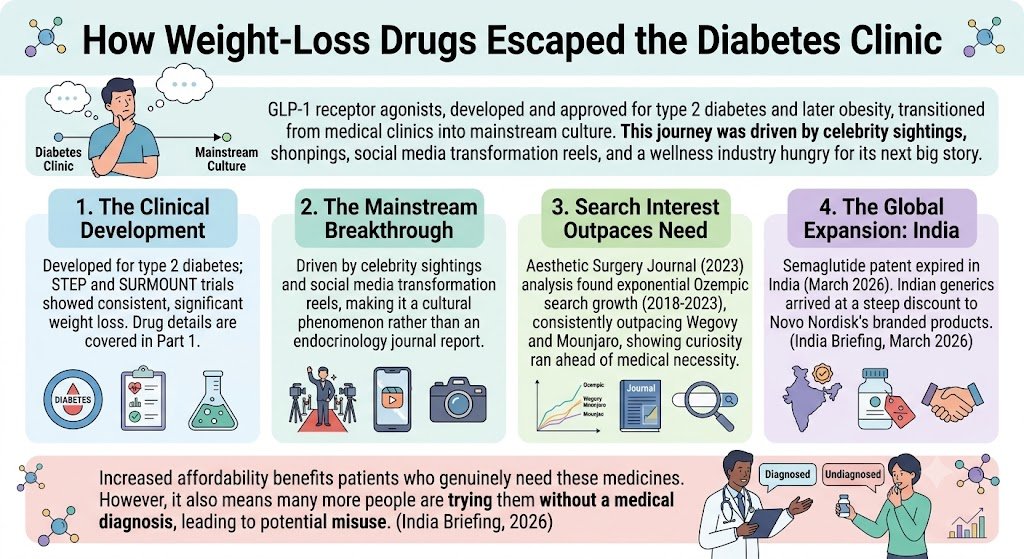
How Weight-Loss Drugs Escaped the Diabetes Clinic
GLP-1 receptor agonists were developed and approved for type 2 diabetes, with obesity approval following only after trials like STEP and SURMOUNT showed consistent, significant weight loss — details we cover in Part 1 on how these drugs work.
But the drug’s journey into mainstream culture wasn’t driven by endocrinology journals. It was driven by celebrity sightings, social media transformation reels, and a wellness industry hungry for its next big story.
A Google Trends analysis published in the Aesthetic Surgery Journal, 2023 found that public search interest in Ozempic grew exponentially between 2018 and 2023, consistently outpacing search interest in Wegovy and Mounjaro during the same window — a clear signal that public curiosity was running well ahead of medical need.
In India specifically, that curiosity turned into real demand after semaglutide’s patent expired in March 2026, when Indian generics arrived at a steep discount to Novo Nordisk’s branded products, according to India Briefing, March 2026.
Cheaper access is good for patients who genuinely need these medicines — but it also means many more people are trying them for reasons that have nothing to do with a medical diagnosis.
Why are people so interested in these drugs?
- Traditional dieting often leads to hunger and weight regain.
- GLP-1 drugs reduce appetite, making weight loss feel easier.
- These drugs are often perceived as a rapid or simplified approach to weight loss, even when they don’t meet medical criteria.
- Pocket friendly cost.
What Does “Off-Label” Actually Mean?
Off-label prescribing means a doctor prescribes an approved medicine for a use, dose, or population outside what regulators originally approved it for. This is legal and common in medicine — but it should always be a deliberate clinical decision backed by evidence, not a shortcut around proper evaluation.
- Evidence-based off-label use: A doctor prescribes semaglutide for obesity-related complications even at a slightly lower BMI threshold than official labeling, based on published trial data and the patient’s overall risk profile.
- Misuse: Someone with a BMI of 21 obtains the drug through unregulated online sources with no medical evaluation, purely to lose a few kilos before a wedding.
The difference isn’t the drug — it’s the decision-making process behind it. A review in the Journal of Population Therapeutics and Clinical Pharmacology, 2023 examining the ethics of off-label GLP-1 use notes that unsupervised cosmetic use bypasses the risk screening that regulatory approval was designed to require.
India’s drug regulator, the CDSCO, has stated that GLP-1 obesity drugs are approved with the condition that they be prescribed only by qualified specialists after proper evaluation, per PIB, Government of India, 2025-26.
When Good Medicine Turns Into Bad Practice
Misuse of GLP-1 drugs in India commonly arises due to inappropriate access and lack of medical supervision. Buying injections through unregulated online sellers, WhatsApp groups, or wellness clinics without a prescription has become common enough that India’s drug controller intensified surveillance in 2026, auditing pharmacies, wholesalers, and slimming clinics for unauthorized sales (PIB, Government of India, 2025-26).
Why does misuse happen?
- Social events create intense pressure for accelerated weight reduction, driving individuals to replicate peer or influencer medication regimens without professional oversight, ignoring critical variations in personal safety and metabolic response
- Using a prescription medicine purely for cosmetic weight loss, Gym/ bodybuilding and social media transformation culture without any medical evaluation of BMI, metabolic health, or contraindications (see Part 5 for who should avoid GLP-1 drugs entirely)
- Chasing the fastest possible weight loss by escalating doses too quickly, which sharply increases nausea, vomiting, and dehydration risk
A global infodemiological study tracking worldwide semaglutide search interest found that unsupervised, socially-driven demand has been directly linked to drug shortages and reports of adverse events occurring without adequate safety monitoring (BMC Infodemiological Study, 2024).
What an Endocrinologist Actually Sees
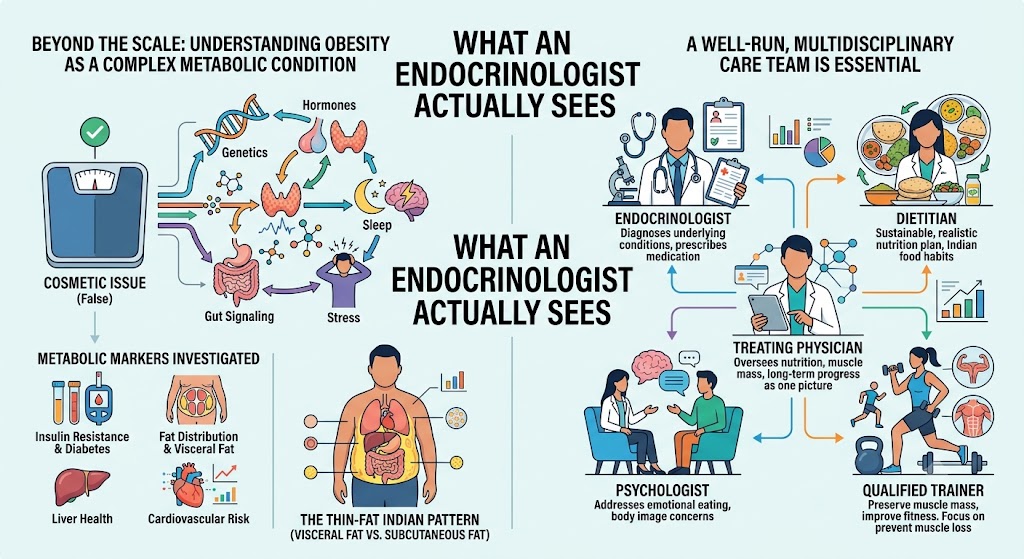
To a specialist, obesity isn’t a cosmetic issue — it’s a complex, chronic metabolic condition shaped by genetics, hormones, gut signaling, sleep, and stress, not simply a matter of willpower.
An endocrinologist looks past the number on the scale to metabolic markers: insulin resistance, diabetes, fat distribution, liver health, and cardiovascular risk, much like the thin-fat Indian pattern discussed in Part 2 of this series.
Effective, safe treatment rarely comes from one professional working alone. A well-run care team typically includes:
- Endocrinologist — diagnoses the underlying condition and prescribes medication when appropriate
- Dietitian — builds a sustainable, realistic nutrition plan around Indian food habits
- Qualified trainer — helps preserve muscle mass and improve fitness during weight loss, a concern we detail in Part 5‘s discussion of muscle loss on GLP-1 drugs
- Psychologist (when needed) — addresses emotional eating patterns and body image concerns
- The treating physician oversees nutrition, muscle mass, side effects, and long-term progress as one connected picture, not isolated numbers
What a Gym Trainer Sees — And Where Their Role Ends
Fitness professionals play a genuinely valuable role: building strength, improving body composition, and keeping clients accountable to healthy habits. It’s no surprise that many clients now ask trainers directly about GLP-1 drugs, dosing, or whether to combine them with intense workouts.
Reasons for patient reliance on fitness trainers include:
- Trainers often see rapid physical changes but don’t have access to medical history, blood tests, or contraindications.
- Difference between exercise advice and prescribing medication.
- Acknowledge that many qualified trainers work responsibly within their scope and collaborate with doctors.
But a trainer’s expertise, however skilled, stops at the point of diagnosis, prescription, and medical risk assessment. A trainer can help someone lift heavier or eat more protein; only a qualified doctor can assess whether a GLP-1 drug is medically appropriate, safe with existing conditions, or being used at a dangerously aggressive pace.
Why Patients Get Conflicting Advice
Part of the confusion comes from mismatched goals. A doctor treating obesity is optimizing for long-term metabolic health; a wellness influencer chasing engagement is optimizing for a dramatic transformation story.
An endocrinologist is looking at the bigger picture—better blood sugar control, lower health risks, healthier liver function, preserved muscle, and weight loss that can be maintained over the long term. On social media, success is often measured by a striking before-and-after photo or a dramatic transformation in a matter of weeks.
Both may talk about the same drug and mean something completely different by “success ”and it’s important not to mistake one for the other.
Peer-reviewed science and personal success stories don’t carry the same weight, even though social media often presents them as equally credible. Industry analysis of Ozempic’s online footprint found that platforms like TikTok drove search volume growth far faster than clinical literature could keep pace with, blurring the line between expert opinion and anecdotal testimony (Healthy Weight Meds, TikTok–Ozempic Report).
A single dramatic transformation post says nothing about the person’s muscle loss, rebound weight gain, or side effects six months later — details that rarely make it into a 30-second reel.
The Risks That Often Go Unnoticed
Rapid weight loss on GLP-1 drugs doesn’t only remove fat — it can take muscle along with it, especially in Indians who often start with lower baseline muscle mass, a risk explored in depth in Part 5‘s coverage of the thin-fat Indian body.
- Muscle loss alongside fat loss, leading to fatigue and reduced strength if protein intake and resistance training aren’t prioritized
- Digestive side effects such as nausea, bloating, and constipation, which can affect nutrition if meals are skipped rather than adjusted
- Weight regains after stopping the medication, since appetite-suppressing effects fade once treatment ends — a pattern also discussed in Part 1‘s FAQ section
- The ongoing need for exercise and adequate protein throughout treatment, not just before or after it, to protect long-term metabolic health
These medicines should not be viewed as a short-term fix. Obesity is a chronic disease for many people, and maintaining weight loss usually requires ongoing lifestyle changes, with or without medication.
The Bigger Impact on Society
Individual misuse doesn’t stay individual — it ripples outward. The same worldwide semaglutide search-trend analysis linked surging off-label, non-diabetic demand directly to global supply shortages that affected patients who needed the drug for diabetes control (BMC Infodemiological Study, 2024).
India’s booming generic GLP-1 market has also become a target for counterfeiters. In April 2026, Haryana drug control authorities seized counterfeit Mounjaro injections worth nearly ₹70 lakh in Gurugram, raising concerns about unsafe manufacturing and storage in the wider supply chain (India Today, April 2026).
Quality concerns have followed too — by July 2026, multiple Indian semaglutide manufacturers had recalled batches or delayed supply over quality issues, even as generics came to dominate the market (India Today, July 2026).
A parallel grey market has also emerged on e-commerce platforms, where unrelated tablets, patches, and powders are marketed using GLP-1 branding despite having no connection to the actual drug (Hindustan Times, July 2026).
For context on how India’s pricing landscape shifted so quickly, Part 7 of this series covers the cost and access changes following semaglutide’s 2026 patent expiry in detail.
How patients can avoid fake products
- Buy only from licensed pharmacies.
- Never purchase through WhatsApp, Instagram, or unofficial websites.
- Check packaging and batch details.
- Use only medicines prescribed by a qualified doctor.
- This gives readers practical advice.
More Than A Medical Issue: The Ethical Debate
There’s a genuine ethical question underneath all of this: where is the line between treatment and enhancement? Prescription medicines are meant to treat diagnosed conditions — but should a healthy person with no metabolic disease be able to use the same drug simply to look slimmer?
Reasonable people disagree here. Personal choice matters, and adults should have some autonomy over their own health decisions.
But that autonomy has to be balanced against responsible prescribing, honest risk disclosure, and a healthcare system that isn’t overwhelmed by cosmetic demand crowding out patients with genuine medical need — a tension the off-label ethics literature explicitly frames as a policy challenge, not just an individual choice (Journal of Population Therapeutics and Clinical Pharmacology, 2023).
India’s regulators have leaned firmly toward protecting medical need, restricting advertising and non-prescription promotion of these drugs as of March 2026 (PIB, Government of India, 2025-26).
Myths vs Facts
Myth | Fact |
These drugs melt fat without effort. | They reduce appetite and slow digestion, but sustainable results still depend on nutrition, protein intake, and physical activity. |
They’re safe for anyone who wants to lose weight. | They are approved for specific medical criteria — diabetes or clinically defined obesity — and carry real risks for people outside those groups. |
You don’t need exercise if you’re on a GLP-1. | Skipping exercise increases the risk of losing muscle instead of fat, especially in Indians with lower baseline muscle mass. |
Once you lose weight, you can stop immediately. | Stopping typically leads to appetite returning and weight regaining unless lifestyle changes are firmly in place first. |
Who Should Patients Trust?
Cutting through the noise doesn’t require expert-level medical knowledge — it requires knowing when to ask for it. A patient considering a GLP-1 drug should be able to answer these questions honestly before starting:
- Has a qualified endocrinologist or physician evaluated my overall metabolic health, not just my weight?
- Do I have a dietitian or nutrition plan in place to protect muscle mass and support the medicine’s effects?
- Am I clear on the side effects and warning signs covered in Part 5 of this series, and do I know when to call my doctor?
- Do I have a realistic plan for what happens if or when I eventually stop the medication?
The value of teamwork — doctor, dietitian, and trainer working from the same page — consistently produces better, more sustainable outcomes than any single professional working alone.
Key takeaways
- A medicine being safe for a patient with diabetes says nothing about it being safe for a healthy person seeking cosmetic weight loss.
- Ask who is prescribing and what they are accountable for. A trainer has a role, and it stops well before dosing.
- Counterfeit supply is a real and growing problem in India — buying without a prescription is where most of that risk sits.
- Plan for what happens after stopping, because weight regain is the norm without one.
- Treat this as an ethical question as well as a medical one. The social effects are part of the picture.
Frequently Asked Questions
Is it illegal to buy GLP-1 drugs without a prescription in India?
Yes. These are prescription-only medicines in India, and regulators have actively cracked down on unauthorized retail, online, and clinic sales since March 2026 (PIB, Government of India, 2025-26).
Can a gym trainer prescribe or recommend GLP-1 dosing?
No. Trainers can support fitness and nutrition goals, but only a qualified doctor can assess medical suitability, dosing, and safety for a prescription medicine.
Why are counterfeit GLP-1 drugs a growing problem in India?
Rapid demand growth after 2026’s patent expiry made these drugs an attractive target for counterfeiters, with fake injections seized in cities including Gurugram (India Today, April 2026).
Will I regain weight if I stop taking a GLP-1 drug?
Often, yes, unless sustainable diet and exercise habits are already in place, since the drug’s appetite-suppressing effect fades once treatment stops.
Glossary
- Off-label prescribing: Using an approved medicine for a purpose, dose, or population not specifically listed on its official approval
- CDSCO: Central Drugs Standard Control Organisation — India’s national pharmaceutical regulator
- Grey market: Unauthorized sale of a genuine or counterfeit drug outside licensed, regulated channels
- Sarcopenia: Loss of muscle mass and strength, a key risk during rapid weight loss
- BMI: Body Mass Index, a simple weight-to-height ratio used to classify body weight categories
External References
- Han SH, Safeek R, Ockerman K, et al. Public Interest in the Off-Label Use of Glucagon-like Peptide 1 Agonists (Ozempic) for Cosmetic Weight Loss: A Google Trends Analysis. Aesthetic Surgery Journal, 2023. https://pubmed.ncbi.nlm.nih.gov/37402640/
- Journal of Population Therapeutics and Clinical Pharmacology. The off-label use of GLP-1 agonists for cosmetic weight loss: implications on public health and ethics, 2023. https://jptcp.com/index.php/jptcp/article/view/4746
- Raubenheimer JE, et al. An infodemiological study of worldwide interest in semaglutide and drug shortages. BMC, 2024. https://link.springer.com/article/10.1186/s44263-024-00095-w
- Healthy Weight Meds. From 2 Million to 1.2 Billion Views: How TikTok Made Ozempic a Phenomenon. https://healthyweightmeds.com/blog/ozempic-tiktok-phenomenon.html
- PIB / CDSCO. Regulatory Surveillance Over Weight Loss Drug (GLP-1). Press Information Bureau, Government of India, 2025-26. https://www.pib.gov.in/PressReleasePage.aspx?PRID=2244252
- India Briefing. India’s GLP-1 Market Set for Shake-up, March 2026. https://www.india-briefing.com
- India Today. Fake Mounjaro racket busted: Spotting real vs spurious injections, April 2026. https://www.indiatoday.in/health/story/counterfeit-mounjaro-drugs-seized-gurugram-rising-demand-glp-1-therapies-2898870-2026-04
- India Today. Quality concerns hit cheap Ozempic copies in India, July 2026. https://www.indiatoday.in/health/story/semaglutide-recalls-india-generic-obesity-drugs-quality-concerns-2944078-2026-07-09
- Hindustan Times. India’s GLP-1 frenzy sparks flood of misleading weight-loss products, July 2026. https://www.hindustantimes.com/india-news/indias-glp-1-frenzy-sparks-flood-of-misleading-weight-loss-products-on-ecommerce-sites
A Note From HiGoodHealth
HiGoodHealth exists to give Indian readers clean, credible, myth-busting health information — especially on topics like this one, where hype and hard science get tangled together fast.
Explore the rest of our GLP-1 series, including Part 1 on the basics, Part 2 on why South Asians face earlier metabolic risk, Part 5 on side effects, Part 6 on combining GLP-1 with metformin or insulin, and Part 7 on cost and access in India, and write to us with topics you’d like covered next.
Disclaimer: This article is for general education only and is not a substitute for personal medical advice, diagnosis, or treatment. GLP-1 medicines should only be started, changed, or stopped under the guidance of a qualified doctor. Never purchase prescription medicines without a valid prescription from a licensed healthcare provider.