
Part of the HiGoodHealth peptides series.
- Our pillar guide, Peptides in India: What They Are, Which Ones Are Real Medicines, and What Is Being Sold to You, covers the science and the landscape.
- Are Peptides Legal in India? What the Law Actually Says covers the law in full.
- This article carries the compound-specific picture for TB-500, and for MOTS-c alongside it.
At a glance
TB-500 is sold as a recovery peptide — for tendon and muscle injuries, for training tolerance, and for healing that has stalled. It is not an approved medicine for human use in India, and it never has been.
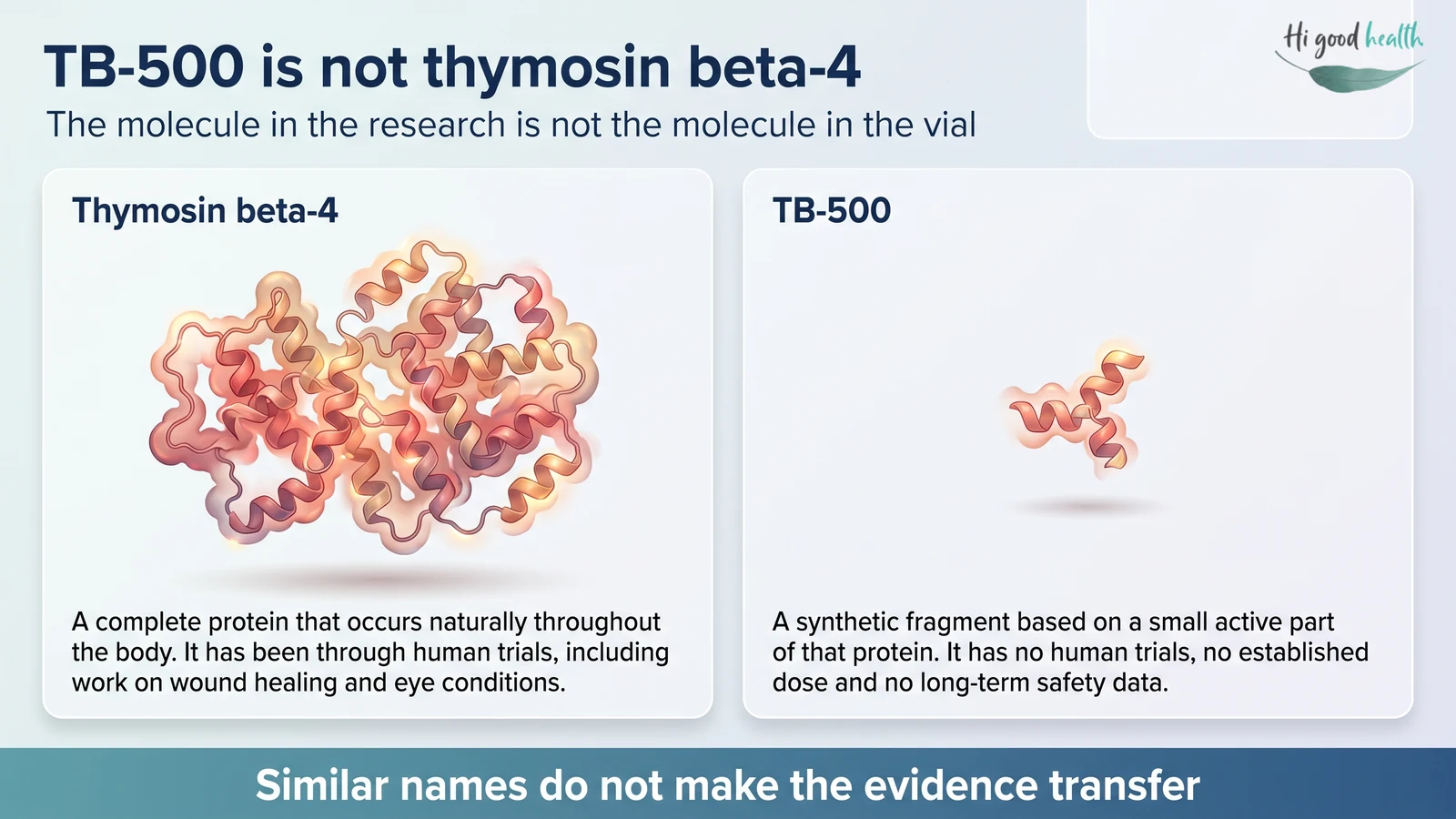
The single most important thing to understand about TB-500 is that it is not the same molecule as thymosin beta-4, the natural protein it is derived from. Marketing uses the two names interchangeably. The research does not, and the difference decides how much of the evidence actually applies.
Much of TB-500’s reputation was built in veterinary medicine, particularly in racehorses. That is a real use history, and it is not evidence of safety or effectiveness in people.
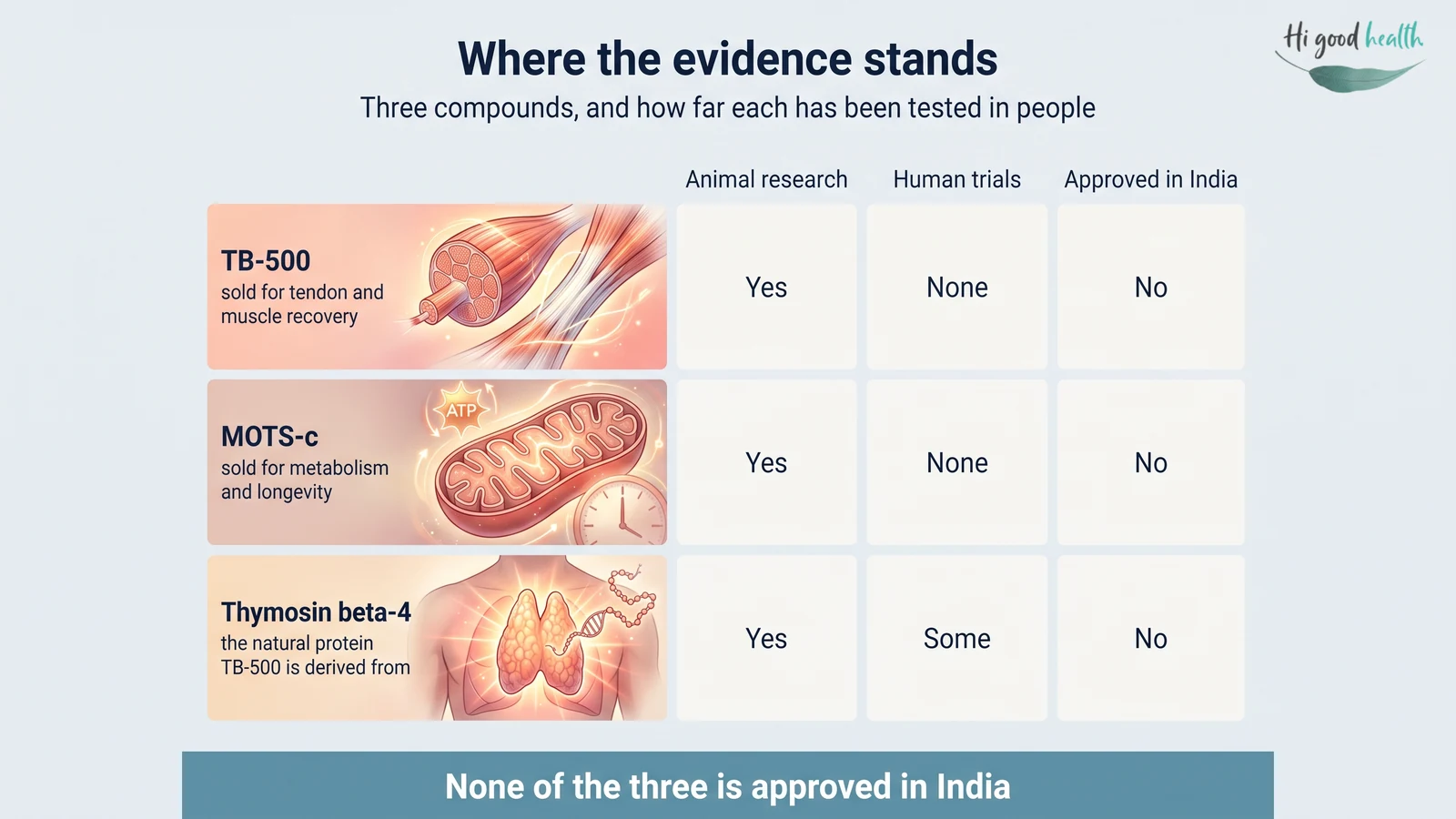
TB-500 is not an approved medicine in India. It does not appear in CDSCO’s published lists of new drugs approved in 2025 or 2026, and CDSCO has issued no alert or public notice about it either way.
For anyone tested in sport, the question is already closed. NADA India adopts the WADA Prohibited List, and the 2026 list names TB-500 explicitly — thymosin-beta-4 and its derivatives, prohibited at all times.
You will also see TB-500 sold in India today, in rupees, both as a “research use only” chemical and, on business marketplaces, as a recovery injection. Neither presentation makes it an approved medicine.
This article gives no dosing information for TB-500, and the reason is simple: no study has established one in humans.
Why recovery peptides attract attention
An injury that will not resolve is one of the few problems in medicine where the honest answer is usually patience. Tendons heal slowly, and there is very little a clinician can offer to speed that up.
That is the space recovery peptides occupy, and it explains their appeal better than any claim on a vendor site. A compound that promises to shorten the wait is answering a genuine frustration, not inventing one.
TB-500 also carries something BPC-157 does not: a visible history of use in performance animals. For a reader who trains seriously, “used in racehorses” sounds like proof. It is worth being clear about why it is not.
What TB-500 actually is — and what it is not
Thymosin beta-4 is a small protein that occurs naturally throughout the body. It plays a role in the regulation of actin, a protein central to how cells change shape and move, and it is involved in cell migration, blood vessel formation and wound repair. It is a real molecule with a real body of research behind it.
TB-500 is not thymosin beta-4. It is a synthetic peptide based on the short active region of that protein — the fragment thought to carry the actin-binding activity.
This distinction is where most of the confusion in this market comes from, and it runs in a direction that favors the seller.
Thymosin beta-4 has been through human clinical work, including trials in wound healing and eye conditions. Those trials studied thymosin beta-4. They did not study TB-500. A fragment is a different molecule with different behavior in the body, and evidence does not transfer from one to the other because the names are similar.
When a vendor cites “clinical trials” for TB-500, check which molecule was in the trial. It is usually not the one in the vial.
The veterinary history, and what it proves
TB-500 has been used in horses, particularly racehorses, for tendon and soft-tissue injuries. This is the origin of much of its reputation and much of its available anecdote.
It also puts TB-500 on the radar of racing authorities, which have their own testing regimes and their own prohibitions.
Veterinary use is not human evidence. It is not gathered under the conditions a human medicine requires: no randomised human trials, no dose-finding in people, no long-term human safety follow-up, and outcome measures that answer a trainer’s question rather than a patient’s.
Species differ in tissue repair in ways that have defeated translation many times over. A horse healing faster tells you something worth investigating. It does not tell you what happens in a person.
What the evidence actually shows
Evidence comes in tiers, and the tier matters as much as the result. A finding in cells justifies studying animals. A finding in animals justifies studying people. Only a controlled trial in people tells you what a treatment does to a patient.
The preclinical research
How TB-500 Is Studied in the Laboratory
Research relevant to TB-500 and thymosin beta-4 has been conducted at several levels, including cell-based experiments and animal models. These studies examine processes such as cell migration, wound closure, angiogenesis and tissue remodeling. They can show that a biological effect is plausible. They cannot establish that TB-500 improves recovery from a specific injury in people.
That requires well-designed human clinical trials, with appropriate controls and clinically meaningful outcomes.
The human research
Human evidence is extremely limited. In 2026, FDA staff scientists reviewed the submitted material and concluded it was insufficient to establish safety or effectiveness, recommending against its inclusion on the compounding list.
There is no published human pharmacokinetic profile — nothing that establishes how much is absorbed, how long it persists, or how it is cleared. There is no dose-finding study in humans. There is no long-term safety data.
None of that proves TB-500 is ineffective. It simply means the question remains unanswered, and claims of effectiveness go beyond the available evidence.
Why a mechanism is not a result
A plausible mechanism explains how a compound might help. It does not establish that it actually benefits a person at a tolerable dose, or that potential benefits outweigh possible risks. Compounds with elegant mechanisms and strong animal data fail in human trials routinely. That is the ordinary outcome, not the exception.
MOTS-c, and why it appears here rather than in its own guide
MOTS-c is a peptide encoded in mitochondrial DNA. It has been studied for roles in glucose and energy metabolism and in the response to exercise, and it is marketed on the strength of that research for metabolic health and longevity.
It is included here rather than in a separate guide because its evidence picture mirrors TB-500’s, but with even less support: mostly preclinical work, no human trials, no approval, and no established dose.
Two cautions specific to it. MOTS-c is frequently marketed for fat loss, which is the least defensible use of an unapproved compound — weight-loss claims attract the most vulnerable readers and the least evidence.
And MOTS-c is prohibited in sport, under WADA category S4.4.1, which covers activators of AMP-activated protein kinase. That is a different category from TB-500’s.
MOTS-c is not approved in India either. It does not appear in CDSCO’s published new-drug approval lists. Nothing about it has been approved here.
Safety: what is known, and what is not
TB-500 and Cancer: An Unanswered Safety Question
Some biological processes associated with thymosin beta-4 research, including cell migration and angiogenesis, are involved in normal tissue repair but can also play roles in tumor biology. This does not establish that TB-500 causes cancer.
However, because TB-500 has not been adequately studied in humans, its effects in people with existing or undiagnosed cancer remain unknown. Long-term research would be needed to determine whether influencing these pathways presents any clinically meaningful risk.
Reported short-term effects in the available research have been mild. The long-term safety of TB-500 in humans is unknown, because the work that would establish it has not been done.
Specific unknowns worth naming:
Effects on tissue growth. A compound whose proposed mechanism is promoting cell migration and blood vessel formation raises an obvious question about tissue you would not want encouraged. That question is unanswered in humans, and it is the reason regulators treat growth-factor-like compounds cautiously.
Immunogenicity. The risk of provoking an unwanted immune response is a standing regulatory concern with peptide products, and it was the FDA’s stated reason for keeping ipamorelin acetate restricted.
Interactions. No systematic study exists of how TB-500 behaves alongside prescription medicines.
Injection practice. These products are injected at home, using materials of unverified sterility. Infection and abscess follow from that regardless of what the vial contains.
The American Medical Association has urged caution on injectable peptides marketed for anti-aging or performance, on the grounds that most supporting evidence is from animal studies.
What Researchers Still Don’t Know
Despite the attention TB-500 receives, several basic pharmacological and clinical questions remain unanswered in humans:
- How much of the compound reaches the bloodstream after administration
- How long it remains in the body
- How it is distributed, metabolized and eliminated
- What exposure, if any, produces a clinically meaningful effect
- Whether repeated exposure changes its effects or risks
- How it behaves alongside commonly used medicines
- Whether uncommon or delayed adverse effects emerge with longer exposure
These gaps matter because a plausible biological mechanism does not establish that a treatment is safe or effective in humans.
What is in the vial is its own risk
Why Peptide Stability Matters
The identity of a peptide is only one part of product quality. Peptides can be affected by formulation, storage and handling, and degradation can alter the amount of intact active material in a product.
So for an unapproved product obtained outside a controlled pharmaceutical supply chain, the uncertainty is not only about the clinical effects of TB-500. It also covers the product’s identity, purity, strength and stability.
TB-500 is sold in India under a “research use only” label. One India-facing vendor lists this class of peptide in rupees with the disclaimer “Not for human or veterinary use.” That is a marketing formula, not a quality standard.
On Indian business-to-business marketplaces the labelling drops away entirely. Listings from sellers in Gurugram, Nagpur, New Delhi, Bathinda and Vasai-Virar offer BPC-157 and TB-500 as injections, and as a recovery injection pen, priced between roughly ₹3,000 and ₹10,800.
A product described as an injection, sold without a prescription, for a compound with no Indian approval, is not a research chemical in any meaningful sense. Gray-market peptide products have also tested positive for testosterone, a controlled substance.
A buyer therefore faces two separate problems: a compound whose effects in humans are unestablished, and a product that may not be what the label says.
If You Have Already Used TB-500
If you have already used an unapproved peptide, tell your healthcare professional what product you used, where it came from, when you used it and whether you experienced any symptoms. Keep the vial, packaging or product information if available. This information can help a clinician assess the potential exposure and determine whether further evaluation is appropriate.
Athletes: TB-500 is prohibited in India, and approval is irrelevant to that
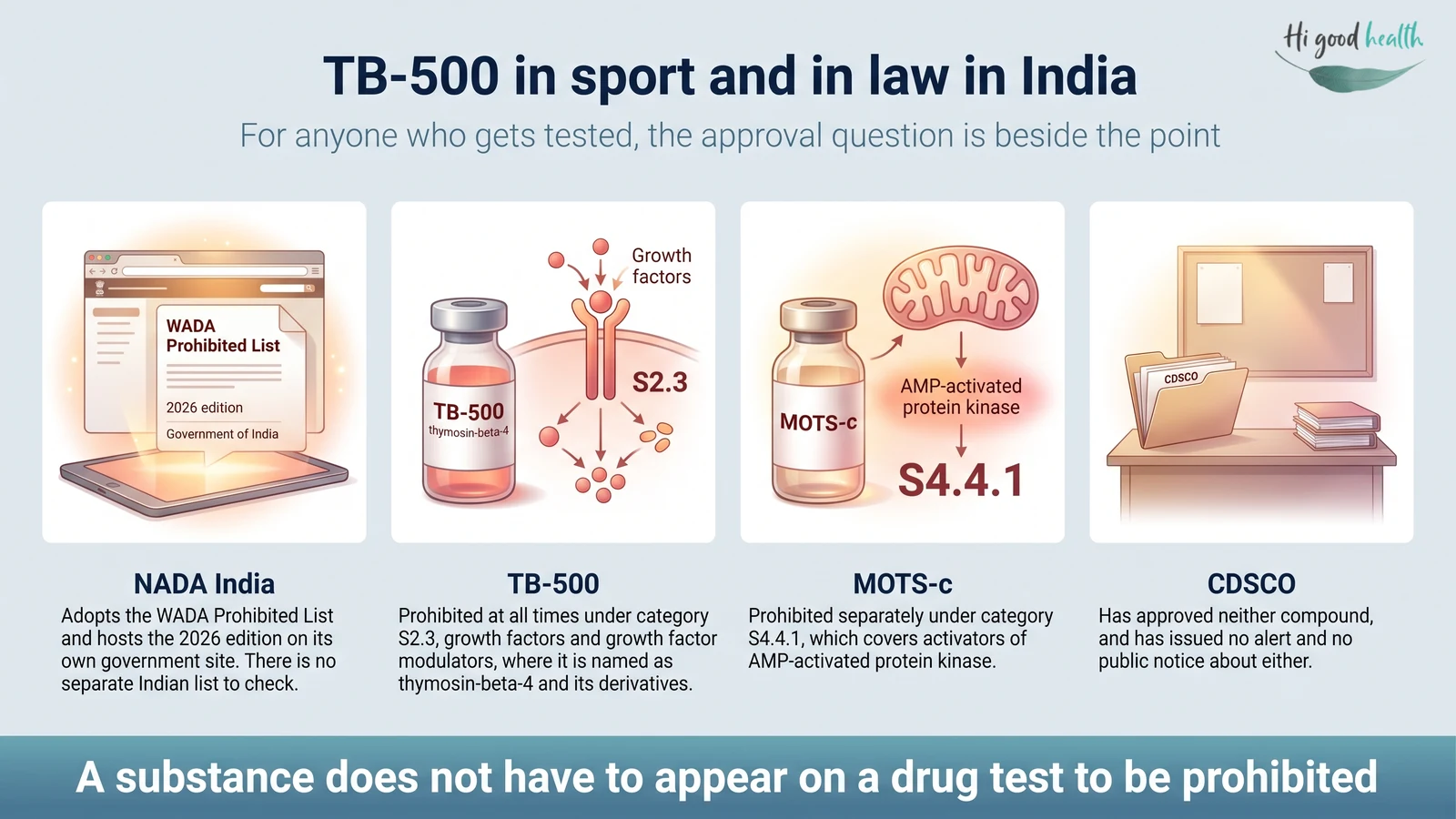
NADA India adopts the WADA Prohibited List and hosts the 2026 edition on its own government site. There is no separate Indian list to check.
On that list TB-500 appears under S2.3 — growth factors and growth factor modulators — named as “thymosin-beta-4 and its derivatives”. It is prohibited at all times, with no off-season allowance. MOTS-c appears separately, under S4.4.1.
The National Anti-Doping Act, 2022 made NADA a statutory body and gives it the power to set the Prohibited List by regulation. It did not change which substances are banned — NADA continues to adopt the WADA list.
Important safety note: a substance does not have to appear on a routine drug screen to be banned. Standard employment panels do not test for peptides at all. Anti-doping authorities use purpose-built methods and prohibit substances irrespective of how routinely they screen for them.
NADA’s own guidance to athletes is blunt about supplements: athletes are “solely accountable for prohibited substances in their system”, and “no supplement is 100% risk free”. That principle of strict liability applies whatever a label claims.
Where TB-500 stands legally in India
Status in India: not approved by CDSCO. No Indian regulator has ruled on it either way.
That second sentence matters, and it is easy to misread. TB-500 does not appear in CDSCO’s published lists of new drugs approved in 2025 or 2026. CDSCO has also issued no alert and no public notice naming it.
So the honest answer is that India has no stated legal position on TB-500. It is unapproved because nobody has taken it through approval, not because India examined it and said no. Anyone telling you that India has banned it, or that India has cleared it, is going beyond what any Indian regulator has actually said.
What follows is therefore how the general framework applies, not a ruling anyone has made about this compound.
Under the New Drugs and Clinical Trials Rules, 2019, a substance not already used in India to any significant extent is a “new drug”. Importing one requires CDSCO permission; manufacturing it for sale requires a separate permission. TB-500 has neither.
Where the only clear rules are American ones, we say so. Most of what is written about these compounds describes US law, because that is where the regulatory activity has happened.
In July 2026 a US FDA advisory committee voted to recommend TB-500 and MOTS-c for pharmacy compounding there. That vote was non-binding and the FDA has not acted on it. It also has no Indian equivalent — India has no counterpart to the US compounding-bulks list, and no comparable process has taken place here.
Read that coverage as news about the United States. It says nothing about where TB-500 stands in India.
Personal import is not a loophole. India does allow small quantities of an unapproved drug to be imported for personal use, under Rule 36 of the Drugs Rules, 1945 — but only on a permit applied for in advance in Form 12-A, granted in Form 12-B, and supported by a prescription from a registered medical practitioner.
A compound with no approved indication has no basis for such a prescription.
The law in full is covered in our guide to peptide legality in India. This article carries the compound-specific status only.
What would make TB-500 a real medicine
The path is not mysterious, and TB-500 has not taken it.
- Human pharmacokinetics — what the body does with the compound, and at what exposure.
- Dose-finding, establishing a range that is both active and tolerated.
- Randomised controlled trials against a defined injury or condition, measuring outcomes a patient would recognise.
- Long-term safety monitoring, with particular attention to tissue growth and immune response.
- Manufacturing standards, so the product sold is reliably the product studied.
Every approved peptide medicine has been through all five.
Key takeaways
- TB-500 is not thymosin beta-4. Human trials of thymosin beta-4 are not evidence for TB-500, and the two are routinely conflated in marketing.
- TB-500 is not approved by CDSCO, and cannot lawfully be sold in India for human use. No Indian regulator has ruled on it either way.
- Veterinary use in horses is not human evidence. It is where the reputation came from, not where the proof is.
- There is no established human dose, because no dose-finding study exists.
- Long-term safety is unknown, with open questions about tissue growth and immunogenicity.
- TB-500 is prohibited at all times in sport. NADA India adopts the WADA list, which names it under S2.3. MOTS-c sits under S4.4.1.
- It is already on sale in India, in rupees, as both a “research use only” chemical and a recovery injection. Neither makes it a medicine.
Frequently asked questions
1. Is TB-500 the same as thymosin beta-4?
No. TB-500 is a synthetic peptide based on a short active fragment of thymosin beta-4. Human research on thymosin beta-4 studied the full protein, not the fragment, so those results do not transfer.
2. Does TB-500 actually work?
Preclinical research suggests effects on cell migration and tissue repair. Human evidence remains extremely limited. FDA staff scientists in 2026 judged it insufficient to establish safety or effectiveness. The honest answer is that effectiveness in people has not been demonstrated.
3. Is TB-500 legal in India?
It is not approved by CDSCO and cannot lawfully be sold here for human use. India has issued no ruling on it either way, so the honest answer is that the position is unstated rather than settled.
4. Did the July 2026 US advisory vote change anything in India?
No. That was a United States process, it was non-binding, and the FDA has not acted on it. India has no equivalent list and no equivalent vote took place here.
5. Will TB-500 show up on a drug test?
Not on a standard employment panel, which does not test for peptides. In sport it is a different matter: NADA India adopts the WADA list, which prohibits TB-500 at all times under category S2.3.
6. Is TB-500 safe because it is used in horses?
No. Veterinary use tells you the compound has been given to animals, not that it is safe or effective in people. Human safety data does not exist.
7. Can TB-500 and BPC-157 be combined?
This is the most searched question about both compounds, and we will not answer it as a protocol. Neither compound has an established human dose, so a combination has neither an evidence base nor a safe starting point.
8. What about MOTS-c?
The same picture, with less behind it: preclinical research, no human trials establishing effectiveness, no approval, and no established dose. It is also prohibited in sport.
Glossary
- TB-500: a synthetic peptide based on the active fragment of thymosin beta-4. Not an approved medicine.
- Thymosin beta-4: a naturally occurring protein involved in actin regulation, cell migration and wound repair. A different molecule from TB-500.
- Actin: a protein central to cell structure and movement, and to how cells migrate into a wound.
- MOTS-c: a peptide encoded in mitochondrial DNA, studied for roles in metabolism and exercise response. Not approved.
- CDSCO: the Central Drugs Standard Control Organisation, India’s national drug regulator.
- New drug (NDCT Rules, 2019): a substance not already used in India to any significant extent. Importing or manufacturing one requires CDSCO permission.
- NADA India: the National Anti-Doping Agency, which adopts the WADA Prohibited List for Indian sport.
- S2.3: the WADA category covering growth factors and growth factor modulators. Prohibited at all times. S4.4.1 covers AMPK activators, where MOTS-c sits.
- RUO (“research use only”): a labeling disclaimer, not a legal exemption and not a quality standard.
References
All reference links checked and confirmed live on 21 September 2026.
- NADA India — 2026 WADA Prohibited List, hosted by the National Anti-Doping Agency: https://nadaindia.yas.gov.in/wp-content/uploads/2026list_en_final_clean_september_2025.pdf
- CDSCO — Procedure for permission to import small quantities of drugs for personal use (Rule 36, Form 12-A / 12-B): https://cdsco.gov.in/opencms/resources/UploadCDSCOWeb/2018/UploadConsumer/ProcedureforpermissiontoImportSmallQuantitiesofDrugsForPersonalUse_link.pdf
- NADA India — Supplements and athletes, on strict liability and contamination risk: https://nadaindia.yas.gov.in/supplements-and-athletes/
- WADA — 2026 Prohibited List: https://www.wada-ama.org/en/resources/2026-prohibited-list
- FDA — Certain Bulk Drug Substances for Use in Compounding That May Present Significant Safety Risks: https://www.fda.gov/drugs/human-drug-compounding/certain-bulk-drug-substances-use-compounding-may-present-significant-safety-risks
- FDA — Pharmacy Compounding Advisory Committee, 23–24 July 2026 meeting: https://www.fda.gov/advisory-committees/advisory-committee-calendar/july-23-24-2026-meeting-pharmacy-compounding-advisory-committee-07232026
- STAT — FDA panel backs peptides for compounding pharmacies (23 July 2026): https://www.statnews.com/2026/07/23/fda-panel-okays-peptides-compound-pharmacies-bpc-157-kpv/
- STAT — FDA peptide compounding panel backs Epitalon, rejects emideltide (24 July 2026): https://www.statnews.com/2026/07/24/fda-peptide-compounding-panel-backs-epitalon-rejects-emideltide/
- AJMC — FDA panel backs 6 peptides for compounding: https://www.ajmc.com/view/fda-panel-backs-6-peptides-for-compounding
- NBC News — FDA panel recommends peptides; scientists raise concerns: https://www.nbcnews.com/health/health-news/peptides-restrictions-ease-fda-panel-recommend-bpc-157-scientists-rcna588879
- FDA — Warning letter, Wholesale Peptide (17 June 2026): https://www.fda.gov/inspections-compliance-enforcement-and-criminal-investigations/warning-letters/wholesale-peptide-729447-06172026
- CNN — What are peptides, and what happens next at the FDA (31 July 2026): https://edition.cnn.com/2026/07/31/health/what-are-peptides-fda-next-steps-wellness
Medical disclaimer
This article is for general education and is not medical advice. TB-500 and MOTS-c are not approved medicines in India, their long-term effects in humans are unknown, and nothing here is a recommendation to use either. Speak to a registered medical practitioner about any injury or condition, and about any substance you are considering.