Part of the HiGoodHealth peptides series.
- Our India guide, Peptides in India: What They Are, Which Ones Are Real Medicines, and What Is Being Sold to You, covers the science and what is actually on sale here.
- This article answers the one question that follows it: is any of this legal in India?
- The answer is not the American one. India has its own drug law, its own regulator and its own rules on what you may bring in through customs, and none of it moved because a committee in Maryland voted.
At a glance
Some peptides are ordinary prescription medicines in India and always have been. Insulin is a peptide. So are the GLP-1 injections now sold here for diabetes and weight. These are approved by CDSCO, sold against a prescription, and there is nothing legally doubtful about them.
The peptides sold online as vials of powder — BPC-157, TB-500, MOTS-c and the rest — are a different thing entirely. None of them is approved by CDSCO.
Under the Drugs and Cosmetics Act 1940 an unapproved new drug cannot be manufactured, sold or distributed for human use in India. Selling them here is not a grey area. It is an offence.
For the buyer the picture is softer but not safe. Enforcement in India, as almost everywhere, goes after sellers rather than individuals. But a parcel of vials can be stopped at customs, and there is a legal route for bringing medicine in for yourself that almost nobody using these sites has followed.
If you compete in any sport, none of the above matters. The National Anti-Doping Agency applies the WADA Prohibited List in India under the National Anti-Doping Act 2022, and BPC-157, TB-500 and the growth-hormone secretagogues are all on it.
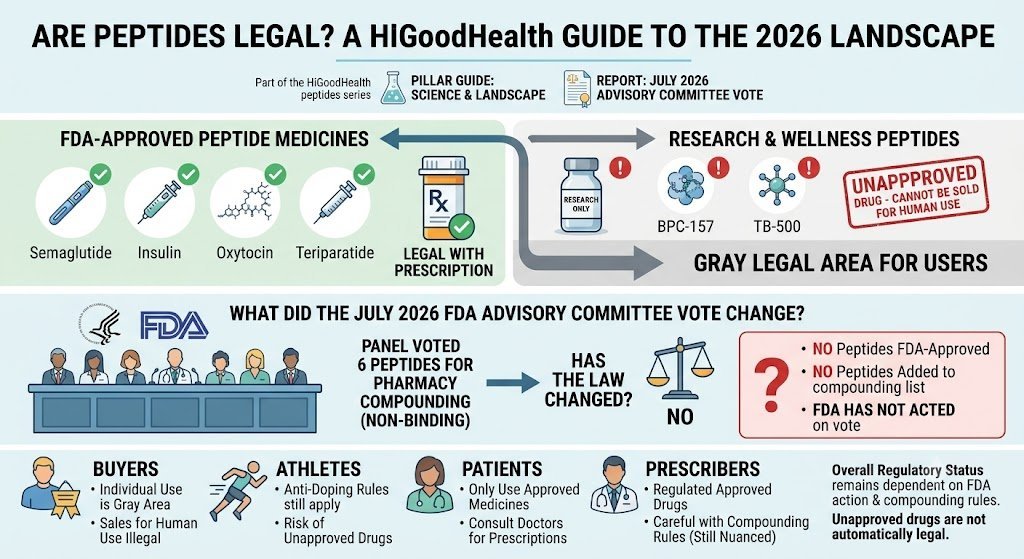
The American news you may have read — an FDA advisory panel voting in July 2026 to recommend six peptides for pharmacy compounding — changed nothing in India, and did not change much in America either. It was a recommendation, it was not binding, and no peptide has been approved as a result.
Why the answer keeps sounding different
Ask three people whether peptides are legal and you will get three answers, because the word covers two completely different things.
One is a class of approved medicines that Indians take every day. The other is a set of laboratory compounds sold in vials on websites that take UPI payments and ship in unmarked boxes.
Both are called peptides. Only one of them has ever been through a regulator. The word describes a chemical shape, not a legal status, in the same way that “plant extract” tells you nothing about whether something is a medicine or a weed.
Everything below depends on keeping those two apart.
How a drug actually becomes legal in India
CDSCO, and what approval means
India’s drug regulator is the Central Drugs Standard Control Organisation, CDSCO, working under the Drugs and Cosmetics Act 1940 and its Rules of 1945. A medicine that has not been marketed in India before is treated as a new drug under the New Drugs and Clinical Trials Rules 2019, and it cannot be sold until CDSCO has cleared it.
Approval is not a formality. It means the data on safety and effect has been examined, a specific use has been allowed, and the label and the dose have been fixed. That is what an Indian patient is relying on when a doctor writes a prescription.
Schedule H and Schedule H1
Almost every peptide medicine sold in India sits in Schedule H of the Drugs Rules, which means it is prescription-only. A chemist who hands it over without a prescription is breaking the law, whatever the customer says.
Schedule H1 is the tighter list, mostly antibiotics and a few other molecules, where the chemist must also keep a register of who bought it and on whose prescription. The peptide question rarely reaches H1, but it is worth knowing the difference, because “Schedule H” is the phrase you will see on the strip.
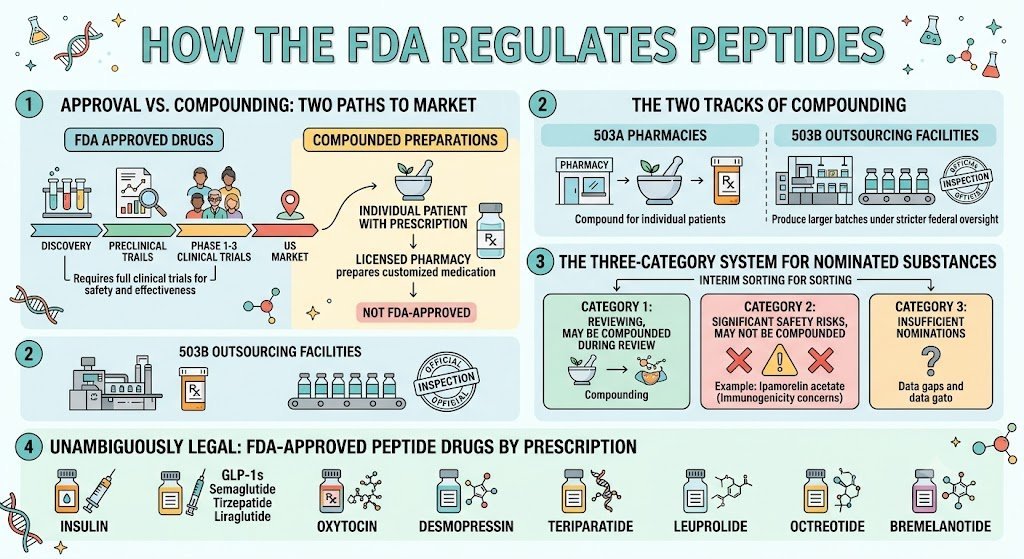
There is no Indian compounding route
This is the point where the American story stops applying. In the United States a licensed pharmacy may compound a medicine for one named patient, and the whole July 2026 argument was about which raw substances such a pharmacy may use.
India has no equivalent 503A or 503B system. There is no Indian list of bulk substances that a chemist may lawfully compound with, so there is no Indian version of the question the FDA panel was voting on. A peptide is either an approved drug here or it is not.
The peptides that are legal in India right now
| Status in India | Examples | What it means for you |
|---|---|---|
| Approved, prescription only | Insulin, semaglutide, tirzepatide, liraglutide, teriparatide, octreotide, leuprolide, desmopressin | CDSCO-approved for stated uses, sold in pharmacies against a prescription |
| Approved but tightly restricted | Oxytocin | A peptide hormone with real medical uses, whose retail sale India restricted after widespread misuse in dairy and agriculture |
| Not approved for human use | BPC-157, TB-500, MOTS-c, Semax, Epitalon, KPV | No CDSCO approval. Cannot lawfully be manufactured, sold or distributed for human use in India |
| Sold anyway | Anything offered online as “research use only” | Not legal to sell for human use here. Purity, dose and sterility are nobody’s responsibility |
The first row is worth pausing on, because it is the row most Indians are actually in. Insulin has been a peptide medicine for a century.
The GLP-1 injections that arrived in Indian pharmacies through 2025 are peptides too, and they are approved, prescribed and dispensed like any other medicine. Our GLP-1 series covers how they are used and what they cost here.
The vials sold online, and why they are not a grey area for the seller
BPC-157, TB-500 and MOTS-c have not been approved by CDSCO for any use in any human being. That is the whole of the legal analysis for anyone selling them.
Under the Drugs and Cosmetics Act, manufacturing, selling, distributing or stocking an unapproved new drug for human use is an offence, and the penalties are not trivial. The Act does not care whether the website called it a supplement, a research chemical or a peptide.
The Indian market for these is visible and growing. Sites selling “99% pure” peptides to Indian addresses advertise openly, take domestic payments, and ship without asking for a prescription, because asking for one would defeat the point.
In August 2026 the question stopped being theoretical. An invite-only “peptide party” was scheduled in Koramangala, Bengaluru, advertising peptide tastings alongside music, food and networking.
On 28 August the Karnataka Food Safety and Drug Administration issued the organisers a notice asking for the composition, manufacturer, regulatory status, dosage and intended use of the preparations. It noted that the promotion suggested the products might be supplied or administered to those attending. The event was cancelled the next day.
That is an Indian regulator doing exactly what Indian law allows it to do, in an Indian city, without waiting for anyone abroad to decide anything.
The “research use only” label does not do what buyers think
Every vial arrives with the same wording: research use only, or not for human consumption. Buyers read it as legal cover. It is the opposite — it is the seller’s attempt at cover, and it is aimed at protecting the seller, not you.
What decides the legal question is what the product is intended for, and intention is read from how it is sold: the marketing copy, the dosing advice in the FAQ, the before-and-after photographs, the fact that it is packaged in an injectable vial at a human dose.
American regulators have said this in writing repeatedly. In a June 2026 warning letter the FDA told one vendor that “evidence obtained from your product labeling… establishes that your products are intended to be drugs for human use,” despite the research-use wording.
Indian law reasons the same way about intended use, and no Indian court has ever treated a disclaimer as a licence.
If you are the buyer
What actually happens at the border
This is the part almost nobody knows. India does allow you to import a medicine for your own use — but there is a procedure, and it is not the one anybody ordering peptides is following.
Under Rule 36 of the Drugs and Cosmetics Rules, you apply to the licensing authority in Form 12-A and, if it is granted, you receive a permit in Form 12-B. The application needs a prescription from a Registered Medical Practitioner carrying their registration number, naming the drug, the quantity and how long it is for.
The quantity allowed is capped: not more than one hundred average doses of any single drug, with exceptions possible in individual cases. There is no fee.
Read that against how research peptides are actually bought — no prescription, no permit, no declared quantity — and the position is clear. A parcel that is stopped is not being treated unfairly. It is being treated normally.
And what is in the vial
The legal risk is the smaller of the two. The larger one is that nobody has checked what you are injecting.
These products come from an unregulated supply chain with no batch testing anyone can verify. Grey-market peptide products tested abroad have come back containing testosterone — and testosterone is not an ambiguous substance in Indian law either.
A certificate of analysis emailed by the seller is not independent testing. It is a document produced by the person selling you the vial.
Athletes, and the rule that overrides everything else
If you compete at any level that tests, stop here. Nothing about CDSCO, prescriptions or customs applies to you in the way you think.
India has its own anti-doping law — the National Anti-Doping Act 2022 — and the National Anti-Doping Agency applies the WADA Prohibited List in India. A substance does not have to be illegal, or even detectable on a routine panel, to end a career.
On the WADA list, BPC-157 sits under S0 as a non-approved substance, TB-500 under S2.3, and CJC-1295, sermorelin, ipamorelin and the GHRPs under S2.2. These are prohibited under the relevant categories including outside competition. There is no off-season.
A gym trainer telling you it will not show up on a test may even be right about the test. He is wrong about the rule.
If you are considering peptides anyway
- Start with what is approved. If an approved peptide medicine treats your condition, that is the only route with real safety data and a real prescriber behind it.
- Ask who is dispensing it. A licensed pharmacy against a valid prescription is a different world from a website that takes UPI and ships from an unmarked warehouse.
- Treat “research use only” as unregulated, not as legal. Nobody has verified purity, dose accuracy or sterility, and the label is there for the seller’s benefit.
- Warning signs: no prescription asked for, payment only by UPI or crypto, dosing advice sitting beside a not-for-human-use label, claims of FDA or CDSCO approval that no regulator’s website confirms, and shipping direct from overseas.
- If you are tested — any competitive sport, any federation, the services — assume research peptides are out of bounds.
- Ask your doctor three questions: is this approved in India, where is it dispensed from, and what is the evidence for it in my specific condition.
What happened in America in July 2026, and why it did not change Indian law
It is worth knowing what the news was about, because it is where most of the confusion comes from.
On 23–24 July 2026 an FDA advisory committee in the United States reviewed seven peptides and recommended six of them — BPC-157, KPV, TB-500, MOTS-c, Semax and Epitalon — for a list of substances American pharmacies may compound with. It rejected the seventh.
Three things about that vote get lost in the retelling. The margins were narrow, several passing 8–6. The panel voted against the advice of the FDA’s own scientists, who found the supporting studies short and small.
And the vote was not binding. The FDA has not acted on it, nothing has been added to any list, and none of these peptides has been approved as a drug in the United States either.
For an Indian reader the takeaway is simpler still. Even if the FDA had acted, it would have opened an American compounding route that India does not have. The news changed the conversation. It did not change the law in either country.
Key takeaways
Peptides are not one thing. Insulin and the GLP-1 injections are approved, prescription medicines in India. BPC-157, TB-500, MOTS-c and the rest have no CDSCO approval, and selling them for human use in India is an offence under the Drugs and Cosmetics Act.
India has no compounding route of the American kind, so the July 2026 FDA advisory vote — which was non-binding and has not been acted on — has no Indian equivalent and changed nothing here.
There is a lawful way to import a medicine for yourself: Form 12-A, a permit in Form 12-B, a prescription from a registered practitioner, and no more than a hundred average doses. Nobody ordering peptides from a website is doing that.
For anyone who competes, the National Anti-Doping Act 2022 and the WADA list settle it regardless of what any drug regulator decides.
Frequently asked questions
1. Are peptides legal in India?
Some are, some are not. Insulin, the GLP-1 injections and several other peptide medicines are approved by CDSCO and sold on prescription. BPC-157, TB-500, MOTS-c and similar research peptides have no approval, and selling them for human use in India is an offence under the Drugs and Cosmetics Act.
2. Can I be prosecuted for buying peptides for myself?
Enforcement is aimed at manufacture, sale and distribution rather than at individual buyers. That is not the same as permission. A parcel can be detained at customs, and there is a lawful import route under Rule 36 that requires a permit and a prescription.
3. How do I legally import a medicine for my own use?
Apply to the licensing authority in Form 12-A with a prescription from a Registered Medical Practitioner giving their registration number, the drug, the quantity and the duration. If granted, the permit is issued in Form 12-B. The limit is one hundred average doses of any single drug. There is no fee.
4. Is BPC-157 legal in India?
No. It has no CDSCO approval, so it cannot lawfully be sold for human use here. It is also prohibited in sport under the WADA list, which the National Anti-Doping Agency applies in India.
5. Does the July 2026 FDA vote change anything in India?
No. It was an American advisory recommendation about pharmacy compounding, it was not binding, and the FDA has not acted on it. India has no compounding route of that kind, so there is nothing here for it to change.
6. Will peptides show up in a drug test?
Not on an ordinary employment panel, which looks for a different class of substance altogether. Anti-doping testing is different: NADA applies the WADA Prohibited List under the National Anti-Doping Act 2022, and detection is not the point — presence on the list is.
7. Are peptides the same as steroids?
No. Anabolic steroids are testosterone derivatives. Peptides are short chains of amino acids. But that distinction only tells you what a peptide is, not whether it is legal to sell, and an unapproved drug is unlawful to sell whatever family it belongs to.
8. What does “research use only” on the vial mean?
It is a label the seller applies, not a legal status the product has. What matters is what the product is intended for, and that is read from how it is marketed and sold, not from the wording on the sticker.
The peptides series
Peptides are a large subject, so we have split it into focused guides rather than one unreadable page. Each is written to the same standard: a named medical reviewer, primary sources, and a clear line between what is approved and what is merely marketed.
- Peptides in India: What They Are, Which Ones Are Real Medicines, and What Is Being Sold to You — the guide to start with. What a peptide is, which ones Indians actually use, and what is being sold under the name.
- Are Peptides Legal in India? — you are reading this one. CDSCO approval, Schedule H, the import rules, the grey market and anti-doping.
- The GLP-1 series — the peptide medicines most Indians will actually be offered, how they work, what they cost here and how they are being sold online.
Sources
- CDSCO — Procedure for permission to import small quantities of drugs for personal use (Form 12-A and Form 12-B)
- CDSCO — Import of small quantity of drugs for personal use, online application
- CDSCO — The Drugs and Cosmetics Act 1940 and Rules 1945
- CDSCO — The Drugs Rules 1945, as amended
- Ministry of Youth Affairs and Sports — National Anti-Doping Agency
- National Anti-Doping Agency — NADA Rules
- WADA — 2026 Prohibited List
- FDA — Pharmacy Compounding Advisory Committee, 23–24 July 2026 meeting
- FDA — Warning letter, Wholesale Peptide, 17 June 2026
- USADA — BPC-157 is a prohibited peptide
- Business Standard — Peptide party in Bengaluru cancelled after FSDA seeks event details, 29 August 2026
Disclaimer
This article is general education, not legal or medical advice. Regulatory status changes, and most of the peptides discussed here are not approved as medicines in India. Speak to a qualified doctor before making any health decision, and to a qualified lawyer about any legal question that affects you personally.