
Most Indians already take a peptide. It is called insulin, and about a hundred million people here live with diabetes.
That is the useful starting point, because it makes the central fact obvious. Peptide is a shape of molecule, not a claim. Insulin is a peptide. So is semaglutide. So is the unlabelled vial being sold on a Telegram channel to a twenty-two-year-old in a gym.
So what are peptides, and which of them should you actually trust? This article separates the three: the peptides that are proper medicines, the ones in cosmetics and supplements, and the ones being sold in India with no approval behind them at all.
At a glance
What are peptides? Short chains of amino acids that the body uses as chemical messengers. Insulin, GLP-1, glucagon and oxytocin are all peptides your own body makes.
Several of the most important medicines in India are peptides. Insulin, semaglutide, tirzepatide, teriparatide for osteoporosis, desmopressin. These are approved, prescribed and monitored.
Most “wellness peptides” sold online are not medicines. BPC-157, TB-500, MOTS-c, Semax, Epitalon and the rest are experimental compounds with limited human evidence and no approval for treatment.
In India the regulator is CDSCO, and regulatory news from abroad that circulates about peptides does not change what is legal or approved here.
The buying route is the real Indian risk. Injectable peptides ordered from an Instagram seller, a gym, or an overseas website arrive with no assurance of what is in the vial.
If you are reading this because of weight loss, the GLP-1 series on this site covers that in detail, including generics, cost and side effects in India.
So what are peptides, exactly?
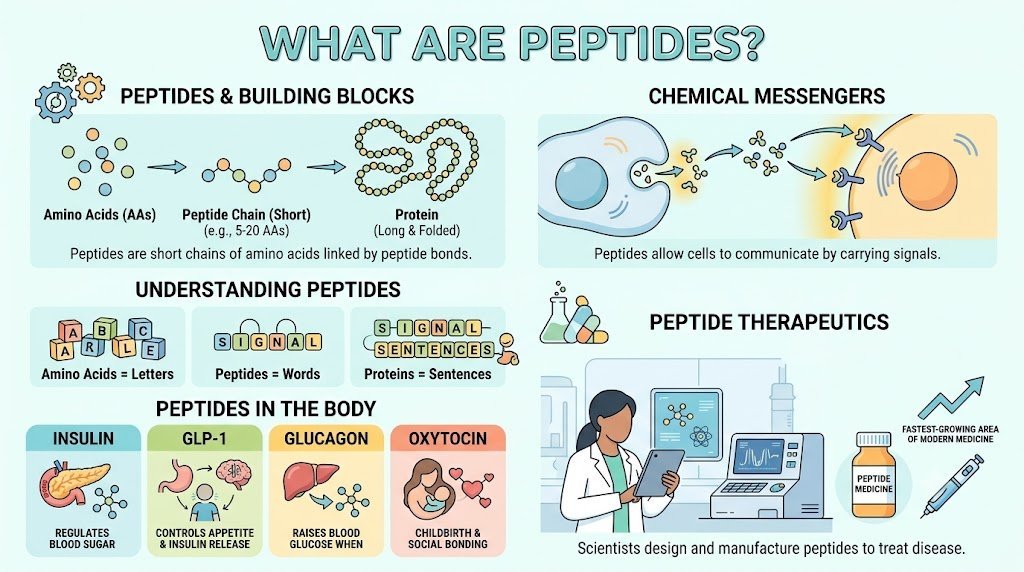
A peptide is a short chain of amino acids joined end to end. Amino acids are the letters, peptides are the words, and proteins are the long sentences.
Your body makes hundreds of them and uses them to carry instructions between cells. Insulin tells cells to take up glucose. GLP-1 signals fullness and prompts insulin release. Oxytocin is involved in labour and in bonding.
Because these are signalling molecules with very specific receptors, a peptide drug can act precisely on one pathway. That precision is what makes peptides such useful medicines, and it is also why a peptide with no evidence behind it is not automatically harmless.
Most peptides have to be injected, because the digestive system breaks them down. That is why insulin is an injection, and it is why the arrival of an oral semaglutide tablet was a genuine advance rather than a marketing one.
The peptides Indians actually use
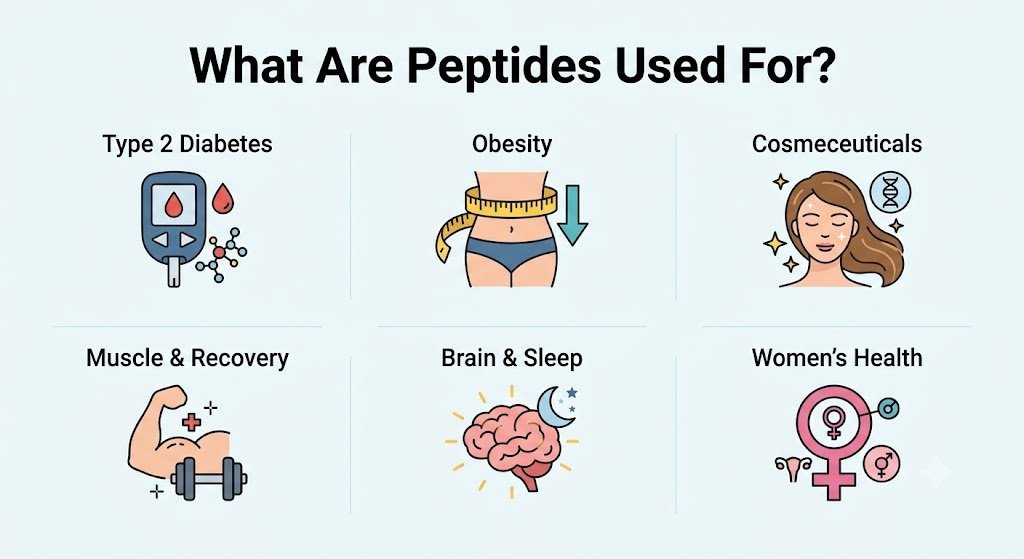
Insulin. India has one of the world’s largest diabetic populations, and insulin is by a very large margin the peptide medicine most used here. India is also a major manufacturer of insulin and of biosimilar versions, which is why it is more affordable here than in many countries.
GLP-1 medicines. Semaglutide and tirzepatide are now available in India for type 2 diabetes and for obesity, and this is the fastest-moving area in Indian medicine at the moment.
The key Indian development is that semaglutide’s patent position in India opened the way for generic versions, which is changing price and access here in a way it has not changed in the West. That brings its own problems: more prescribing without follow-up, more selling by people who are not doctors, and more counterfeits.
This site covers GLP-1 medicines in a ten-part series, including how they fit with metformin and insulin, what they cost in India, side effects, and how they interact with Indian eating patterns. If weight loss is why you are here, that series is the more useful reading.
Teriparatide for severe osteoporosis, desmopressin, octreotide, and several hormone-related peptides are all in ordinary Indian hospital use.
Approved medicine, cosmetic, supplement, or research chemical
This is the distinction that matters, and it is the one the marketing works hardest to blur.
| Category | Examples | Status in India | Evidence |
|---|---|---|---|
| Made by the body | Insulin, GLP-1, oxytocin | Not applicable | Established |
| Approved medicine | Insulin, semaglutide, tirzepatide, teriparatide | Approved by CDSCO, prescription only | Strong |
| Cosmetic peptide | GHK-Cu, Matrixyl in serums | Sold as cosmetics | Moderate, for appearance rather than disease |
| Nutritional peptide | Collagen peptide powders | Sold as food supplements under FSSAI | Modest, and mostly for skin and joints |
| Research peptide | BPC-157, TB-500, MOTS-c, Semax, Epitalon | Not approved for treatment | Limited human evidence |
A cosmetic peptide in a serum and an injectable research peptide are not the same category of thing, even though both are legitimately called peptides. The first is regulated as a cosmetic and is broadly low risk. The second is an unapproved injectable of unknown purity.
The Indian grey market, and why it is the real risk
In the West the peptide argument is mostly about compounding pharmacies and regulatory technicalities. In India the problem is more basic: who is selling it, and what is in it.
Unapproved injectable peptides are sold here through gym networks, Instagram and Telegram sellers, “anti-ageing” and “wellness” clinics in the metros, and overseas websites shipping to India. Vials arrive labelled research use only, or with no meaningful label at all.
“Research use only” is a commercial label, not a safety finding. It usually means the opposite: that the compound has not been approved for use in people anywhere.
Independent testing of such products internationally has repeatedly found the wrong dose, the wrong compound, or contamination. There is no reason to think an unregulated Indian supply chain is cleaner than an unregulated Western one, and several reasons to think it is not.
Two further Indian realities make this worse.
Prescription medicines are widely sold without a prescription here, so the barrier that is supposed to sit between a person and an injectable drug is often not there.
And self-injection without supervision means no dose control, no sterility guarantee, and nobody watching for a reaction. Injection is a medical procedure, not a supplement.
Collagen peptides, and a question that matters in India
Collagen peptide powders are heavily marketed in India for skin, hair, nails and joints.
The evidence is modest rather than absent. Some trials show small improvements in skin hydration and elasticity, and some suggest benefit for joint discomfort. It is a mild effect, and it is not doing what an injectable prescription peptide does.
The Indian question the international version of this article never asks: collagen is an animal product. It is made from bovine hide and bone, porcine skin, or fish scales and skin. There is no plant collagen, and a product marketed as “vegan collagen” is either a collagen-builder made of amino acids and vitamin C, or it is mislabelled.
For a vegetarian household this is not a minor detail, and the source is frequently buried on the back of the pack. If it matters to you, read the ingredient list and look for the green or brown mark.
Marine collagen is a common alternative for those who avoid bovine or porcine sources, and it is still an animal product.
Peptides for muscle, recovery and performance
This is where most young Indian men encounter peptides, and it deserves a direct answer.
Growth-hormone secretagogues such as sermorelin and CJC-1295, and recovery compounds such as BPC-157 and TB-500, are marketed in Indian gyms for muscle growth and faster healing. None of them is an approved medicine for that purpose.
The evidence in humans is thin. The supply is unregulated. And the same channels that sell these also sell anabolic steroids and testosterone, which are a far bigger and better-documented problem in Indian gyms, with real effects on the liver, heart, mood and fertility.
If you are being sold an injectable by someone who is not a doctor, in a place that is not a clinic, that is the whole answer.
Peptides in skincare
Cosmetic peptides such as GHK-Cu and the Matrixyl family appear in a growing number of serums sold in India, both imported and domestic.
This is the low-risk end. A peptide in a serum works on the surface, the concentrations are small, and the claims are cosmetic rather than medical.
Reasonable expectations: some improvement in the look of fine lines and skin texture with consistent use over months. Not a substitute for sunscreen, which remains the single most effective anti-ageing product available in India and the most under-used.
Brain, sleep and “longevity” peptides
Semax and Selank for focus and mood, DSIP for sleep, Epitalon for longevity. These are sold online, they are not approved medicines anywhere in mainstream regulatory use, and the human evidence is very limited.
Sleep, in particular, is worth naming. If you are not sleeping, the useful steps are a consistent schedule, less late caffeine, less screen, and a doctor’s opinion if it persists. An injectable of unknown provenance is a poor first move.
The 2026 regulatory news from abroad, and why it does not apply here
In 2026 an advisory committee of the United States regulator reviewed several commonly marketed peptides, including BPC-157, TB-500, MOTS-c, GHK-Cu, Semax, Selank, DSIP and Epitalon, and made recommendations about pharmacy compounding.
Two things about that are worth being clear on.
Those votes were advisory only. They did not make any of those compounds an approved medicine, and they did not establish that any of them is safe or effective for treatment.
And they were made in another country. In India, drug approval and manufacture sit with the CDSCO and the Drugs and Cosmetics Act. A recommendation from a foreign advisory panel changes nothing about what is legal or approved in India, and sellers here quote that news precisely because it sounds like approval and is not.
What to ask before you take any peptide
- Is it approved in India for the thing I want it for? Not approved somewhere, for something. Approved here, for this.
- Did a doctor prescribe it, after examining me, and will they follow it up?
- Where did it come from? A licensed pharmacy with a bill, or a person on a messaging app.
- Does it need to be injected? If so, who is injecting it and where.
- What is the evidence, in people? Not in cells, not in mice, not in testimonials.
- What happens if it goes wrong? With a prescribed medicine there is a doctor. With a vial from an online seller there is nobody.
Key takeaways
What are peptides? A shape of molecule, not a quality mark. Insulin and an unlabelled gym vial are both peptides.
The peptide medicines that matter in India are insulin and the GLP-1 drugs, and both belong with a doctor rather than with a seller.
Generic semaglutide is changing access in India, which is good for people who need it and is also drawing in people selling it without any medical involvement.
Research use only means not approved for people. It is a commercial label, not a safety statement.
Regulatory news from abroad does not change Indian approval. Our regulator is CDSCO.
Collagen supplements are animal-derived, which matters in a vegetarian household and is rarely made obvious on the pack.
Cosmetic peptides in serums are the low-risk end, with modest, cosmetic effects. Sunscreen still does more.
The riskiest thing on this page is not any particular molecule. It is an injectable of unknown content, bought from someone who is not a doctor.
Frequently asked questions
What are peptides, in plain language?
A short chain of amino acids that acts as a chemical messenger between cells. Amino acids are the letters, peptides are the words, proteins are the sentences. Insulin and GLP-1 are peptides your own body makes.
Are peptides approved in India?
Some are. Insulin, semaglutide, tirzepatide, teriparatide and several others are approved by CDSCO and available on prescription. Most of the peptides marketed online for recovery, longevity or performance are not approved for treatment anywhere.
Is BPC-157 legal in India?
It is not an approved medicine for treatment in India. It is sold through unregulated channels, and buying an unapproved injectable from such a source carries real risks of contamination, wrong dose and wrong compound.
Did the FDA approve peptides in 2026?
No. A United States advisory committee made recommendations about pharmacy compounding, and those votes were advisory only. They did not approve anything, and they have no bearing on what is approved in India, where CDSCO decides.
Are peptide injections from a gym safe?
No. There is no assurance of what is in the vial, no dose control, no sterility guarantee and no medical supervision. This is the single riskiest way to encounter peptides in India.
Is collagen peptide powder vegetarian?
No. Collagen comes from cattle, pigs or fish. There is no plant collagen, and a “vegan collagen” product is either a collagen-builder made of amino acids and vitamin C or it is mislabelled. Check the pack.
Do collagen supplements actually work?
The evidence is modest. Some trials show small improvements in skin hydration and elasticity and in joint discomfort. It is a mild effect over months, not a transformation.
Are peptide serums for skin worth using?
They are the low-risk end of this subject and can modestly improve skin texture with consistent use. Sunscreen does considerably more for Indian skin and is used considerably less.
Should I use peptides for weight loss?
If you mean a prescribed GLP-1 medicine, that is a genuine treatment and a conversation with a doctor. If you mean an unapproved peptide bought online, no. Our GLP-1 series covers the approved route in detail.
Can peptides help me sleep or focus better?
The compounds sold for this are unapproved and the human evidence is very limited. Sleep problems are worth a doctor’s opinion and a look at caffeine, screens and schedule before anything injectable.
Coming in this series
This is the overview. Each of these gets its own guide.
- BPC-157: claims, evidence and what it means to buy it in India
- TB-500 and MOTS-c: recovery and longevity peptides
- Peptides and prescription GLP-1 medicines: what the difference actually is
- Semaglutide in India: what works, what is hype, and what generics change
- Collagen peptides for skin, hair and nails, and the vegetarian question
- GHK-Cu and copper peptides in skincare
- Peptides for muscle and recovery in Indian gyms
- Peptides for brain and sleep
- Peptides in women’s health
- Peptide side effects and risks
- Are peptides legal in India?
Glossary
Peptide: a short chain of amino acids, roughly fifty or fewer.
Amino acids: the building blocks of peptides and proteins.
GLP-1 agonist: a class of peptide medicines, including semaglutide and tirzepatide, used in type 2 diabetes and obesity.
Biosimilar: a close copy of a biological medicine, approved after its own testing. India makes many biosimilar insulins.
CDSCO: the Central Drugs Standard Control Organisation, India’s drug regulator.
FSSAI: the food regulator, which governs supplements sold as nutraceuticals rather than as medicines.
Research use only: a commercial label meaning the compound is not approved for use in people.
Disclaimer
This article is for general education only and does not replace medical advice. Many of the peptides discussed here are unapproved and unregulated. Do not start any injectable treatment without a doctor, and do not stop or change a prescribed medicine, including insulin or a GLP-1 medicine, on the basis of an article.
References
- Central Drugs Standard Control Organisation, Government of India. Approved drug lists and regulatory notices.
- Drugs and Cosmetics Act, 1940, and Rules, Government of India.
- Food Safety and Standards Authority of India. Regulations on health supplements and nutraceuticals.
- Indian Council of Medical Research and Ministry of Health and Family Welfare. National guidelines on diabetes management.
- World Health Organization. Essential Medicines List, insulin and analogues.
- Reports of contamination and mislabelling in unregulated peptide products.