
Indian families match kundlis before a wedding with enormous care. Almost nobody matches blood reports.
One of those two practices changes what happens to the children. If both partners carry the thalassaemia trait, one child in four will have thalassaemia major, which means blood transfusions every few weeks for life. A test that costs a few hundred rupees finds it.
This article is about the medical check that belongs alongside every other pre-wedding arrangement, what is actually worth testing in India, and one thing these tests must never be used for.
At a glance
Thalassaemia and sickle cell carrier screening is the single most valuable test on this page for Indian couples. Carrier rates are high in several Indian communities, carriers are completely healthy, and the risk only appears when two of them marry.
Blood group and Rh factor. Simple, cheap, and it prevents a problem in the second pregnancy that is entirely preventable if known in advance.
Thyroid, blood sugar, haemoglobin and vitamin B12 and D. All commonly abnormal in Indian adults, all silent, and all treatable before a pregnancy rather than during one.
Infection screening is voluntary and confidential. Hepatitis B, HIV and syphilis are all treatable or manageable, and nobody in India can be compelled to be tested as a condition of anything.
Fertility testing only if there is a reason. It is not part of a routine premarital panel for most couples.
And the line this article will not blur: none of these tests may be used to find out the sex of a future child. That is a criminal offence in India.
Why this matters more here
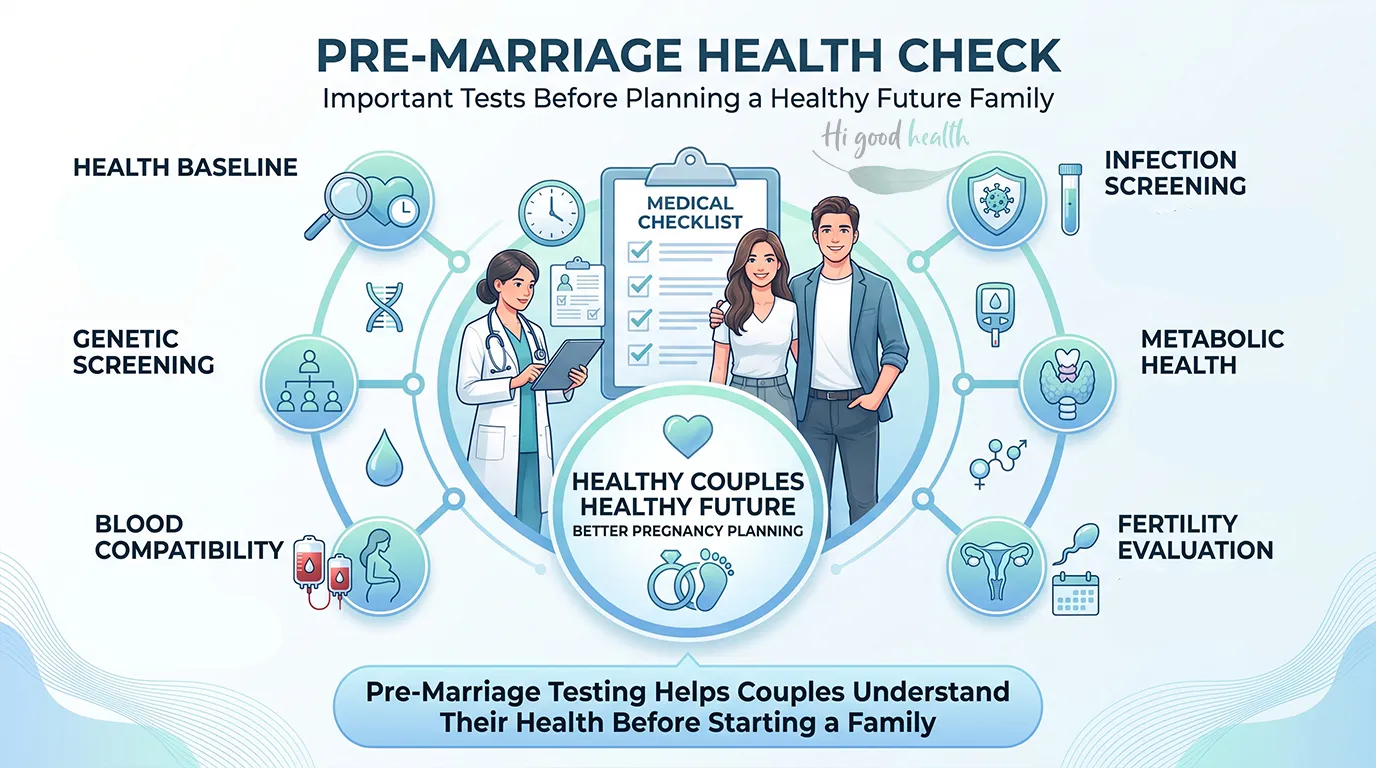
Preconception screening is good practice everywhere. Three things make it more consequential in India.
Carrier rates. India carries one of the world’s largest thalassaemia burdens, with high trait rates in several communities. Sickle cell disease is common across central and western India and in many tribal populations, and is now the subject of a national elimination mission.
Marriage patterns. Marriage within a community concentrates shared genetics, and in parts of southern India and some communities elsewhere marriage between cousins remains common. Both raise the chance that two people carry the same recessive condition.
Timing. Arranged marriage in India means there is usually a defined window before the wedding when both families are already organising documents, dates and medical formalities. That window is the natural time to do this, and it is a practical advantage most countries do not have.
The one test to do, if you do only one
A carrier test for thalassaemia and, where relevant, sickle cell.
A thalassaemia carrier is entirely healthy. The trait causes no symptoms and no problems, and most carriers have no idea. The screening test is a complete blood count followed by HbA2 on haemoglobin electrophoresis or HPLC, which is widely available and inexpensive.
The arithmetic is simple. If only one partner is a carrier, no child will have the disease; some children will be carriers, like the parent. If both partners are carriers, each pregnancy carries a one in four chance of thalassaemia major.
That is a child needing lifelong transfusions and iron chelation, and it is an enormous burden on the child and the family, medically and financially.
Knowing beforehand does not decide anything for a couple. It puts the decision in their hands, with a doctor and a genetic counsellor, before there is a pregnancy to make it about.
Sickle cell works the same way and matters most in Chhattisgarh, Madhya Pradesh, Maharashtra, Gujarat, Odisha, Jharkhand and neighbouring regions, and in many tribal communities. Screening and carrier cards are available through the national programme.
If the couple are related by blood, carrier screening and genetic counselling stop being merely sensible and become genuinely important, because the chance that both carry the same recessive condition is higher.
Blood group and Rh factor
Cheap, quick, and it prevents something real.
If a woman is Rh negative and her baby is Rh positive, her immune system can make antibodies against the baby’s blood cells. The first pregnancy is usually unaffected. Later pregnancies can be, seriously.
It is almost entirely preventable when the Rh status is known and an anti-D injection is given at the right times. Knowing your blood group before all of this begins is the whole point.
Infection screening, and how to think about it
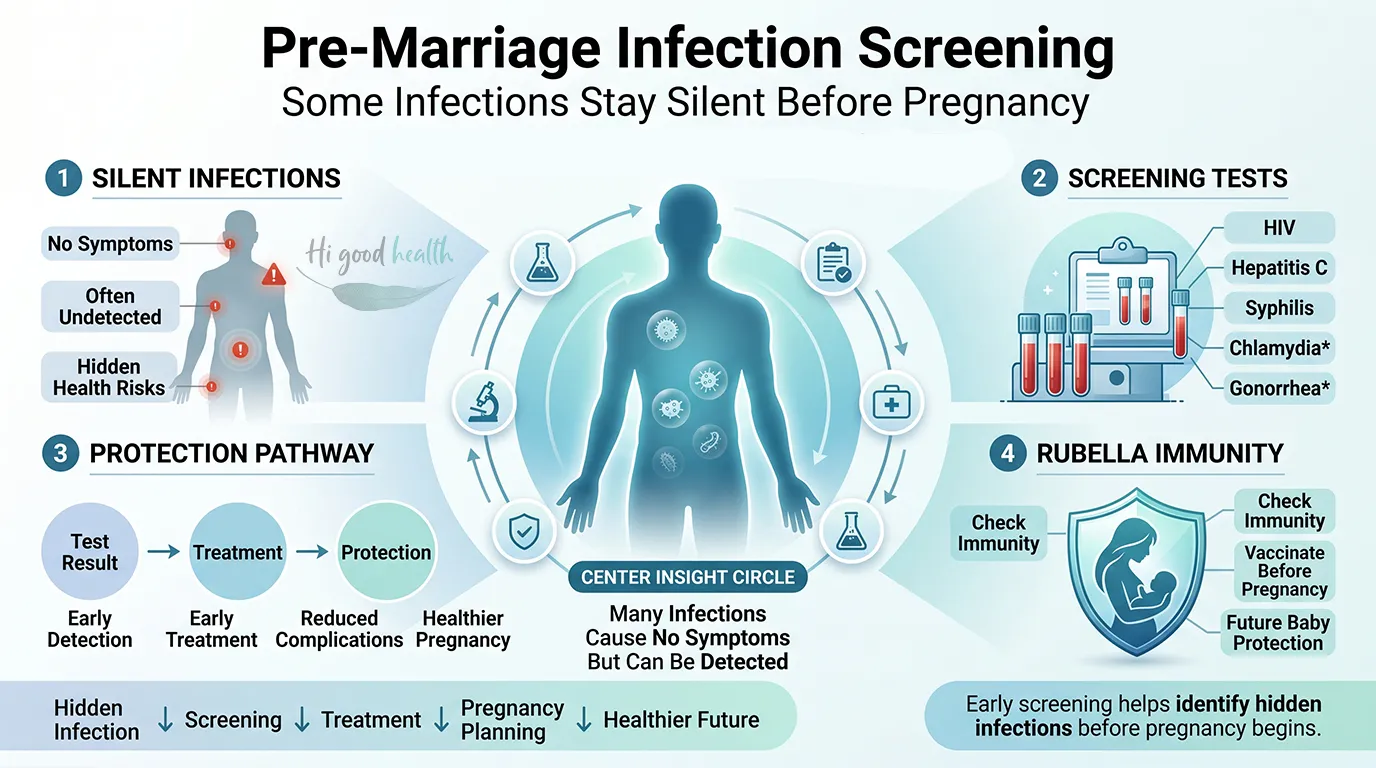
Several infections are silent, treatable, and matter in pregnancy: hepatitis B, hepatitis C, HIV and syphilis, with others depending on individual risk.
Hepatitis B deserves particular mention in India. Carrier rates here are not low, most carriers have no symptoms, transmission from mother to baby is preventable with vaccination and immunoglobulin at birth, and the partner can simply be vaccinated. A hepatitis B test and a vaccination course are among the highest-value items on this list.
Two things need saying plainly.
These tests are voluntary. In India nobody can be compelled to undergo an HIV test as a precondition, and results are confidential and belong to the person tested. A family cannot demand them as a condition of a marriage.
And a positive result is not the end of anything. HIV is a manageable long-term condition with treatment, and transmission to a partner or a baby can be reduced to very low levels. Hepatitis B is manageable and vaccine-preventable in the partner. Syphilis is cured with antibiotics. The reason to test is that all of these have answers.
Vaccines to sort out before, not during, pregnancy
- Rubella. Rubella in early pregnancy causes serious birth defects. India ran a large measles-rubella campaign, but immunity should be confirmed rather than assumed. The vaccine cannot be given during pregnancy, so this has to happen before.
- Hepatitis B, if not already immune.
- Varicella, chickenpox, if there is no clear history of the illness or the vaccine.
- Tetanus and Td, kept current.
Allow a few weeks between a live vaccine and trying to conceive. Ask the doctor how long.
The silent conditions that are common in Indian adults
These are ordinary tests at any Indian lab, and all of them are worth more before a pregnancy than during it.
| Test | Why it matters here |
|---|---|
| Haemoglobin, and ferritin if low | Anaemia is extremely common in Indian women, and pregnancy makes it worse |
| TSH | Hypothyroidism is common in Indian women, disrupts ovulation and affects the baby’s development. Fully treatable |
| Fasting glucose and HbA1c | South Asians develop diabetes younger and at lower body weight. Uncontrolled sugar in early pregnancy raises the risk of birth defects |
| Vitamin B12 | Deficiency is widespread in Indian vegetarians and matters for the baby’s nervous system |
| Vitamin D | Deficiency is very common here, including in people who are outdoors daily |
| Blood pressure and weight | Simple, and both change the plan |
| Urine routine | Cheap, and picks up silent infection and protein |
Folic acid deserves a line of its own. It should be started before conception, not after a pregnancy is confirmed, because the neural tube closes in the first few weeks, often before a woman knows she is pregnant. India has a high rate of neural tube defects, and this is one of the cheapest preventive measures in medicine.
Fertility testing: only if there is a reason
Most couples do not need a fertility workup before marriage, and a package that sells one to everybody is selling something.
It is worth doing when there is an actual question: irregular or absent periods, very painful or very heavy periods, known PCOS or endometriosis, past pelvic surgery or chemotherapy, an older bride or groom, or a couple who already know they want to delay a pregnancy for years.
For women that means AMH and an antral follicle count, plus thyroid and prolactin.
For men it means a semen analysis, which is cheap, quick and available everywhere in India, and which is the most neglected test in Indian fertility. About half of infertility involves a male factor, and in most Indian families the woman is the one investigated.
A clinician may also ask about varicocele, undescended testes in childhood, mumps affecting the testes after puberty, and any use of testosterone or anabolic steroids, all of which reduce sperm production. Steroid and testosterone use in Indian gyms is common and is rarely mentioned to a doctor.
These tests describe the present. They are not a prediction, and they are not a verdict on anybody.
The line this article will not blur
Under the PCPNDT Act, determining or disclosing the sex of a fetus is a criminal offence in India, for the person who asks and for the doctor or laboratory that provides it.
Genetic testing has real uses in reproductive medicine, and sex selection is not one of them. Any clinic, laboratory or intermediary that offers to tell you the sex of a future child is breaking the law, and should be refused and reported.
This belongs in an article about premarital genetic screening precisely because these tools can be misused, and because being clear about it is part of using them properly.
The other thing worth being honest about
A premarital medical report can be used well or badly.
Used well, it is two people getting information together, before there is a pregnancy, so that decisions are theirs and taken early.
Used badly, it becomes a document a family demands about a prospective bride, and a reason to break an engagement over something that is nobody’s fault and often not even a disease.
Being a thalassaemia carrier is not an illness. Having PCOS is not a defect. A low AMH is a piece of planning information, not a verdict. These results belong to the two people, and to their doctor.
If a family is asking for medical reports about a woman while asking for none about the man, that is worth naming for what it is.
A practical checklist
- Both partners, thalassaemia carrier screening. CBC and HbA2 by electrophoresis or HPLC. Add sickle cell screening if either family is from a high-prevalence region.
- Blood group and Rh factor, both.
- Hepatitis B, and vaccinate whoever is not immune.
- Rubella immunity for the woman, and vaccinate before conception if not immune.
- HIV, hepatitis C and syphilis, voluntarily, both partners, confidentially.
- TSH, fasting glucose or HbA1c, haemoglobin, vitamin B12, vitamin D.
- Blood pressure, weight and height.
- Folic acid started before trying to conceive.
- Genetic counselling if any carrier result is positive, if there is a family history of inherited disease, or if the couple are related.
- Fertility tests only if there is a specific reason to ask the question.
- Stop tobacco and cut alcohol, both partners, ideally three months before trying.
Choosing a package without being sold one
Premarital packages are heavily marketed by Indian labs and hospitals, and they vary enormously.
- Ask for the itemised list, not the package name. Two packages at the same price can contain very different tests.
- Check that thalassaemia screening is actually included, and that it is HbA2 by electrophoresis or HPLC rather than only a haemoglobin reading.
- Do not pay for whole-body scans, tumour markers or long vitamin panels that have nothing to do with the question you are asking.
- Use an NABL-accredited laboratory, and keep the reports.
- Take the results to a doctor. A page of values with a few figures in bold is not an interpretation.
Where this fits: this is stage 2 of the pregnancy-planning series. The full seven-stage guide is Pregnancy Planning in India: Folic Acid, Tests and Timing.
Key takeaways
Thalassaemia carrier screening is the test that changes outcomes, and it costs very little. Sickle cell screening too, in the regions where it matters.
Both partners, not one. Half of the relevant information here is the man’s.
Blood group and Rh factor prevents a serious and entirely preventable problem in later pregnancies.
Hepatitis B testing and vaccination is one of the highest-value items on the list in India.
Rubella immunity has to be sorted out before pregnancy, because the vaccine cannot be given during it.
Thyroid, blood sugar, haemoglobin, B12 and vitamin D are commonly abnormal in Indian adults and all are silent.
Folic acid starts before conception, not after the test is positive.
Sex determination is a crime in India. Any offer to do it should be refused and reported.
These reports belong to the couple, not to the wider family, and a carrier result is not a defect.
Frequently asked questions
What is the single most important premarital test in India?
Thalassaemia carrier screening for both partners, by CBC and HbA2 on haemoglobin electrophoresis or HPLC. Add sickle cell screening if either family comes from a high-prevalence region.
We are both healthy. Why would we be carriers?
Because carriers are healthy. That is the whole point. A thalassaemia or sickle cell carrier has no symptoms and usually no family history, and the risk only appears when two carriers have a child together.
What happens if we are both carriers?
Each pregnancy has a one in four chance of the disease. It does not decide anything for you, but it is information you want before a pregnancy rather than during one, and it is a conversation for a genetic counsellor.
Is HIV testing compulsory before marriage in India?
No. Testing is voluntary and results are confidential and belong to the person tested. No family or institution can compel it. It is still worth doing, because everything on that panel is treatable or manageable.
When should the tests be done?
Ideally three to six months before the wedding, which leaves time for vaccination, for treating anaemia or thyroid problems, and for genetic counselling if anything turns up.
What does a premarital package cost?
It varies widely by city and lab. Ask for the itemised list rather than comparing package prices, check that thalassaemia screening is genuinely included, and skip the scans and tumour markers that some packages add.
Should the man be tested too, or only the woman?
Both, on every item that applies. Carrier screening is meaningless with only one partner’s result, and about half of infertility involves the man.
Do we need fertility tests before marriage?
Usually not. They are worth doing when there is a reason: irregular periods, known PCOS or endometriosis, past surgery or chemotherapy, an older couple, or a plan to delay children for several years.
We are cousins. What should we do differently?
Get expanded carrier screening and see a genetic counsellor before conception. The risk of both partners carrying the same recessive condition is higher, and counselling is the right place to work out what that means for you.
Can these tests tell us the baby’s sex?
No, and asking for it is a criminal offence in India under the PCPNDT Act, for the person asking as well as the provider. Any clinic that offers this should be refused and reported.
Glossary
Carrier: a healthy person who carries one copy of a recessive gene and can pass it on. Two carriers together are the risk.
Thalassaemia trait: carrying one thalassaemia gene. No symptoms, no treatment needed, and important to know before marriage.
HbA2 electrophoresis or HPLC: the laboratory test that identifies a thalassaemia carrier.
Rh factor: a protein on red blood cells. An Rh-negative mother and Rh-positive baby need managing in later pregnancies.
Consanguinity: marriage between blood relatives, which raises the chance both partners carry the same recessive condition.
AMH: anti-Mullerian hormone, one marker of how many eggs remain.
Semen analysis: a laboratory test of sperm count, movement and shape.
PCPNDT Act: the Indian law that makes determining or disclosing the sex of a fetus a criminal offence.
NABL: the national accreditation body for Indian testing laboratories.
Disclaimer
This article is for general education only and does not replace medical advice. Test results should be interpreted by a qualified doctor or genetic counsellor, not from an article or a lab print-out. Screening is voluntary and confidential, and no test described here may be used for sex determination, which is a criminal offence in India.
References
- National Health Mission. Guidelines on Prevention and Control of Haemoglobinopathies in India: thalassaemia, sickle cell disease and other variant haemoglobins.
- National Sickle Cell Anaemia Elimination Mission, Government of India.
- Pre-Conception and Pre-Natal Diagnostic Techniques (PCPNDT) Act, 1994, Government of India.
- HIV and AIDS (Prevention and Control) Act, 2017, Government of India.
- Indian Council of Medical Research. National guidelines relevant to genetic screening and counselling.
- Ministry of Health and Family Welfare. Anaemia Mukt Bharat and National Iron Plus Initiative.
- World Health Organization. Preconception care guidance.
- American College of Medical Genetics and Genomics. Screening for autosomal recessive and X-linked conditions, 2021.