
Part of the HiGoodHealth peptides series.
- Our pillar guide, Peptides in India: What They Are, Which Ones Are Real Medicines, and What Is Being Sold to You, covers the science and the landscape.
- Are Peptides Legal in India? What the Law Actually Says covers the law in full.
- This article carries the women’s-health picture — what is approved, what is only marketed, and what the labels say.
At a glance
Women already receive peptide medicines routinely, and most people never think of them as peptides. Oxytocin in labour, the hormones used in IVF, teriparatide for osteoporosis after menopause, and the GLP-1 injections are all peptide drugs.
A note on which regulator this article quotes. Several of the medicines below have a published United States approval and no equivalent Indian record we can point to. Where that is the case this article says so plainly and cites the US label, because a US label with a warning in it is more use to a reader than silence. It is not a statement that the product is approved or available in India. Insulin, semaglutide, tirzepatide, liraglutide, teriparatide, octreotide, leuprolide and desmopressin are CDSCO-approved and sold here on prescription.
The marketed category is a different thing entirely. Compounds promoted online for menopause, fertility, energy and skin are, with one exception, not approved for any of it. Being a peptide says nothing about whether something works.
The exception is bremelanotide (Vyleesi), approved in the United States in 2019 for low sexual desire in premenopausal women. It is the only peptide approved anywhere for a women-specific complaint, and it carries a real contraindication that its online copies never mention. Whether it is available in India is a question for a gynaecologist — but the same molecule is sold online here as PT-141, and that is the point of this section.
The most useful women-specific safety fact in this article has nothing to do with wellness peptides. If you take a GLP-1 injection and swallow your contraceptive pill, the tirzepatide label tells you to add a barrier method. That is the sort of detail marketing leaves out and a prescriber does not. Ask your prescriber how the Indian pack insert words it.
Why women’s health became a marketing target
Fertility care, menopause management and cosmetic dermatology are large, growing and largely paid for out of pocket. They also involve decisions that are personal, time-pressured and emotionally loaded.
That combination is what marketers look for. A woman deciding about fertility is deciding on a deadline, and a deadline weakens the instinct to wait for evidence.
Peptides fit the pitch neatly. They sound biological rather than pharmaceutical, and the word carries the borrowed credibility of the approved medicines above.
The gap is wide. Many peptides promoted for women’s health are not approved for human use, not supported by trials in women, and not legally sold for the purpose being advertised.
Social media can amplify this effect by turning individual testimonials into apparent evidence. Fertility, ageing, appearance and sexual health are deeply personal concerns, so the pressure to find a quick solution can be particularly strong. But the number of testimonials is not a measure of clinical evidence.
The peptide medicines women already receive
These are established prescription medicines with defined indications, approved labelling and manufacturing standards.
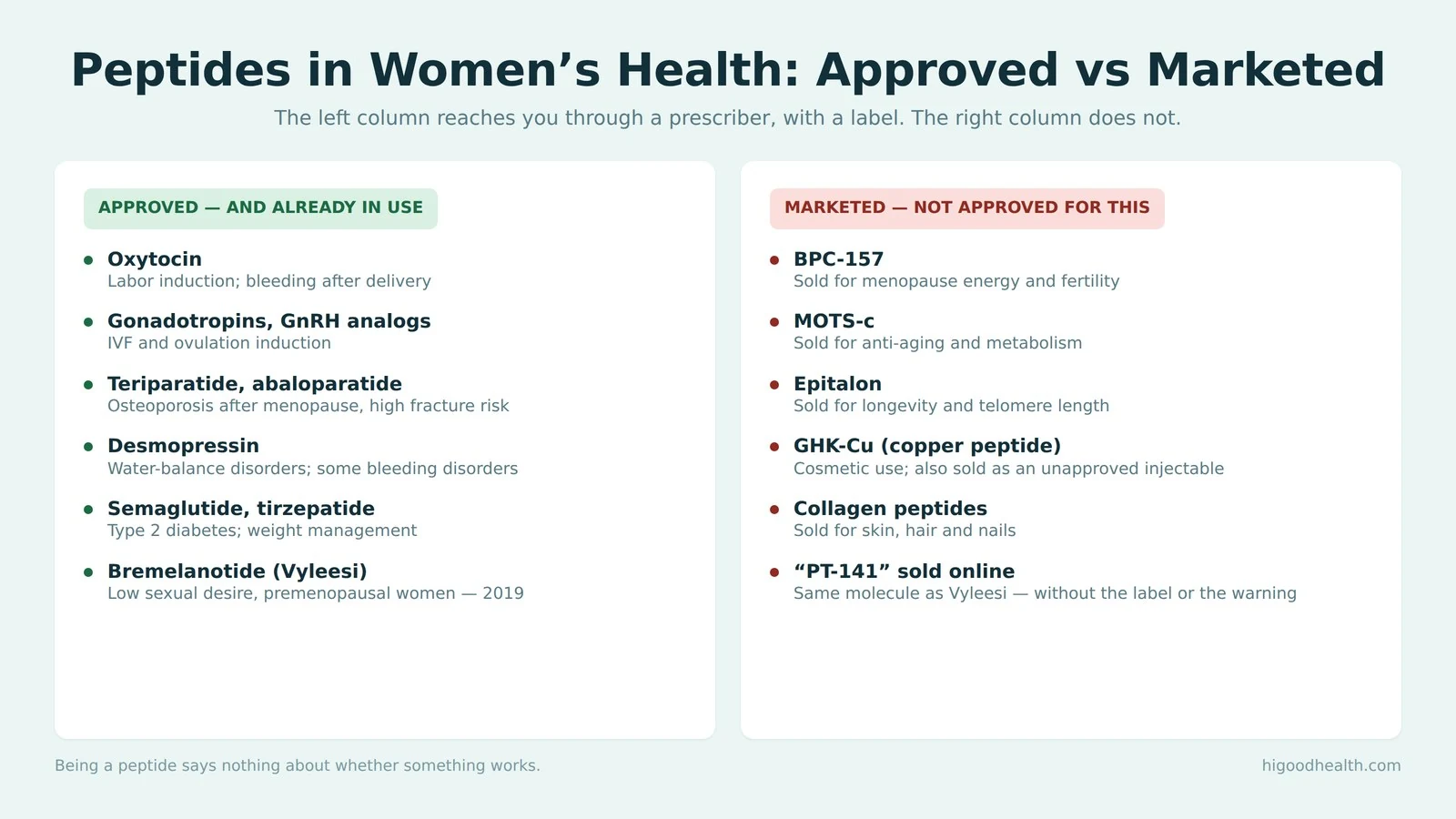
Oxytocin is used to induce or augment labour and to manage bleeding after delivery. It is given in a monitored hospital setting because the dose and the response both matter.
Gonadotropins and GnRH analogues — follitropin, leuprolide, cetrorelix, ganirelix — are the backbone of IVF and ovulation induction, and Indian fertility clinics run on them exactly as clinics elsewhere do. Leuprolide is on the CDSCO-approved list.
Tesamorelin carries a US approval with a narrow indication — reducing excess abdominal fat in adults with HIV-associated lipodystrophy. It is not approved as a general weight-loss, menopause or anti-ageing treatment anywhere. Its example reinforces an important rule: a peptide can be approved without being approved for every use for which it is marketed.
Teriparatide is a peptide analogue used for osteoporosis in postmenopausal women at high fracture risk, and it is CDSCO-approved and prescribed in India. Abaloparatide is a related medicine approved in the United States in 2017 for the same indication; we have no Indian approval record for it.
Desmopressin regulates water balance and is used in diabetes insipidus and some bleeding disorders.
GLP-1 injections — semaglutide, tirzepatide, liraglutide — are CDSCO-approved for type 2 diabetes and for weight management, and are prescribed to large numbers of women in India.
The point is not that peptides are suspect. It is that the approved ones arrive through a prescriber, with a label, and the marketed ones do not.
GLP-1 medicines and women of reproductive age
GLP-1 injections have changed obesity and metabolic care, and the benefits are real. What follows are the women-specific parts of the label that get lost in the marketing. The wording quoted here is from the United States prescribing information, which is the published source; the Indian pack insert for the same molecule is the one your prescriber will be reading, so ask them how it puts each point.
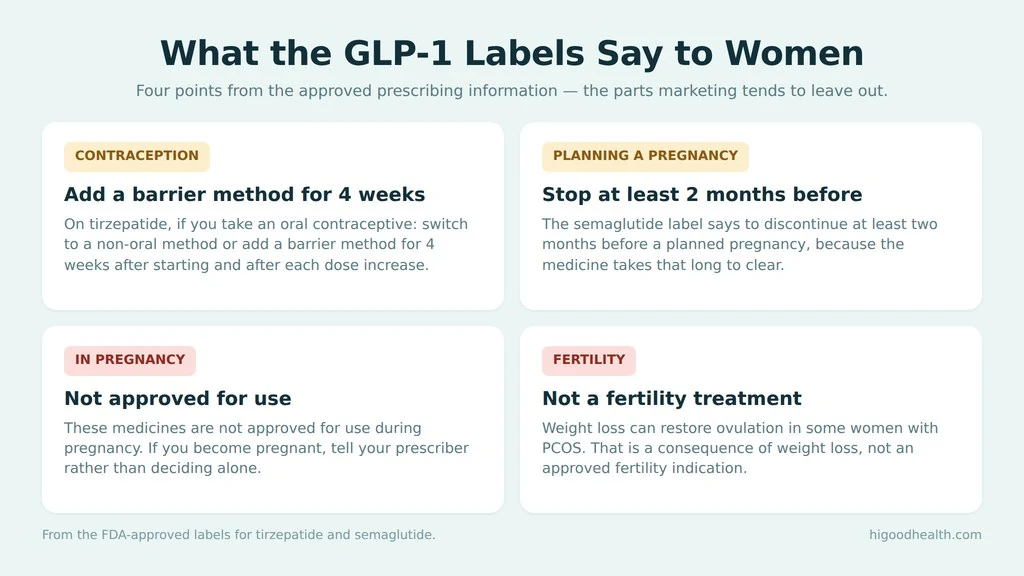
Contraception. The tirzepatide label advises patients using oral hormonal contraceptives to switch to a non-oral method or add a barrier method “for 4 weeks after initiation and for 4 weeks after each dose escalation.” Delayed stomach emptying can reduce how much of a swallowed pill is absorbed.
Planning a pregnancy. The semaglutide label says to “discontinue OZEMPIC in women at least 2 months before a planned pregnancy due to the long washout period for semaglutide.” That is a two-month gap to plan around, not a decision to make in the same week.
Fertility claims. No GLP-1 is approved as a fertility treatment. Weight reduction can restore ovulation in some women with PCOS, which is a genuine effect and also why unplanned pregnancies happen on these medicines.
Marketing that presents a GLP-1 as a fertility treatment is turning a possible consequence of weight loss into an indication the drug does not have.
For the wider picture on how these medicines are sold, see our guide to the GLP-1 telehealth boom.
Peptides and menopause
- What is marketed. BPC-157, MOTS-c and various “hormone balance” blends are promoted for menopausal fatigue, mood, sleep and body composition and general vitality.
- What has evidence. For menopausal symptoms themselves, established treatments include hormone therapy and several non-hormonal medicines, depending on the symptom and the individual’s medical history.
These treatments have been studied specifically for menopausal symptoms. That is a fundamentally different evidence base from laboratory research on experimental peptides.
- What remains experimental. BPC-157 and MOTS-c are not approved for menopause anywhere, and there are no adequate clinical trials in menopausal women establishing that they safely and effectively treat menopausal symptoms. Our BPC-157 guide sets out what that evidence does and does not cover.
- Compounding is not approval, and it is not an Indian category at all. Pharmacy compounding is a United States route; a pharmacy being permitted to compound a substance there is a supply decision, not a finding that it works. They do not establish that the substance is effective for menopause, fertility, ageing or any other condition. Products sold with a “research use only” label are carrying a labelling disclaimer, not a legal exemption and not a quality standard. Compounding rules address when a pharmacy may prepare a particular substance.
Peptides for skin, hair and ageing
- Collagen peptides and GHK-Cu are the two most heavily marketed to women, and they are different products with different routes and different evidence.
- Collagen peptides is a swallowed protein fragments generally sold as dietary supplements rather than prescription medicines. Some clinical studies and reviews have reported improvements in measures such as skin hydration or elasticity. However, the evidence has limitations, including small studies, varying formulations and substantial industry involvement.
Our guide to collagen peptides for skin, hair and nails goes through those trials in detail.
- GHK-Cu is a copper-bound signalling peptide used mainly in topical skincare, and sometimes promotes as an injectable. Evidence for a cosmetic formulation does not automatically transfer to an injected product. The route of administration changes exposure, dosing, safety questions and regulatory status.
- The regulatory point matters here. Cosmetics are not required to show effectiveness before sale the way medicines are. That is a different bar, not a lower-quality version of the same one.
- Cosmetics are not medicines. Cosmetic products are subject to a different regulatory framework from prescription drugs. They generally do not have to demonstrate effectiveness through the same premarket clinical trials required for an approved medicine. That does not mean every cosmetic peptide is ineffective. It means a cosmetic claim should not be interpreted as equivalent to a drug indication.
Peptides and fertility
Established reproductive medicine already runs on peptides — the gonadotropins and GnRH analogues above, used under monitoring, with cycle-by-cycle adjustment.
Against that, BPC-157 and TB-500 are marketed online for fertility with no clinical validation in this setting at all. Our TB-500 and MOTS-c guide covers what is actually known about them.
Fertility is the area where weak evidence does the most damage. Cycles are expensive, emotionally costly and finite. An unapproved compound taken alongside a monitored protocol also introduces a variable nobody can interpret.
If a clinic or seller offers a peptide as a fertility aid, the question to ask is which trial in women it is based on.
Kisspeptin is another peptide relevant to female reproductive health. It is part of the biological pathway that regulates GnRH release and reproductive hormone signalling. Researchers have studied kisspeptin for triggering ovulation and its potential use in assisted reproduction, including in women undergoing IVF. Early human studies are promising, but kisspeptin is not an approved fertility treatment anywhere and does not have the established clinical role of gonadotropins or GnRH medicines.
Sexual and pelvic health: the one approved peptide
- Bremelanotide (Vyleesi) was approved in the United States in June 2019 for hypoactive sexual desire disorder in premenopausal women. It is a melanocortin receptor agonist, self-injected before anticipated activity. We have no Indian approval record for it.
- It is also the clearest example in this article of why the approved version and the online version are not the same product. The label states plainly: “VYLEESI is contraindicated in patients who have uncontrolled hypertension or known cardiovascular disease.” It transiently raises blood pressure after each dose, and it is not recommended in pregnancy.
- The same molecule is sold online, in India as everywhere else, as PT-141. But a molecule and an approved medicine are not the same thing. Products sold online as PT-141 may not carry the approved labelling, manufacturing controls, quality assurance or prescribing information associated with Vyleesi — and that is true whichever country you are buying from.
- A contraindication only protects patients when the product is properly labelled and the warning is understood.
- Approved treatments exist elsewhere in pelvic health too — for genitourinary symptoms of menopause, for example. They are prescribed after an examination, which is the step wellness marketing removes.
“Anti-ageing” peptides marketed to women
- MOTS-c is a mitochondrial-derived peptide studied in cells and animals. It is not approved anywhere and has not been shown to slow ageing in people.
- Epitalon is promoted for telomere length and longevity on the strength of a small and largely non-replicated literature. It has no approval in India or the United States.
- Growth-hormone–related peptides such as CJC-1295, ipamorelin and sermorelin are also marketed for anti-ageing, body composition and “hormone optimisation.” Their effects on growth-hormone signalling do not establish that they treat menopause or slow ageing, and these compounds should not be confused with approved peptide medicines.
- The gap between these two facts is where the marketing lives. A peptide can have a plausible mechanism, real laboratory data, and still no evidence of benefit in a human being. Cell to animal to human to randomised trial is a ladder, and most of these compounds are on the bottom rung.
For where the law stands on this class in India, see Are Peptides Legal in India? — CDSCO approval, Schedule H, the import rules and the grey market.
Pregnancy and breastfeeding
This is the one section where the distinction is not academic. Approved medicines carry pregnancy and lactation information because someone was required to study it and write it down.
For many experimental peptides, adequate human reproductive and lactation safety data are missing. Some may have preclinical data, but animal findings cannot establish that a product is safe during human pregnancy.
Absence of a warning is not evidence of safety. It usually means nobody looked. Anyone pregnant, breastfeeding or planning a pregnancy should treat an unapproved peptide as an unknown, and should tell their obstetrician about anything already taken.
How to evaluate a peptide claim
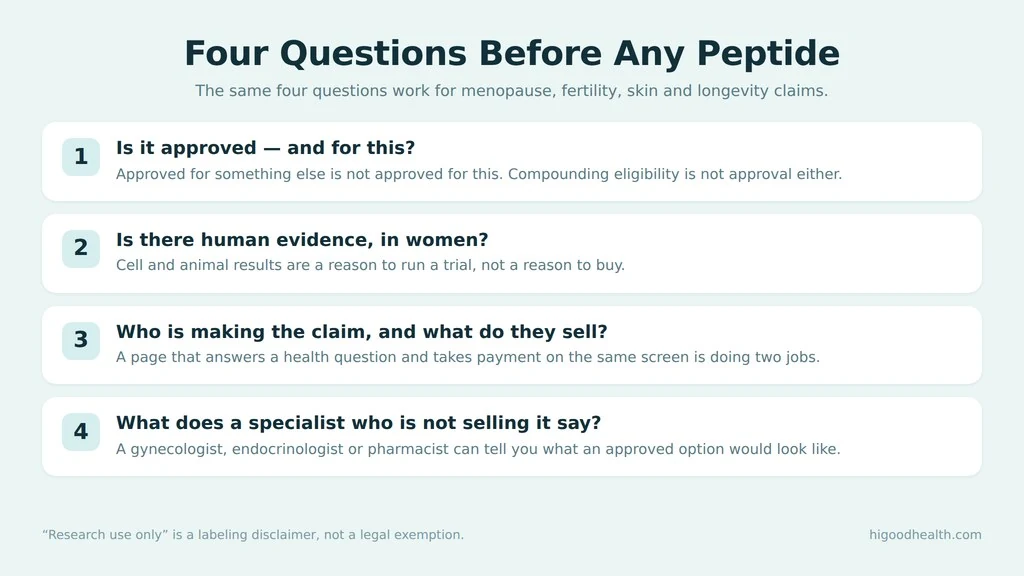
- Is it approved, and for what? Approved for something else is not approved for this. Compounding eligibility is not approval either.
- Is there human evidence in women? Cell and animal work is a reason to run a trial, not a reason to buy.
- Who is making the claim, and what do they sell? A page that answers a health question and takes a payment on the same screen is doing two jobs.
- Ask a specialist who is not selling it. A gynaecologist, endocrinologist or pharmacist can tell you what an approved option would look like for your situation.
- “Research use only” is a labelling statement indicating that a product is not intended for human use.
Bottom line
Peptides are already part of women’s healthcare, and they arrived through prescriptions rather than advertisements. Oxytocin, the IVF hormones, the osteoporosis analogues and the GLP-1 injections all have approvals, labels and evidence behind them.
The marketed category is where the claims outrun the data. Menopause, fertility, skin and longevity peptides are sold with confidence that no trial in women supports, and the one genuinely approved women’s peptide is copied online with its safety warning removed.
The honest position is not that peptides do not work. It is that this specific product, for this specific purpose, has not been shown to. That is a narrower claim, and it is the one the evidence actually supports.
Key takeaways
Women already receive peptide medicines routinely — oxytocin in labour, gonadotropins and GnRH analogues in fertility care, teriparatide for postmenopausal osteoporosis, and the GLP-1 injections. All are prescription drugs with approvals and labels behind them, and most are CDSCO-approved and sold here.
Bremelanotide (Vyleesi) is the only peptide approved anywhere for a women-specific complaint, low sexual desire in premenopausal women, and that approval is a United States one. It is contraindicated in uncontrolled hypertension and known cardiovascular disease, and the same molecule sold online as PT-141 carries none of that warning.
Two women-specific GLP-1 label points get lost in marketing: add a barrier method for four weeks after starting and after each dose increase if you take an oral contraceptive, and stop semaglutide at least two months before a planned pregnancy.
No GLP-1 is approved as a fertility treatment, though weight loss can restore ovulation in some women with PCOS.
The peptides marketed for menopause, fertility, skin and anti-ageing — BPC-157, MOTS-c, Epitalon, GHK-Cu — are not approved for those uses and have not been studied in women in trials that would support the claims. Compounding eligibility is not approval, and “research use only” is a labelling disclaimer rather than a legal exemption or a quality standard.
In pregnancy and breastfeeding the gap is widest. Approved medicines carry reproductive safety information because someone was required to produce it; unapproved peptides carry none, and absence of a warning usually means nobody looked.
Frequently asked questions
- Are any peptides approved specifically for women? One is. Bremelanotide (Vyleesi) is approved in the United States for hypoactive sexual desire disorder in premenopausal women. Several other peptide medicines are used routinely in women’s care — oxytocin, fertility hormones and teriparatide — though they are not women-only approvals.
- Do peptides help with menopause symptoms? No wellness peptide is approved for menopausal symptoms, and none has been studied in menopausal women in a way that supports the claims made for it. The treatments with trial evidence are hormone therapy and a small number of non-hormonal medicines.
- Can GLP-1 medicines improve fertility? They are not approved as fertility treatments. Weight reduction can restore ovulation in some women with PCOS, which is why unplanned pregnancies occur on these medicines. That is a consequence of weight loss, not a fertility indication.
- Do GLP-1 injections affect the contraceptive pill? The US tirzepatide label advises adding a barrier method or switching to a non-oral method for four weeks after starting and after each dose increase. Ask your prescriber how the Indian pack insert for your medicine puts it.
- Is PT-141 the same as Vyleesi? They are the same molecule, but not the same product. Vyleesi is an approved medicine with a label, a contraindication in cardiovascular disease and a known manufacturing standard. Material sold online as PT-141 has none of those guarantees.
- Are peptides safe during pregnancy or breastfeeding? Approved peptide medicines have pregnancy and lactation information on their labels, and your obstetrician can weigh it. Unapproved peptides have no such data at all, and should not be assumed safe.
- Does “research use only” mean it is legal to take? No. It is a labelling disclaimer, not a legal exemption and not a quality standard. The US FDA has been explicit that intended use, not the wording on a vial, determines how a product is regulated, and Indian law takes the same view.
- What happens if something goes wrong? With an approved medicine, there are established dosing instructions, contraindications, adverse-event information and quality controls. With an unapproved product, those protections may be substantially different.
- Who can give me an unbiased view? A gynaecologist, endocrinologist, fertility specialist or pharmacist can explain what an established treatment would look like for your situation.
Glossary
- Peptide: a short chain of amino acids. The word describes a molecule’s size, not its safety, effectiveness or legal status.
- GnRH analogue: a peptide that acts on the gonadotropin-releasing hormone pathway, used in fertility protocols to control the timing of ovulation.
- Gonadotropins: hormones such as FSH and LH, given in IVF and ovulation induction.
- Melanocortin receptor agonist: the drug class bremelanotide belongs to; it acts on brain pathways involved in sexual desire.
- HSDD: hypoactive sexual desire disorder — persistently low sexual desire that causes distress and is not explained by another cause.
- Compounding: preparation of a medicine by a pharmacy for an individual patient. Eligibility to compound a substance is not approval of it, and compounding is a United States route with no Indian equivalent.
- Research use only (RUO): a labelling disclaimer applied to material not intended for human use. It is not a legal exemption and not a quality standard.
References
- US FDA — VYLEESI (bremelanotide) prescribing information, initial US approval 2019: https://www.accessdata.fda.gov/drugsatfda_docs/label/2019/210557s000lbl.pdf
- US FDA — MOUNJARO (tirzepatide) prescribing information, oral contraceptive advice: https://www.accessdata.fda.gov/drugsatfda_docs/label/2025/215866s031lbl.pdf
- US FDA — OZEMPIC (semaglutide) prescribing information, discontinuation before planned pregnancy: https://www.accessdata.fda.gov/drugsatfda_docs/label/2024/209637s032lbl.pdf
- US FDA — TYMLOS (abaloparatide) prescribing information: https://www.accessdata.fda.gov/drugsatfda_docs/label/2025/208743s017lbl.pdf
- US FDA — Certain bulk drug substances for use in compounding that may present significant safety risks: https://www.fda.gov/drugs/human-drug-compounding/certain-bulk-drug-substances-use-compounding-may-present-significant-safety-risks
- CDSCO — The Drugs and Cosmetics Act 1940 and Rules 1945: https://cdsco.gov.in/opencms/export/sites/CDSCO_WEB/Pdf-documents/acts_rules/2016DrugsandCosmeticsAct1940Rules1945.pdf
- NIH / MedlinePlus — Oxytocin injection: https://medlineplus.gov/druginfo/meds/a682685.html
- WADA — 2026 Prohibited List: https://www.wada-ama.org/en/resources/2026-prohibited-list
- Kisspeptin-54 triggers egg maturation in women undergoing in vitro fertilization. https://www.jci.org/articles/view/75730
- US FDA — Full Prescribing Information for EGRIFTA WR (tesamorelin)
- Garcia, J. M. (2026). Growth Hormone and Aging. Endotext. https://www.ncbi.nlm.nih.gov/books/NBK279163/
Medical disclaimer
This article is for general education and is not medical advice. It describes what is approved and what is marketed, and is not a recommendation to take or avoid any product. Speak to a qualified healthcare professional — a gynaecologist, endocrinologist or pharmacist — about menopause, fertility or sexual health concerns, and before starting anything if you are pregnant, breastfeeding or planning a pregnancy.
