Quick Recap: What We Covered in Part 1
This is Part 2 of our GLP-1 series. In Part 1 — GLP-1 Drugs Explained, we covered what GLP-1 drugs are, how they work, their benefits, side effects, who they are for, and why India’s 2026 generic wave is a turning point for millions. If you have not read it yet, start there first because it lays the foundation for everything in this article. In Part 2, we look closely at why GLP-1 for weight loss may matter even more for South Asian bodies.
At a glance: GLP-1 for Weight Loss and South Asians
GLP-1 for weight loss describes a group of medicines that lower appetite and blood sugar at the same time. For South Asians, who often develop diabetes and stubborn belly fat at a lower BMI, this matters even more. Semaglutide (sold as Ozempic for type 2 diabetes and as Wegovy for weight loss) and tirzepatide (Mounjaro for weight loss) can shrink visceral belly fat, steady blood sugar, and lower heart risk together. But these weight loss injections are long-term medical tools, not cosmetic quick fixes, so they need a specialist’s supervision alongside diet and strength training.
The Wake-Up Call Nobody Is Talking About
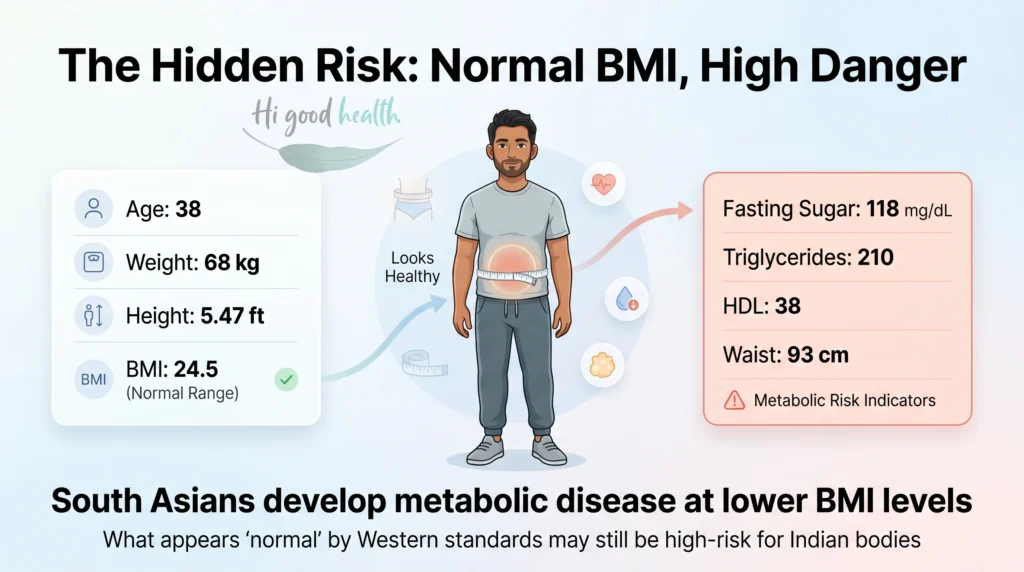
Picture this. Rohit is 38 years old. He weighs 68 kg and is 5.47 feet tall. His BMI reads 24.5, which looks perfectly “normal” on most charts. He is not obese by Western standards. He goes to the gym twice a week. His friends and relatives say he looks fit as well.
Then a routine health check arrives: fasting sugar 118 mg/dL, triglycerides 210, HDL 38, waist 93 cm. But by South Asian biology, he is already in the danger zone. South Asians are known to develop diabetes at younger ages and at the BMI that is safe as per western standards [13], which is why this topic matters so much for Indian families.
Body Composition and Fat Distribution
The Thin-Fat Paradox
Medical science often describes South Asians as “thin outside, fat inside.” That means many people who do not look obese still carry dangerous internal fat around the organs. A 2024 review on semaglutide use in Asian populations [3] explains that South Asians tend to carry more visceral fat at lower BMI than White Caucasian populations.
This is one major reason why the same BMI number does not carry the same meaning across ethnic groups. Trial diversity data in GLP-1 obesity studies also notes that South Asian diabetes risk at BMI 30 in White populations may already appear around BMI 23.9 in South Asians.
Lower Muscle Mass and Smaller Frame
South Asians also tend to have lower skeletal muscle mass relative to body weight. Less muscle means less room to store glucose safely and a lower resting metabolic rate. This hypothesis paper on why South Asians are prone to diabetes [5] describes how reduced lean mass and impaired fat storage capacity may push calories toward more harmful fat depots.
Abdominal Adiposity
For South Asians, waist size often tells the truth better than body weight. A waist above 90 cm in men or 80 cm in women points to significantly higher metabolic risk, even if BMI looks acceptable. Duke Health’s overview for South Asian diabetes risk [30] highlights why earlier screening is important in this community.
One can check Waist-to-Height Ratio (WHtR) by using a simple “formula” for assessing risk across all body types.
The Formula: Waist circumference/ Height (Both should be in same units)
The “Alarm” Threshold: Your waist should be less than half your height (a ratio of < 0.5). Action Required: A ratio of 0.5 to 0.59 indicates increased risk, while 0.6 or more is considered high risk and requires medical consultation.
Ectopic Fat and Fatty Liver
When the body cannot safely store extra fat under the skin, fat spills into organs such as the liver, pancreas and kidneys. This is called ectopic fat. South Asians exhibit higher visceral to subcutaneous fat ratios and have significantly more liver fat (type of ectopic fat). This metabolic profile leads to diabetes at lower weight thresholds and younger ages.
Atherogenic Dyslipidemia
Many South Asians do not just have “high cholesterol.” They often show a more dangerous pattern: high triglycerides, low HDL, and small dense LDL particles. A 2026 review of obesity phenotypes and atherogenic dyslipidemia [21] explains why this lipid pattern increases heart disease risk even when a routine lipid report looks only mildly abnormal.
Metabolic and Genetic Differences
Lower BMI, Higher Metabolic Risk
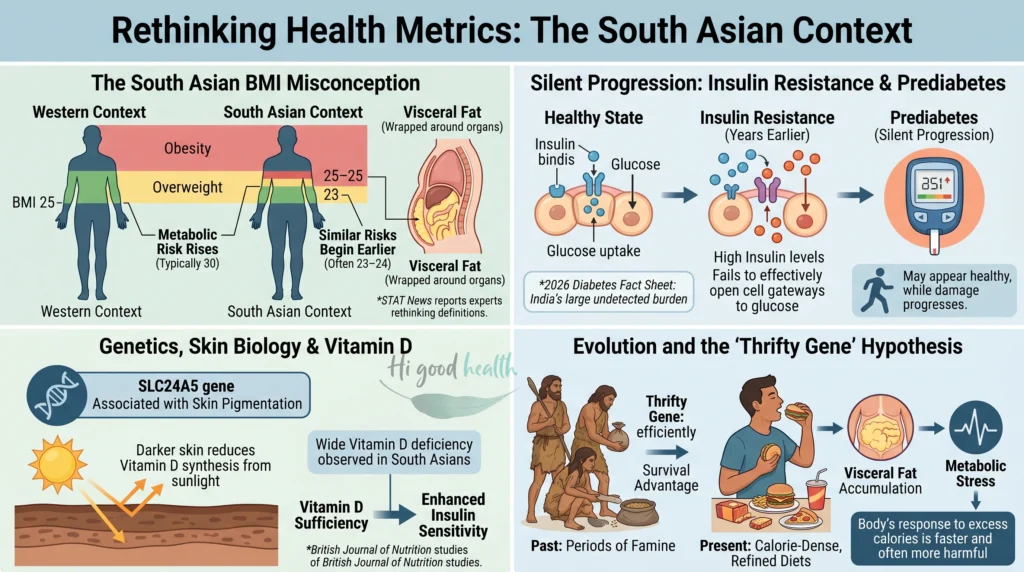
This is why the old BMI rules do not work well for South Asians. Risk in Western populations at BMI ~30 and Similar risk in South Asians can be seen at BMI ~23–24. STAT News on India’s obesity rulebook after semaglutide [4] reported that experts are rethinking obesity definitions in India because harmful visceral fat often appears much earlier than standard Western thresholds suggest. This is why many experts advocate earlier screening and lower thresholds.
Insulin Resistance and Prediabetic Status
South Asians often become insulin resistant years before diabetes is formally diagnosed. The 2026 Diabetes Fact Sheet [26] notes that India has a massive burden of prediabetes and diabetes, much of it still undetected.
Skin Differences, SLC24A5, and Vitamin D
The SLC24A5 gene is associated with skin pigmentation patterns seen in South Asians and Europeans. On its own, it is not a diabetes gene, so this point should be handled carefully. But vitamin D biology may still matter because vitamin D deficiency is common in South Asians and has been linked with insulin resistance. British Journal of Nutrition study on vitamin D and insulin resistance in South Asian women [16] found improved insulin sensitivity after vitamin D supplementation in insulin-resistant South Asian women.
Evolutionary Thrifty Genes
One widely discussed theory is the “thrifty gene” hypothesis. It suggests that populations exposed to repeated famine may have evolved to store energy very efficiently. This review of genetic and environmental factors in visceral fat [15] helps explain why modern diets rich in refined carbohydrates may trigger disproportionate metabolic harm in South Asian bodies.
Why Risk Appears Earlier
Lower Metabolic Buffer
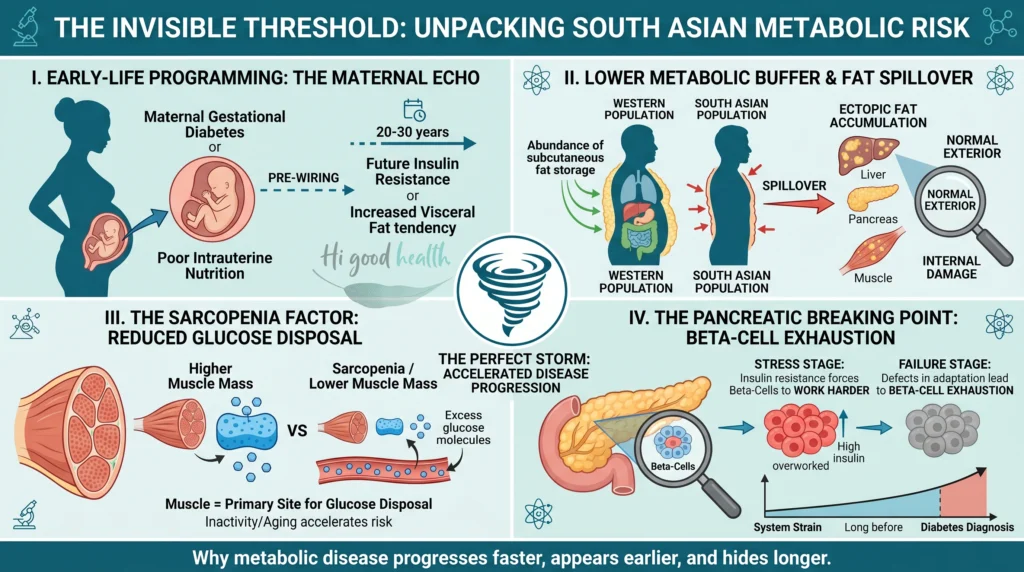
South Asians often have less metabolic flexibility—meaning the body has limited capacity to safely store excess calories. As a result, Blood sugar rises quickly, Triglycerides increase faster .Fat accumulates in organs sooner even before visible obesity appears, internal damage may already be underway. South Asian diabetes review in Diabetes Care [13] summarizes these novel risk factors clearly.
Sarcopenia Components
If a person starts with lower muscle mass and then loses even more through inactivity, age, or crash dieting, glucose control worsens further. This is one reason South Asians may slip toward diabetes faster than expected.
Maternal Programming
Risk may begin before birth. This review on gestational diabetes in South Asians [14] explains how maternal diabetes and poor intrauterine nutrition can program children toward higher future risk of insulin resistance, visceral fat, and diabetes.
Earlier Beta-Cell Exhaustion
South Asians not only become insulin resistant earlier; they may also lose beta-cell function earlier. A landmark paper on failing beta-cell adaptation in South Asian families [6] showed that defects in beta-cell adaptation can emerge before diabetes is fully established.
Because South Asians face earlier beta-cell exhaustion and heart risk, these medicines offer vital organ protection for the heart and kidneys.
Why GLP-1 for Weight Loss May Work Differently in South Asians
Most people first hear about these medicines by their brand names. Semaglutide is sold as Ozempic for type 2 diabetes and as Wegovy for weight loss, while tirzepatide is sold as Mounjaro for weight loss. Whichever name is on the box, the same question applies to Indian bodies: does GLP-1 for weight loss behave differently here? A few features of South Asian physiology suggest it might.
Higher Baseline Incretin Levels
Interestingly, healthy South Asians may naturally produce higher GLP-1 levels after a glucose load, yet still show worse insulin resistance. This review asks whether Indians are different in their incretin response [7] suggesting that the issue may not just be GLP-1 production, but also GLP-1 sensitivity.
Metabolic and Fat Profile
Because South Asians carry more visceral and ectopic fat, medicines that reduce these depots may deliver outsized metabolic benefit. South Asian liraglutide trial showing reduction in visceral adipose tissue [17] supports this theory directly.
Greater Relative Risk Reduction
A 2026 meta-analysis found that GLP-1 receptor agonists delivered stronger cardiovascular risk reduction in Asian populations than in White populations. [2]
Stroke Prevention and MACE Reduction
This matters because South Asians face a heavy burden of early heart disease and stroke. If GLP-1 medicines reduce major adverse cardiovascular events more strongly in Asian populations, that makes GLP-1 for weight loss especially relevant here. JAPI guidance on GLP-1 implementation in cardiovascular prevention [19] supports using these drugs thoughtfully in high-risk patients.
Reducing Visceral Adipose Tissue
South Asians often carry inflammatory fat around the liver, heart, and abdomen. GLP-1 for weight loss appears to target this dangerous belly fat more effectively than many older treatments. PMC trial in South Asians with type 2 diabetes [17] reported that reduction in visceral fat was associated with improved HbA1c.
Correcting Atherogenic Dyslipidemia
GLP-1 therapy may also improve the South Asian pattern of high triglycerides, low HDL, and smaller LDL particles. This is one reason GLP-1 for weight loss is more than just a set of “weight-loss injections.” Review on obesity phenotypes and dyslipidemia [21] helps frame why lipid changes matter so much in this group.
Enhancing Glycemic Response
GLP-1 medicines increase insulin only when glucose is high, suppress glucagon, slow stomach emptying, and reduce appetite. In a population with high insulin resistance and earlier beta-cell stress, those effects can be especially useful, which is part of why GLP-1 for weight loss is drawing so much attention in India. Critical review of GLP-1 receptor agonists [29] explains these mechanisms clearly.
Why Different Doses for the Same Medication?
Dose decisions for GLP-1 for weight loss should always be individualized. The idea is not that all South Asians need a higher dose, but that body size, GI tolerance, insulin resistance, and treatment goals can alter response. Indian and global commentary on GLP-1 practice patterns also notes that access, adherence, side effects, and oral options may shape real-world use in India.
The Risks of GLP-1 Weight Loss to Watch
Muscle Wasting
This point is crucial for South Asians. If GLP-1 treatment causes quick weight loss without enough protein intake and strength training, some of that loss may come from muscle. Mass General guidance on preserving lean body mass on GLP-1 [24] and a 2025 review on muscle loss and GLP-1 agonists [23] both emphasize resistance training and adequate protein to protect lean mass.
Managing weight loss in Indian bodies requires caution to prevent muscle wasting (sarcopenia); read our guide on how to protect your lean mass while on GLP-1.
Weight Regain Trap
GLP-1 for weight loss is not a short cosmetic fix. When people stop GLP-1 for weight loss abruptly, weight regain is common. WHO guidance on GLP-1 medicines for obesity [20] is clear that these medicines should be part of a broader long-term care plan.
GI Sensitivity
Nausea, bloating, constipation, and vomiting are some of the most common side effects. Indian regulators have also tightened oversight around misuse and unauthorized sales. PIB note on GLP-1 use, risks, and regulation in India [25] reinforces that GLP-1 for weight loss should only be used under qualified medical supervision.
Key Takeaways
- South Asians can develop diabetes, fatty liver, and heart risk at lower BMI because of the thin-fat phenotype, higher visceral fat, and lower muscle mass.
- Waist size, triglycerides, HDL, fasting sugar, and family history often matter more than BMI alone.
- GLP-1 for weight loss may offer especially meaningful benefit in South Asians because these medicines target appetite, glucose control, visceral belly fat, and cardiovascular risk together.
- Ozempic, Wegovy, and Mounjaro are brand names for the same family of GLP-1 weight loss treatment; the right choice and dose should be decided with a doctor.
- These medicines are powerful but not magic. Protein intake, strength training, sleep, and specialist supervision remain essential.
Frequently Asked Questions
If you prefer a more visual version, check out our YouTube video here:
Q: Can I have diabetes risk even if I am not overweight?
A: Yes. In South Asians, metabolic risk often appears at lower BMI. Waist size and blood tests may reveal risk long before visible obesity appears.
Q: Are GLP-1 medicines a cure?
A: No. They are effective long-term treatment tools, not a cure. They work best with diet, activity, and medical monitoring.
Q: Why is belly fat more dangerous than weight on the scale?
A: Because visceral fat around organs drives insulin resistance, fatty liver, inflammation, and cardiovascular risk.
Q: Can I take these drugs without a specialist?
A: No. In India, these medicines should be prescribed and monitored by qualified specialists because side effects, dose selection, and drug interactions matter.
Q: How can I protect muscle while losing weight?
A: Use enough daily protein from foods such as dal, paneer, tofu, soy, legumes, nuts, and seeds, and combine this with regular resistance training.
Q: Is GLP-1 for weight loss the same as Ozempic and Wegovy?
A: They are closely related. Ozempic and Wegovy are brand names for semaglutide, and Mounjaro is a brand name for tirzepatide. All of them work through the GLP-1 pathway, so people often group them together as GLP-1 for weight loss.
Q: Are GLP-1 weight loss injections available in India?
A: India saw a generic semaglutide wave in 2026, and regulators have tightened oversight around misuse. Availability and rules keep changing, so ask a qualified doctor about your options rather than buying these injections on your own.
Q: Does GLP-1 for weight loss reduce belly fat specifically?
A: Research suggests these medicines can lower visceral and ectopic fat, the deep belly fat linked to diabetes and heart risk. That is one reason GLP-1 for weight loss may be especially useful for South Asians.
Glossary
- GLP-1: A natural gut hormone that helps regulate blood sugar, insulin release, stomach emptying, and appetite.
- Visceral fat: Fat stored around internal organs; more dangerous than fat under the skin.
- Ectopic fat: Fat stored in the wrong places, such as liver, pancreas, or heart.
- Prediabetes: Blood sugar higher than normal but not yet in the diabetes range.
- MACE: Major adverse cardiovascular events, usually meaning heart attack, stroke, or cardiovascular death.
- Sarcopenia: Loss of muscle mass and strength.
- Atherogenic dyslipidemia: A harmful lipid pattern of high triglycerides, low HDL, and small dense LDL particles.
References and Credible Sources ( All reference links valid and accessible on July 2026)
- GLP-1 Receptor Agonists and Cardiovascular Outcomes in Asian Populations — Diabetes & Obesity Management, 2026
🔗 https://dom-pubs.onlinelibrary.wiley.com/doi/10.1111/dom.70458 - GLP-1 Cardiovascular Outcomes in Asian vs White Populations (MACE Meta-analysis, HR 0.73) — PubMed, 2026
🔗 https://pubmed.ncbi.nlm.nih.gov/41565576/ - Reconsidering Semaglutide Use in Asian/South Asian Patients — PMC, 2024
🔗 https://pmc.ncbi.nlm.nih.gov/articles/PMC11622169/ - Generic Semaglutide in India Requires a New Rulebook — STAT News, March 2026
🔗 https://www.statnews.com/2026/03/17/generic-semaglutide-india-bmi-obesity-definition/ - Why South Asians Are Prone to Type 2 Diabetes — PMC, 2020
🔗 https://pmc.ncbi.nlm.nih.gov/articles/PMC7531132/ - Failing Beta-Cell Adaptation in South Asian Families With High Diabetes Risk — PMC/Diabetologia, 2014
🔗 https://pmc.ncbi.nlm.nih.gov/articles/PMC4340485/ - Incretin Response in Asian Type 2 Diabetes: Are Indians Different? — PMC, 2015
🔗 https://pmc.ncbi.nlm.nih.gov/articles/PMC4287776/ - Liver, Visceral, and Subcutaneous Fat in South Asians vs White Europeans — PubMed/Diabetologia, 2023
🔗 https://pubmed.ncbi.nlm.nih.gov/36224274/ - Body Composition, Ectopic Fat and Diabetes Risk in South Asians — PMC/NIH, 2019
🔗 https://pmc.ncbi.nlm.nih.gov/articles/PMC6489113/ - Less Favourable Body Composition in South Asians vs Whites — PMC, 2015
🔗 https://pmc.ncbi.nlm.nih.gov/articles/PMC4821815/ - Diabetes and Associated Complications in the South Asian Population — PMC, 2014
🔗 https://pmc.ncbi.nlm.nih.gov/articles/PMC4026332/ - Diabetes and Cardiometabolic Risk in South Asian Youth — PMC, 2020
🔗 https://pmc.ncbi.nlm.nih.gov/articles/PMC8191592/ - Diabetes in South Asians: Uncovering Novel Risk Factors — Diabetes Care/PMC, 2023
🔗 https://pmc.ncbi.nlm.nih.gov/articles/PMC10733655/ - Gestational Diabetes in South Asian Populations — PMC, 2017
🔗 https://pmc.ncbi.nlm.nih.gov/articles/PMC5621966/ - Genetic and Environmental Factors Contributing to Visceral Fat in South Asians — PMC, 2020
🔗 https://pmc.ncbi.nlm.nih.gov/articles/PMC7803598/ - Vitamin D Supplementation Reduces Insulin Resistance in South Asian Women — British Journal of Nutrition, 2010
🔗 https://www.cambridge.org/core/journals/british-journal-of-nutrition/vitamin-d-and-insulin-resistance-south-asian-women - Liraglutide in South Asian Patients With Type 2 Diabetes — PMC, 2019
🔗 https://pmc.ncbi.nlm.nih.gov/articles/PMC6615254/ - Higher GLP-1 Levels in Healthy South Asians vs Caucasians — Metabolism, 2013
🔗 https://www.sciencedirect.com/science/article/abs/pii/S0026049513003405 - iCARDIO Alliance GLP-1 Implementation Guidelines for India — JAPI, 2026
🔗 https://www.japi.org/article/japi-74-3-e1 - WHO Global Guideline on GLP-1 Medicines for Obesity — WHO, December 2025
🔗 https://www.who.int/news/item/01-12-2025-who-issues-global-guideline-on-the-use-of-glp-1-medicines-in-treating-obesity - Obesity Phenotypes and Atherogenic Dyslipidemia — European Journal of Clinical Investigation, 2026
🔗 https://onlinelibrary.wiley.com/doi/10.1111/eci.70151 - Real-World Evidence of Tirzepatide in Indian Adults With Type 2 Diabetes — Cureus, 2026
🔗 https://www.cureus.com/articles/458192 - Muscle Loss and GLP-1 Receptor Agonist Use — PMC, 2025
🔗 https://pmc.ncbi.nlm.nih.gov/articles/PMC12957034/ - Preserving Lean Body Mass in Patients on GLP-1 for Weight Loss — Mass General Brigham, 2025
🔗 https://advances.massgeneral.org/endocrinology/article.aspx?id=1601 - GLP-1 Drugs Use, Risks, and Regulation in India — PIB/Government of India, April 2026
🔗 https://www.pib.gov.in/PressNoteDetails.aspx?NoteId=157978&ModuleId=3®=3&lang=2 - Diabetes Fact Sheet 2025: India and South Asian Epidemiology — PMC, 2026
🔗 https://pmc.ncbi.nlm.nih.gov/articles/PMC12996949/ - Comparative Efficacy of GLP-1 Receptor Agonists in Asian vs White Populations — Diabetes Care, 2025
🔗 https://diabetesjournals.org/care/article/48/3/489/157707/ - South Asians at Increased Risk for Diabetes — Carleton University, 2025
🔗 https://carleton.ca/news/story/south-asians-increased-risk-diabetes/ - GLP-1 Critical Review — Clinical Diabetology, 2022
🔗 https://journals.viamedica.pl/clinical_diabetology/article/view/DK.a2022.0026 - Duke Health: Diabetes in South Asian People — Duke Health, 2026
🔗 https://www.dukehealth.org/blog/diabetes-south-asian-people-what-you-need-know - Waist-to-Height Ratio as a Screening Tool for Obesity and Cardiometabolic Risk — Korean Journal of Pediatrics, 2016
🔗 https://doi.org/10.3345/kjp.2016.59.11.425
About HiGoodHealth
HiGoodHealth.com/India exists to share clean, credible, simple health education with families across India and beyond. We aim to bust myths, encourage healthy living, and make global medical research easier to understand. If this article helped you, explore more topics on our website and share your feedback or future topic ideas.
Call to Action
If your waist is rising, your blood sugar is borderline, or diabetes runs in your family, do not wait for a crisis. Get evaluated early, and ask your doctor whether GLP-1 for weight loss is right for you. Read Part 1 of this series, share this article with someone you care about, and follow HiGoodHealth.com for the next article in this series.
Medical Disclaimer
This article is for education only and is not a substitute for professional medical advice, diagnosis, or treatment. Always consult a qualified doctor before starting, stopping, or changing any treatment.