The choice that confuses almost everyone
One medicine. Two different ways to take it. That is why semaglutide has become such a major topic in India. Oral semaglutide and injectable semaglutide contain the same active molecule, but they differ in how the body absorbs them, how convenient they are, and how much weight loss they usually produce [1][2].
For most readers, the real question is not “Which one is stronger?” but “Which one fits my life, my stomach, my goals, and my budget?” That is the right question, because the best medicine is the one a person can take correctly and consistently [3]. This oral vs injectable semaglutide guide walks through both options in plain language, including where the popular oral tablet Rybelsus, starting at the Rybelsus 3 mg dose, fits in.
At a glance: oral vs injectable semaglutide
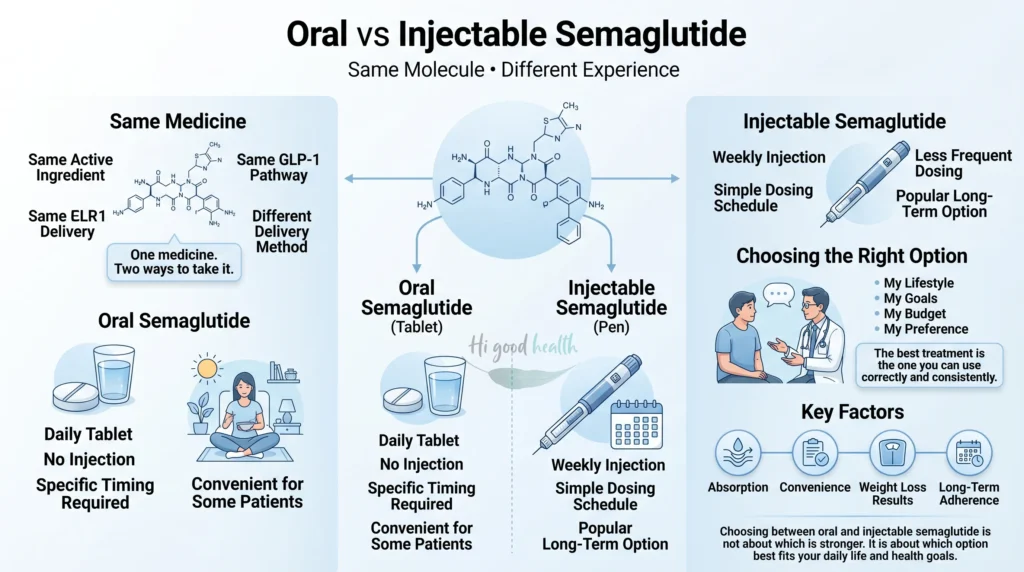
Oral semaglutide (the tablet, sold as Rybelsus and started at the Rybelsus 3 mg dose) and injectable semaglutide (the weekly shot, sold as Ozempic and Wegovy) use the same molecule. In studies, the weekly injection usually gives slightly more weight loss and a more predictable effect, while the tablet is needle-free but must be taken on an empty stomach with a strict morning routine [3][4]. There is no single winner. The better choice is the one you can take correctly every time, chosen with a qualified doctor. Neither oral nor injectable semaglutide should be started on your own.
What semaglutide actually is
Semaglutide is a GLP-1 receptor agonist, meaning it mimics a natural gut hormone that helps improve blood sugar control, reduces appetite, slows stomach emptying, and supports weight loss [5][6]. It was first developed for people living with type 2 diabetes, and Rybelsus for type 2 diabetes is the daily tablet version of that same molecule.
Oral semaglutide is taken as a tablet, while injectable semaglutide is given as a weekly shot under the skin [1][2].
The oral form is not simply a lighter version. It is a harder delivery problem, because the tablet must survive the stomach environment and be absorbed properly, which is why it must be taken on an empty stomach with a small amount of water and followed by a fasting window [1][2][5].
Oral vs injectable semaglutide: the practical difference
Here is the practical difference most people care about: injectable semaglutide usually produces slightly greater weight loss, while oral semaglutide can be easier for people who dislike injections and want a tablet-based routine [3][4].
In a JAMA report on oral semaglutide, weight loss with the oral form was described as comparable in trial settings, but real-world studies still often favor the injectable form for weight reduction [3][4].
Feature | Oral semaglutide | Injectable semaglutide |
|---|---|---|
Form | Daily tablet, example Rybelsus [1] | Weekly injection, examples Ozempic and Wegovy [3] |
Absorption | Approximately 1% Sensitive to food and timing [5] | High and more predictable bioavailability (89%) after subcutaneous injection [4] |
Convenience | No needle, but strict routine [2] No refrigeration required as it can be stored at room temperature | Fewer doses, but injection required [3] Refrigeration required, but after opening many formulations can stay at room temperature for a limited period. |
Weight-loss effect | Good, sometimes slightly less (5-10% of body weight) [3] | Often slightly stronger (10-15% of body weight) [4] |
Best for | Needle-averse, disciplined routine | People wanting a more consistent routine |
Rybelsus dosing: why it starts at 3 mg
Rybelsus comes in three tablet strengths: Rybelsus 3 mg, 7 mg, and Rybelsus 14 mg tablets. Treatment always begins with the Rybelsus 3 mg dose once daily for the first 30 days [1][6].
The Rybelsus 3 mg tablet (oral semaglutide 3 mg) is a starting dose, not a target dose. This semaglutide 3mg tablet mainly helps the stomach and gut get used to the medicine, so it is not expected to control blood sugar on its own [1]. After 30 days on Rybelsus 3 mg, the dose is usually raised to 7 mg, and if more effect is needed after at least another 30 days, to the Rybelsus 14 mg tablets, which is the maximum daily oral dose [1][6].
Every dose change should be guided by a doctor. Moving up too fast can worsen nausea, and staying only on the low starting dose long-term may not give the blood-sugar benefit you need for type 2 diabetes [7].
Why the tablet is tricky
Rybelsus only works properly when taken exactly as directed. The official guidance says it should be taken on an empty stomach in the morning with a maximum of 120 ml of plain water, and you should wait at least 30 minutes before eating, drinking, or taking other oral medicines [1][2]. This applies from the very first tablet through to the higher strengths.
Studies on oral semaglutide show that food and shorter fasting windows reduce drug exposure, which means the medicine may not work as intended if the routine is not followed carefully [5].
That matters in India because mornings are often rushed. Tea, coffee, poha, idli, milk, and other daily medicines (iron tablets, thyroid medicine, blood pressure pills, and sugar medicine) can all interfere with the timing if the routine is not planned well [2].
Who may prefer injections
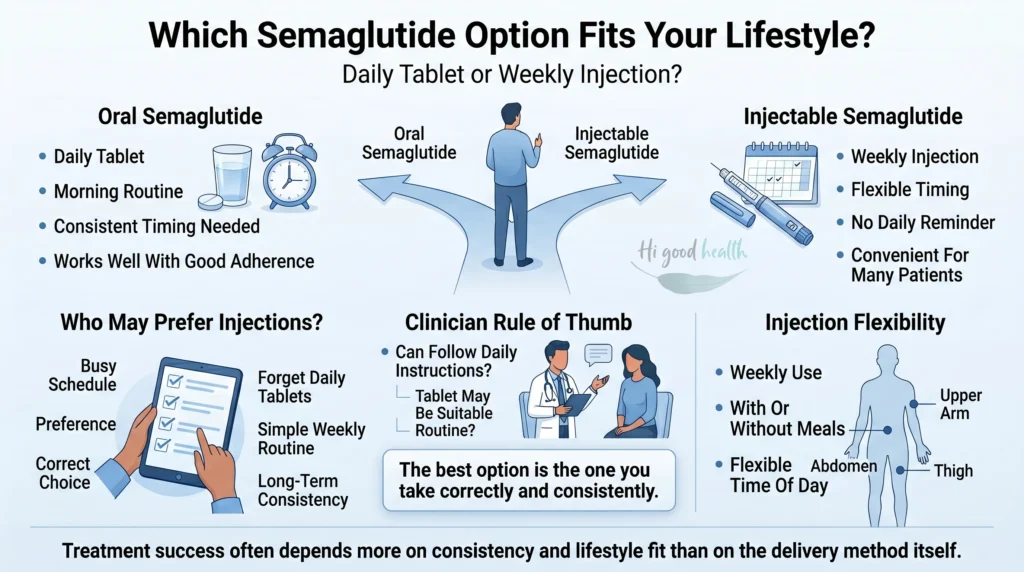
In practice, injections often suit people who want a simpler weekly routine, have trouble remembering daily tablets, or want the more established weight-loss effect of injectable semaglutide [3].
A useful rule of thumb from clinicians is this: if a patient can reliably follow the tablet instructions every single morning, oral semaglutide can work well; if not, the weekly injection under the skin (subcutaneously) in the abdomen, thigh, or upper arm may be the more dependable option. It can be taken with or without meals and, importantly, you can take it at your own convenience, at any time of day [4]. These same injection sites apply to other GLP-1 injections too, so patients researching Mounjaro injection sites will find the abdomen, thigh, and upper arm used in much the same way.
Who may prefer the tablet
Oral semaglutide is attractive for people who feel anxious about injections or have a strong preference for tablets [2][11]. For many of these readers, starting on the low Rybelsus 3 mg dose feels like a gentle way to begin.
It may also be more acceptable for someone starting GLP-1 therapy who wants to test tolerance before moving to an injectable plan, though that decision should always be made by a qualified doctor [3].
But there is a trade-off. The tablet is less forgiving. If you take it with breakfast, tea, or other medicines too soon, absorption falls and the medicine may underperform [1][2].
What the studies show
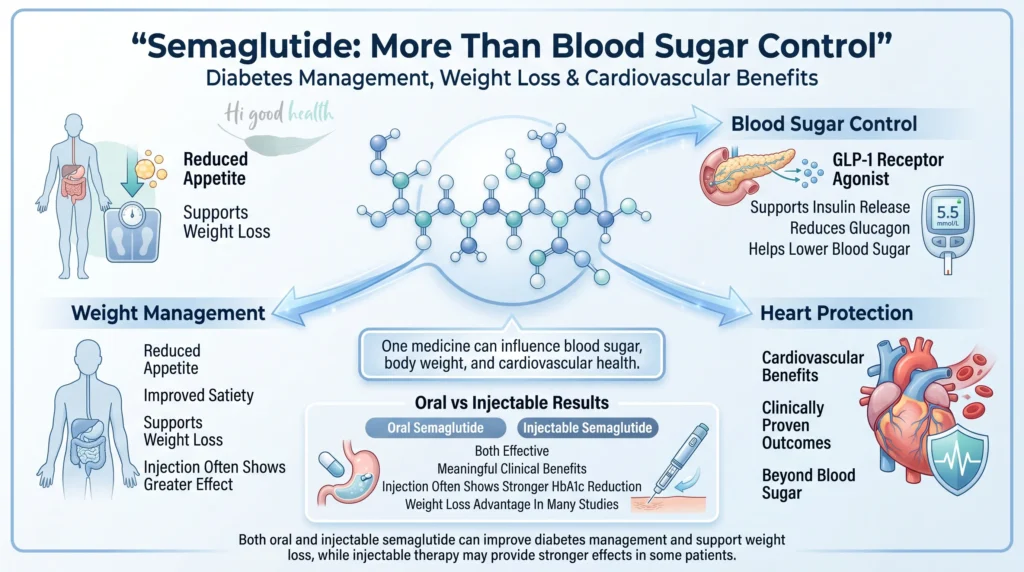
Semaglutide was originally developed and approved as a type 2 diabetes treatment, functioning as a GLP-1 (glucagon-like peptide-1) receptor agonist that stimulates insulin secretion, suppresses glucagon, and lowers blood sugar levels when used alongside diet and exercise. Beyond glycemic control, large-scale clinical trials have confirmed its significant cardiovascular protective benefits [6].
Clinical and real-world studies generally show that both forms help with blood sugar and weight, but the injection often has an edge for weight loss [3][4].
A comparative analysis found subcutaneous semaglutide achieved better HbA1c reduction than oral semaglutide, while both still provided meaningful clinical benefits [4].
The Phase 3 TRIUMPH clinical trial program has evaluated retatrutide, Eli Lilly’s once-weekly GLP-1/GIP/glucagon receptor triple agonist, across multiple obesity populations. In TRIUMPH-1, involving adults with obesity or overweight without type 2 diabetes,
Retatrutide achieved a mean weight loss of 28.3% (70.3 lb/31.9 kg) at 80 weeks, increasing to 30.3% at 104 weeks. TRIUMPH-2, which enrolled participants with obesity and type 2 diabetes, demonstrated 20.8% mean weight loss alongside HbA1c reductions of up to 1.6 percentage points.
In TRIUMPH-3, conducted in adults with severe obesity and established cardiovascular disease, participants achieved 22.6% mean weight loss, with a favorable cardiovascular safety profile and fewer major adverse cardiovascular events (MACE-5) than placebo.
TRIUMPH-4, involving individuals with obesity and knee osteoarthritis, reported 22.4% mean weight loss, accompanied by significant improvements in knee pain, physical function, and mobility.
Collectively, these findings suggest that retatrutide produces substantial and sustained weight loss while also improving important obesity-related comorbidities across diverse patient populations.
Rybelsus, Ozempic & Wegovy: same molecule, different missions
All three drugs — Rybelsus, Ozempic, and Wegovy — contain the same active ingredient semaglutide, a GLP-1 receptor agonist that helps control blood sugar, slows digestion, and reduces appetite. However, they differ in their FDA-approved indications, delivery methods, and dosage strengths [10].
Quick comparison
Feature | Rybelsus | Ozempic | Wegovy |
|---|---|---|---|
Form | Daily oral tablet | Weekly injection | Weekly injection |
Primary Use | Type 2 Diabetes | Type 2 Diabetes + CV risk reduction | Weight Management |
FDA approved Doses | 3 mg, 7 mg, 14 mg once daily | 0.25 mg–2 mg once weekly | 0.25 mg–2.4 mg (up to 7.2 mg for Wegovy HD newest; FDA approved March 2026) once weekly |
Weight Loss Approved | ❌ No | ❌ No (off-label use) | ✅ Yes |
Effect on weight loss | Moderate | Slightly More | Highly efficient |
Needle-Free | ✅ Yes | ❌ No | ❌ No |
Wegovy — the weight-loss specialist, an emerging star
Wegovy received FDA approval in 2021 specifically for chronic weight management, and it delivers greater weight loss results — clinical trials showed an average body weight reduction of ~15% over 68 weeks. It is also approved for adolescents aged 12 and older, making it unique among the three. Wegovy is titrated gradually (0.25 mg, 0.5 mg, 1 mg, then Wegovy 1.7 mg, up to 2.4 mg once weekly) to reduce early side effects [8].
Wegovy pill: first oral GLP-1 approved for weight loss
In a landmark development, the FDA approved the Wegovy pill (oral semaglutide 25 mg) on December 22, 2025, making it the world’s first oral GLP-1 receptor agonist approved specifically for weight management — a major shift from the injection-only landscape [8].
Key takeaway for Indian readers
While Ozempic is widely used off-label for weight loss in India, it is not officially approved for that purpose — Wegovy is. Rybelsus remains the only needle-free option, making it preferred for patients with needle anxiety or those managing diabetes with a simple daily tablet routine that starts at Rybelsus 3 mg [10].
The Indian lifestyle factor
This choice becomes more complicated in Indian homes because meals, work schedules, travel, fasting traditions, and tea-drinking habits are not always predictable. A daily tablet that must be taken before food can be difficult if the morning routine changes every day, while a weekly injection may fit better for people with irregular schedules [2][1].
The success of the oral tablet depends on timing; find out how traditional Indian breakfast habits like chai and poha can interfere with your medication’s absorption.
For many Indian readers, the right message is not hype, but habits: medicine works best when the routine around it is realistic [4].
Safety and side effects
Both forms can cause nausea, vomiting, diarrhea, constipation, bloating, and reduced appetite, especially early in treatment or after dose increases such as moving up from Rybelsus 3 mg [1].
The official label also warns about thyroid C-cell tumor risk, pancreatitis, acute kidney injury, hypoglycemia when combined with insulin or sulfonylureas, hypersensitivity reactions, and gallbladder disease [1].
The usual practical advice is simple: eat smaller meals, chew slowly, drink enough fluids, and increase fiber gradually if constipation appears. If side effects are severe, the dose may need to be slowed or changed under medical supervision [7].
Cost and access in India
Price often decides which option an Indian family can actually sustain month after month, so it deserves a close look alongside the medical differences [3].
Semaglutide price in India 2026: branded vs generic
India’s semaglutide market underwent a major price revolution in March–April 2026 following patent expiry, with Indian generics arriving at 70% discount to Novo Nordisk’s branded products [9].
Choosing between a daily pill and a weekly shot often comes down to the monthly budget; compare the real-world costs of Rybelsus vs. new Indian generics.
Branded Prices (Post April 2026 Price Cut)
Drug | Dose | New Price (per injection) | Monthly Cost |
|---|---|---|---|
Ozempic | 0.25 mg/week | ₹1,415 | ~₹5,660 |
Ozempic | 1 mg/week | ₹2,275 | ~₹9,100 |
Wegovy | 0.25 mg/week | ₹1,415 | ~₹5,660 |
Wegovy | 0.5 mg/week | ₹2,025 | ~₹8,100 |
Wegovy | 1 mg/week | ₹2,275 | ~₹9,100 |
Generic Semaglutide Prices in India (April 2026 Onwards)
Brand | Type | Starting Price |
|---|---|---|
Natco Pharma | Vial (injection) | ₹1,290/month |
Natco Pharma | Pen device | ~₹4,500/month |
Dr. Reddy’s / Zydus / Sun Pharma | Pen injection | ₹3,000–₹5,000/month |
The entry of generics from major Indian pharma companies like Dr. Reddy’s, Zydus Lifesciences, and Sun Pharma has dramatically improved accessibility [9].
Because this market is changing quickly, and because approval and availability can differ by product, readers should rely on current prescriptions and pharmacy verification rather than social-media pricing claims. For Indian patients, affordability, continuity, and authenticity matter as much as efficacy [4].
How to decide
A simple way to think about it is this:
- Choose oral semaglutide if you strongly prefer tablets and can follow a strict morning routine every day, starting at the Rybelsus 3 mg dose [2][1].
- Choose injectable semaglutide if you want a weekly routine and are looking for a more predictable and often stronger effect on weight [3].
- Do not choose either one without a doctor if you have complex diabetes, gallbladder disease, a history of pancreatitis, or take multiple medicines [1].
- Do not choose based on influencers, gym advice, or pharmacy chatter [4].
In real life, the best option is the one that matches both the biology and the behavior of the patient.
Key takeaways
- Oral semaglutide (Rybelsus tablet) and injectable semaglutide (Ozempic, Wegovy) share the same molecule but differ in absorption, convenience, and weight-loss strength.
- Rybelsus for type 2 diabetes always starts at the Rybelsus 3 mg dose for 30 days, then steps up to 7 mg and, if needed, to Rybelsus 14 mg tablets, always under a doctor.
- The tablet must be taken on an empty stomach with a 30-minute wait; injectable semaglutide is more forgiving on timing.
- Injectable semaglutide usually gives slightly more weight loss and better HbA1c control in studies; oral is the needle-free choice.
- In India, generics since April 2026 have cut prices sharply, but availability and approval should be verified with your doctor and pharmacy, not social media.
A note for readers of HiGoodHealth
HiGoodHealth exists to share clean, credible health information in simple language, bust myths, and make global research easier to understand for Indian families. A good health blog should not just inform; it should help people make better choices in daily life [3].
If you prefer a more visual version, check out our YouTube video here:
What is Rybelsus 3 mg used for?
It is the starting dose of oral semaglutide, a tablet used mainly for type 2 diabetes. The 3 mg strength is a starter dose that helps your body get used to the medicine, and it is usually raised to 7 mg and then 14 mg for a fuller effect. Always follow the dosing plan your doctor sets.
Is oral semaglutide as effective as injectable semaglutide for weight loss?
In many studies the weekly injection gives slightly more weight loss than the tablet, though both can help. Real-world data often favors injectable semaglutide for weight reduction, while the tablet stays a strong needle-free option for people who dislike injections.
How should Rybelsus be taken for the best absorption?
Take it first thing in the morning on an empty stomach with no more than 120 ml of plain water, then wait at least 30 minutes before eating, drinking, or taking other tablets. Food or drinks taken too soon lower how much medicine is absorbed.
Can I switch from Rybelsus tablets to injectable semaglutide?
Many people do move between oral and injectable semaglutide, but the switch, timing, and dose must be decided by a doctor. Do not change on your own, because the strengths are not simply interchangeable.
Is Rybelsus approved for weight loss in India?
Rybelsus is approved as a type 2 diabetes tablet, not as a dedicated weight-loss drug. Some doctors may use GLP-1 medicines off-label, but approval and availability can change over time, so confirm the current status with your doctor and pharmacy.
What are the common side effects of oral and injectable semaglutide?
Both forms can cause nausea, vomiting, diarrhea, constipation, bloating, and reduced appetite, especially early on or after a dose increase. Eating smaller meals and raising fluids and fiber slowly can help. Tell your doctor if symptoms are severe.
What is the difference between Rybelsus 3 mg, 7 mg, and 14 mg?
The 3 mg tablet is only a 30-day starter dose to reduce stomach upset. The 7 mg and 14 mg strengths are the working doses that actually help control blood sugar, with 14 mg being the maximum daily oral dose.
Which is better for type 2 diabetes, oral or injectable semaglutide?
Both lower blood sugar well. Studies suggest injectable semaglutide can give slightly better HbA1c control, but the best choice depends on whether you can follow the strict tablet routine or prefer a weekly injection. Your doctor will help you decide.
References
All reference links valid and accessible on July 2026
- U.S. FDA. RYBELSUS (semaglutide) tablets — Prescribing Information. accessdata.fda.gov
- Novo Nordisk. How to Start and Take RYBELSUS — patient guidance. rybelsus.com
- Real-World Comparison of Oral vs Injectable Semaglutide. PMC11559783
- Comparative Effectiveness and Safety of Oral Versus Subcutaneous Semaglutide. PMC12085783
- Oral Semaglutide — NIH/PMC review. PMC6969659
- Novo Nordisk. RYBELSUS Dosing & Prescribing (NovoMedLink). novomedlink.com
- Novo Nordisk. What to Expect with RYBELSUS — Dosing & Side Effects. rybelsus.com
- Everyday Health. First GLP-1 Pill for Weight Loss Gets FDA Approval. everydayhealth.com
- Nirvana Clinics. Ozempic Price in India 2026: April Cut, Generics & Who Should Take It. nirvanaclinics.com
- Fay Nutrition. Oral vs. Injectable Semaglutide: Rybelsus, Ozempic & Wegovy Compared. faynutrition.com
- Everyday Health. Rybelsus Is Ozempic in a Pill — Is It Just as Good? everydayhealth.com
- Lilly’s triple agonist, retatrutide, delivered powerful weight loss in pivotal Phase 3 obesity trial (2026, May 21) https://investor.lilly.com/news-releases/news-release-details/lillys-triple-agonist-retatrutide-delivered-powerful-weight-loss
- Eli Lilly and Company. (2026, July 23). Lilly’s triple agonist, retatrutide, successful in two additional Phase 3 obesity trials, delivering significant improvements in weight and A1C. https://www.prnewswire.com/news-releases/lillys-triple-agonist-retatrutide-successful-in-two-additional-phase-3-obesity-trials-delivering-significant-improvements-in-weight-and-alc-302832674.html
- Lilly’s triple agonist, retatrutide, delivered powerful weight loss in pivotal Phase 3 obesity trial (2026, May 21) https://investor.lilly.com/news-releases/news-release-details/lillys-triple-agonist-retatrutide-delivered-powerful-weight-loss
- Eli Lilly and Company. (2026, July 23). Lilly’s triple agonist, retatrutide, successful in two additional Phase 3 obesity trials, delivering significant improvements in weight and A1C. https://www.prnewswire.com/news-releases/lillys-triple-agonist-retatrutide-successful-in-two-additional-phase-3-obesity-trials-delivering-significant-improvements-in-weight-and-alc-302832674.html
Glossary
- GLP-1: Glucagon-like peptide-1, a gut hormone that helps control appetite and blood sugar.
- Semaglutide: A GLP-1 receptor agonist used for diabetes and weight management.
- Oral semaglutide: Tablet form of semaglutide (Rybelsus), taken daily on an empty stomach.
- Injectable semaglutide: Weekly injection form of semaglutide (Ozempic, Wegovy).
- HbA1c: A blood test showing average blood sugar over about 2 to 3 months.
- Bioavailability: How much of a medicine actually enters the bloodstream and works.
Disclaimer
This article is for education only and is not a substitute for medical advice, diagnosis, or treatment. Always consult a qualified doctor before starting, stopping, or changing any medicine, especially if you have diabetes, obesity, thyroid disease, or other long-term conditions [1][2].