At a Glance: Are Honey and Figs Vegan?
- Honey is not vegan, and that is settled rather than debated. It is made by an animal, for that animal, and taken from it. Vegan societies exclude it; the disagreement is about how much it matters, not about the definition.
- Most figs you buy have never contained a wasp. Common varieties — Black Mission, Brown Turkey, Kadota — set fruit without pollination at all, a process called parthenocarpy.
- Smyrna-type figs, including Calimyrna, do need a wasp. If avoiding them matters to you, this is the name to look for.
- Where a wasp is involved, you are not eating an insect. The fig’s own enzyme, ficin, breaks the wasp down into protein the fruit absorbs long before it is picked. There is no recognisable wasp in a ripe fig.
- The honest answer on figs is that it is a personal line, not a scientific one. No animal is farmed, killed for the product, or added to it — but an insect does die as part of the plant’s reproduction.
- In India this lands differently. Many Jain and strictly vegetarian households already avoid honey, on a reasoning that predates veganism by a very long way.
With the increasing awareness for healthy and active lifestyle the demand for the various therapeutic diets is emerged and adapted, Amongst which “Veganism” OR “Plant based lifestyle” is widely adapted with a view of creating harmony with nature. , many people are re-evaluating what it truly means to follow a vegan diet.
While avoiding meat, dairy, and eggs may seem straightforward, certain foods, like honey and figs often spark debate on whether they are. Are they genuinely vegan, or do they fall into a grey area?
In this blog, we’ll explore the facts, ethical debates, and scientific perspectives surrounding honey and figs so you can make an informed choice.
Curious about starting a vegetarian lifestyle? Check out our in-depth blog: Nutrition & Diet: A Beginner’s Guide to Vegetarianism.
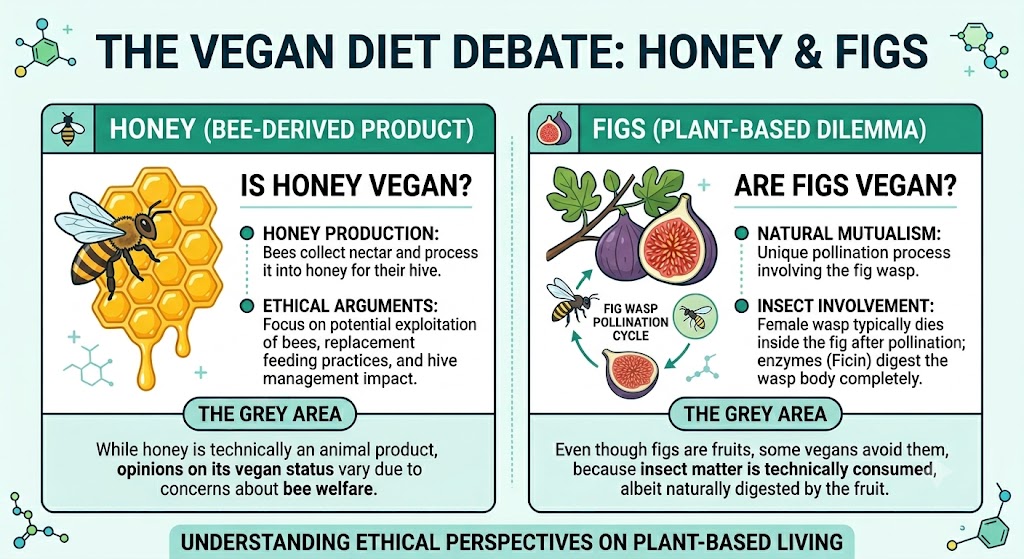
Honey and Veganism : Where Biology meets ethics
As we all know honey is a byproduct of flower nectar and digestive enzymes of bees .
Honey isn’t seen as vegan because it comes from bees, and using it can lead to increase apiculture production which eventually leads to disturbing their ecosystem hurt them.
Why honey isn’t considered vegan?:
- Bees make honey to feed themselves, not us.
- It is pure byproduct of animal enzyme degradation
- Taking honey can stress or harm the bees.
- Some beekeepers kill bees when collecting honey.
- It’s about using animals and their work for profit.
- Many vegans avoid anything that involves exploiting animals.
How Is Honey Produced and Why It Matters to Vegans
Honey is made by bees gathering nectar from flowers and turning it into a food source for their colony. After collecting nectar from the flower it swallows it into its honey stomach and thereafter the nectar sugar (Sucrose and moisture) is converted into Fructose via enzymatic degradation “Invertase”
However, studies show that commercial honey production often interferes with bees’ natural behaviours. Beekeepers remove honey stores and replace them with sugar substitutes, which lack the nutrients bees need. This weakens colonies and causes stress to the bees. “Research published in PMC (National Center for Biotechnology Information) demonstrates that honey samples provide superior nutritional content compared to artificial sugar substitutes, with bees fed on honey showing significantly better lifespans and learning-memory capabilities than those fed sugar syrup.
Due to this many vegans choose to avoid honey to stay consistent with their ethical values against animal exploitation.
The Ethical Debate: Bees and Veganism
At the heart of veganism is the principle of minimizing harm to animals. However, opinions differ when it comes to bees.
Some people argue that honey harvesting exploits bees and interferes with their natural behaviour, while others view ethical beekeeping as a mutually beneficial and environmentally sustainable practice.
A 2022 study in Nature Scientific Reports found that while global honey production has nearly tripled over recent decades, the introduction of large-scale commercial beekeeping can have pervasive negative impacts on wild pollinator biodiversity and plant-pollinator network connectivity.
This ongoing debate continues to shape how different individuals interpret veganism and the ethical treatment of insects.
https://pubmed.ncbi.nlm.nih.gov/40871527
The India Angle: Honey Was Already a Question Here
Most writing about whether honey is vegan treats it as a modern Western argument. In India it is not a new question at all.
Honey is traditionally avoided in Jain dietary practice, and has been for a very long time, on ahimsa grounds — the principle of causing the least possible harm to living things. Many strict vegetarian households outside the Jain tradition avoid it for related reasons, and others use it freely and consider it entirely acceptable. It is not a single Indian position.
What is worth noticing is how much older the reasoning is than the label. A vegan in 2026 declining honey and a Jain family declining it are arriving at the same place from different directions, centuries apart — which is a useful thing to know if you are the person in the family explaining a new diet to everyone else.
The practical Indian version of the question is usually narrower anyway: what goes in the tea, and what goes on the chyawanprash. Jaggery, gur, date syrup and sugarcane juice all do the sweetening job, and none of them raises the question at all.
Vegan Alternatives to Honey You Can Try
Not all honey is created equal, but from a strict vegan standpoint, most types are considered non-vegan because they involve bees and their labour. However, there are some variations in how honey is produced and sourced that might influence opinions. For those looking to avoid animal products altogether, here are some popular vegan honey alternatives made entirely from plants:
- Agave nectar: A sweet syrup from the agave plant with a mild flavour.
- Maple syrup: Made from the sap of maple trees, rich and flavourful.
- Date syrup: Thick, naturally sweet syrup made from dates.
- Rice syrup: A mild, less sweet syrup made from fermented rice.
- Coconut nectar: Extracted from coconut blossoms, with a subtle caramel taste.
What About Fig Wasps? Why Figs Are Controversial
Figs have a unique pollination relationship with tiny fig wasps, which enter the fruit to lay eggs and pollinate it. This natural process often leads to the wasps dying inside the fig, raising ethical concerns among vegans about whether consuming figs indirectly harms animals.
Do figs really contain wasps?
Some figs are pollinated by female “fig wasps” that crawl inside and lay their eggs in the fruit. While these wasps and fig trees need each other to reproduce, scientists believe that they did not always coexist, and that the wasps must have evolved at the same time as the fig trees. The wasp pollinates the fig, and the fig is the only place her offspring can develop. Neither can reproduce without the other.
The first thing to correct is the word fruit. A fig is not really one — it is a syconium, an inside-out cluster of hundreds of tiny flowers enclosed in a fleshy pouch. That is the whole reason a wasp has to go inside: the flowers have nowhere else to be pollinated.
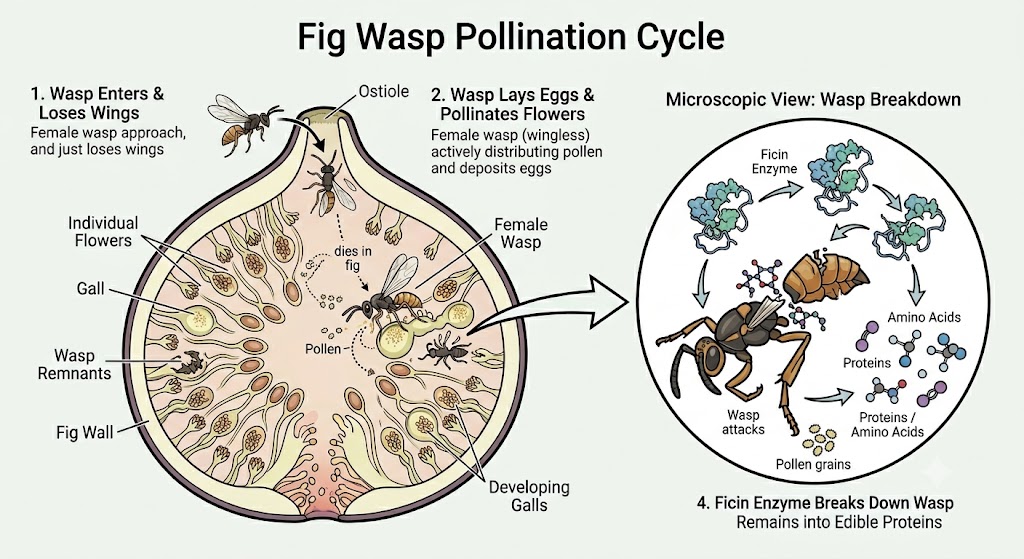
The female wasp is often stuck inside after entering the tree losing her wings in the process. It will then die in the fig after she loses her wings. Here is what actually happens, step by step — most versions of this story skip the part that matters.
- She goes in, and she cannot come out. The entrance — the ostiole — is so narrow that forcing through it tears off her wings and antennae. That is not an accident of the process; it is the process. She has days to live and one job.
- She does two things at once. She lays eggs in the short-styled flowers, and she scrapes pollen from her own body onto the long-styled ones. The first makes wasps. The second makes seeds.
- She dies inside. This is the fact the whole vegan question hangs on.
- Her sons hatch first — wingless, often blind. They mate with the females still in their galls, chew an escape tunnel through the fig wall, and then die inside too. They never leave.
- The daughters leave through that tunnel, collecting pollen on the way out, and fly off to find another fig — where the whole thing happens again.
So yes: in a wasp-pollinated fig, a wasp died in there, and so did her sons. That is why people assume supermarket figs contain wasps. Two things make that assumption wrong, and they are the next two sections.
Additionally, the wasp’s body is broken down by an enzyme called ficin, a proteolytic enzyme naturally present in figs. This process effectively digests the wasp’s remains long before the fruit is consumed.
Scientific research describes ficin as a cysteine protease with strong protein-breaking properties, meaning no recognisable wasp remnants remain in the edible fruit.
Are figs vegan?
The wasp-fig pollination is totally natural.The female will lay eggs in the fig, and then the eggs will crawl to the outside, hatch and grow (exit as a larvae). It actually dies giving birth instead of being consumed alive.
They are both evolved that way (both fig and wasp), so this truly is not something we’d compare to non-veganism or animal cruelty.The wasp also will be digested inside the fig, using an enzyme called ficin, and later help to break down the bodies of the wasps into protein. That has the added advantage of making certain that no human inadvertently ends up eating up the remains of the insect when eating the fruit.
Scientific studies have confirmed that ficin is a cysteine endoproteolytic protease with powerful proteolytic activity capable of breaking down proteins completely, ensuring no wasp remnants remain in the consumed fruit.
Want to ensure you’re getting all the essential nutrients on a vegetarian diet? Read our comprehensive guide: How to Get All Your Essential Nutrients on a Vegetarian Plan.
Figs That Don’t Need Wasp Pollination
Most common edible figs, like the Ficus carica species, don’t require fig wasps to pollinate them. These figs develop fruit without pollination, a process called parthenocarpy. Popular varieties that don’t rely on wasps include:
- Black Mission: Sweet, dark-skinned figs.
- Brown Turkey: Brownish-purple and tasty.
- Kadota: Green-skinned with sweet flesh.
- Adriatic: Pale green skin, deep pink flesh — another common parthenocarpic type.
These self-pollinating figs are great for growers, especially in places without fig wasps, because they produce fruit reliably without needing insects.
And here is the one to know if this matters to you: Calimyrna. Calimyrna is the Californian name for the Smyrna type, and Smyrna figs do require wasp pollination — the fruit will not set without it. Growers hang baskets of wild caprifigs full of wasps in the orchards to make it happen, and the practice has its own name: caprification. So Calimyrna and other Smyrna-type figs are the ones a strict reader would want to avoid. The common varieties listed above are the ones they would not.
Where can you purchase figs that are free of wasps?
Figs can be bought from plenty of places, such as supermarkets, grocery stores, farmers’ markets, natural food stores, online shopping, and specialty food stores. Fresh figs are generally in season and best enjoyed from late summer through early fall, but dried figs can be enjoyed all year round.
As for wasp pollination, the common figs that are sold in most stores are free from wasps because they are typically parthenocarpic varieties—meaning they develop fruit without pollination. These commercial varieties, such as Black Mission, Brown Turkey, and Kadota, don’t require fig wasps to produce fruit. Even in varieties that do involve wasp pollination, the wasp is completely broken down by enzymes inside the fig during the ripening process, leaving no trace. So whether you’re buying fresh or dried figs from your local store, you can enjoy them without any concern about wasps.
The Real Deal on Honey and Figs for Vegans
So, are honey and figs truly vegan? It comes down to how you view veganism and your own personal values. Honey is about bees and their work, and vegans tend to avoid consuming it because of how it affects the bees. Figs, meanwhile, have their own natural relationship with fig wasps, but most common figs don’t actually require wasps to grow, so they’re more vegan-friendly than you’d think.
At its core, veganism is less about strict rules and more about making compassionate and informed choices that aim to reduce harm to living beings — both big and small.
Key Takeaways
- Honey is not vegan. That part is not really disputed — it is an animal product taken from the animal that made it.
- Most figs sold have never involved a wasp. Black Mission, Brown Turkey, Kadota and Adriatic all set fruit without pollination.
- Calimyrna and other Smyrna types do need one. That is the name to look for if this matters to you.
- There is no wasp in a ripe fig. Ficin, the fig’s own protease, breaks the body down into protein the fruit absorbs. You are not eating an insect.
- A fig is not a fruit — it is a syconium, hundreds of flowers turned inward. That single fact explains the whole strange arrangement.
- Figs are a personal line, not a scientific one. No animal is farmed for them, none is added to them, and an insect dies as part of a plant reproducing. Where that sits is a judgement, and most vegan organisations leave it to the individual.
- In India, the honey question is older than veganism — and jaggery, gur and date syrup sidestep it entirely.
Frequently Asked Questions
Why is honey generally not considered vegan?
Honey is typically excluded from a vegan diet because it involves the exploitation of bees and their labour. Producing honey for human consumption can cause stress to the bees, and commercial beekeepers often replace the honey stores with sugar substitutes that lack the nutrients bees need to survive.
Do figs really contain dead wasps?
In wasp-pollinated figs, a female wasp does die inside the fruit, but you will not find a whole insect when you eat it. The fig produces an enzyme called ficin that completely digests the wasp, breaking it down into protein. This ensures you aren’t inadvertently eating the remains of an insect.
Which types of figs are definitely vegan?
If you want to avoid the risk of wasp pollination entirely, look for common varieties that are parthenocarpic, meaning they develop fruit without insects. Varieties like Black Mission, Brown Turkey, and Kadota do not need wasps to grow, making them a safe choice for strict vegans.
What can I use instead of honey on a vegan diet?
There are many excellent plant-based alternatives. Agave nectar is a popular choice for its mild flavour, while maple syrup offers a richer taste. Other great options include date syrup, rice syrup, and coconut nectar, which has a subtle caramel flavour.
Is eating figs considered animal cruelty?
Most vegans do not view eating figs as animal cruelty. The relationship between figs and wasps is a natural evolutionary process where the two species rely on each other to reproduce, rather than human-enforced exploitation. Additionally, most common supermarket figs are grown without any wasp involvement.
Is honey vegan?
No. Honey is made by bees, for bees, and taking it means taking an animal product from the animal that produced it. Vegan societies exclude it and this is not really a contested point within veganism. What people do disagree about is how much it matters compared with other animal products, and whether small-scale or backyard beekeeping sits differently from commercial production. Those are worth arguing about; the definition is not.
Are figs vegan?
Most are, straightforwardly, because most figs sold are parthenocarpic varieties that never involve a wasp. For Smyrna-type figs such as Calimyrna, which do require wasp pollination, it becomes a judgement rather than a fact. No animal is farmed for the fig, none is added to it, and the wasp dies as part of a plant reproducing rather than as part of a food process. Most vegan organisations treat figs as acceptable and leave the decision to the individual.
How does fig pollination work?
A fig is not a fruit but a syconium, an inside-out pouch containing hundreds of tiny flowers, which is why pollination has to happen from the inside. A female wasp forces her way in through a narrow opening called the ostiole, tearing off her wings and antennae in the process so she can never leave. Inside she lays eggs in some flowers and deposits pollen on others, then dies. Her wingless sons hatch, mate with their sisters, chew an exit tunnel and die inside as well. The daughters leave through that tunnel carrying pollen to the next fig.
Can you buy figs without wasps?
Yes, and it is easier than most people think. Look for common parthenocarpic varieties — Black Mission, Brown Turkey, Kadota and Adriatic — which set fruit with no pollination at all. Avoid Calimyrna and other Smyrna types if you want to be certain. Most fresh figs in Indian supermarkets are common varieties, and dried figs sold in India are commonly Smyrna-type, so the dried ones are where the question actually arises.
Is raw, organic or manuka honey vegan?
No. The processing method, the certification and the price do not change what honey is or where it came from. Raw honey is unfiltered, organic honey means the foraging area meets certain standards, and manuka honey comes from a particular flower — none of that makes it plant-based.
What is ficin and does it really dissolve the wasp?
Ficin is a proteolytic enzyme — a cysteine protease — that occurs naturally in figs. It breaks down protein, including the wasp’s body and exoskeleton, and the fig absorbs the result as it ripens. So in a ripe wasp-pollinated fig there is no recognisable insect left. The crunch in a fig is its seeds, not anything else.
Do Jains eat honey?
Honey is traditionally avoided in Jain dietary practice on ahimsa grounds — the principle of causing the least possible harm to living things — and that tradition long predates modern veganism. Many strictly vegetarian households outside the Jain tradition avoid it for related reasons, while others use it freely. It is not a single Indian position, and the practical substitutes are the ones already in most kitchens: jaggery, gur, date syrup and sugarcane juice.
REFERENCES
- Hu Y, Lu F, et al. Effect of artificial sugar supplement on the lifespan and learning memory ability of honey bee (Apis cerana) worker bee offspring. Journal of Economic Entomology. 2024;117(5):1723–1728.
- Valido A, Rodríguez-Rodríguez MC, Jordano P. Honeybees disrupt the structure and functionality of plant-pollinator networks. Scientific Reports. 2019;9:4711.
- Phiri BJ, Fèvre D, Hidano A. Uptrend in global managed honey bee colonies and production based on a six-decade viewpoint, 1961–2017. Scientific Reports. 2022;12:21298.
- Angelella GM, McCullough CT, O’Rourke ME. Honey bee hives decrease wild bee abundance, species richness, and fruit count on farms regardless of wildflower strips. Scientific Reports. 2021;11:3202.
- Yang Y, Shen D, Long Y, et al. Intrinsic Peroxidase-like Activity of Ficin. Scientific Reports. 2017;7:43141.
- Piot N, Schweiger O, Meeus I, et al. Honey bees and climate explain viral prevalence in wild bee communities on a continental scale. Scientific Reports. 2022.
- Fauviau A, Baude M, Bazin N, et al. A large-scale dataset reveals taxonomic and functional specificities of wild bee communities in urban habitats of Western Europe. Scientific Reports. 2022;12:18866.
Disclaimer
The content provided on higoodhealth.com is for general informational purposes only. While we strive to offer accurate and up-to-date content, much of the information is derived from publicly available sources and personal research. We do not make any warranties about the completeness, reliability, or accuracy of this information.
