Are you wondering if your daily morning walk is truly enough for your overall well-being? The benefits of walking are real and well documented — a stronger heart, a brighter mood, and easier weight management — yet many people still ask whether walking alone can carry their whole fitness routine.
At a glance
The benefits of walking are genuine: a brisk daily walk strengthens your heart, lifts your mood, and supports walking for weight loss. But walking mainly works your legs and cardiovascular system, so it is not a complete workout on its own. For balanced, holistic fitness, and to get the full benefits of walking, pair your daily walk with strength training, flexibility work, and mindful movement like yoga.
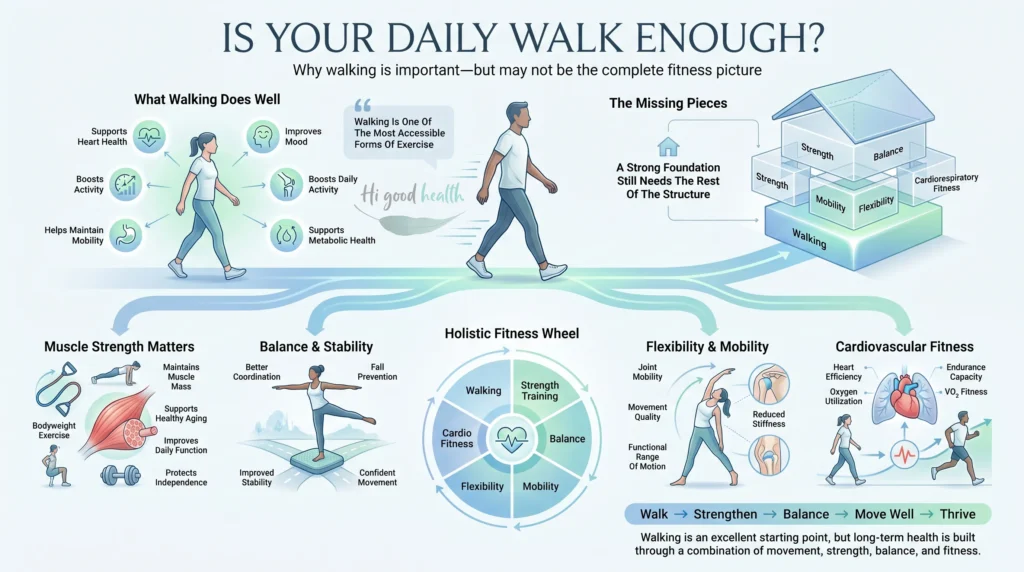
This guide looks at the science behind the benefits of walking, shows where a daily walk falls short, and helps you build a holistic exercise routine that supports your entire body. If you have ever asked “is walking enough exercise?”, the honest answer is a little nuanced, and it starts with understanding what a daily walk does well and where the benefits of walking stop.
The Ancient Footsteps to Modern Health: Are the Benefits of Walking Enough on Their Own?
For centuries, walking has been instinctively linked to good health. From the daily routines of hunter-gatherers to the leisurely morning walks of earlier generations, consistent movement has always been fundamental to human life.
This inherent connection often leads us to believe that walking alone is the cornerstone of a healthy life. And while the benefits of walking are many — from better cardiovascular health to a lift in mood — the real question remains: is it truly sufficient for optimum well-being in our modern, often sedentary, lives?
The answer, as we will explore, is nuanced, particularly when you are aiming for holistic physical fitness rather than leg fitness alone.
The Real Benefits of Walking Every Day
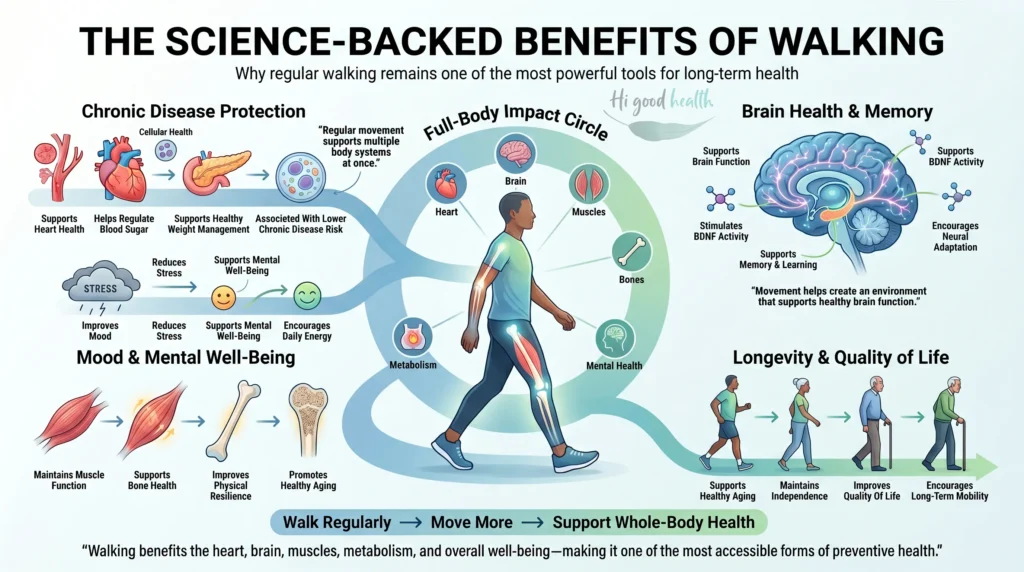
Before we talk about walking’s limits, it helps to be clear about how much a simple daily walk gives you. The daily walking benefits below are some of the most reliable, low-cost wins in all of health.
This is why doctors and Indian public-health bodies keep coming back to walking exercise benefits when they recommend a first step towards fitness. The benefits of walking really are that broad.
- A healthier heart: Brisk walking counts as moderate-intensity aerobic activity and helps lower the risk of heart disease and high blood pressure [1].
- Support for weight loss: Walking for weight loss works because a daily walk burns calories, steadies blood sugar, and is easy to keep up over months and years.
- A better mood: One of the most immediate morning walk benefits is a calmer, brighter mood, thanks to the release of feel-good brain chemicals.
- Steadier blood sugar and metabolism: Regular walking helps the body use insulin better, one of the clearest advantages of walking daily.
- Stronger bones and joints: As a weight-bearing activity, walking gently loads your bones and helps keep them dense as you age.
These are serious health wins from a habit almost anyone can start today. So if the benefits of walking are this good, why do we say walking is not the whole story? The rest of this guide answers exactly that.
The Scientific Stroll: What Research Says About the Benefits of Walking
Numerous scientific studies clearly establish the link between regular walking and improved health. Research consistently shows that consistent walking can significantly reduce the risk of chronic diseases such as heart disease, type 2 diabetes, and certain cancers [3].
It aids in weight management, strengthens bones and muscles, and even boosts thinking and mood. These are core benefits of walking that show up again and again in the research.
Walking does more than just burn off a meal; it actually triggers a brain chemical called BDNF. This protein helps repair damaged brain cells and even builds new ones in the hippocampus — the specific part of your brain that handles memory and learning [4].
Organisations like the Indian Heart Association and the Ministry of Health and Family Welfare (MoHFW) actively promote walking as a readily accessible and effective form of physical activity, citing its positive impact on longevity and quality of life [1][2]. These recommendations are a big part of why the benefits of walking are so widely trusted in India.
Beyond the Pavement: Explaining the “Healthy Non-Walkers”
We all know someone who rarely seems to walk but appears to be in excellent health. How do these exceptions fit in? The truth is that, while the benefits of walking are real, the benefits of walking make up just one piece of the wellness puzzle. These individuals often get their movement in other ways, such as:
- Resistance or strength training
- Sports or high-intensity exercise
- Physically demanding work or daily chores
Their overall lifestyle — including diet, stress management, and genetics — also plays a big role, which shows the benefits of walking add to a wider picture rather than replacing it. The key isn’t necessarily walking itself, but consistent, varied movement that challenges the body in different ways, forming a truly balanced exercise routine.
Pacing Yourself: How Much Brisk Walking Do You Need?
So, what is the sweet spot for walking? Current guidelines suggest aiming for at least 150 minutes of moderate-intensity aerobic activity, or 75 minutes [1] of vigorous-intensity activity, per week.
For walking, this often works out to about 30 minutes of brisk walking most days of the week. “Brisk” means you can talk but not sing.
You may have heard the popular goal of 10000 steps a day; it is a useful target, but it isn’t a magic number — even 6,000 to 8,000 steps a day carries clear daily walking benefits.
While any time of day helps, some studies suggest morning walk benefits include a small metabolism and mood boost, while evening walks might aid sleep. In the end, consistency matters more than perfect timing, and the right pace depends on your own fitness level and health goals, but the benefits of walking build up with steady practice.
How Far Is 10,000 Steps? Steps, Distance and Calories
One of the most common questions Indian walkers ask is simple: how many kilometres is 10,000 steps? There is no single answer, because it depends on your height and stride length, but a useful rule of thumb is that most adults take roughly 1,300 to 1,500 steps per kilometre.
That puts 10,000 steps at about 7 to 8 km for an average-height adult — a distance most people cover in 90 to 100 minutes of steady walking.
| Steps | Approximate distance |
|---|---|
| 2,000 steps | ~1.5 km |
| 5,000 steps | ~3.8 km |
| 8,000 steps | ~6 km |
| 10,000 steps | ~7.6 km |
| 12,000 steps | ~9 km |
Calories burned while walking depend on your body weight and pace, but a good estimate is around 50 to 60 kcal per kilometre for a 70 kg adult. Walking briskly, on an incline, or carrying weight raises the number.
| Walk | Approx. calories (70 kg adult) |
|---|---|
| 1 km | ~55 kcal |
| 3 km | ~165 kcal |
| 5 km | ~275 kcal |
| 30-minute brisk walk | ~150 kcal |
Timing Your Walk: Morning Walks and Walking After Meals
In India the morning walk is a wellness institution, and for good reason. A morning walk, even on an empty stomach, can help set your circadian rhythm, lift your mood before a busy day, and make the habit easier to keep.
If you have a health condition, check with your doctor before fasted exercise, but for most people a gentle morning walk is a safe, sustainable way to capture the benefits of walking.
Walking after meals — the traditional post-dinner stroll many Indian families already practise — is quietly one of the most effective habits you can adopt. A 10 to 15 minute walk after eating helps blunt the post-meal blood-sugar spike and supports digestion. You do not need a long or brisk session; an easy amble soon after your meal is enough to make a measurable difference.
Walking for Weight Loss: Making Every Step Count
Can you lose weight by walking? Yes — but the results come from consistency and a modest calorie deficit rather than any single walk.
Pairing a daily brisk walk with sensible eating is what drives fat loss over weeks and months. To make walking work harder for weight loss, add pace (a brisk walk where you can talk but not sing), gentle inclines, or a short after-dinner walk on top of your main session. Steady effort beats occasional intense walks.
The Perils of Pounding the Pavement: When Too Much Walking Backfires
While walking is largely good for you, it’s worth remembering that an excess of anything — even a good thing — can have drawbacks. For some people, particularly those covering ultra-long distances or living with pre-existing conditions, too much walking can cause specific problems.
Overuse injuries like stress fractures, shin splints, and plantar fasciitis are common when there is high-volume, repetitive impact. In some cases, extreme tiredness can become a chronic issue, a sign that the body is not recovering well, which chips away at the benefits of walking rather than adding to them.
Listening to your body and allowing proper rest and recovery are just as important as the activity itself. Recovery is what protects the benefits of walking over the long run. This is where moderation and smart recovery protect you from walking overuse injuries.
Expensive creams cannot fix sagging skin because the real problem is a specific type of muscle loss that starts after you turn 35. To learn more about how muscle loss contributes to visible ageing, read: “Sagging Face or Breasts After 35? It Might Be Muscle Loss — Not Just Ageing.“
The Leg-Centric Dilemma: Why Walking Isn’t the Whole Picture
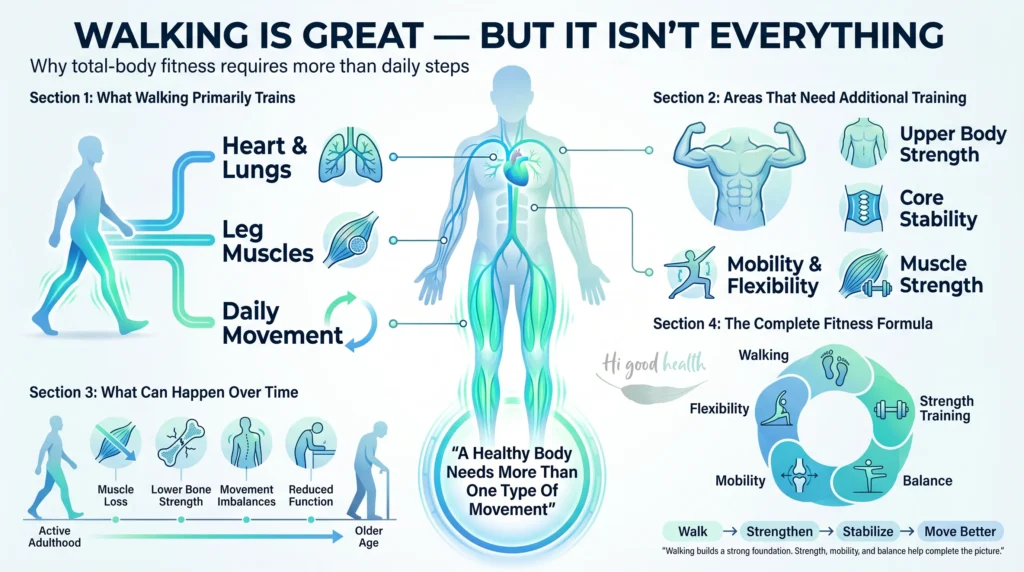
Walking mainly works the lower body and the cardiovascular system. On its own, though, it does little for:
- Upper body strength
- Core stability
- Muscle size and strength development
- Flexibility and joint mobility
Relying only on walking may, over time, lead to:
- Reduced muscle mass (especially with ageing)
- Decreased bone density
- Muscular imbalances
- Reduced functional strength for everyday tasks
A holistic approach recognises that every part of your body deserves attention for good health and injury prevention. That is the case for adding full-body exercise on top of the benefits of walking.
The Sedentary Toll: Ailments Beyond Leg Day
Skipping a well-rounded exercise routine can lead to a chain of health issues that go well beyond weaker arms, and they can quietly undo some of the benefits of walking.
Too little full-body physical activity may contribute to:
- Poor posture and back or neck discomfort
- A higher risk of muscle and joint pain, especially in the neck and lower back
- Reduced joint mobility and flexibility
- A greater chance of injury from muscle imbalances and weak stabilising muscles
Importantly, long periods of sitting — even in people who hit basic exercise targets such as a daily walk — are independently linked with a higher risk of:
- Overweight and obesity
- Metabolic problems (including insulin resistance and unhealthy cholesterol)
- Cardiovascular disease
- Certain cancers (for example, colon and breast cancer)
This is why the benefits of walking are best paired with breaking up long stretches of sitting throughout your day. To explore the importance of the soleus muscle in leg health and metabolism, read: “The Soleus: A Key Muscle for Circulation, Endurance, and Lower-Body Health.“
Ancient Wisdom, Modern Wellness: The Power of Yoga and Other Holistic Practices
Many ancient disciplines, such as Yoga, Pranayama, and Pilates, offer real health benefits without treating walking as their main form of exercise. These practices build flexibility, strength, balance, and mindful movement, often through breathing exercises and meditation.
They engage the whole body and mind at once. Centuries of practice and a growing body of research suggest that an intentional, holistic movement practice can be just as valuable as logging steps — a strong reminder that the benefits of walking are one path among several.
These are excellent examples of mind-body exercise and alternative fitness methods, and they complement the benefits of walking nicely.
Beyond the Stride: The Body’s Adaptability and Non-Walking Routines
If your main exercise doesn’t involve walking — say, a dedicated yoga practice — is that harmful for your legs or your body overall? Generally no, as long as your chosen activities are challenging and varied enough.
The human body is remarkably adaptable. Yoga, for instance, builds strength, flexibility, balance, and core stability, though it may not match the cardiovascular conditioning of sustained walking or running, nor the bone-loading of higher-impact movement. Even so, people who regularly do vigorous yoga, cycling, or swimming develop excellent fitness and strength.
A recent 2026 study found that people who do the widest variety of exercises (for example, walking plus gardening plus yoga) had a 19% lower risk of premature death than those doing only one type, even when the total activity level was the same [9].
As for being able to run or walk long distances when needed, it depends on the demands of your usual routine.
Someone who cycles will have great leg endurance for cycling, but might find a long run tough because of different muscle patterns and impact. A dedicated yogi will have wonderful body control and flexibility, but may need to ease into walking or running to build the specific endurance and impact tolerance those need.
The key is specificity of training. If you need to be able to do a particular activity, some practice in that activity always helps, even if your fitness base comes from elsewhere. Your body adapts to the demands you place on it — another reason to keep your routine varied rather than relying on the benefits of walking alone.
Mind, Body, Breath: Integrating Mental and Physical Harmony
The connection between mental and physical health is well established. Practices like Yoga and Pranayama build in breathing exercises and mindfulness, creating a strong link between body and mind.
This is not only about stress relief; controlled breathing can improve heart health, reduce inflammation, and sharpen focus.
Adding practices that balance mental and physical health — whether meditation, conscious breathing, or mindful movement — is central to true holistic well-being and resilience against modern stress. It is a reminder that mental wellness exercises belong right alongside the benefits of walking and other physical activity.
Your Blueprint for Holistic Health: A Full-Body Exercise Chart
Good health comes from a well-rounded approach that goes beyond the benefits of walking alone and covers every part of physical fitness: cardiovascular endurance, strength, flexibility, and balance.
Here is a general guide for holistic exercise, keeping in mind that individual needs vary. Always check with a healthcare professional before starting any new exercise programme, so you can enjoy the benefits of walking and other activity safely.
Holistic Exercise Chart (General Guidelines)
Age Group | Focus Areas & Recommended Activities | Notes |
Children (6–17) | Cardio: Play, running, swimming, cycling (60+ mins daily) | Emphasise fun and variety. |
Adults (18–64) | Cardio: Brisk walking, jogging, cycling, swimming, dancing (150 mins moderate or 75 mins vigorous/week) | Aim for a mix of activities. |
Seniors (65+) | Cardio: Walking, swimming, water aerobics (150 mins moderate/week) | Focus on mobility and preventing falls. |
Body Part Focus (Integrating into Your Routine)
- Legs: Walking, squats, lunges, cycling, stair climbing.
- Core (Abs & Back): Planks, crunches, bird-dog, Pilates, Yoga.
- Upper Body (Arms, Chest, Shoulders): Push-ups, pull-ups (assisted if needed), rows, overhead press, resistance band exercises.
- Full Body & Flexibility: Yoga, Pranayama, swimming, dynamic stretching, dancing.
- If you are a complete beginner, start with “exercise snacks” — bursts of activity lasting 1 to 5 minutes (like stair climbing or very brisk walking) spread through the day. These are now recognised as effective tools for staying fit without dedicated gym time.
Summary: Beyond Steps — Embracing a Holistic Health Journey
Walking is an accessible and effective tool for health, but it helps to see it as one part of a broader mix of physical activity. Overrating walking and skipping other forms of exercise can leave real gaps in your well-being.
The benefits of walking are a foundation, not the finished house. True holistic health comes from a balanced approach that combines cardiovascular exercise, strength training for all the major muscle groups, flexibility work, and practices that link mind and body. By keeping your movement varied and mindful, you can make the most of your body’s potential, prevent common aches, and build a more vibrant, resilient life. Enjoy the benefits of walking — and then build the rest of your routine around them, starting today.
Glossary
- Aerobic activity: Movement that raises your heart rate and breathing, such as brisk walking, cycling, or swimming. Adults are generally advised to get at least 150 minutes a week of moderate-intensity aerobic activity.
- Brisk walking: A faster walking pace where you can talk, but not sing. It counts as moderate-intensity aerobic exercise.
- BDNF: Brain-derived neurotrophic factor, a protein linked to brain health, memory, and learning.
- Core stability: The ability of the muscles around your trunk to support posture and movement.
- Muscle-strengthening activity: Exercise that works major muscle groups, such as resistance training, bodyweight workouts, or heavy gardening. Adults are advised to do this on at least 2 days a week.
- Moderate-intensity activity: Exercise that gets your body moving at a noticeable but sustainable effort, such as brisk walking.
- Overuse injury: Pain or damage caused by repeated stress without enough recovery, such as shin splints or plantar fasciitis.
- Pranayama: Breath-control practices used in yoga to support calm, focus, and controlled breathing.
- Variety of physical activity: Doing different kinds of exercise across the week, not just repeating one routine. Greater variety was linked with lower mortality in the 2026 BMJ Medicine study.
- Vigorous-intensity activity: Exercise done at a harder effort, such as running or fast cycling, where speaking becomes difficult. WHO and CDC guidance recognise 75 minutes a week as a common target.
Key Takeaways
- The benefits of walking are real: better heart health, steadier blood sugar, an easier path to weight loss, and a brighter mood.
- Aim for about 30 minutes of brisk walking on most days; even 6,000–8,000 steps a day helps, so 10000 steps a day is a goal, not a rule.
- Walking mainly trains your legs and heart, so on its own it is not enough exercise for a complete routine.
- Add strength training, flexibility work, and mindful movement like Yoga to cover what walking misses.
- Break up long periods of sitting — a daily walk does not fully cancel out the harm of prolonged sitting, so the benefits of walking need help from the rest of your routine.
Frequently Asked Questions (FAQ) About the Benefits of Walking & Holistic Exercise
Is walking 30 minutes a day enough exercise?
Walking 30 minutes a day meets cardiovascular guidelines, but it isn’t a complete fitness solution. It focuses mainly on the legs, so you should add upper body strength and flexibility work for a truly balanced, holistic routine.
Can walking help me lose weight?
Yes. Walking for weight loss works because a daily walk burns calories and is easy to sustain. For bigger results, combine it with a healthy diet and varied movement that challenges the body beyond simple steps.
Does walking count as cardio?
Yes, as long as it is brisk — meaning you can talk but not sing. This moderate-intensity activity strengthens the heart and lungs, and helps you meet the recommendation of 150 minutes of aerobic activity per week. [1]
How do I turn a walking routine into holistic exercise?
To make your fitness holistic, add what walking misses: upper body strength, core stability, and flexibility. Include activities like Yoga, Pilates, or resistance training alongside your walks to prevent muscle imbalances and injury.
What are the risks of walking too much?
While beneficial, excessive walking without recovery can cause overuse injuries like stress fractures, shin splints, and plantar fasciitis. If you feel chronic fatigue or pain, your body needs rest and more varied, low-impact movement.
What are the best alternatives if I cannot walk?
If walking hurts or isn’t for you, try swimming, cycling, or Yoga. These low-impact activities build cardiovascular fitness and strength without the repetitive pounding of pavement, giving you a well-rounded approach to fitness.
Do I need special shoes for walking?
Yes, proper footwear helps prevent discomfort and conditions like plantar fasciitis. Wear comfortable athletic shoes with good support. If you walk long distances or have foot problems, consult a specialist for specific advice.
Is daily walking safe for seniors?
Absolutely. Walking improves longevity and quality of life for seniors. To prevent falls and keep mobility, seniors should combine walking with balance and flexibility exercises, such as Yoga or gentle stretching.
What are the benefits of walking every day?
The benefits of walking every day include a stronger heart, steadier blood sugar, easier weight management, better mood, and stronger bones. A daily walk is one of the simplest habits with the widest range of health rewards.
Do I really need 10,000 steps a day?
No. 10000 steps a day is a popular goal, not a medical rule. Research shows real daily walking benefits from around 6,000 to 8,000 steps, and even fewer steps help if you are just getting started. Aim for steady progress rather than a single magic number.
Is a morning walk better than an evening walk?
Both are good. Morning walk benefits can include a small boost to metabolism and mood for the day ahead, while an evening walk may aid digestion and sleep. The best time is the one you can keep up consistently.
External Sources
5. “Yoga: The Path to Holistic Health” by B.K.S. Iyengar: A classic text on the philosophy and practice of Yoga.
6. “Spark: The Revolutionary New Science of Exercise and the Brain” by John J. Ratey, MD: Explores the impact of exercise on thinking and mental well-being.
9. Physical activity types, variety, and mortality: results from two prospective cohort studies.
Disclaimer
The content provided on higoodhealth.com is for general informational purposes only. While we strive to offer accurate and up-to-date content, much of the information is derived from publicly available sources and personal research. We do not make any warranties about the completeness, reliability, or accuracy of this information.