
To explore how everyday products can affect your health, check out: Are Plastic Bottles Safe? The Hidden Risks of Drinking Water from Plastic & What to Do
At a Glance: Does Perfume Actually Make You More Attractive?
- No human pheromone has ever been identified. Not one. The compounds sold as pheromones — androstadienone and estratetraenol — have failed in controlled trials, and the organ they are supposed to be detected by does not work in adult humans.
- So “pheromone perfume” is marketing, not biology. If a product’s claim rests on pheromones, the claim rests on nothing.
- Scent does affect attraction — just not that way. Smell is bound up with memory and association far more than with any hidden chemical signal, which is why a fragrance someone already associates with you works better than an expensive one they do not.
- The most reliable effect of perfume is on the wearer. People rated as more attractive while wearing fragrance are frequently rated so in conditions where the rater cannot smell it at all — the change is in how the wearer carries themselves.
- Cleanliness beats fragrance, and less beats more. Overapplication is the single most common mistake, and you are the last person able to detect it.
The Science Behind Fragrance and Attraction
How smell affects the brain
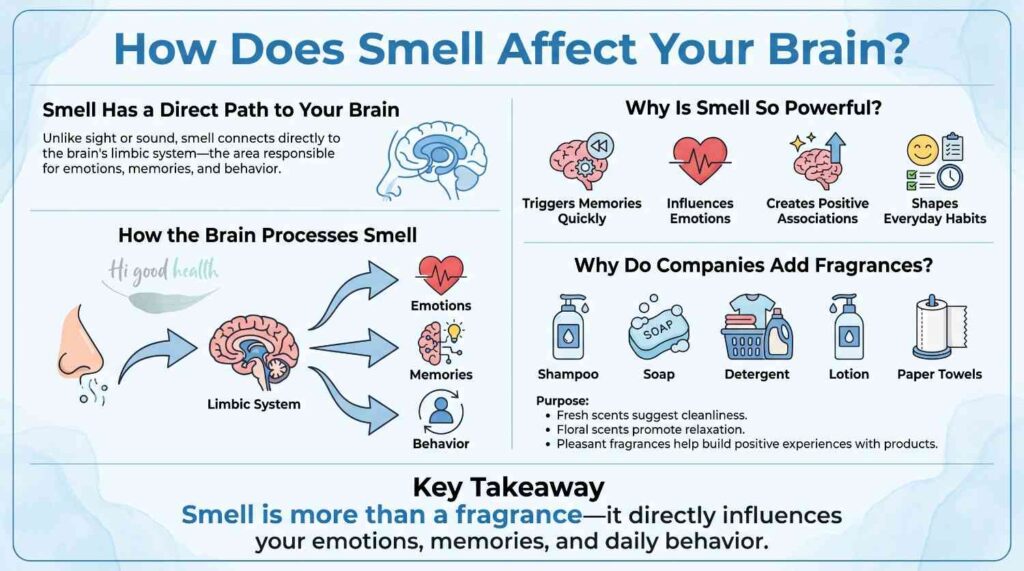
Unlike sight or sound, smell has a direct connection to the brain’s limbic system — the area responsible for emotions, memory, and behaviour. Smell is one of the fastest ways to trigger a memory or emotion. That is why companies add scents to shampoos, soaps, detergents, lotions, and even paper towels. A fresh scent signals cleanliness. A floral note feels relaxing. Brands know that scent can help build positive habits and associations.
Do scents really influence attraction?
Science and real-world experience suggest the answer is yes, but it is not about using the strongest or most expensive perfume. Subtlety, confidence, and personal chemistry matter far more. A study on body odour and deodorant use found that fragrance and antimicrobial spray could affect self-confidence and how women judged men’s attractiveness in video clips.
Before synthetic fragrances, people relied on natural body odour — something still deeply rooted in human biology. Humans may subconsciously pick up certain biological and emotional cues through body odour. A well-chosen fragrance can improve your scent, but it cannot fully replace your chemistry.
Want to know why synthetic materials may affect comfort, skin, and health? Read here: Why Our Parents Warned Us About Synthetic Clothes? Pros and Cons of Synthetic Fabrics
Relationships often attach strong memories to fragrance. Some scents become comforting and familiar, while others become linked to unpleasant social experiences. Fragrance can help, but it needs to be subtle and suited to your personality and chemistry.
A Quick Look at the History of Fragrance
Time Period | Region | Use & Popularity |
|---|---|---|
3,000 BCE | Egypt | Used oils and resins in rituals and burial rites |
1000 BCE | India and Persia | Herbal extracts and sandalwood oils used for bathing and spirituality |
Roman Empire | Europe | Bathhouses used rosewater and aromatic oils |
17th Century | France | Birth of modern perfumery in Grasse; perfumes became a status symbol |
20th Century | Global | Commercial perfumes boomed with Chanel, Dior, and celebrity branding |
Indian perfumery has long been linked with sandalwood, herbal oils, baths, and spiritual use, so this history fits naturally with local fragrance traditions.
Do Pheromone Perfumes Actually Work?
This deserves its own section, because it is the single biggest claim made for fragrance and it is the one with the least behind it.
The short answer: no human pheromone has ever been identified. Not one compound, after decades of searching. That is not a fringe position — it is the mainstream one, and the researchers who study human chemical communication are the ones saying it loudest.
What a pheromone actually has to be
The word has a strict meaning. A pheromone is a specific chemical, produced by members of a species, that reliably triggers a particular response in other members of that species. It has to be isolated, chemically identified, and shown to produce the effect on its own, in properly controlled tests. Insects have them. Some mammals have them. For humans, nothing has cleared that bar.
The two compounds sold as human pheromones
Almost every “pheromone” product traces back to two molecules — androstadienone and estratetraenol. They were never isolated by the rigorous method the definition requires; they were picked as plausible candidates and studied afterwards.
When they were finally tested properly — a double-blind study of 94 participants, exposed on separate days to the compound or a control, then asked to judge faces for gender, attractiveness and faithfulness — they did nothing. No effect on perceived gender, no effect on perceived attractiveness. The lead researcher’s own summary was that whatever human reproductive chemistry exists, these are unlikely to be the active compounds.
And the organ that was supposed to detect them does not work
Pheromone marketing usually invokes the vomeronasal organ, a structure that in many animals detects exactly these signals. Humans do have a small pit in the nasal septum that corresponds to it. The problem is everything downstream of it:
- Adults appear to lack the accessory olfactory bulb — the brain structure the organ would need to report to.
- The genes for the receptor proteins it would use are mutated and inactive in humans.
- No functional nerve connection to the brain has been demonstrated in adults.
The consensus is that in adult humans it is vestigial — a leftover, not a sense.
What this means if you are about to buy something: a product marketed on pheromones is selling you a mechanism that has not been shown to exist, detected by an organ that does not appear to function, using molecules that failed when tested. It may still smell good. That is a different claim, and an honest one.
So What Does Affect Attraction Through Smell?
Quite a lot — which is why the pheromone story took hold. Scent genuinely matters. It just does not work like a signal being broadcast and received.
- Association and memory. Smell is wired unusually directly into the parts of the brain that handle memory and emotion. A scent someone already associates with you carries more weight than a more expensive one they have no history with. This is the largest effect in the whole subject and it is almost never what the advertising is about.
- Natural body scent, which is partly genetic. There is long-running research on preferences relating to immune-system genes (MHC), covered further down. It is real, contested in its details, and — importantly — it is about a person’s own smell, not a bottle.
- Health and hygiene. Unremarkable and true: clean skin, clean clothes and dental health do more than any fragrance, and no perfume covers their absence.
- Confidence — the effect on the wearer. This one is well documented and slightly funny: people wearing fragrance are often rated as more attractive in silent video, by raters who cannot smell anything at all. The fragrance changed how they carried themselves. That is a real benefit. It just is not the one on the box.
- Cultural and personal familiarity. What reads as pleasant is heavily learned. Attar, oud, sandalwood, jasmine and khus carry associations for an Indian audience that a European fragrance chart will not predict.
Common Myths About Perfumes & Attraction
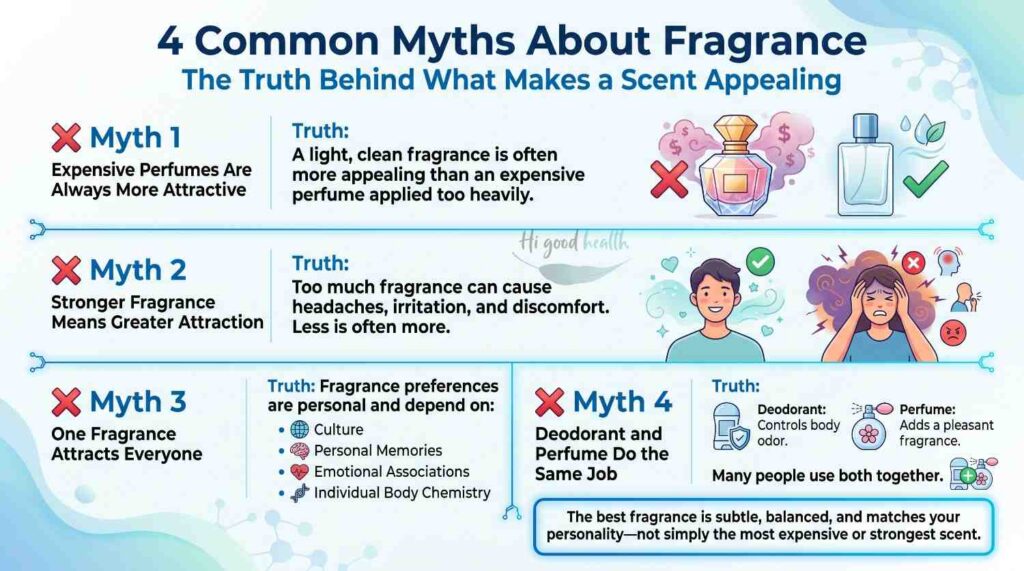
Myth 1: Expensive Perfumes Are Always More Attractive
Price does not guarantee attractiveness. A subtle, clean scent often performs better socially than a luxury fragrance applied too heavily.
Myth 2: Stronger Fragrance Means Greater Attraction
Overpowering scents can trigger headaches, irritation, or discomfort. In many social settings, less is more.
Myth 3: There’s a “Universal Seduction Scent”
No single fragrance attracts everyone. Preferences vary based on:
- Culture
- Personal memories
- Emotional associations
- Individual biology
Myth 4: Deodorants and Perfumes Work the Same Way
Deodorants primarily reduce body odour and sweat-related smell, while perfumes are designed to create a pleasant scent experience. Many people use both together.
A friend once told me that her partner’s usual cologne “smelled like him — even when he wasn’t there,” and it made her feel emotionally closer. On the other hand, I’ve also heard stories of dates ruined because someone wore too much musky cologne and it overwhelmed the space.
Fragrance can help — but it needs to be subtle and well-matched to your personality and chemistry.
What People Actually Think
A 2020 UK-based online survey by FragranceDirect and YouGov asked over 1,200 people to rate strangers based on scent alone:
- 83% of women and 67% of men said scent significantly affected their first impression of someone.
- More than half reported they’d lost interest in someone because of an overpowering or unpleasant fragrance.
- Clean, soft, and natural-smelling perfumes scored the highest. Heavy musk and synthetic fruity notes were often rated as “too much.”
- Respondents preferred scents that felt “warm,” “fresh,” or “comforting” — not flashy or loud.
These findings support the idea that less is more, and being subtle and clean often wins over strong or trendy fragrances.
How to Choose the Right Scent (and Use It Well)
- Try testers on your skin, not paper.
- Don’t follow trends blindly — what works for others may not suit you.
- Consider the climate (lighter scents in summer, deeper in winter).
- Less is more: apply once or twice, not all over.
- Rotate scents; don’t wear the same perfume every day.
Why People Often Wear Too Much Perfume Without Realising It
Scientists call it olfactory adaptation or nose blindness. When you wear the same fragrance regularly, your brain gradually becomes less sensitive to it. This can make people think their perfume has faded even when others can still smell it clearly.
That’s one reason fragrance experts recommend subtle application instead of repeated spraying throughout the day.
When Is the Best Time to Apply Fragrance?
- Right after a shower (clean skin holds scent better)
- On pulse points: wrists, behind ears, collarbone
- Not on clothes (can stain or change smell)
- Morning: fresh citrus or aquatic tones
- Evening: deeper woods, spices, or musk
Best-Selling & High-End Perfume Brands
Brand & Type | Category | Approx. Price (INR) | Made In |
|---|---|---|---|
Chanel No.5 | Luxury Classic | ₹11,326 (50 ml) | France |
Dior Sauvage | Popular Modern | ₹11,326 (60 ml) | France |
Tom Ford Black Orchid | Designer | ₹13,685 (50 ml) | USA |
Le Labo Santal 33 | Niche | ₹20,764 (50 ml) | USA |
Axe Body Spray | Budget/Youth | ₹566–₹944 | Global (Unilever) |
Old Spice | Classic Deodorant | ₹377–₹755 | USA |
Scientific Insights: What the Research Says
Several psychology and cosmetic science studies suggest fragrance can influence self-confidence and social perception, although effects vary by context and individual preference.
Some studies suggest people may prefer body odours associated with certain immune-system gene differences, though findings remain mixed and are not universally replicated.
In one study, men who believed they were wearing a powerful deodorant acted more confident, even if the scent was neutral. Confidence, in turn, made them appear more attractive.
Not All Good News: Harms of Overusing Perfume
- Can trigger allergies or asthma in sensitive people.
- Overuse may cause migraines or nausea in closed spaces.
- Some synthetic perfumes include phthalates or preservatives that may disrupt hormones, though more evidence is needed.
- Strong scents may mask body odour — but they may also mask true compatibility.
Dermatologists recommend using minimal quantity and choosing hypoallergenic or alcohol-free options if you have sensitive skin.
How Are Different Perfumes Made?
Type | Description | Made From | Lasts For |
|---|---|---|---|
Perfume/Parfum | Highest concentration (20–30%) | Natural oils + alcohol | 8–12 hours |
Eau de Parfum | Medium-high concentration (15–20%) | Oils + alcohol | 5–8 hours |
Eau de Toilette | Lighter (5–15%) | More alcohol, casual use | 3–5 hours |
Cologne | Very light (2–4%) | Citrus & aquatic tones | 2–4 hours |
Attars | Traditional oil-based scents | Herbs, woods, flower petals | 6–10 hours |
Final Verdict: Do Perfumes Make You Attractive?
Yes — but not in the exaggerated way advertisements suggest.
Perfumes and deodorants can:
- Improve first impressions
- Enhance confidence
- Trigger emotional memories
- Increase perceived attractiveness
But genuine attraction still depends on personality, chemistry, hygiene, communication, and emotional connection.
Fragrance is an enhancer — not a substitute for authenticity.
Key Takeaways
- No human pheromone has ever been identified. Products sold on that basis are selling a mechanism nobody has demonstrated.
- The vomeronasal organ is vestigial in adults — no accessory olfactory bulb, inactive receptor genes, no demonstrated nerve connection.
- Fragrance’s most reliable effect is on the person wearing it. It shows up even when the rater cannot smell anything.
- Association beats chemistry. A scent someone already links to you does more than an expensive one they do not.
- Hygiene outranks fragrance, and no perfume covers its absence.
- Overapplication is the common mistake — your nose adapts within minutes, so you are the last to notice.
- Price is a weak predictor. Fit with your own skin and your own associations matters more than the label.
Frequently Asked Questions
Do perfumes really make you more attractive?
Indirectly, yes — but not the way the marketing implies. The best-documented effect is on the wearer: people wearing fragrance are often rated as more attractive even by raters who cannot smell it, because it changes how they carry themselves. Scent also affects first impressions through association and memory. What does not hold up is the pheromone claim, which is covered in its own section above.
How do I choose the right scent for my body chemistry?
Always test perfumes on your skin rather than paper, as your natural chemistry affects how a fragrance smells. Avoid following trends blindly; what works for others might not suit you. The skin microbiome, the bacteria naturally living on our skin, may influence how perfumes develop over time. This helps explain why the exact same fragrance can smell noticeably different from person to person.
What is the difference between Eau de Parfum and Eau de Toilette?
The main difference is concentration. Eau de Parfum has more oil (15–20%) and lasts 5–8 hours. Eau de Toilette is lighter (5–15%), contains more alcohol, and typically lasts only 3–5 hours.
Where is the best place to apply cologne or perfume?
Apply fragrance to pulse points like wrists, behind ears, and the collarbone. It is best to apply it right after a shower because clean skin holds the scent better than dry skin.
Does natural body odour matter more than cologne?
It can. Humans are biologically drawn to natural scents that may indicate immune system compatibility. While fragrance can enhance your presence, heavy artificial perfumes may mask this important biological signal.
Which type of perfume lasts the longest?
Parfum (pure perfume) lasts the longest — up to 8–12 hours — because it has the highest oil concentration at 20–30%. In contrast, colognes are very light and typically fade within 2–4 hours.
Can wearing too much perfume be a turn-off?
Absolutely. More than half of people have lost interest in someone due to overpowering fragrance. Strong scents can be overwhelming or even trigger migraines and allergies, so “less is more” is the best approach.
Are expensive perfumes always better than budget ones?
Not necessarily. Attraction depends more on personal chemistry than price. While luxury brands like Chanel are iconic, budget options like Old Spice remain popular classics. The right match matters most.
Does pheromone perfume work?
No, and the reason is worth knowing. No human pheromone has ever been identified. The two compounds these products are built on, androstadienone and estratetraenol, were never isolated by the method the definition requires, and when tested in a controlled double-blind study they had no effect on perceived gender or attractiveness. The vomeronasal organ they are supposed to be detected by appears vestigial in adult humans, who lack the accessory olfactory bulb it would report to and carry inactive versions of the relevant receptor genes. A pheromone perfume may smell good. That is a different claim.
Are human pheromones real?
Not as far as anyone has been able to demonstrate. Humans certainly emit chemicals, and body scent certainly influences other people, but a pheromone has a strict definition: a specific identified compound that reliably produces a particular response. Decades of searching have not produced one for humans. Researchers in the field describe what has been found so far as modulators of social cues rather than true pheromones, and are fairly blunt that the commercial products ran far ahead of the evidence.
Does body odour really affect attraction?
Yes, though less mysteriously than the pheromone story suggests. There is long-running research on scent preferences relating to immune-system genes, which is real but contested in its details. Much larger and less exotic are health and hygiene, and association: smell is wired unusually directly into memory and emotion, so a scent someone already links to you carries more weight than an unfamiliar one. Note that this is about a person’s own scent, not a bottle, and heavy fragrance can mask it.
How much perfume is too much?
Less than most people use, and you are the worst judge of it. The nose adapts to a constant smell within minutes, so what seems faint to you can be overpowering to someone sitting next to you. Two sprays at pulse points is plenty for most fragrances, one for anything concentrated. If someone can smell you before you enter the room, that is too much. It is also worth remembering in shared offices, lifts and public transport, where strong fragrance triggers headaches and asthma in some people.
Glossary
- Body odour: The smell produced by sweat and skin bacteria.
- Deodorant: A product that helps reduce body odour.
- Perfume: A fragrance product made to smell pleasant.
- Eau de Parfum (EDP): A stronger fragrance concentration that lasts longer.
- Eau de Toilette (EDT): A lighter fragrance concentration.
- Pulse points: Warm areas like wrists and neck where fragrance projects well.
- Olfactory adaptation: When your nose gets used to a smell and notices it less.
- Skin chemistry: The way your skin changes how a fragrance smells on you.
- Attar: A traditional oil-based fragrance, often used in India.
References
- The Future of Fragrance Personalization: Harnessing Skin Microbiome Insights for Enhanced Performance, Safety, and Sustainability[sciety]
- Major histocompatibility complex-associated odour preferences and human mate choice: near and far horizons[pubmed.ncbi.nlm.nih]
- Olfactory adaptation[academic.oup]
- Emotional expression in human odour[pubmed.ncbi.nlm.nih]
- MHC-dependent mate preferences in humans[pubmed.ncbi.nlm.nih]
- Aromatherapy Facts and Fictions: A Scientific Analysis of Olfactory Effects on Mood, Physiology and Behaviour[pubmed.ncbi.nlm.nih]
Disclaimer
The content provided on higoodhealth.com is for general informational purposes only. While we strive to offer accurate and up-to-date content, much of the information is derived from publicly available sources and personal research. We do not make any warranties about the completeness, reliability, or accuracy of this information.