Imagine bringing home a bright-eyed puppy — and within 72 hours, watching them collapse, stop eating, and fight for their life. This is the devastating reality of canine parvovirus, and it happens to thousands of families across India every year.
At a glance
The first parvo symptoms are usually lethargy and refusing food, followed within a day or so by repeated vomiting and foul-smelling, often bloody diarrhoea. A puppy showing these signs needs a vet the same day, not the next morning.
Parvo is treatable but not curable at home, and the parvo symptoms above are the whole warning you get. There is no medicine that kills the virus — treatment is intensive supportive care that keeps the puppy alive while its own immune system clears the infection. With prompt hospital care, survival is good. Without it, most puppies die.
It is almost entirely preventable. The parvo vaccine is part of the standard puppy course, and until that course is finished a puppy should not be walked in public places or meet unvaccinated dogs. If you are reading this because your puppy already has parvo symptoms, stop reading and call a vet.
As a veterinarian, I’ve held grieving pet parents in exam rooms more times than I care to count — all because a silent, nearly indestructible virus moved faster than anyone expected.
This article will tell you exactly what parvo is, why it is so catastrophic for puppies specifically, how to recognise the warning signs, and what current veterinary medicine offers for treatment and prevention. Whether you are a first-time puppy owner or an experienced dog lover, understanding this disease could help save a life.
What Is Canine Parvovirus? Parvo Disease in Dogs Explained
Canine parvovirus type 2 (CPV-2) is one of the most contagious and serious viral diseases known to affect dogs. First identified in the late 1970s, it swept across the globe in a matter of years and blindsided the veterinary community.
It primarily attacks two body systems with ruthless efficiency: the gastrointestinal tract, causing life-threatening bloody diarrhoea and vomiting, and in very young puppies, the heart muscle (myocardium), sometimes causing sudden cardiac death.
The virus is shockingly resilient. CPV-2 can survive in contaminated soil, grass, or on surfaces — including your shoes and clothing — for months to years. You don’t even need direct dog-to-dog contact for transmission. A single gram of infected faeces contains enough viral particles to infect thousands of dogs.
This is not an exaggeration — it is why parvo is widely prevalent across India, with studies reporting positivity rates ranging from 5–30% in dogs presenting with gastroenteritis at veterinary clinics, with higher rates in puppies below six months of age.
“Canine parvovirus is one of the most significant infectious agents affecting dogs globally — its ability to mutate and survive in the environment makes it an ongoing major veterinary health concern.” — PubMed/NIH Research Overview, 2024
Why Is Parvo So Deadly in Puppies?
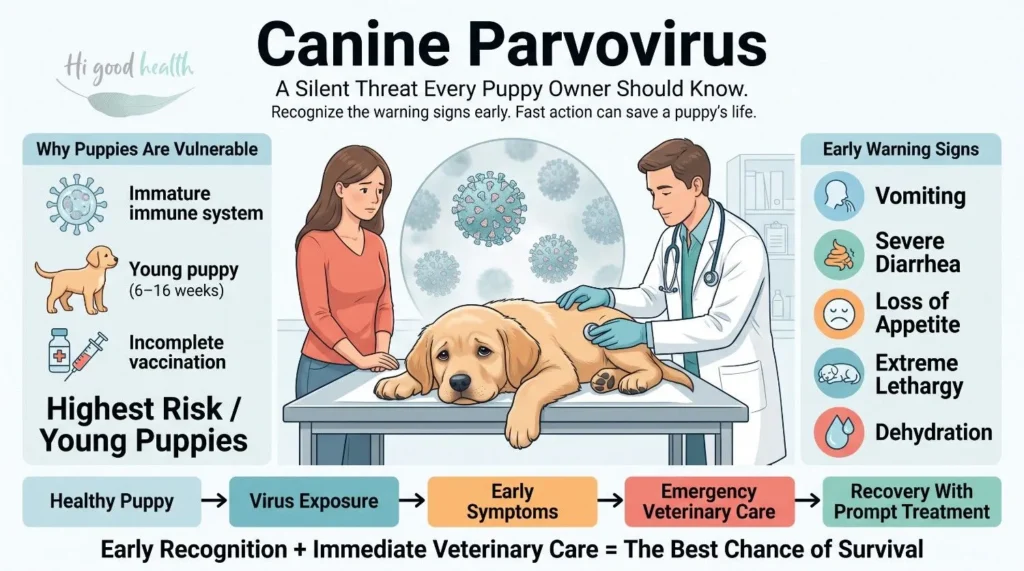
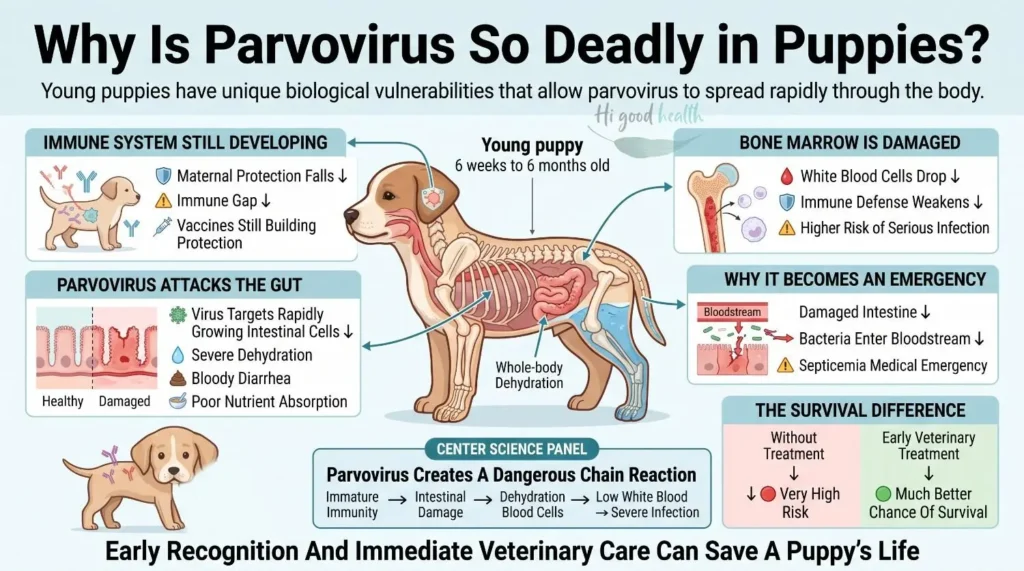
Adult vaccinated dogs can fight off the virus. But puppies — especially those between 6 weeks and 6 months of age — are devastatingly vulnerable. Here’s the biological reason why:
1. The Immune System Is Still Under Construction
A puppy’s immune system isn’t fully developed. Their maternal antibodies (protective proteins received through their mother’s milk) begin to wane around 6–8 weeks of age, and this creates a dangerous “immunity gap” before vaccines kick in fully.
2. The Virus Attacks the Fastest-Dividing Cells
CPV-2 has a uniquely sinister strategy — it targets cells that divide rapidly. In puppies, the intestinal lining cells (enterocytes) are rapidly multiplying, making them a prime target.
The virus destroys these cells, obliterating the gut’s ability to absorb water and nutrients. The result: severe dehydration, bloody diarrhoea, and a breakdown of the gut barrier that allows bacteria to flood the bloodstream — a life-threatening condition called septicemia.
3. The Bone Marrow Takes a Hit
The virus also attacks the bone marrow, the factory that produces white blood cells — the very soldiers your puppy’s body needs to fight infection. With white blood cell counts crashing, the immune system essentially goes offline at the worst possible moment.
4. The Numbers Are Sobering
Without any treatment, CPV has a mortality rate of over 91%. Even with outpatient treatment, mortality can reach 25%. The difference between life and death is almost always the speed of diagnosis and quality of care.
Parvo Symptoms: Common Signs to Watch For — Seek Veterinary Care Immediately
Parvo moves fast. Symptoms can escalate from mild to critical within 24–48 hours. If your puppy shows any of the following, treat it as a veterinary emergency:
- Sudden, severe lethargy — a normally playful puppy that simply won’t get up
- Loss of appetite — refusing food or water completely
- Vomiting — often repeated, sometimes with yellow bile
- Bloody, foul-smelling diarrhoea — a hallmark sign of parvoviral enteritis
- Fever (or in severe cases, dangerously low body temperature)
- Bloated, painful abdomen
- Rapid weight loss and sunken eyes — signs of acute dehydration
Critical reminder: Many new puppy owners initially mistake early parvo for an “upset stomach” or stress from a new environment. Do not wait for symptoms to worsen. Call your vet immediately.
Parvo Treatment: Why Early Care Is the Difference Between Life and Death
Here’s what every worried pet parent should know: parvo has no cure, but the body can fight it, if you give it enough support, fast enough.
Treatment focuses on keeping the puppy alive while its immune system — with help — eliminates the virus. This is called supportive care, and it includes:
- Intravenous (IV) fluids to combat life-threatening dehydration
- Anti-nausea medications (antiemetics) to stop vomiting so the gut can rest
- Antibiotics to prevent bacterial infections from crossing the compromised gut wall
- Nutritional support — early feeding through a feeding tube if needed, which research now shows accelerates gut recovery
- Blood glucose monitoring — puppies can crash dangerously fast
With prompt, intensive hospital care, survival rates can climb to 90% or higher. The key phrase is prompt. Every hour without treatment allows the virus to do more damage and dehydration to deepen.
In India, treatment costs can range from approximately ₹5,000 to ₹25,000 or more depending on disease severity, the breed’s size, and the duration of hospitalisation. Anti-parvo serum alone can cost ₹3,300–3,500 per dose. Early treatment is far less expensive — and far less heartbreaking — than managing a critical case.
Modern Diagnostic Tools: How Vets Confirm Parvo Fast
Speed of diagnosis is everything. Veterinary clinics across India use several tools:
- Rapid Antigen Tests (SNAP/ELISA): An in-clinic test done in minutes using a small faecal sample. Highly practical for immediate decision-making. The Ubio Quick VET Canine Parvovirus antigen rapid test kit is widely used in Indian clinics.
- PCR Testing (Gold Standard): Polymerase chain reaction testing detects even tiny amounts of viral DNA with exceptional accuracy. Used when rapid tests are negative but suspicion remains high.
- CBC (Complete Blood Count): Measures the white blood cell count — a severely low count confirms bone marrow suppression and indicates disease severity. A CBC typically costs ₹300–500 at most veterinary labs in India.
- Point-of-Care Monitoring: Continuous monitoring of blood pressure, blood sugar, and electrolytes helps guide real-time treatment decisions in hospitalised puppies.
New and Emerging Parvo Treatments That Are Changing Survival Odds
This is where veterinary medicine is truly exciting right now. For decades, treatment was purely supportive. That has now changed.
Monoclonal Antibody Therapy
A significant global development in 2023 saw regulatory approval granted to Elanco Animal Health for the first-ever targeted treatment for canine parvovirus — a Canine Parvovirus Monoclonal Antibody (CPMA).
This laboratory-engineered protein works by binding directly to the parvovirus, preventing it from entering and destroying intestinal cells. It is administered as a single intravenous dose and has been shown to significantly reduce clinical signs and prevent death.
Real-world data released in October 2024 confirmed that CPMA meaningfully improves puppy survival rates in clinical settings — representing the first true antiviral breakthrough in nearly 50 years of battling this disease. Availability in India is evolving; ask your veterinarian whether it is accessible at their clinic or through a referral centre.
“This is the first and only approved therapeutic solution proven to treat canine parvovirus.” — Elanco Animal Health
Plasma Therapy
Hyperimmune plasma — plasma from dogs that have recovered from parvo and carry high levels of antibodies — can be transfused into sick puppies to provide passive immunity. This is used selectively, particularly in critically ill patients, to give the immune system an immediate boost.
Immunotherapy: Filgrastim (G-CSF)
Filgrastim is a drug that stimulates the bone marrow to produce white blood cells. Since parvovirus attacks the bone marrow, this therapy directly addresses one of the virus’s most dangerous effects. Research into its use in canine parvoviral enteritis is ongoing and shows promise.
Gelatin Tannate (Tasectan) — Under Investigation
Ongoing clinical research is currently evaluating a compound called Tasectan, derived from tannic acid (a natural plant compound). It works by forming a protective biofilm on the inflamed intestinal lining, reducing water loss, and blocking harmful bacteria. Early results are promising and the drug has been well tolerated.
What’s remarkable about Tasectan is its plant-derived origin — evidence that nature-based compounds may play a meaningful role in future integrative veterinary care.
Parvo Vaccine and Prevention: What Actually Works
Prevention is dramatically more effective — and less heartbreaking — than treatment. Here’s a practical prevention roadmap:
Vaccinate on schedule. The core canine vaccine (DHPPi) includes parvovirus protection. Puppies need a series of vaccines starting at 6–8 weeks, with boosters every 3–4 weeks until 16 weeks of age, because maternal antibodies can interfere with earlier vaccine responses.
Do not skip or delay boosters. In India, the winter season has been shown to carry higher CPV prevalence — plan your puppy’s vaccine series well before cold months.
Avoid high-risk environments until the vaccine series is complete. Public parks, pet exhibitions, stray dog-dense areas, and apartment society gardens are high-risk for unvaccinated puppies.
Disinfect properly. Parvovirus is resistant to most common household cleaners. Bleach-based disinfectants (a 1:32 dilution of household bleach) are one of the few solutions proven to kill the virus on surfaces.
Don’t carry the virus home unknowingly. If you’ve handled an unknown dog, wash hands thoroughly and change clothing before interacting with an unvaccinated puppy. This is especially important in India where contact with stray dogs is common during walks or in open common areas.
What Every Pet Parent Must Know About Parvo and Humans
A common and important question: Can my puppy give me parvo?
No. Canine parvovirus does NOT spread from dogs to humans. It is species-specific. However, humans can act as passive carriers — the virus can hitch a ride on your clothes, shoes, or hands and be transported to other dogs and environments. This is why good hygiene and proper disinfection matter, even for humans who feel perfectly healthy.
Note: There is a separate human parvovirus (B19) that causes “fifth disease” in children — it is a completely different virus and has no connection to the canine form.
Parvo Survival Rate: What the Numbers Actually Say
This is the question every owner asks first, and the honest answer is that it depends almost entirely on how fast treatment starts after the first parvo symptoms appear.
With prompt, properly resourced hospital treatment started as soon as parvo symptoms appear, survival rates of around 85 to 90% are commonly reported. Without treatment, the picture reverses — the large majority of infected puppies die, usually from dehydration and septic shock rather than from the virus itself.
That gap is the single most important fact on this page. It is also why parvo symptoms are worth recognising a day earlier rather than a day later: the first 72 hours largely decide the outcome.
Some factors make the odds worse. Very young puppies, puppies carrying a heavy worm burden, and those from breeds reported to be more susceptible — Rottweilers, Dobermans, German Shepherds and Labradors among them — tend to do less well.
A puppy that is already collapsed when it reaches the clinic has a harder fight than one brought in on the first day of parvo symptoms.
Parvo Treatment Cost in India
Cost is rarely discussed and frequently decides what happens once parvo symptoms appear, so here are indicative 2026 figures for India. Treat them as a planning range, not a quotation.
An in-clinic parvo test kit typically runs ₹500 to ₹1,500. Hospitalisation with intravenous fluids and supportive care commonly costs ₹2,000 to ₹6,000 a day, and a puppy usually needs five to seven days, so a full course often lands between ₹15,000 and ₹40,000 depending on the city and the clinic.
Set against that, the parvo vaccine costs a few hundred to a couple of thousand rupees as part of the routine puppy course. The entire vaccination course costs less than a single day of intensive treatment for parvo symptoms.
If cost is a barrier, say so to the vet at the first visit rather than delaying once parvo symptoms have started. Many clinics will stage treatment, and government veterinary hospitals and animal-welfare charities in most Indian cities treat parvo at far lower cost.
A puppy with parvo symptoms that waits three days for a cheaper option is usually a puppy that does not survive.
Can Cats Get Parvo?
Cats have their own parvovirus. Feline panleukopenia is a closely related but distinct virus, and it is every bit as serious in kittens as canine parvovirus is in puppies — the parvo symptoms look similar too, with vomiting, diarrhoea and rapid collapse.
Canine parvovirus itself only rarely affects cats, so parvo symptoms in a cat usually point to panleukopenia rather than the dog virus.
The practical point for a multi-pet household is that a dog vaccine does not protect a cat and a cat vaccine does not protect a dog. Panleukopenia is covered by the standard feline vaccination course, so kittens need their own schedule.
Questions Real Pet Parents Are Asking (And the Honest Answers)
How long does parvo last in a puppy that survives?
Most puppies who receive timely treatment and survive show significant improvement within 3–5 days of starting intensive care. Full recovery typically takes 1–2 weeks. Recovered puppies develop strong immunity and are generally protected against reinfection.
Can a vaccinated puppy still get parvo?
Yes, though it’s rare. No vaccine is 100% effective, and the virus continues to evolve. Breakthrough infections can occur, particularly in immunocompromised dogs or if the vaccine series was incomplete. This is why completing all booster doses matters.
Is parvo contagious to other pets in the house?
It only affects dogs and other canids (foxes, wolves, jackals). Cats, rabbits, and other household pets are not at risk from CPV-2.
How do I know if my home is contaminated after a parvo case?
The virus can persist in your home environment for 6 months to a year. Thorough cleaning with a bleach-based disinfectant is essential before bringing a new puppy into a home where an infected dog lived.
Latest Scientific Studies Explained Simply
Recent published research, including studies from India and global reviews, summarised the current state of CPV research:
- New viral strains (CPV-2a, 2b, 2c) have emerged since the original 1970s strain. CPV-2c has been detected in dogs in Kolkata, indicating that evolved strains are actively circulating in India. Some of these show slightly different vaccine responses, prompting researchers to develop next-generation vaccines.
- Biomarker research is identifying specific proteins in the blood that can predict whether a puppy will survive — potentially guiding more personalised treatment decisions as early as day one of hospitalisation.
- The “One Health” concept is being applied to CPV — recognising that controlling parvovirus isn’t just about individual dogs, but about managing it at the community and environmental level, especially in shelter populations. In India, this is particularly relevant given the large urban stray dog population that acts as an unvaccinated reservoir.
A Vet’s Personal Note
Early in my practice, I treated a 10-week-old Labrador mix named Bholu. Bholu’s owners had been told by well-meaning neighbours that “puppies get sick — just wait it out.” By the time they brought him in, his white cell count was dangerously low and he was barely responsive.
We fought for three days. Bholu made it — but just barely. His case is why I believe with every fibre of my clinical training that education saves lives — not just in humans, but in the animals who depend entirely on us.
Stories like Bholu’s are the reason HiGood Health exists — to give you clean, credible, science-backed information in simple language, so you can make fast, confident decisions when it matters most. We’re here to bust the myths, share what the latest research actually says, and stand beside you on your pet health journey.
Take Action Now — Your Puppy Is Counting on You
- Schedule your puppy’s vaccine series today if you haven’t already. Call your vet or find a nearby clinic through platforms like Wiggles, DCC Animal Hospital, or your city’s municipal veterinary services.
- Bookmark this page and share it with every new dog owner you know.
- Explore more on HiGood Health — check out our related articles on puppy nutrition and immunity, common dog diseases and prevention, and how the canine immune system works.
- Tell us what you’d like us to cover next — drop a comment or message us. Your questions help us build a healthier community, one pet family at a time.
Key Takeaways
- The earliest parvo symptoms are lethargy and refusing food, before the vomiting and bloody diarrhoea most people associate with it. That gap is where the time is won or lost.
- Parvo symptoms in a puppy are a same-day emergency. Not tomorrow morning.
- There is no cure for parvo and no home remedy — parvo symptoms need a clinic, not a kitchen. Treatment is intensive supportive care that keeps the puppy alive while its own immune system clears the virus.
- Survival is around 85 to 90% with prompt hospital treatment, and poor without it. The first 72 hours largely decide it.
- In India, expect roughly ₹15,000 to ₹40,000 for a full course of treatment — against a vaccination course costing a fraction of one day of that.
- The virus survives months in the environment, so parvo symptoms can appear in a puppy that never left the house. Bleach-based disinfectant works; most ordinary household cleaners do not.
- Watch for parvo symptoms and keep an unfinished-course puppy off public ground and away from unvaccinated dogs until the vet says the course is complete.
Frequently Asked Questions
What are the first parvo symptoms in a puppy?
Lethargy and refusing food usually come first, often a day before anything dramatic. Repeated vomiting and foul-smelling, frequently bloody diarrhoea follow, along with fever and rapid dehydration. Because the earliest parvo symptoms look like a puppy simply being off-colour, they are easy to dismiss — and that lost day matters more than almost anything else.
What is the survival rate for parvo in puppies?
Around 85 to 90% with prompt hospital treatment, and poor without it — most untreated puppies die, usually of dehydration and septic shock rather than the virus itself. The first 72 hours largely decide the outcome. Very young puppies and those with a heavy worm burden do less well.
Can parvo be cured at home?
No. There is no medicine that kills the virus and no home remedy that works. Treatment is intensive supportive care — intravenous fluids, anti-nausea medication and infection control — that keeps the puppy alive while its own immune system clears the infection. That care needs a veterinary clinic. If a puppy is showing parvo symptoms, call a vet the same day.
How much does parvo treatment cost in India?
Indicatively in 2026: a test kit around ₹500 to ₹1,500, and hospitalisation ₹2,000 to ₹6,000 a day for five to seven days, so roughly ₹15,000 to ₹40,000 in total depending on city and clinic. Government veterinary hospitals and animal-welfare charities treat parvo for considerably less. Tell the vet at the first visit if cost is a problem rather than delaying treatment.
When does a puppy get the parvo vaccine?
Parvovirus is part of the core combination given in the standard puppy course, which usually starts at 6 to 8 weeks and runs in three or four rounds about three weeks apart, finishing around 14 to 16 weeks. Until the vet confirms the course is complete, keep the puppy off public ground and away from unvaccinated dogs.
Can cats get parvo?
Cats have their own parvovirus — feline panleukopenia, a closely related but distinct virus that is equally serious in kittens. Canine parvovirus only rarely affects cats. A dog vaccine does not protect a cat, so kittens need their own vaccination course.
Glossary of Key Terms
Term | Meaning |
CPV-2 | Canine Parvovirus Type 2 — the main strain affecting dogs |
Enteritis | Inflammation of the intestinal lining |
Enterocytes | The cells lining the intestinal wall that absorb nutrients |
Septicaemia | Bacterial infection that has spread into the bloodstream — life-threatening |
SNAP/ELISA Test | Rapid in-clinic test to detect parvovirus antigen in faeces |
PCR | Polymerase Chain Reaction — a highly sensitive laboratory test to detect viral DNA |
CBC | Complete Blood Count — measures types and numbers of blood cells |
Monoclonal Antibody (mAb) | A lab-engineered protein that targets a specific virus or antigen |
Filgrastim (G-CSF) | A drug that stimulates white blood cell production from bone marrow |
Hyperimmune Plasma | Blood plasma from a recovered dog, rich in antibodies against parvo |
DHPPi Vaccine | Core canine vaccine covering Distemper, Hepatitis, Parvovirus, and Parainfluenza |
Tasectan | Investigational drug containing gelatin tannate; under trial for parvo treatment |
CPMA | Canine Parvovirus Monoclonal Antibody — targeted treatment for parvovirus |
One Health | A global concept recognising the connection between human, animal, and environmental health |
Disclaimer
This article is intended for general health education purposes only and does not constitute veterinary medical advice. The information shared here is based on published scientific research and clinical knowledge available as of May 2026.
Always consult a licensed veterinarian for diagnosis, treatment, or medical decisions related to your pet’s health. In case of a veterinary emergency, contact your local vet or an emergency animal hospital immediately.
At HiGood Health, our mission is simple: give you the kind of clean, credible, research-backed health information that empowers you — not just for yourself, but for every member of your family, including the four-legged ones.
If this article helped you, please share it with another pet parent who needs to read it. And if there’s a pet health topic you’d like us to explore next, we want to hear from you.
