
Imagine two dogs at a park. One is fully vaccinated, chasing a ball, sniffing every corner, and splashing through puddles without much risk beyond muddy paws.
At a glance
The standard dog vaccination schedule in India starts at 6 to 8 weeks and runs in three to four rounds about three weeks apart, finishing at 14 to 16 weeks. Rabies is given separately, usually at 12 weeks or later, and then annually for life.
Budget roughly ₹3,000 to ₹6,000 for the complete first-year course including consultation, and ₹1,200 to ₹2,500 a year afterwards for boosters. Prices vary widely between a metro clinic and a small-town practice, so treat those as a planning range and confirm locally.
Your vet sets the actual dates on any dog vaccination schedule. A plan shifts for a puppy that was ill, was rescued at an unknown age, or has no vaccination record — which is common with Indian street rescues.
If a dog has bitten a person, that is a medical emergency for the person, not a scheduling question: wash the wound and get to a hospital the same day.
The other looks just as healthy on the outside but is vulnerable to invisible threats in the grass, the soil, and the water — threats like contagious viruses and bacteria that can turn an ordinary day into a medical emergency.
That is the hidden power of canine immunisations: when they work, nothing dramatic happens, and that quiet outcome is exactly the point.
In India, dogs are family. They share sofas, cars, bedrooms, footpaths, and routines. So when veterinarians talk about vaccination, they are not just talking about a “vet requirement” for boarding, grooming, or daycare. They are talking about a practical shield that helps protect the dog, the household, and in some cases the wider community. [conbun]
That point matters more now because pet owners are flooded with mixed messages. Some sources make it sound like every dog needs every shot without question. Others suggest indoor dogs barely need protection at all.
The truth is more useful than either extreme: every dog needs a vaccine plan, but the right plan should be based on science, age, lifestyle, and local risk.
Built upon a foundational framework and updated with the latest clinical standards from WSAVA and IVRI, this guide demystifies canine immunisation. It covers everything from essential vaccine schedules to managing side effects, giving you the tools to make informed, stress-free decisions for your dog’s future. [petraah]
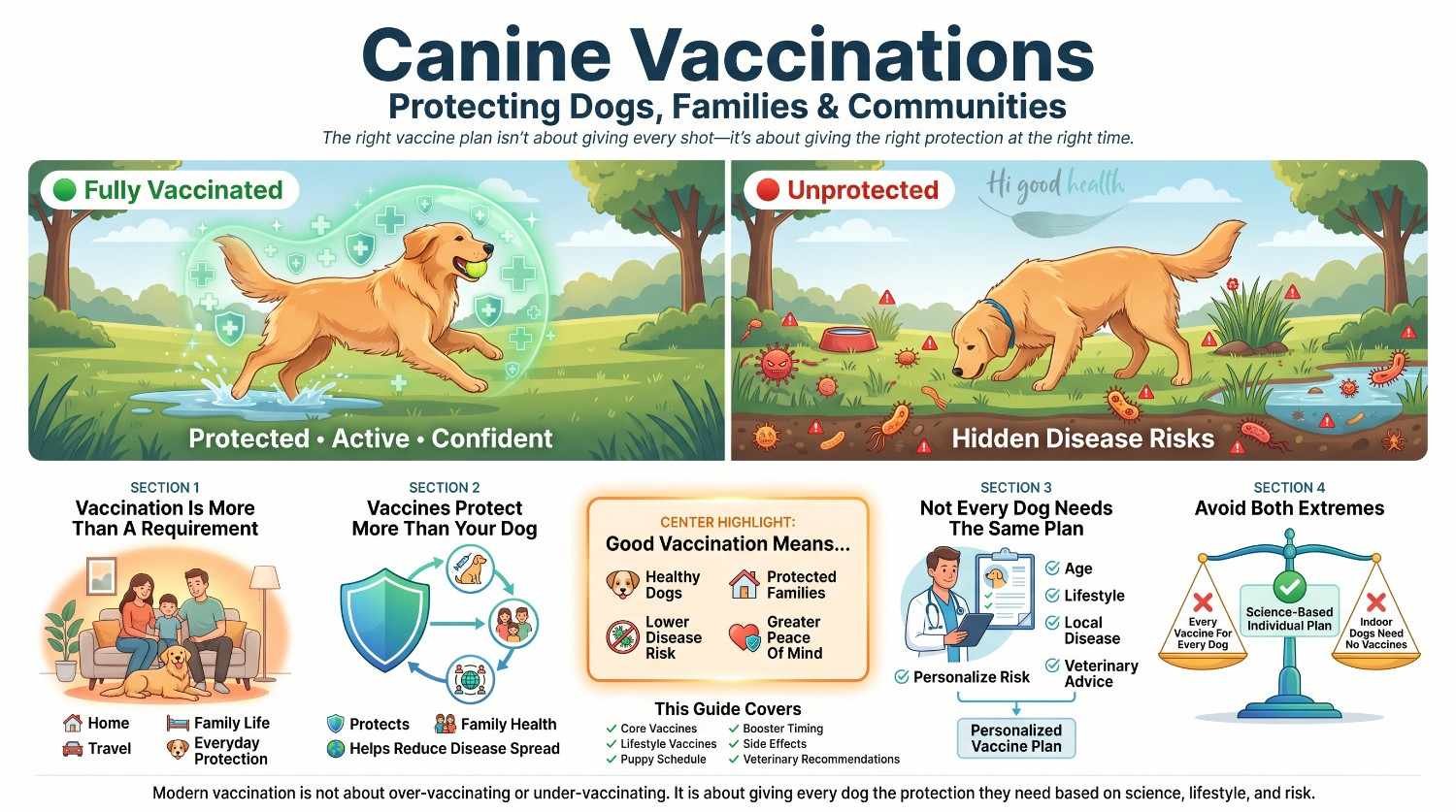
What are vaccines and how do they actually work?
A vaccine is like a training manual for the immune system. It introduces the body to a harmless version of a virus or bacterium, or to a piece of it, so the immune system can learn what the “bad guy” looks like without the dog having to suffer the full disease itself.
Once the immune system has seen that training material, it creates memory. Those memory cells act like experienced security guards. If the real infection shows up later, the body can recognise it faster and respond much more effectively.
This is also why boosters matter.
Immunity developed can weaken with time, and not every vaccine lasts the same length of time. The WSAVA 2024 Vaccination Guidelines emphasises that vaccine recommendations should consider a dog’s previous vaccination immune status and the expected duration of immunity — which is a more precise and evidence-based way to protect dogs than using a one-size-fits-all schedule. [wsava]
That is why vaccines should be given to healthy, disease-free dogs. A healthy immune system is able to respond better to vaccination and develop effective protection against infectious diseases.
In simple terms, the goal is not to give more shots than necessary. The goal is to give the right protection at the right time and refresh it when needed.
Core vaccines vs lifestyle vaccines
One of the easiest ways to understand a vaccine plan is to divide it into two groups: core vaccines and lifestyle vaccines. Core vaccines are the non-negotiables for most dogs because the diseases are either highly dangerous, highly contagious, or important to public health.
Lifestyle vaccines depend more on where the dog goes, what the dog does, and what risks are common in that environment. [wsava]
The non-negotiables: core vaccines
Vaccination against the rabies virus is the most critical in the public health sense. It is a fatal viral disease, and once symptoms begin, it has no cure. That is why rabies vaccination is treated so seriously by public health authorities and why laws require it.
In India, rabies vaccination is legally mandated under the Prevention of Cruelty to Animals Act, 1960, and the Animal Birth Control (Dogs) Rules, 2023. [wsava]
In addition, viruses like canine distemper, adenovirus, and parvovirus are also considered core and are usually included in combination vaccines such as DHPPi or DHPP. These diseases can be aggressive, especially in puppies and dogs with no protection.[petraah]
A major recent update involves leptospirosis. WSAVA and Indian veterinary practice strongly recommend leptospirosis vaccination as essential for dogs in India because the disease can be life-threatening and has zoonotic relevance. A study from Bengaluru found a 70% positivity rate for leptospirosis among tested dogs, with higher risk during the south-west monsoon season.[biogal]
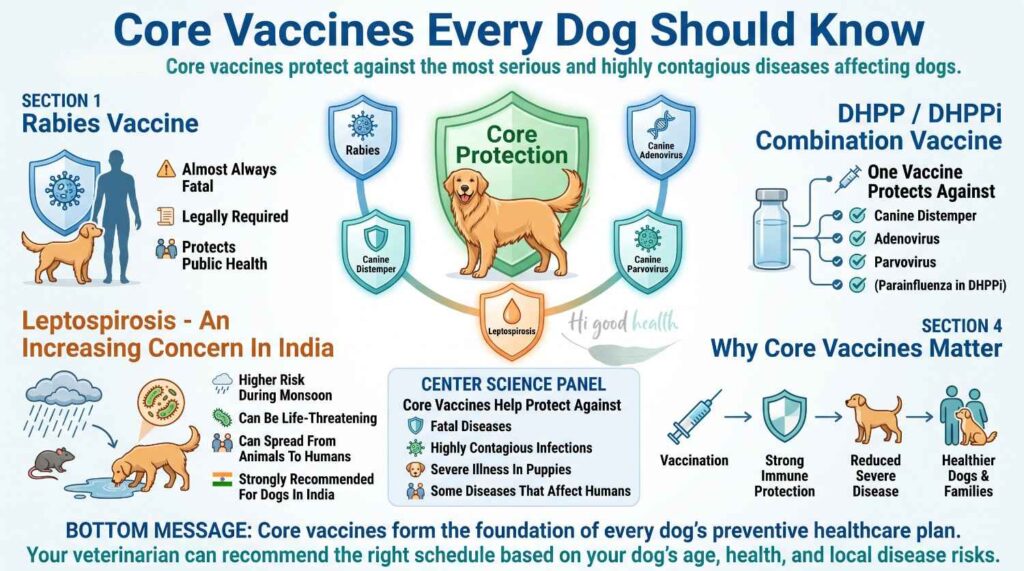
The lifestyle-based choices: Non-core vaccines
Some vaccines depend on how a dog lives. A social dog that goes to daycare, boarding, grooming, or training sessions may need Bordetella vaccination because respiratory infections spread more easily in shared dog spaces.
A dog that hikes, visits wooded trails, or lives in a tick-prone area may benefit from Lyme vaccination. A dog that explores puddles, society compounds,urban runoff, wet parks, or wildlife-prone areas may face more leptospirosis exposure.[petraah]
The key idea is that “optional” does not mean unimportant. It simply means the recommendation is driven by exposure rather than the same rule for every single dog.
Dog Vaccination Schedule: A Practical Timeline
As already discussed, the standard dog vaccination schedule followed by veterinarians across India is divided into core vaccines (essential for all dogs) and non-core vaccines (recommended based on lifestyle). Because maternal antibodies can interfere with early shots, puppies require a specific series of boosters to ensure long-term immunity.[petraah]
Puppy Vaccination Schedule (6–16+ Weeks)
The goal for puppies is to create a “bridge” of protection as their mother’s natural immunity fades.
Puppy’s Age | Core Vaccinations | Non-Core Vaccinations |
|---|---|---|
6–8 weeks | DHPPi+L (distemper, hepatitis,parvovirus,parainfluenza and leptospirosis) | Bordetella |
10–12 weeks | 1st Booster dose- DHPPi+L | Bordetella |
12-14 weeks | 2nd booster of DHPPi+L, Rabies | corona |
16-18 weeks | Rabies | Corona |
Every year | DHPPi+L, Rabies | Bordetella,Corona |
[conbun]
Note: Some veterinarians now recommend a final DHPPi booster at 18–20 weeks for certain high-risk breeds or environments to ensure the “immunity gap” is fully closed. Indian vets particularly recommend this for breeds like Labradors, Golden Retrievers, and German Shepherds that are common in Indian households. [petraah]
Adult Dog Vaccination Schedule and Annual Boosters
Once the puppy series and the 1-year boosters are complete, the frequency of shots typically decreases for core vaccines.
1. Core Vaccines (Essential)
- Rabies: Required by law across India. Indian vets recommend annual rabies boosters given the country’s high stray dog population and rabies exposure risk. [wsava]
- DHPPi+L: WSAVA guidelines, applied in the Indian context, suggest these are effective for every 3 years in most adult dogs, though many Indian vets recommend annual boosters due to high environmental exposure. [indiacode.nic]
2. Non-Core Vaccines (Lifestyle-Dependent)
These generally require annual (yearly) boosters because the immunity they provide doesn’t last as long as core vaccines:
- Bordetella (Kennel Cough): Recommended for dogs visiting groomers, parks, or boarding. Some high-traffic facilities may require this every 6 months.
- Tick-borne diseases: Relevant for dogs in forested, hilly, or rural areas. Discuss with your vet based on your location. [petraah]
- Canine corona virus vaccine-This vaccine will work only for the CCoV type of coronavirus. It is not effective for the prevention of COVID-19.Hence discretion is based on the vet and the pet’s lifestyle and environment.
Titer Testing: If you are concerned about over-vaccination for an adult dog, you can ask your vet for a titer test. This blood test measures the level of existing antibodies in your dog’s system to determine if a booster is actually necessary for Distemper or Parvo. (Note: This cannot be used in place of the Rabies vaccine for legal requirements.)
Rabies Vaccine for Dogs: Schedule, Law and Cost
Rabies deserves its own section because it is the one vaccine in the dog vaccination schedule that protects people as much as the dog. India carries a large share of the world’s human rabies deaths, and almost all of them follow a dog bite.
The anti rabies vaccine for dogs is normally given at 12 weeks or later, repeated once after a year, and then annually. Some vets follow a three-year protocol for adult dogs on certain products, but annual dosing remains the common practice in India.
Several states also make rabies vaccination a legal requirement for pet dogs and ask for a certificate when you register the animal with the municipal body. Check your city’s rules — enforcement and paperwork differ a great deal between municipalities.
Within a dog vaccination schedule, expect roughly ₹300 to ₹600 a dose for the canine rabies vaccine at a private clinic, before consultation. Government veterinary hospitals and many municipal camps offer it far cheaper or free — worth asking about, particularly if you look after community dogs.
Dog Vaccination Cost in India: What to Budget
Cost is the part most dog vaccination schedule guides skip, and it is usually the first thing a new owner in India actually wants to know. The figures below are indicative private-clinic ranges as of 2026.
| Vaccine | Typical range per dose | How often |
|---|---|---|
| Anti-rabies | ₹300 to ₹600 | From 12 weeks, then yearly |
| DHPPi (often sold as 7-in-1) | ₹600 to ₹1,200 | Puppy course, then yearly |
| 9-in-1 or 11-in-1 combination | ₹800 to ₹1,500 | Puppy course, then yearly |
| Kennel cough (intranasal or injectable) | ₹600 to ₹1,200 | Lifestyle-dependent |
| Canine corona | ₹500 to ₹800 | Lifestyle-dependent |
| Consultation fee per visit | ₹300 to ₹800 | Each visit |
Totalled up, a full first-year dog vaccination schedule usually lands between ₹3,000 and ₹6,000 including consultations, and annual boosters after that run ₹1,200 to ₹2,500.
Metro clinics sit at the top of these ranges and small-town practices well below them. Government veterinary hospitals and NGO camps are cheaper again. Prices also move year to year, so use this to plan rather than to argue with your vet’s invoice.
Indian Vaccine Brands: What Your Vet Is Likely to Stock
Owners often see a brand name on the vaccination card and cannot tell what it covers. These are the products that most commonly fill an Indian dog vaccination schedule.
Nobivac (MSD) is the range most widely stocked — Nobivac Rabies, Nobivac DHPPi for the core combination, and Nobivac KC for kennel cough. Raksharab (Indian Immunologicals) is a widely used Indian-made rabies vaccine and is typically the cheaper option. Megavac and Canishot also appear on Indian vaccination cards.
Brand matters far less than cold chain and timing. A correctly stored, correctly timed dose of an Indian-made vaccine protects a dog properly. Ask that the vial is taken from the refrigerator in front of you and that the batch number goes onto the card.
Breed Notes: Labrador, German Shepherd and Shih Tzu in India
The dog vaccination schedule itself does not change by breed. What changes is exposure, and that is worth thinking about for India’s three most popular breeds.
Labradors and German Shepherds are large, outdoor-oriented and frequently walked in parks and on streets, which raises their exposure to leptospirosis from puddles and rodent urine and to kennel cough from other dogs. Both are also commonly boarded during travel, and most boarding facilities in India require a current kennel cough vaccination.
Shih Tzus and other small indoor breeds have lower street exposure, but the core schedule is unchanged — parvovirus and distemper travel on shoes and hands, and an indoor-only puppy is not protected by staying indoors.
Discuss the non-core parts of the dog vaccination schedule with your vet based on where your dog actually goes, not on breed reputation.
Why dog vaccines matter more than many people think
The biggest misconception about dog vaccines is that risk only exists if your pet is directly interacting with a sick animal. In reality, many infectious threats are incredibly resilient and closer to home than most owners realize.
A dog can easily be exposed on a routine neighbourhood walk, in a shared apartment corridor, at the groomer, near standing water, or in a housing society garden frequented by stray animals.
Because of this, a dog’s vaccine plan is about much more than pet wellness—it is a critical layer of family health due to zoonotic diseases, which are infections that can spread directly from animals to humans.
Rabies is the most urgent example of why this prevention matters. According to the World Health Organization (WHO), India accounts for 36% of the world’s rabies deaths, resulting in over 20,000 human fatalities annually, with most caused by dog bites.
The National Centre for Disease Control (NCDC) emphasizes that keeping pets vaccinated against rabies is one of the most vital public health measures a family can take.
In most Indian cities and towns, encounters with stray animals are a realistic everyday occurrence. When your dog is vaccinated, it acts as a community shield; a chance encounter with a rabid animal ends quietly, rather than turning into a tragedy for your household.
Leptospirosis, often called “lepto,” is another severe, life-threatening infection that owners frequently underestimate. The World Small Animal Veterinary Association (WSAVA) and Indian veterinary bodies warn that dogs easily contract leptospirosis from contaminated water, soil, or the urine of infected wildlife and strays.
Once infected, a dog can bring that bacteria into the home, creating an environmental contamination risk for the entire family.
Indian veterinary experts note that vaccinating dogs against lepto is crucial for protecting human households, particularly during and after the monsoon season when standing water causes cases to spike. Ultimately, preventing transmission starts at home, and vaccinating your pet is the most effective way to stop these dangerous pathogens from entering your living room.
Common myths vs reality
Myth 1: “My dog stays in a fenced compound, so the risk is low.”
A fence keeps a dog contained, but it does not keep disease out. Stray animals, contaminated soil, runoff water, and even other small animals can introduce infectious risks into a compound or garden.
Myth 2: “My dog is indoors, so vaccines are not necessary.”
Indoor dogs are not sealed off from the outside world. People carry contamination on shoes, clothes, bags, and hands, and indoor dogs still go to the vet, use shared apartment spaces, and step outside for walks or bathroom breaks.
Parvovirus, for example, can survive on shoes and floors for months — your dog does not need to leave the flat to be exposed. [petraah]
Myth 3: “Vaccines are more dangerous than the diseases.”
It is reasonable for owners to worry about side effects, but the balance of risk still strongly favours vaccination. The diseases being prevented can be severe or fatal, while serious vaccine reactions are much less common.
A complete puppy vaccination course costs approximately ₹2,500–5,000. Treatment for parvovirus alone can cost ₹15,000–40,000 — and there is still a 20–30% mortality rate even with treatment. Rabies in dogs is always fatal once symptoms appear. [petraah]
What to expect after your dog is vaccinated
Most dogs do very well after vaccination. Some may be a little sleepy, less excited about a walk, mildly sore at the injection site, or less interested in food for a short period. That is often a normal sign that the immune system is responding.
A useful rule is the “24-hour lens.” Mild lethargy, slight soreness, and a temporary dip in appetite are usually expected and often pass quickly. Most vets in India will ask you to wait 15–20 minutes at the clinic after vaccination to observe for any immediate reactions.
Still, owners should know the warning signs that need prompt veterinary attention. Facial swelling, hives, repeated vomiting, diarrhoea, collapse, or difficulty breathing are not normal post-vaccine reactions and should be treated seriously.
What the latest science is saying
The latest guidance is not just telling owners to vaccinate. It is telling veterinarians to think more carefully about who needs what and when. The WSAVA 2024 Vaccination Guidelines emphasise individualised vaccination based on immune status, risk exposure, and duration of immunity.[indiacode.nic]
The most important practical update for Indian dog owners is the stronger recommendation around leptospirosis. WSAVA and the Indian Veterinary Research Institute (IVRI) now recommend annual leptospirosis vaccination for all dogs starting at 12–18 weeks of age, after an initial two-dose series spaced four weeks apart. [biogal]
IVRI and practising Indian veterinarians also say experts recommend all dogs be vaccinated against leptospirosis, beginning at 12–18 weeks of age, with two vaccinations spaced four weeks apart and annual boosters after that. [petraah]
This matters because older advice often treated lepto as something only “farm dogs” needed. Newer evidence and guidance paint a different picture: the disease is broader, especially in urban Indian settings with monsoon flooding, the public health implications are real, and routine discussion belongs in mainstream dog care.[scribd]
A practical prevention plan for owners
Every dog is unique, and the best protection plan should be unique too. That does not mean the process has to be complicated. It simply means the plan should match the dog’s actual life.
A helpful way to approach the next vet visit is to ask:
- Which vaccines are core for this dog right now?
- Which lifestyle vaccines fit this dog’s routine?
- What is the vaccination schedule for new puppies?
- Which boosters are due, and when?
- What mild reactions are normal, and what symptoms mean the clinic should be called immediately?
That short conversation can prevent a lot of confusion. It can also save owners from relying on generic social media advice that does not reflect their dog’s age, environment, or health history.
A common scenario across India: Ravi from Nagpur got his Labrador’s puppy vaccines done properly. Life got busy. One year became three years. Then his dog was bitten by a stray during a walk, and the vaccination certificate showed the last rabies shot was years ago.
The family had to go through revaccination, monitoring, and weeks of anxiety — all of which was completely avoidable. [conbun]
If there is one action step worth taking today, it is this: check your dog’s records. Open the vet app, pull out the paperwork, or call the clinic and ask what is due. Keep physical copies and photograph every vaccination record — housing societies, airlines, and boarding centres across India increasingly require up-to-date documentation.
A few minutes of planning now can provide years of healthier, safer living later.[conbun ]
Why vaccination is an investment in longevity
It is easy to focus on the needle because it is the visible part of the appointment. But the true value of vaccination is what happens after that moment: fewer preventable diseases, lower emergency risk, stronger public health protection, and better odds that the dog remains a happy part of the family for years to come.
Vaccination is not about overmedicalising normal life. It is about proactive wellness — choosing prevention before a painful or expensive crisis forces the issue. In a country with one of the world’s highest rabies burdens, this is not just good pet care. It is responsible citizenship. [conbun]
At Hi Good Health, the goal is to make this kind of information simple, credible, and useful. Families deserve guidance that cuts through myths, explains the science clearly, and helps them make practical everyday health decisions for the animals they love.
If a Dog Bites Someone: What to Do First
This is the one part of this page that is not about your dog. A bite that breaks the skin is a medical emergency for the person bitten, and it is handled by a doctor, not by a vaccination chart.
Wash the wound immediately with soap under running water for at least 15 minutes. This single step removes a large part of the virus load and is the most useful thing anyone can do in the first hour. Then apply an antiseptic such as povidone-iodine.
Go to a hospital the same day. Do not wait to see whether symptoms appear. Once rabies symptoms begin it is almost always fatal, and it is almost entirely preventable when post-exposure treatment starts promptly.
Do not apply chilli powder, turmeric, oil or lime to a bite wound, and do not have it stitched closed unless a doctor decides it is necessary. These are common responses in India and they make the outcome worse rather than better.
The doctor decides what treatment is needed and on what dates. That usually means a course of anti-rabies vaccine, and for deeper or multiple wounds they may add rabies immunoglobulin. Follow the dates you are given exactly and complete the course.
On cost: anti-rabies vaccine is available free or heavily subsidised at many government hospitals in India under the national rabies control programme, and runs roughly ₹350 to ₹600 a dose privately. Immunoglobulin costs considerably more. Never let cost delay the first visit — go to a government hospital if that is the affordable route, but go today.
A dog with an up-to-date rabies vaccination is much lower risk, and that is a large part of why the vaccine matters. It does not remove the need for the bitten person to be assessed by a doctor.
Key Takeaways
- The puppy dog vaccination schedule runs from 6 to 8 weeks in three or four rounds about three weeks apart, finishing around 14 to 16 weeks.
- Rabies sits outside the core dog vaccination schedule and is given separately from around 12 weeks, then annually.
- In several Indian states rabies vaccination is also a legal requirement for registration.
- Budget ₹3,000 to ₹6,000 for the first-year course including consultations, and ₹1,200 to ₹2,500 a year for boosters. Government veterinary hospitals cost far less.
- Nobivac and Raksharab are the brands most commonly stocked in India for a dog vaccination schedule. Cold chain and correct timing matter more than which brand is used.
- Breed does not change the schedule. Exposure does — outdoor and boarded dogs need the lifestyle vaccines discussed with a vet.
- An indoor puppy is not automatically safe. Parvovirus and distemper travel indoors on shoes and hands.
- If a dog bites a person: wash for 15 minutes with soap under running water, then get to a hospital the same day. Do not wait for symptoms and do not let cost delay it.
Frequently Asked Questions
What is the dog vaccination schedule for a puppy in India?
Most vets start at 6 to 8 weeks and give three or four rounds about three weeks apart, finishing around 14 to 16 weeks. The core combination covers distemper, hepatitis, parvovirus and parainfluenza, with leptospirosis usually included. Rabies is given separately from about 12 weeks. Your vet sets the exact dates based on the puppy age and health.
How much does dog vaccination cost in India?
At a private clinic in 2026, expect roughly ₹3,000 to ₹6,000 for the complete first-year course including consultation fees, and ₹1,200 to ₹2,500 a year for boosters after that. Individual doses run about ₹300 to ₹600 for rabies and ₹600 to ₹1,500 for the core combinations. Government veterinary hospitals and NGO camps cost considerably less.
When should a puppy get the rabies vaccine?
Usually at 12 weeks or later, repeated once after a year and then annually. Some products allow a three-year interval for adult dogs, but annual dosing remains common practice in India. Several states require a current rabies certificate to register a pet dog.
What is the difference between 7-in-1 and 9-in-1 dog vaccines?
They differ in how many diseases the single injection covers. A 7-in-1 typically covers the core group plus a couple of leptospirosis strains, while 9-in-1 and 11-in-1 add further leptospirosis serovars and sometimes canine coronavirus. More valencies is not automatically better — the right choice depends on what your dog is actually exposed to, which is a conversation for your vet.
My rescue dog has no vaccination record. What should I do?
This is very common with Indian street rescues. Vets normally restart the core course from scratch rather than guess, because there is no risk in vaccinating a dog that may already have some protection. Get the dog examined first — a sick or heavily parasitised dog is usually treated before vaccination begins.
What should I do if a dog bites someone?
Wash the wound with soap under running water for at least 15 minutes, apply an antiseptic, and get to a hospital the same day. Do not wait to see whether symptoms appear, and do not apply chilli, turmeric or oil. The doctor decides what treatment is needed. Anti-rabies vaccine is free or subsidised at many government hospitals in India, so cost should never delay the first visit.
External Sources
- WHO: Rabies in India
- WOAH: Rabies
- WSAVA 2024 Vaccination Guidelines (PDF)
- WSAVA Core and Non-Core Vaccine Recommendations
- Indian Veterinary Research Institute (IVRI) — Canine Vaccination Protocols
- National Centre for Disease Control (NCDC), India — Rabies Data
- Canine Leptospirosis in Bengaluru — Study Results
- Petraah: Complete Dog Vaccination Schedule India 2026
[scribd]
Glossary
- Booster: A repeat vaccine dose used to refresh protection over time.
- Core vaccine: A vaccine recommended for most or all dogs because the disease risk is serious or broadly relevant.
- Distemper: A serious viral disease of dogs covered by core vaccination.
- Leptospirosis: A bacterial disease dogs can catch from contaminated water, soil, or urine; it can also infect people. Particularly prevalent during India’s monsoon season.
- Lifestyle vaccine: A vaccine recommended based on a dog’s activities, geography, or exposure risk.
- Parvovirus: A highly contagious viral disease that can be especially dangerous in puppies. Thrives in India’s warm, humid climate.
- Zoonotic disease: A disease that can spread between animals and humans.
[scribd]
Disclaimer
This article is for educational purposes only and does not replace personalised veterinary advice. Vaccine decisions should always be made with a licensed veterinarian who can assess a dog’s age, medical history, local disease patterns, and lifestyle risk.
