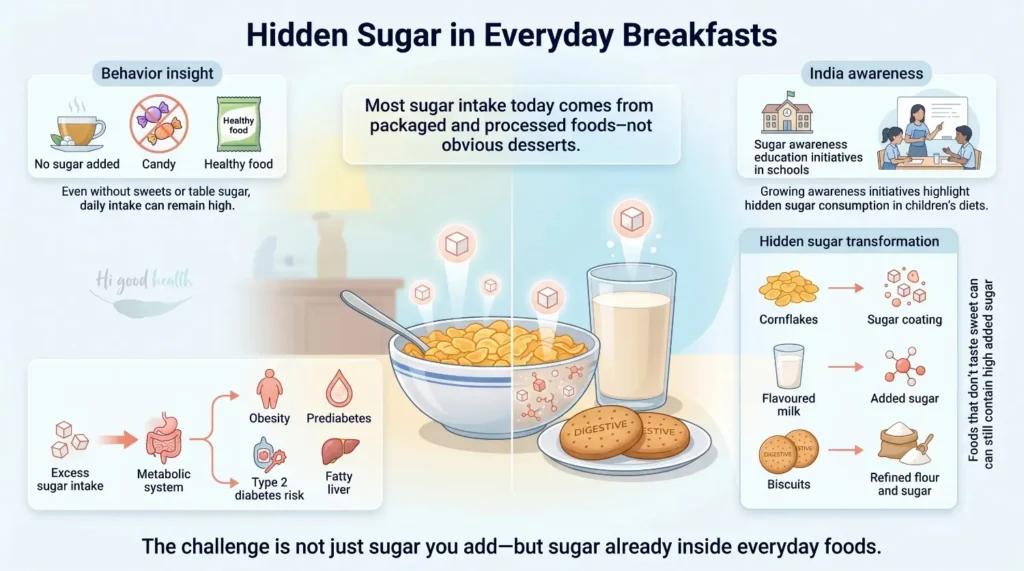
Imagine a child starting the day with what many Indian parents consider a healthy breakfast:
- A bowl of cornflakes
- A glass of flavoured milk
- Two digestive biscuits
It sounds nutritious, doesn’t it?
Yet this breakfast may contain several teaspoons of added or free sugars before the day has even begun.
Many people think they consume very little sugar because they avoid sweets, stop adding sugar to tea, or choose “healthy” packaged foods. Unfortunately, much of today’s sugar intake comes from foods that do not even taste particularly sweet.
Recent concern over rising sugar consumption among Indian children has become so significant that the Central Board of Secondary Education (CBSE) advised schools to install “Sugar Boards” to educate students and parents about excessive sugar intake and its health effects. [5]
The message is clear: the biggest source of sugar in many diets is no longer sweets and desserts—it is packaged food. That is what hidden sugar in food means in practice.
This matters because India is facing a growing burden of obesity, prediabetes, type 2 diabetes, and fatty liver disease. While many factors contribute to these conditions, excessive consumption of hidden sugars and highly processed foods is an important piece of the puzzle.
The real problem is often not the sugar you see. It is the sugar you don’t.
At a glance
Most hidden sugar in food is not in sweets at all. It is in cornflakes, flavoured yoghurt, ketchup, biscuits, packaged juice, bread and drinks sold as nutrition products. The World Health Organization advises keeping free sugars below 10% of daily energy, and says there is further benefit below 5%. [1]
Jaggery, honey, coconut sugar and date syrup are all added sugars. They are less refined than white sugar, but the body still handles them as sugar. Refined starches such as maida and rice flour raise blood glucose just as quickly, and they never appear under sugar on a label at all.
The reliable test is the ingredient list, not the claim on the front of the pack. Anything ending in -ose is a sugar, and several sugar names in one list usually means more sugar than the product looks like it contains.
If you have diabetes, prediabetes or another metabolic condition, set your intake with your doctor rather than from a general guideline.
What Exactly Is Sugar?
Sugar is a type of carbohydrate that provides energy to the body.
When you eat carbohydrate-containing foods, the digestive system breaks them down into simple sugars, primarily glucose, which enter the bloodstream and provide energy.
Not all sugars are the same.
Understanding the difference between natural sugar and added sugar can help you make healthier choices.
Added Sugar vs Natural Sugar: What Is the Difference?
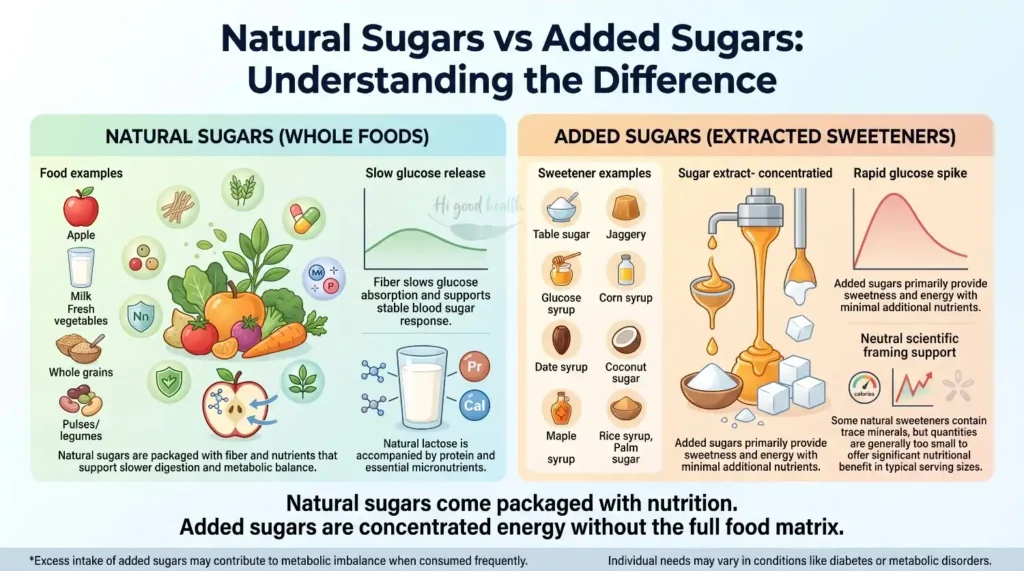
Natural Sugars
Natural sugars occur naturally in foods such as:
- Fruits
- Milk
- Vegetables
- Whole grains
- Pulses
These foods also contain beneficial nutrients such as fibre, vitamins, minerals, antioxidants, and plant compounds.
Example
An apple contains natural sugar, but it also contains fibre that slows digestion and helps prevent a rapid rise in blood sugar.
Similarly, milk contains lactose (a natural sugar), but it also provides protein, calcium, and other nutrients.
For most healthy individuals, naturally occurring sugars consumed through whole foods are generally not a major concern because they are accompanied by fibre and other beneficial nutrients. However, individuals with diabetes or certain metabolic conditions may still need to monitor total carbohydrate intake.
Added Sugars
Added sugars are sugars that manufacturers, cooks, or consumers add to foods and beverages.
Examples include:
- Table sugar
- Jaggery
- Honey
- Glucose syrup
- Corn syrup
- Date syrup
- Coconut sugar
- Maple syrup
- Rice syrup
- Palm sugar
Unlike whole fruits and vegetables, these sweeteners primarily provide sweetness and calories. Although some, such as jaggery and honey, contain small amounts of minerals and antioxidants, these amounts are generally too small to provide significant health benefits.
When consumed frequently and in large amounts, they can contribute to excessive calorie intake and metabolic health problems.
Is Jaggery Better Than Sugar? The Jaggery, Honey and Coconut Sugar Myth
One of the most common nutrition myths in Indian households is that replacing sugar with jaggery automatically makes food healthy.
Many people say:
“I don’t use sugar. I use jaggery.”
Or:
“It’s made with honey, so it’s healthy.”
Unfortunately, this is not how the body works.
Expert Insight
Minal Joshi-Marathe, Dietitian,CDE explains:
“One of the most common misconceptions I see is that people believe jaggery, honey, or coconut sugar are sugar-free alternatives. While they may contain small amounts of minerals, they still raise blood glucose levels and should be considered added sugars.”
Jaggery, honey, date syrup, coconut sugar, and palm sugar may be slightly less processed than refined sugar, but they still contribute to total sugar intake.
A teaspoon of jaggery is still sugar.
A teaspoon of honey is still sugar.
A teaspoon of coconut sugar is still sugar.
Although their composition differs from table sugar, the body still metabolizes them as sources of dietary sugar.
Is Jaggery Better Than Sugar? What the Numbers Say
The mineral argument for jaggery is real but tiny, and the quantities are what kill it.
| Sweetener | What it adds beyond sweetness | How the body treats it |
|---|---|---|
| White sugar (chini) | Essentially nothing — close to pure sucrose | Added sugar |
| Jaggery (gur) | Traces of iron, potassium and magnesium; still largely sucrose | Added sugar |
| Palm jaggery | Slightly higher mineral traces than cane jaggery | Added sugar |
| Brown sugar | White sugar with some molasses returned; trace minerals | Added sugar |
| Honey | Trace enzymes and antioxidants | Free sugar |
| Coconut sugar | Small amounts of inulin and minerals | Added sugar |
The problem is dose. To take in a nutritionally meaningful amount of iron from jaggery you would have to eat far more sugar than any guideline allows — you would reach the harm long before the benefit. The same logic applies to the antioxidants in honey and the minerals in coconut sugar.
None of this means jaggery is banned. It means jaggery should be counted in the same budget as sugar, in the same teaspoons, rather than treated as a free pass. Use it because you like the flavour or because a dish traditionally calls for it — not because it is thought to cancel the sugar out.
Why Hidden Sugar in Food Is Difficult to Spot
If manufacturers simply wrote “sugar” on every ingredient list, consumers would have a much easier time making decisions.
Instead, sugar often appears under many different names.
Some of these names sound scientific and do not immediately suggest sugar.
As a result, consumers may unknowingly purchase products containing multiple forms of added sugar.
Hidden Sugar Names You Should Know
The following ingredients are all forms of sugar or ingredients that contribute significantly to sugar intake:
Common Sugar Names | Alternative Sugar Names |
|---|---|
Sucrose | Maltodextrin |
Glucose | Corn Syrup |
Fructose | High-Fructose Corn Syrup |
Dextrose | Brown Rice Syrup |
Maltose | Rice Syrup |
Lactose | Invert Sugar |
Galactose | Cane Syrup |
Honey | Cane Juice Concentrate |
Jaggery | Fruit Juice Concentrate |
Coconut Sugar | Molasses |
Palm Sugar | Date Syrup |
Maple Syrup | Agave Syrup |
Simple Rule
If an ingredient ends in “-ose”, it is usually a type of sugar.
Examples:
- Glucose
- Fructose
- Sucrose
- Maltose
- Dextrose
This simple trick can help you identify hidden sugars more easily when reading food labels, and it works even when the sugar figure on the panel looks low.
The Refined Starch Trap Most People Miss
Sugar is not the only ingredient capable of raising blood sugar quickly.
Many people carefully avoid sugar while unknowingly consuming large amounts of refined starch.
Examples include:
- Maida
- Tapioca starch
- Refined rice flour
- Corn starch
- Corn flour
These ingredients may not appear under the sugar section of a label, but they are rapidly broken down into glucose during digestion.
Many refined starches are rapidly digested and can cause substantial increases in blood glucose levels, sometimes comparable to those produced by foods containing added sugars
Expert Insight
“Many consumers focus only on the sugar content listed on the package and ignore refined starches. However, ingredients such as maida and refined rice flour can contribute significantly to blood glucose spikes,” says Minal Joshi-Marathe.
This is why foods such as:
- White bread
- Instant noodles
- Bakery products
- Refined breakfast cereals
- Packaged snacks
may not appear extremely sugary but can still contribute to poor metabolic health.
Where Hidden Sugar in Food Hides in Indian Diets
Many sources of hidden sugar in food are consumed daily in Indian households.
In fact, some of them are regularly marketed as healthy.
Breakfast Foods
- Cornflakes
- Chocolate cereals
- Granola
- Muesli
- Instant flavoured oats
- Breakfast bars
Dairy Products
- Flavoured yoghurt
- Sweetened curd
- Flavoured milk
- Milkshakes
- Sweet lassi
- Shrikhand
Packaged Foods
- Biscuits
- Cookies
- Bread
- Buns
- Pav
- Bakery products
- Chocolate spreads
Sauces and Condiments
- Tomato ketchup
- Pasta sauce
- Pizza sauce
- Sweet chilli sauce
- Imli chutney
Beverages
- Packaged fruit juices
- Energy drinks
- Sports drinks
- Soft drinks
- Sweetened tea beverages
Popular Health Drinks
Many parents are surprised to learn that several products marketed as nutrition drinks may contain substantial amounts of added sugars depending on the brand and formulation.
This is why reading the ingredient list is often more useful than trusting the marketing message on the front of the package.
10 Common Indian Foods That May Contain Hidden Sugar
Food | Hidden Sugar Source |
|---|---|
Cornflakes | Added sugar + refined starch |
Flavoured milk | Added sugar |
Digestive biscuits | Sugar + refined flour |
Ketchup | Sugar syrup |
Flavoured yoghurt | Added sugar |
Granola | Honey, syrups, sugar |
Packaged fruit juice | Fruit juice concentrate |
Chocolate spread | Added sugar |
Health drinks | Sugar and flavouring agents |
Bakery products | Sugar + refined starch |
Many of these foods are consumed daily and are often perceived as healthy choices.
The lesson is not that these foods must never be eaten. The lesson is to understand what they contain and consume them mindfully.
India’s Diabetes Crisis and the Role of Hidden Sugar in Food
India is home to one of the world’s largest populations living with diabetes and prediabetes.
Recent national estimates suggest that more than 100 million Indians are living with diabetes, with an even larger number affected by prediabetes. [6]
Several factors contribute to this trend:
- Sedentary lifestyles
- Reduced physical activity
- Increasing consumption of processed foods
- Excess calorie intake
- High consumption of refined carbohydrates
- Hidden sugars in packaged foods
While sugar alone does not cause diabetes, regularly consuming foods that cause repeated blood sugar spikes can contribute to weight gain, insulin resistance, and metabolic dysfunction.
What Happens Inside Your Body After a “Healthy” Breakfast?
Consider a breakfast that includes:
- A packet of flavoured oats
- A glass of flavoured milk
- Two digestive biscuits
Many people consider this a healthy breakfast.
Let’s see what happens inside the body.
Step 1: Rapid Digestion
The sugars and refined carbohydrates are digested quickly.
Step 2: Blood Sugar Rises
Glucose enters the bloodstream rapidly.
Step 3: Insulin Is Released
The pancreas releases insulin to help move glucose into cells.
Step 4: Energy Crash
Blood sugar may fall quickly after the spike.
Step 5: Hunger Returns
You feel hungry again much sooner than expected.
Step 6: The Cycle Repeats
You snack again.
More glucose enters the bloodstream.
More insulin is released.
Over time, cells may become less responsive to insulin.
This condition is known as insulin resistance. [11]
Insulin resistance is strongly associated with:
- Prediabetes
- Type 2 diabetes
- Fatty liver disease
- Obesity
- Heart disease
Expert Insight
“Many people think they have a slow metabolism when they feel hungry every few hours. In reality, highly processed breakfasts rich in sugar and refined carbohydrates often contribute to rapid blood sugar fluctuations and early hunger,” says Minal Joshi-Marathe.
Health Problems Associated With Excess Hidden Sugar in Food
Occasional consumption is unlikely to cause harm.
The concern arises when high sugar intake becomes a daily habit.
Research has linked excessive sugar consumption with:
- Prediabetes
- Type 2 diabetes
- Obesity
- Fatty liver disease
- Heart disease
- Metabolic syndrome
- Dental cavities
- Chronic inflammation
Children are particularly vulnerable because dietary habits established early in life often continue into adulthood.
How Much Sugar Per Day Is Safe?
Knowing where the hidden sugar in food is only helps if you know what you are measuring it against. There is a clear international number, and a stricter Indian one.
The World Health Organization recommends that free sugars stay below 10% of total daily energy, and states that dropping below 5% brings additional health benefits. The ICMR-NIN Dietary Guidelines for Indians take the tighter line, advising that added sugar stay under 5% of total energy intake. [3]
How Many Grams of Sugar Per Day Is That?
Percentages are hard to shop with, so here is the same guidance in grams and teaspoons. One level teaspoon of sugar is about 4 grams.
| Daily energy intake | WHO upper limit (10%) | WHO ideal (5%) |
|---|---|---|
| 1,600 kcal (many women, older adults) | 40 g / 10 tsp | 20 g / 5 tsp |
| 2,000 kcal (average adult) | 50 g / 12 tsp | 25 g / 6 tsp |
| 2,400 kcal (active adult) | 60 g / 15 tsp | 30 g / 7 tsp |
| Children, 4 to 10 years | Lower again — scale to their smaller energy needs | Roughly 4 to 5 tsp |
Set against that budget, single items stop looking harmless. One 300 ml soft drink can carry most of an adult’s ideal daily allowance on its own. A cup of sweetened flavoured yoghurt, a glass of flavoured milk and two biscuits can quietly finish it before lunch.
These are population guidelines for generally healthy people. If you live with diabetes, prediabetes, fatty liver or another metabolic condition, your target is a clinical decision — set it with your doctor or dietitian, not from a table.
Total Sugar vs Added Sugar on the Label
This is the single most confusing line on an Indian nutrition panel. Most packs declare total sugars, which lumps together the sugar naturally present in the ingredients and the sugar the manufacturer put in.
The difference between total sugar and added sugar is what the guideline above is actually about — the 5% and 10% limits apply to added and free sugars only, not to the lactose in plain milk or the fructose in a whole fruit.
A practical workaround when only total sugar is declared: check the ingredient list. Plain curd and plain milk have no added sugar even though total sugars are not zero.
A flavoured version of the same product with sugar, glucose syrup or fruit juice concentrate in the ingredients is carrying added sugar, and the gap between the two totals is roughly what was put in.
How to Read Food Labels for Sugar Like a Detective
Food labels can help you identify hidden sugar in food if you know what to look for. Label reading is the one skill that makes every other recommendation on this page usable.
Step 1: Read the Ingredient List
Look for ingredients such as:
- Sugar
- Dextrose
- Glucose syrup
- Maltodextrin
- Fruit juice concentrate
- Rice syrup
- Invert sugar
- Corn syrup
- Honey
- Jaggery
- Date syrup
If multiple sugar ingredients appear in the ingredient list, the product may contain more sugar than you realize.
Step 2: Check Total Sugar Content
Compare products and choose options with lower sugar content whenever possible.
Step 3: Check Fibre Content
Higher fibre generally slows glucose absorption and improves satiety.
Step 4: Check Protein Content
Protein can help reduce rapid blood sugar spikes and keep you fuller for longer.
Don’t Be Misled by Marketing Claims
Words such as:
- Natural
- Healthy
- Multigrain
- Fat-Free
- Nutritious
- Satvik
- Vegan
do not automatically mean low sugar.
Many products marketed as healthy contain significant amounts of added sugar.
Always trust the ingredient list and nutrition panel more than the advertising message on the front of the package.
Easy Swaps for Indian Families
Small changes often produce the biggest long-term benefits.
Instead of Flavoured Yoghurt
Choose:
✓ Plain curd with fresh fruit
Instead of Packaged Fruit Juice
Choose:
✓ Whole fruit
Instead of Sugary Breakfast Cereals
Choose:
✓ Homemade poha
✓ Vegetable upma
✓ Besan chilla
✓ Moong chilla
✓ Oats prepared at home without added sugar
Instead of Sweetened Health Drinks
Choose:
✓ Plain milk
✓ Buttermilk
✓ Lemon water
✓ Unsweetened beverages
Better Snack Choices
Choose:
✓ Fruit
✓ Roasted chana
✓ Nuts
✓ Makhana
✓ Sprouts
Instead of relying on packaged snacks.
Practical Habits That Actually Work
- Read labels before purchasing packaged foods.
- Include protein with breakfast.
- Limit sugary beverages.
- Keep healthy snacks available at home.
- Cook more meals at home whenever possible.
- Avoid assuming jaggery or honey makes a food healthy.
- Teach children to identify sugary foods early.
These small habits may seem simple, but they can significantly reduce daily sugar intake over time.
Key Takeaways
- Hidden sugar in food is mostly in packaged products, not sweets — cereals, biscuits, sauces, flavoured dairy and beverages.
- Keep free sugars under 10% of daily energy, ideally under 5% — roughly 6 teaspoons a day on a 2,000 kcal diet. ICMR-NIN advises the stricter figure.
- Jaggery, honey, coconut sugar and date syrup are still added sugars. Less refined does not mean lower impact on blood glucose.
- Maida and refined rice flour raise blood sugar rapidly and never appear as sugar on the panel — the sugar figure alone will not catch them.
- Most Indian packs declare total sugars, not added sugars. Use the ingredient list to tell the two apart.
- Front-of-pack words like natural, multigrain, satvik and fat-free say nothing about sugar content.
- If you have diabetes, prediabetes or fatty liver, set your own limit with a doctor rather than from a general guideline.
Frequently Asked Questions
Is jaggery healthier than sugar?
Jaggery contains small amounts of minerals, but it still raises blood sugar levels and should be consumed in moderation.
Is honey safe for people with diabetes?
Honey is still a form of sugar and can affect blood glucose levels. Individuals with diabetes should discuss appropriate intake with their healthcare provider.
Is fruit sugar harmful?
Whole fruits contain fibre, vitamins, minerals, and antioxidants. For most people, whole fruits are a healthy part of a balanced diet.
Are sugar-free products always healthy?
Not necessarily. Some sugar-free products contain refined starches, unhealthy fats, or artificial sweeteners. Always read the label.
How much added sugar should adults consume?
The World Health Organization recommends limiting free sugar intake to less than 10% of daily energy intake and suggests additional health benefits below 5%.
How do I read a food label for hidden sugar?
Start with the ingredient list rather than the nutrition panel. Ingredients are listed by weight, so anything sugar-like near the top matters. Look for sugar, glucose syrup, maltodextrin, invert sugar, fruit juice concentrate, jaggery and honey — and remember that anything ending in -ose is a sugar. Several sugar names in one list usually means more sugar than the product appears to contain.
What is the difference between total sugar and added sugar?
Total sugar includes both the sugar naturally present in an ingredient and the sugar a manufacturer put in. Added sugar is only the latter. WHO and ICMR-NIN limits apply to added and free sugars, not to the lactose in plain milk or the fructose in whole fruit. Most Indian packs declare only total sugars, so the ingredient list is what tells the two apart.
Is palm jaggery or brown sugar better than white sugar?
Only marginally, and not enough to matter. Palm jaggery and brown sugar carry slightly more trace minerals than refined white sugar, but the amounts are too small to be nutritionally useful at the quantities anyone actually eats. Count them in the same daily sugar budget as white sugar.
Conclusion
Hidden sugar in food has quietly become a regular part of modern diets.
It hides in breakfast cereals, biscuits, flavoured dairy products, sauces, packaged drinks, and even foods marketed as healthy.
The next time you pick up a packet labelled “healthy,” spend a few extra seconds reading the ingredients list.
You may be surprised to discover that the biggest source of sugar in your family’s diet is not dessert—it’s the foods you thought were helping you stay healthy.
The goal is not to eliminate sugar completely. It is to become aware of where it hides and make informed choices.
Small changes, repeated consistently, can have a powerful impact on long-term health.
This article is intended for educational purposes only and should not replace personalized medical advice. Individuals with diabetes, prediabetes, or other medical conditions should consult a qualified healthcare professional regarding dietary changes.
Glossary
Added Sugar: Sugar added during processing, cooking, or packaging.
Natural Sugar: Sugar naturally present in foods such as fruits, vegetables, and milk.
Blood Glucose: The amount of sugar present in the bloodstream.
Insulin: A hormone that helps move glucose from the blood into body cells.
Insulin Resistance: A condition in which cells become less responsive to insulin.
Prediabetes: Blood sugar levels that are higher than normal but not yet high enough for a diabetes diagnosis.
Refined Starch: Highly processed carbohydrates such as maida and tapioca starch that rapidly convert into glucose.
Maltodextrin: A processed carbohydrate commonly used in packaged foods that can raise blood sugar levels quickly.
Fruit Juice Concentrate: Concentrated fruit juice often used as a sweetener in processed foods and beverages.
Hidden Sugar: Sugar present in foods under names consumers may not immediately recognize.
REFERENCES
- World Health Organization (WHO). Guideline: Sugars Intake for Adults and Children.
https://www.who.int/publications/i/item/9789241549028 - Indian Council of Medical Research (ICMR). Dietary Guidelines for Indians.
https://www.icmr.gov.in - National Institute of Nutrition (NIN). Dietary Guidelines for Indians (Latest Edition).
https://www.nin.res.in/dietaryguidelinesindia2024.pdf - Ministry of Health and Family Welfare, Government of India – NPCDCS Programme.
https://mohfw.gov.in - CBSE Advisory on Sugar Boards in Schools.
https://www.cbse.gov.in/cbsenew/documents/Sugar_Board_Guidelines.pdf - International Diabetes Federation (IDF) Diabetes Atlas.
https://diabetesatlas.org - World Health Organization – Healthy Diet Fact Sheet.
https://www.who.int/news-room/fact-sheets/detail/healthy-diet - Harvard T.H. Chan School of Public Health – The Nutrition Source: Added Sugar.
https://nutritionsource.hsph.harvard.edu/carbohydrates/added-sugar-in-the-diet - American Heart Association – Added Sugars.
https://www.heart.org/en/healthy-living/healthy-eating/eat-smart/sugar/added-sugars - Academy of Nutrition and Dietetics – Understanding Added Sugars.
https://www.eatright.org - National Institute of Diabetes and Digestive and Kidney Diseases (NIDDK) – Insulin Resistance & Prediabetes.
https://www.niddk.nih.gov/health-information/diabetes/overview/what-is-diabetes/prediabetes-insulin-resistance
Additional Reference for the CBSE Sugar Board Statistic
- CBSE Circular: Installation of Sugar Boards in Schools to Create Awareness About Excess Sugar Consumption.
https://www.cbse.gov.in/cbsenew/documents/Circular_Sugar_Boards_Schools.pdf - National Institute of Nutrition (NIN) & ICMR Reports on Sugar Consumption and Dietary Patterns in India.
https://www.nin.res.in
Disclaimer
The content provided on higoodhealth.com is for general informational purposes only. While we strive to offer accurate and up-to-date content, much of the information is derived from publicly available sources and personal research. We do not make any warranties about the completeness, reliability, or accuracy of this information.
