What You Need to Know First
If your dog or cat looks healthy, it’s easy to assume worms aren’t a concern. Deworming is not something to do only when you see worms. Many pets carry intestinal worms or their eggs without obvious signs, and that can affect growth, digestion, energy, and even your family’s health.
At a glance: The Deworming Schedule at a Glance
Deworming in dogs and cats should start early, especially in puppies and kittens, and then continue on a risk-based schedule as they grow. The right tablet or an oral solution depends on the parasite, your pet’s age and weight, and your vet’s advice.
In India, a practical parasite-control routine matters because pets can pick up worms from soil, fleas, mosquitoes, contaminated surfaces, or even from their mother when they are very young.
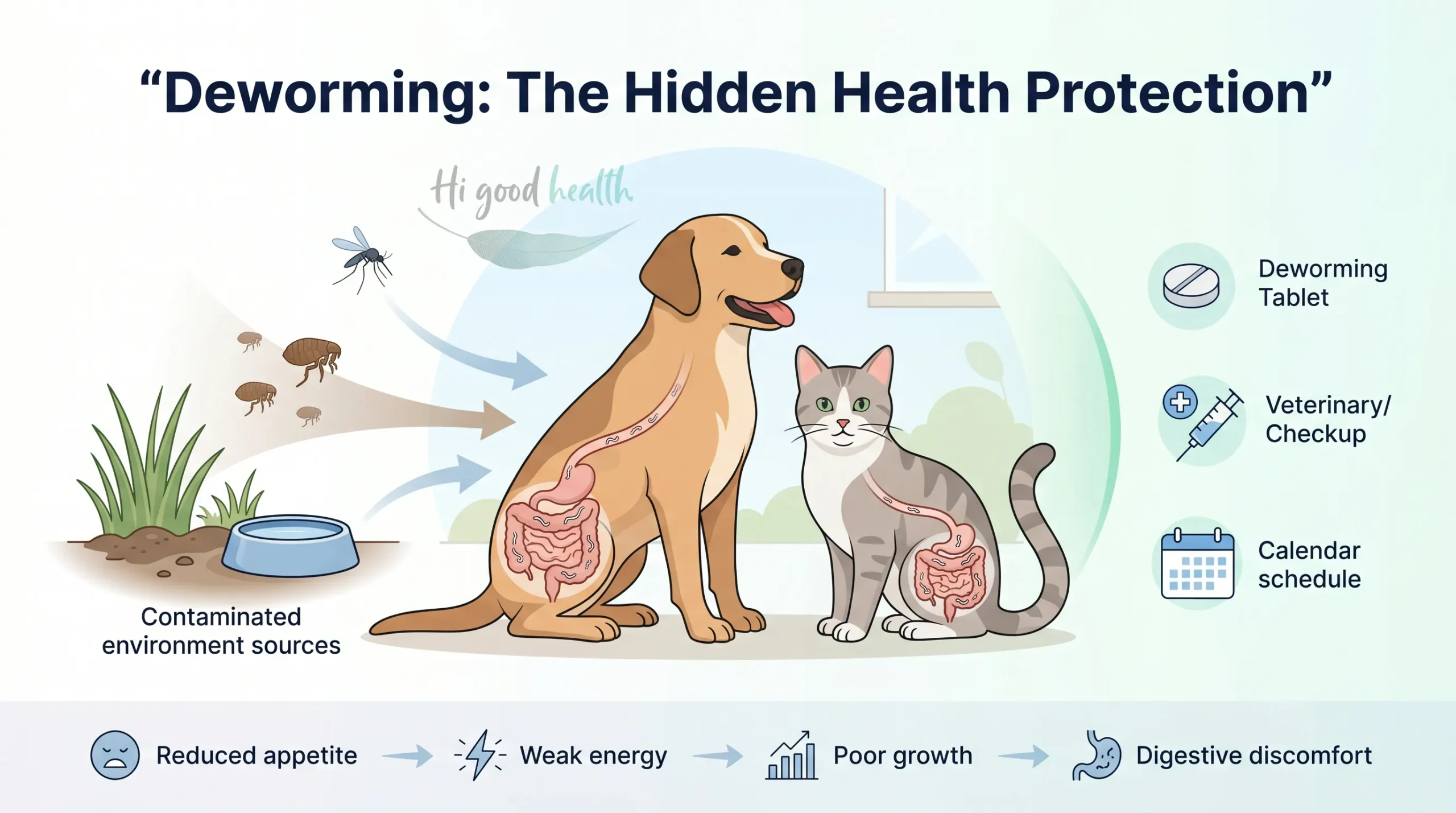
Why deworming matters
Worms feed on nutrients meant for your pet. They can cause poor growth, vomiting, diarrhoea, anaemia, a bloated belly, a dull coat, scooting, and low energy. In puppies and kittens, these signs can appear slowly, so owners may mistake them for simple stomach upset.
Some worms are zoonotic, which means they can spread from animals to people. That is why routine deworming, stool cleanup, flea control, and handwashing matter in Indian homes with children, elderly family members, or many pets.
Common worms in pets
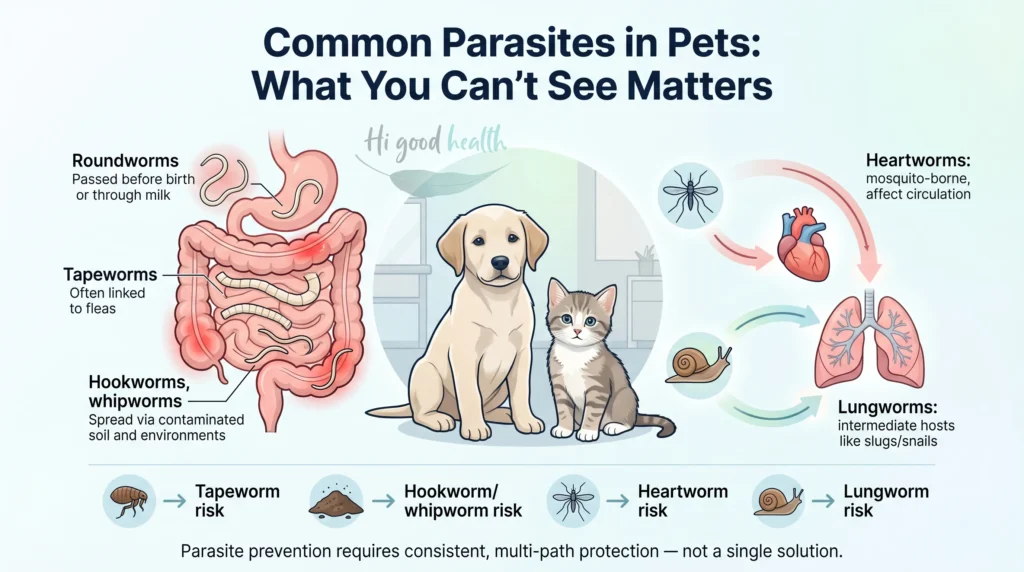
Roundworms are among the most common parasites in young animals. They can be passed before birth or through milk.
Tapeworms often come through fleas. Hookworms and whipworms usually spread through contaminated soil or environments and can damage the intestinal lining.
Heartworms and lungworms are more serious because they are linked to mosquitoes or intermediate hosts like slugs and snails. This is one reason parasite prevention should never be only about one tablet.
Deworming tablets: when they make sense
Deworming tablets are useful when the parasite type is known and the dose can be matched to the pet’s age, weight, and species. Since not all dewormers work against every parasite, using the wrong product may leave an infection untreated.
A veterinarian can help decide whether a tablet, liquid, or broader parasite plan is the safest choice for your pet.
Signs you should not ignore
Worm infestations can be tricky because the symptoms can easily look like a simple, temporary stomach upset. Keep a close watch for these three main types of warning signs:
1. Visual Signs
- Visible Worms or Segments: You may see live, moving roundworms (which look like spaghetti) or small, white tapeworm segments (which look like moving grains of rice) in your pet’s stool or vomit.
2. Physical Body Changes
- The Classic “Potbelly”: A distinct, round, and bloated stomach. This is especially obvious in puppies and kittens who carry a heavy roundworm load.
- Unexplained Weight Loss: Your pet loses weight or fails to grow, even though they have a perfectly normal—or massively increased—appetite.
- A Dull, Starved Coat: Their fur loses its natural shine and becomes dry, brittle, or coarse because the parasites are stealing vital nutrients from their body.
3. Behavioural & Digestive Signals
- Chronic Upset Stomach: Frequent vomiting and persistent, watery, or bloody diarrhoea.
- “Scooting”: If you see your dog or cat dragging their bottom across the floor, they are trying to soothe intense itching and irritation around the anus caused by migrating tapeworms.
- Lethargy: General weakness, sluggishness, and unusually low energy levels because their body is fighting off the infection and suffering from mild anemia.
Recommended Deworming Schedule for Dogs and Cats
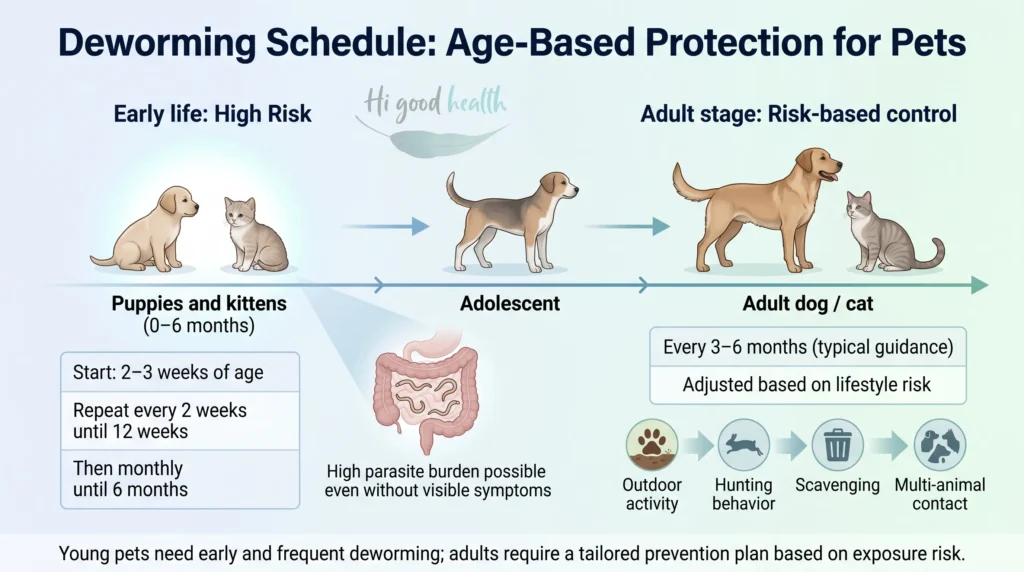
1. Puppies & Kittens
Young animals have virtually zero immunity and frequently contract worms from their mother’s milk or uterus. They require aggressive early intervention.
- 2 to 12 Weeks Old: Deworm every 2 weeks (specifically at weeks 2, 4, 6, 8, 10, and 12).
- 3 to 6 Months Old: Deworm once a month.
- 6 Months & Beyond: Transition to the adult risk-based schedule.
2. Adult Dogs & Cats (Age 6 Months+)
Once a pet reaches adulthood, their schedule is calculated based on their lifestyle and exposure risk:
- Standard Routine (Low-Risk): Every 3 months (4 times a year). This is standard for mostly indoor pets that go for controlled walks.
- High-Risk Pets: Every 1 to 2 months. This is recommended if your dog/cat scavenges, hunts, visits crowded boarding facilities, plays extensively with street animals, or lives in heavily waterlogged areas during the monsoon.
3. Pregnant & Lactating Mothers
Breeding and pregnant animals should follow a veterinarian-approved parasite-control plan. Depending on the medication used and the parasite risk, deworming may be recommended
To prevent passing roundworms and hookworms to the litter:
- Deworm the mother prior to mating.
- Deworm shortly before whelping (delivery), and then concurrently with her puppies/kittens every 2 weeks during early lactation (using vet-approved, safe formulations ).
Deworming schedule for dogs and cats
Pet Age | Recommended Deworming Schedule |
2–12 weeks | Every 2 weeks |
3–6 months | Once a month |
Over 6 months | Every 3 months (or as advised) |
High-risk adult pets | Every 1–2 months |
Pregnant females | As recommended by a veterinarian |
Crucial Note on Fleas & Mosquitoes: Tapeworms are almost always carried by fleas, and heartworms are carried by mosquitoes. If you give a deworming tablet but don’t treat the fleas on your pet’s skin, the tapeworms will return within weeks. True prevention requires a combined approach.
Test and Treat — Don’t Just Guess
Many pet owners assume that buying a random over-the-counter dewormer is enough to clear out parasites. However, blindly guessing can lead to undertreatment or using the wrong medication for a specific parasite.
Why Stool Testing is Crucial
A fecal examination is the safest, most effective way to protect your pet. It is highly recommended when your pet shows persistent symptoms, has high exposure to street animals, or when your vet wants to confirm that a previous treatment actually worked.
- Fecal Flotation: This standard, accessible lab test allows your vet to look at a stool sample under a microscope to detect floating parasite eggs.
- Molecular Tests (PCR): For stubborn or hidden infections, newer DNA-based molecular tests can identify specific parasites that traditional microscopic methods might miss entirely.
By testing first, your vet can match the exact medicine to the specific parasite inside your pet, avoiding unnecessary medication
What Each Worm Looks Like — and What It Does
Most owners find out their pet has worms by seeing one. It helps to know which one you are looking at, because the treatment, the route of infection and the risk to your family all differ — and two of the four most common worms are not visible in stool at all.
| Worm | What you would see | How the pet catches it | Signs to watch for |
| Roundworm | Long, white, cylindrical — like spaghetti or a rubber band. The one most often seen. | Contaminated soil; from the mother before or just after birth | Pot-bellied puppy, dull coat, poor growth, coughing, vomiting |
| Tapeworm | Small flat segments like grains of rice, often around the tail or in bedding | Swallowing an infected flea | Scooting, irritation around the rear, weight loss despite a good appetite |
| Hookworm | Usually invisible — needs a microscope | Swallowed, or burrows through the skin, often the paws | Blood loss, pale gums, weakness, black tarry stool |
| Whipworm | Usually invisible — needs a microscope | Contaminated soil; eggs survive a long time in the ground | Bloody diarrhoea, weight loss, straining |
| Heartworm | Never seen in stool — it lives in the heart and lungs | Mosquito bite | Cough, tiring easily, breathlessness. Often silent until advanced |
The single most useful thing on this table is the invisibility. Hookworm and whipworm — the two that cause blood loss and bloody diarrhoea — are the ones you will not see. So “I checked and there were no worms” is not a clean bill of health, and it is the most common reason a real infection goes untreated for months.
Two of them also change what else you must treat. Tapeworm comes from fleas, and heartworm comes from mosquitoes — so a dewormer alone will not stop either coming straight back.
Worms Your Family Can Catch — Why This Is a Child-Safety Question in India
The live version of this article said, correctly, that some worms are zoonotic. It is worth being much more specific, because the risk is real, it falls mainly on children, and it is almost entirely preventable.
Roundworm (Toxocara canis) is the one that matters most. A dog sheds eggs in its stool; the eggs mature in soil; a child playing in that soil gets them on their hands and then in their mouth. Children are at higher risk than adults for exactly this reason — hand-to-mouth contact and playing in soil, which in most Indian neighbourhoods means shared ground that free-roaming dogs also use.
In people the larvae cannot complete their life cycle, so they wander. That produces two conditions worth knowing by name:
- Visceral larva migrans — larvae migrating through the abdominal organs, causing fever, abdominal pain, nausea and a raised eosinophil count, sometimes with liver, spleen or lung involvement.
- Ocular larva migrans — larvae reaching the back of the eye. It usually affects one eye, typically in children aged around five to ten, and it is a leading infectious cause of childhood blindness.
This is not written to frighten anyone. It is rare, and the prevention is almost embarrassingly simple: keep the pet on its deworming schedule, pick up and dispose of stool rather than leaving it on shared ground, and make handwashing after playing outside and after handling the pet a fixed habit for children. Hand hygiene is the single measure that does the most.
Hookworm has a second, milder human route worth mentioning: its larvae can burrow into skin from contaminated ground, producing an itchy, winding track — which is why shoes matter in areas where dogs foul the soil.
After the Tablet: Which Side Effects Are Normal
Owners often stop deworming because the first dose upset the pet. Knowing what is expected makes that far less likely.
Usually normal, and usually short-lived — most settle within a few hours to about 24 hours:
- Mild vomiting
- Loose stools or mild diarrhoea
- Reduced appetite for a meal or two
- Visible worms in the stool — unpleasant, but it means the medicine is doing its job
Call the vet within a day if: the upset stomach is still going after 24 hours, the pet refuses food for more than a day, or the tiredness is not lifting.
Go now, do not wait, if there is: difficulty breathing, tremors or seizures, or severe weakness or collapse. Those are not side effects to sit out.
One practical note that prevents most problems: deworming doses are by weight, and puppies gain weight fast. A dose calculated a month ago may now be wrong. Weigh before you dose, or let the vet do it.
Can Worms Become Resistant to Deworming Medicines?
Repeated use of the same deworming medication over long periods may contribute to reduced effectiveness in some parasite populations. While dewormer resistance is more commonly discussed in livestock, veterinarians are increasingly monitoring for similar concerns in companion animals. This is one reason why routine parasite control should not rely on repeatedly giving the same product without considering your pet’s actual risk factors and health status.
At-Home Care and Prevention
Administering a deworming tablet is only half the battle. True parasite control happens at home through simple daily habits. Use this checklist to keep your home and your pet safe:
- Keep a Pet Health Log: Always note down the date, your pet’s weight, the exact brand name, and the dosage given. Tracking this on your phone or a calendar prevents dangerous accidental double-dosing and ensures you never miss a routine due date.
- Fight Fleas and Mosquitoes Concurrently: Do not view external pests as a separate issue. Fleas carry tapeworm larvae, and mosquitoes carry heartworms. If you do not use regular flea preventatives (like spot-ons or collars), your pet will ingest a flea while grooming and catch tapeworms all over again within weeks.
- Scoop Poop Immediately: Intestinal parasite eggs are shed in feces and can live in lawn soil for months or even years. Cleaning up your dog’s stool instantly or scooping the cat’s litter box daily breaks the re-infection cycle.
- Practice Strict Hygiene: Always wash your hands thoroughly with soap after playing with your pet, handling their toys, or gardening. This is the single easiest way to protect your human family from zoonotic (animal-to-human) worms.
- Limit Scavenging: Keep your pets on a leash during walks to prevent them from drinking from stagnant monsoon puddles, sniffing contaminated street waste, or scavenging through garbage piles where parasite eggs thrive
Conclusion
Deworming is not a one-time fix or an emergency treatment to use only when you spot a worm. In India’s warm, tropical climate, it is a foundational pillar of preventative pet healthcare. By staying consistent with an age-appropriate schedule, treating external pests like fleas and mosquitoes, and opting for veterinary diagnostic testing over simple guesswork, you aren’t just giving your dog or cat a healthier, higher-energy life—you are actively keeping your entire human household safe from zoonotic diseases.
Remember, the safest and most effective parasite plan is always the one tailored to the specific pet sitting right in front of you. Partner with your veterinarian to establish a routine that matches your pet’s exact lifestyle and risks.
Key Takeaways
- Deworming in dogs and deworming in cats should be routine, not occasional.
- Puppies and kittens need earlier and more frequent deworming.
- Adult pets: every three months as the default, and every one to two months if the risk is high. The full chart is above.
- Two of the four common intestinal worms are invisible in stool. Hookworm and whipworm need a microscope — so “I looked and saw nothing” is not a clean result.
- Roundworm is a child-safety issue, not only a pet one. Handwashing after outdoor play and after handling the pet is the single most effective prevention.
- Doses are by weight and puppies grow fast. Weigh before you dose.
- Mild vomiting or loose stools after a tablet usually settle within a day. Breathing difficulty, tremors, seizures or collapse do not — those are a vet, now.
- Deworming and vaccination are separate schedules that overlap in the first few months: Understanding Canine Immunisations.
- If the pet is also vomiting, has diarrhoea or has gone off food, start there instead: Puppy Vomiting and Diarrhoea · Why Is My Pet Not Eating?
- Flea control and mosquito control are part of worm prevention.
- Stool testing helps when symptoms are unclear or risk is high.
Frequently Asked Questions
How often should dogs and cats be dewormed?
Puppies and kittens need it often — every two weeks from 2 to 12 weeks of age, then monthly until six months. From six months, every three months is the usual plan, moving to every one or two months for high-risk pets. Pregnant females follow whatever the vet advises. The full chart is above.
Can indoor pets get worms?
Yes. Indoor pets can still be exposed through fleas, shoes, contaminated soil, litter, mosquitoes, or contact with other animals.
Do pets need deworming if they look healthy?
Yes. Many worm infections stay hidden at first and may not cause dramatic symptoms early on.
Can people catch worms from pets?
Yes. Roundworm is the main one — a child who gets soil on their hands and then in their mouth can pick up the eggs, and in rare cases the larvae migrate through the organs or the eye. Hookworm larvae can also burrow through skin from contaminated ground. Keeping the pet on schedule, picking up stool and making handwashing a habit for children is what prevents it.
How do I know whether a dewormer is working?
Your vet may suggest stool testing if symptoms persist or if they want to confirm treatment success.
What is the puppy deworming schedule in India?
Every two weeks from two weeks of age until twelve weeks, then once a month until six months old, then every three months as an adult. High-risk adults — free-roaming, hunting, heavy flea exposure, or living with young children — may need it every one to two months. Pregnant females follow a schedule set by the vet. This is the same schedule used internationally; what changes in India is the risk level, not the timing.
What are the symptoms of worms in dogs?
The general picture is a pot belly, a dull coat, poor growth in a puppy, weight loss despite eating normally, vomiting, diarrhoea, coughing, or scooting along the ground. Which worm it is changes the picture: roundworm shows up as poor growth and a pot belly, tapeworm as rice-like segments near the tail and scooting, hookworm as pale gums and weakness from blood loss, whipworm as bloody diarrhoea, and heartworm as coughing and tiring easily. Two of those, hookworm and whipworm, are not visible in stool at all.
What do worms look like in dog poop?
Roundworms look like spaghetti or a rubber band — long, white and cylindrical, and they are the ones most often seen. Tapeworms appear as small flat segments resembling grains of rice, often near the tail or in bedding rather than in the stool itself. Hookworms and whipworms are usually invisible without a microscope, which is why seeing nothing is not proof there is nothing.
What are the side effects of deworming tablets in dogs?
Mild vomiting, loose stools, a reduced appetite for a meal or two, and visible worms in the stool are all common and usually settle within a few hours to about 24 hours. Call the vet if the upset is still going after a day, if the pet refuses food for more than a day, or if lethargy is not lifting. Difficulty breathing, tremors, seizures, severe weakness or collapse need a vet immediately, not a wait.
What are the signs of heartworm in dogs?
Coughing, tiring easily on walks, and breathlessness — but heartworm is often silent until it is advanced, which is what makes it different from intestinal worms. It comes from mosquito bites, not from soil or fleas, so an ordinary deworming tablet does not prevent it. Heartworm prevention is a separate medication and a separate conversation with your vet, and it matters more in mosquito-heavy parts of India.
Can I deworm my dog at home without a vet?
For routine scheduled deworming in a healthy adult pet, an appropriate product given at the correct weight-based dose is reasonable. Two things go wrong when people do it alone. The dose is calculated on old weight — puppies gain fast, so weigh before every dose. And the wrong product is used for the parasite actually present, which is why a stool test matters when a pet has symptoms rather than just being due. If the pet is unwell, pregnant, very young or very small, ask the vet first.
Do I need to deworm my dog and vaccinate at the same time?
They are separate schedules that happen to overlap in the first few months, and vets often line up the visits for convenience. A pet with a heavy worm burden may respond less well to a vaccine, so deworming usually comes first or alongside. Your vet will sequence it. The vaccination schedule has its own guide, linked in the key takeaways above.
Glossary
- Anthelmintic: A medicine that kills or expels parasitic worms.
- Fecal flotation test: A lab test used to look for parasite eggs in stool.
- Zoonotic: Capable of spreading between animals and humans.
- Fecal egg count reduction test: A method used to see whether deworming treatment worked effectively.
References
- Veterinary Diagnostic Laboratory, companion animal parasite testing guidancevetmed.iastate
- FDA, antiparasitic resistance and responsible parasite-control usefda
- RCVS Knowledge, discussion on changing routine worming practicesrcvsknowledge
- India-focused pet deworming guidance and practical schedulesbeomelo
Disclaimer
The content provided on higoodhealth.com is for general informational purposes only. While we strive to offer accurate and up-to-date content, much of the information is derived from publicly available sources and personal research. We do not make any warranties about the completeness, reliability, or accuracy of this information.
