At a Glance
Smartwatches, rings, fitness bands, connected scales and continuous glucose monitors (CGMs) are increasingly becoming part of the GLP-1 treatment landscape. They can continuously track weight, glucose, heart rate, activity, sleep and fitness, giving users a picture of what is happening between clinical appointments.
But there is an important distinction between tracking a signal and measuring a biological outcome. A wearable can show that your resting heart rate has changed, that you are sleeping less or that your activity has fallen.
It cannot tell you directly whether you have lost skeletal muscle, whether your kidneys are functioning normally or whether a change is definitely caused by a GLP-1 drug.
This distinction matters because weight loss with semaglutide and tirzepatide includes reductions in both fat mass and lean mass. However, lean mass is not synonymous with skeletal muscle; it also includes water and other fat-free tissues. The more clinically meaningful question is whether treatment is accompanied by deterioration in muscle mass, strength or physical function. [1,2,3,4]
The most useful role for a wearable is therefore not to act as a body-composition scanner, but to provide longitudinal information about the physiological and behavioural changes surrounding GLP-1 treatment.
1. Weight and Body Composition
Weight is usually the first measurement people follow after starting a GLP-1 drug. A connected smart scale can record weight regularly and show the trend over weeks or months.
The rate of weight loss is often more informative than a single day’s reading. Weight naturally fluctuates with hydration, food intake and other factors. Following the broader trajectory can help distinguish normal fluctuations from sustained weight loss.
Substantial weight loss is not composed entirely of fat. Some lean tissue is commonly lost during weight reduction, including with GLP-1-based treatment. [1,2,3,4] This is why monitoring weight alone is insufficient if muscle preservation is a priority.
Smart scales may also estimate body fat, lean mass or “muscle mass” using bioelectrical impedance analysis (BIA). These measurements can be useful for observing trends when measurements are taken under similar conditions, but they are estimates rather than direct measurements of skeletal muscle. Hydration, food intake and measurement conditions can influence BIA results.
They should not be considered equivalent to DXA. [5]
Waist circumference is another useful measurement to track alongside weight. Although it is not usually measured by a smartwatch or ring, periodic waist measurements provide additional information about changes in abdominal size and central adiposity.
The key limitation is simple: no consumer smartwatch, ring or fitness band directly measures skeletal-muscle mass. If muscle preservation is a major concern, DXA or an appropriate clinical body-composition assessment is more informative. [3,5]
2. Glucose Control
For people using GLP-1-based medicines to manage diabetes, continuous glucose monitors (CGMs) provide another layer of information. Systems such as Dexcom and FreeStyle Libre can show glucose patterns continuously or intermittently, while consumer products such as Abbott Lingo provide glucose-related wellness insights.
Depending on the device and clinical indication, useful measures include:
- Time in range (TIR)
- Average glucose
- Glucose variability
- Daily glucose patterns
- Low-glucose alerts
CGMs are not muscle-loss detectors. Their primary value is understanding glucose patterns and metabolic control.
Hypoglycemia monitoring is particularly important when a GLP-1-based medicine is combined with insulin or a sulfonylurea, because these medications can independently increase the risk of low blood glucose. For many people taking a GLP-1 drug without these medications, CGM is not primarily a tool for detecting muscle loss or determining whether the treatment is working. [6]
Leading wearable glucose monitors include FDA-cleared Dexcom G7 (Dexcom, patch CGM; iCGM status, CE/FDA) and Abbott FreeStyle Libre 3 (Abbott, CGM “flash” sensor, FDA/CE). Dexcom G7 is a single-use sensor/transmitter worn ~15 days, providing real-time interstitial glucose via a smartphone app. Libre 3 is a 14-day patch that sends readings each minute.
Senseonics Eversense E3/E365 are implantable CGMs (90-day/365-day sensors, FDA-approved 2023/2024) that transmit glucose to a smartphone. Medtronic’s Guardian 4 sensor is cleared (with MiniMed pump) but requires pump integration. These devices all measure glucose continuously (metrics: interstitial glucose, often reported as mg/dL) for diabetes management.
Numerous trials have validated CGM accuracy. In a 2022 study (N≈316), Dexcom G7 had MARD ~8.2% (arm placement) and >89% of readings within 15 mg/dL/15% of lab reference. Abbott reported Libre 3’s accuracy similarly (MARD 7.9%, FDA clearance press release). Alva et al. (2023) prospectively evaluated Libre 3 in 100 adults, finding 93.4% of readings within ±20% of reference glucose.
The ENHANCE study (2025, N=110) showed Eversense 365 achieved 8.8% MARD over one year, with ~96–98% alert detection for hypo/hyperglycemia and 90% sensor survival at 365 days. Limitations: most accuracy studies are manufacturer-sponsored or in controlled settings; real-world precision can vary with user technique.
| Device | Type | Regulatory | Metrics | Accuracy (MARD) | Evidence (Sample/Findings) | Use-case |
|---|---|---|---|---|---|---|
| Dexcom G7 | Patch CGM | FDA-cleared iCGM (2022) | Interstitial glucose | ~8.2% | N~316, MARD 8.2% vs YSI reference; high accuracy | T1/T2 diabetes glycemic control |
| FreeStyle Libre 3 | Patch CGM | FDA-cleared (2022) | Interstitial glucose | ~7.8% | N=100, 93.4% readings within ±20% of blood glucose | Diabetes glycemic tracking |
| Senseonics E3 | Implantable CGM | FDA-approved (2023) | Interstitial glucose | ~8.7% | PROMISE study; long-term accuracy; up to 180 days | Long-term glucose monitoring |
| Senseonics 365 | Implantable CGM | FDA-approved (2024) | Interstitial glucose | 8.8% | ENHANCE: 90% sensors lasted 1 year, accurate alerts | One-year continuous CGM |
| Medtronic Guardian 4 | Patch CGM | FDA-cleared (2023, with pump) | Interstitial glucose | 10.6% adults; 11.6% pediatric | FDA pivotal study; 153 adults + 107 pediatric participants | Automated insulin delivery |
3. Heart Health
Heart-related measurements are among the most useful wearable signals to follow during GLP-1 treatment.
A 12-week study of 66 people starting GLP-1 medications used consumer wearable data to monitor physiological changes in everyday life. Participants lost approximately 10% of their body weight, yet their resting heart rate increased by 3.2 beats per minute, while heart rate variability (HRV) decreased by 6.2 milliseconds.
The reduction in HRV statistically explained the rise in resting heart rate. [7]
The finding is notable because weight loss might ordinarily be expected to lower resting heart rate. GLP-1 receptor agonists have a known modest heart-rate-raising effect, which in this short-term study appeared to outweigh the effect expected from weight loss. [7]
HRV — Heart Rate Variability
It measures variation in the time between consecutive heartbeats. Wearables commonly track overnight HRV and compare it with an individual’s baseline.
HRV can provide information about recovery and physiological strain, but it is highly individual. Poor sleep, stress, alcohol, illness and hard training can all reduce it. A single low reading therefore means little; a sustained change from an individual’s normal baseline is more informative. [7]
Blood pressure and ECG
Blood pressure can provide important cardiovascular information, particularly in people with hypertension. However, a validated upper-arm cuff remains preferable to consumer wearable blood-pressure estimates when accurate measurement is required. [7]
Some smartwatches and portable devices, including Apple Watch models and KardiaMobile, can record a single-lead ECG and may help document symptoms such as palpitations. These devices do not replace clinical cardiovascular assessment. [7]
Activity and heart rate
The same 12-week study found that participants increased physical activity by approximately 31 minutes per week. Greater activity was associated with a smaller rise in resting heart rate, although this was an exploratory association and does not prove that exercise prevents the heart-rate effect of GLP-1 therapy. [7]
Key devices include smartwatches (Apple Watch Series 4+, Fitbit Sense, Samsung Galaxy Watch) and patch monitors ( iRhythm Zio patch), plus cuff-based wearables (Omron HeartGuide).
The Apple Heart Study (Stanford/NEJM 2019) enrolled >400,000 participants. Only 0.52% triggered an irregular-pulse alert; among those with follow-up ECG monitoring, 34% had confirmed AFib, and the watch’s algorithm had ~84% positive predictive value. Omron HeartGuide was validated in a small trial (N=20), showing it yielded similar heart rates but significantly lower SBP (mean −10.4 mmHg bias) than reference cuffs.
ECG wearables like AliveCor’s KardiaMobile have shown high sensitivity and specificity (~90%) for AF detection (Cleveland Clinic 2014). Mobile PPG (wrist) vs standard ECG: studies report 70–90% accuracy for rhythm classification. Limitations include motion artifacts and signal dropout (e.g. some Apple/Fitbit study subjects had missing data)
| Device | Type | Regulatory | Metrics | Evidence | Intended Users |
|---|---|---|---|---|---|
| Apple Watch (Series ≥4) | Smartwatch (PPG/ECG) | FDA-cleared ECG app (2018), CE | HR, ECG rhythm, SpO₂, activity | Apple Heart Study (NEJM 2019, N>400K): 0.52% alert rate; 34% confirmed AF; 84% PPV | General consumers, patients |
| Fitbit Sense (and similar) | Smartwatch (PPG/ECG/EDA) | FDA-cleared ECG (2022), CE | HR, ECG, EDA (stress), SpO₂ | Small studies: Fitbit step/HR accuracy ~good at rest (±1 bpm), underestimates BP (via photoplethysmography); EDA validated against stress scales (limited data) | Wellness, stress monitoring |
| iRhythm Zio Patch | Wearable ECG patch | FDA-cleared (2011) | Continuous ECG (14-day) | Studies: ≈92% arrhythmias detected versus Holter | Arrhythmia evaluation |
| Omron HeartGuide | Wrist BP cuff | FDA-cleared (2018) | Oscillometric BP, HR | Validation (N=20): accurate HR, SBP bias −10.4 mmHg; used in hypertension studies |
4. Kidney-Related Monitoring
Wearables cannot directly measure kidney function.
Clinical assessment of kidney function relies on laboratory measurements such as serum creatinine and estimated glomerular filtration rate (eGFR) and, when appropriate, urine albumin-to-creatinine ratio (UACR). [8]
Wearables can nevertheless track factors relevant to kidney health, including:
- Blood pressure
- Weight trends
- Physical activity
- Sleep
- Heart rate and recovery
Hydration needs particular caution. Most consumer wearables do not directly and reliably measure hydration status. Hydration reminders or indirect estimates should not be interpreted as measurements of kidney function.
This distinction becomes important if GLP-1 treatment causes significant nausea, vomiting or diarrhoea. A wearable may show changes in heart rate or activity, but it cannot determine whether dehydration has affected kidney function. Persistent gastrointestinal symptoms or difficulty maintaining fluid intake should be discussed with a healthcare professional.
Some general wearables may indirectly reflect renal health (e.g. blood pressure monitors, body fluid sensors, hydration trackers), but these are not specific to kidney function. Clinical trials in wearable renal diagnostics have not yet yielded consumer devices. Investigational work is ongoing (e.g. sweat patches for renal biomarkers), but these are not yet commercial.
5. Physical Activity
Physical activity is one of the most actionable areas wearables can monitor during GLP-1 treatment.
Most devices can track:
- Daily steps
- Active minutes
- Exercise duration
- Exercise intensity
- Sedentary time
- Workout frequency
- Estimated energy expenditure
During weight loss, maintaining activity—particularly resistance exercise—is important for supporting muscle preservation and physical function. [1,2]
A wearable can record that you completed two resistance-training sessions this week. It generally cannot determine whether the resistance was sufficiently challenging, whether you progressively increased the load or whether the training stimulus was enough to preserve muscle. [7]
Steps should also not be interpreted in isolation. Two people may achieve the same step count while having very different amounts of sedentary time and structured exercise.
Estimated calorie expenditure should similarly be treated as an approximation. Wearable algorithms can provide broad trends but should not be interpreted as an exact measurement of calorie requirements.
Actigraphy watches (Fitbit Charge/Versa, Garmin Vivosmart, Apple Watch) use accelerometers/PPG to quantify movement, heart rate, and estimate energy expenditure. Smart scales (Withings Body+, Fitbit Aria) measure weight and body composition (via bioimpedance) at home (these are connected “wearables” of sorts).
For example, systematic reviews find Fitbit step counts are generally within ±3% of research accelerometers for walking/running, though they can overcount steps in real-world settings. In knee osteoarthritis patients (n≈38), Fitbit Charge 2 overestimated steps and underestimated moderate/vigorous activity vs ActiGraph.
HR accuracy of wrist PPG devices is excellent at rest (error <5%) but can degrade during intense exercise (motion artifacts).
| Device | Type | Regulatory | Metrics | Evidence | Intended Use |
|---|---|---|---|---|---|
| Fitbit Charge/Versa | Wrist tracker | CE, wellness device (no medical claims) | Steps, HR, calories, SpO₂ | Validated steps vs ActiGraph (systematic review: ~46% studies <±3% error) | Daily activity monitoring |
| Garmin (Vivosmart/Venu) | Wrist tracker | CE, wellness | Steps, HR, GPS (some) | Similar accuracy to Fitbit in studies; HR error <5% at rest | Exercise tracking |
| Apple Watch | Smartwatch | FDA-cleared ECG/HR (class II) | HR, accelerometer, calories | HR accuracy <5% (rest), modest error at high intensity | Fitness and lifestyle tracking |
| ActiGraph wGT3X-BT | Research accelerometer | FDA-cleared (research) | 3-axis activity counts | Gold-standard device used in many clinical trials | Clinical research |
6. Sleep and Breathing
Sleep is particularly useful to monitor because GLP-1 treatment can affect it in different ways.
During dose escalation, nausea, reflux and gastrointestinal symptoms may disturb sleep. A wearable can help identify changes in sleep duration, timing and regularity over time. [7]
Longer term, weight loss can improve obesity-related obstructive sleep apnea. In the SURMOUNT-OSA trials, tirzepatide reduced the apnea-hypopnea index by approximately 55% to 63% over 52 weeks. Approximately 43% to 51.5% of participants met criteria for disease resolution. [9,10]
Depending on the device, wearables can provide:
- Sleep duration
- Sleep timing and regularity
- Sleep efficiency
- Overnight heart rate
- Oxygen-saturation trends
- Estimated sleep stages
- Breathing-related alerts on selected devices
However, consumer sleep measurements have limitations. Wearable estimates of REM sleep, deep sleep and sleep-disordered breathing are not equivalent to polysomnography. A systematic review and meta-analysis found that wearable sleep trackers should not be considered substitutes for polysomnography, although they can be useful for longitudinal monitoring. [11]
EEG headbands like Muse and Dreem (2/3) record brain waves to guide meditation or sleep. Dreem (FDA-cleared for sleep staging) has demonstrated substantial PSG agreement (Cohen κ≈0.75). Stress trackers include wrist devices measuring heart rate variability (HRV) or electrodermal activity (EDA): e.g. Fitbit Sense (EDA sensor), Empatica EmbracePlus (wristband with EDA, PPG; FDA-cleared for seizure, now research).
Oura Ring and Whoop also infer stress via HRV during sleep.
| Device | Type | Regulatory | Metrics | Evidence/Study | Use-case |
|---|---|---|---|---|---|
| Muse Headband | Consumer EEG headband | Not a certified medical device; CE/FCC/UL certifications | EEG (meditation score) | RCT in breast cancer pts (N=30): reduced stress/QoL with guided meditation | Meditation training, stress reduction |
| Dreem 3S / Waveband | EEG headband | FDA 510(k)-cleared, 2023 for prescription sleep assessment | EEG (sleep stages) | PSG comparison: N=25; overall sleep-staging accuracy 83.5 ± 6.4%; later 60-person study found 2-stage κ=0.76 and 4-stage κ=0.76–0.86 | Sleep monitoring/stimulation |
| Fitbit Sense | Smartwatch (wrist) | CE, FDA (ECG, HR) | HR, HRV, EDA (stress), SpO₂ | Small study: EDA correlates with stress; HR/SpO₂ accuracy per Fitbit studies (varies) | Stress tracking, HR monitoring |
| Empatica EmbracePlus | Wristband (E4 successor) | FDA 510(k) clearance exists for the EmbracePlus/Empatica Health Monitoring Platform (2023); separate EpiMonitor seizure-monitoring system cleared 2024 | EDA, PPG (HR), temp | Used in many research studies on stress/Anxiety (e.g. DARPA projects); raw accuracy high | Research-grade autonomic monitoring |
| Oura Ring | Smart ring | Consumer/wellness device; not a general-purpose medical diagnostic device | HR, HRV, temperature, sleep metrics | Gen3 PSG validation N=96: sleep/wake accuracy ~91.7–91.8%; sleep-stage accuracy 75.5–90.6%; recent studies support good nocturnal HR/HRV validity | Sleep & recovery tracking, stress indicator |
7. Fitness and Muscle Preservation
For someone worried about GLP-1-associated muscle loss, this is where wearables are most useful as a proxy rather than a muscle scanner.
Potentially useful measures include:
- VO₂ max estimates
- Resistance-training frequency
- Exercise performance
- Workout duration
- Recovery metrics
- Functional mobility
- Walking and movement patterns
- Changes in exercise tolerance
A decline in the ability to perform normal physical activities may be more meaningful than a small change in a smart-scale “muscle mass” estimate.
Wearable-derived VO₂ max is an estimate rather than a laboratory measurement. Accuracy varies between devices, algorithms and populations, and individual-level error can be substantial. A systematic review found that exercise-based wearable algorithms generally performed better than resting-based estimates, but important limitations remained. [12]
Recovery or readiness scores have similar limitations. They combine measurements such as HRV, resting heart rate, sleep and activity into an algorithmic score; they do not directly measure muscle recovery.
Wearables for the musculoskeletal system focus on movement and posture. Activity trackers (Fitbit, Garmin, Apple Watch) fall under this category as they measure steps, gait, and overall mobility. Inertial sensors (APDM, Xsens) provide detailed joint/motion analytics for biomechanics. Smart insoles (Striv, Nurvv, Moticon OpenGo) capture gait and plantar pressure to aid in orthopedic and running analysis.
Posture wearables (e.g. Upright Go) monitor spinal alignment.
| Device | Type | Regulatory | Metrics | Evidence/Studies | Use-case |
|---|---|---|---|---|---|
| Fitbit/Garmin/Apple | Wrist tracker | CE (fitness); FDA (Apple ECG/HR) | Steps, cadence, HR | Systematic reviews: ~50% of studies show <±3% step error; some overestimate in arthritis | Activity tracking, gait monitoring |
| ActiGraph GT9X/GT3X | Wearable accelerometer | FDA (research use) | Activity counts | Gold-standard in research (used in knee OA, metabolic studies) | Clinical studies |
| Striv/Nurvv Insole | Smart insole | CE-marked | Gait (foot pressure, stride) | Runner’s World reviewed; commercial gait/pressure systems with limited independent validation | Running gait analysis |
| Moticon OpenGo | Smart insole | CE (medical device) | Plantar pressure, gait | Validated vs lab force plates (R²>0.9 for pressure) | Post-arthroplasty rehab |
| Upright Go | Posture sensor | CE (wellness) | Spinal angle, posture | Pilot: improved back pain with biofeedback | Posture correction |
The most useful strategy is therefore to combine wearable data with adequate protein intake and regular resistance exercise, while using DXA or clinical assessment when actual body-composition measurement is needed. [1,2,3,4,5]
What Your Wearable Can—and Cannot—Tell You
| Measurement | What it can tell you | What it cannot tell you |
|---|---|---|
| Weight | Weight trend and rate of loss | Whether loss is fat or muscle |
| Waist circumference | Change in abdominal size | Exact visceral-fat mass |
| Smart-scale BIA | Estimated body-composition trends | Direct muscle measurement |
| CGM | Glucose, TIR and variability | Muscle loss |
| Resting heart rate | Change from personal baseline | Exact cause of the change |
| HRV | Recovery and physiological-strain trends | Why HRV changed |
| Blood pressure | BP trends | Kidney function |
| ECG | Some rhythm information | Complete cardiac assessment |
| Steps/activity | Movement and exercise behaviour | Whether training is sufficient to preserve muscle |
| Sleep | Duration, timing and regularity | Definitive sleep-apnea diagnosis |
| Oxygen saturation | Trends on supported devices | Diagnosis of sleep or lung disease |
| VO₂ max | Estimated aerobic-fitness trend | Laboratory VO₂ max |
| Recovery score | Combined algorithmic trend | Actual muscle recovery |
| Muscle mass | Not directly measurable by a ring/watch | — |
The central message is simple: wearables are strongest at measuring trends in behaviour and physiology and weakest when asked to directly measure body composition or diagnose disease.
How to Use a Wearable When Starting a GLP-1
If you already own a wearable, you do not necessarily need to buy another one. Establishing a baseline before treatment can make subsequent changes easier to interpret. Two weeks of resting heart rate, HRV, sleep, activity and weight data can provide a useful reference point. [7]
Then focus on trends rather than individual daily scores:
- Follow weight: Look at the weekly trend and rate of weight loss.
- Measure waist circumference: Record it periodically under similar conditions.
- Protect protein intake: Appetite suppression can make adequate protein intake difficult.
- Strength-train: Resistance exercise should complement, not simply be replaced by, cardio.
- Monitor activity: Follow steps, active minutes, exercise and sedentary time.
- Track sleep: Look for sustained changes rather than reacting to one poor night.
- Watch heart trends: Compare resting heart rate and HRV with your own baseline.
- Use CGM appropriately: If you use a CGM, focus on clinically relevant glucose patterns.
- Follow fitness: Use exercise performance and VO₂ max trends, remembering that VO₂ max is an estimate.
- Use clinical testing when needed: Wearables cannot replace DXA, laboratory testing or professional assessment.
A persistent or substantial rise in resting heart rate or decline in activity—especially when accompanied by dizziness, palpitations, fainting, unusual exercise intolerance or significant difficulty maintaining food and fluid intake—should be discussed with a healthcare professional rather than managed through the wearable itself. [7]
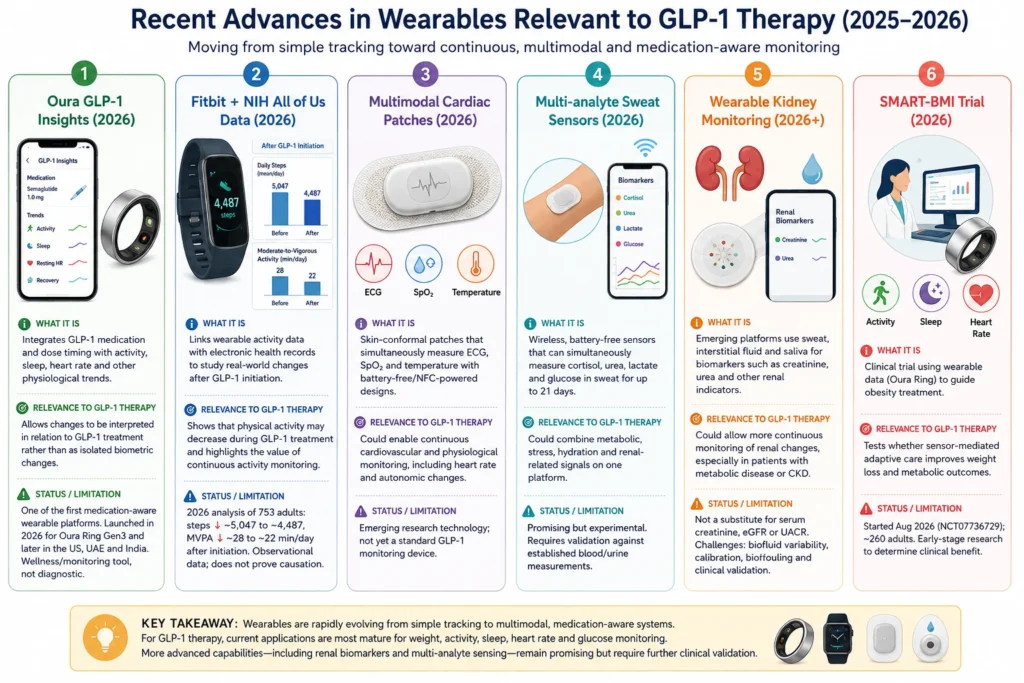
Recent Advances and Ongoing Research in Wearables Relevant to GLP-1 Therapy
The graphic below is transcribed in full. It tracks the move from simple activity tracking toward continuous, multimodal and medication-aware monitoring.
| Advance | What it is | Relevance to GLP-1 therapy | Status and limitation |
|---|---|---|---|
| Oura GLP-1 Insights (2026) | Integrates GLP-1 medication and dose timing with activity, sleep, heart rate and other physiological trends. | Allows changes to be interpreted in relation to GLP-1 treatment rather than as isolated biometric changes. | One of the first medication-aware wearable platforms. Launched in 2026 for Oura Ring Gen3 and later in the US, UAE and India. A wellness and monitoring tool, not diagnostic. |
| Fitbit and NIH All of Us data (2026) | Links wearable activity data with electronic health records to study real-world changes after GLP-1 initiation. | Shows that physical activity may decrease during GLP-1 treatment, and highlights the value of continuous activity monitoring. | 2026 analysis of 753 adults: steps fell from about 5,047 to about 4,487 and moderate-to-vigorous activity from about 28 to about 22 minutes a day after initiation. Observational data; does not prove causation. |
| Multimodal cardiac patches (2026) | Skin-conformal patches that simultaneously measure ECG, SpO₂ and temperature, with battery-free or NFC-powered designs. | Could enable continuous cardiovascular and physiological monitoring, including heart rate and autonomic changes. | Emerging research technology; not yet a standard GLP-1 monitoring device. |
| Multi-analyte sweat sensors (2026) | Wireless, battery-free sensors that can simultaneously measure cortisol, urea, lactate and glucose in sweat for up to 21 days. | Could combine metabolic, stress, hydration and renal-related signals on one platform. | Promising but experimental. Requires validation against established blood and urine measurements. |
| Wearable kidney monitoring (2026 onward) | Emerging platforms use sweat, interstitial fluid and saliva for biomarkers such as creatinine, urea and other renal indicators. | Could allow more continuous monitoring of renal changes, especially in people with metabolic disease or chronic kidney disease. | Not a substitute for serum creatinine, eGFR or UACR. Challenges include biofluid variability, calibration, biofouling and clinical validation. |
| SMART-BMI trial (2026) | Clinical trial using wearable data from an Oura Ring to guide obesity treatment. | Tests whether sensor-mediated adaptive care improves weight loss and metabolic outcomes. | Started August 2026 (NCT07736729) with about 260 adults. Early-stage research to determine clinical benefit. |
The pattern across all six is the same. Wearables are moving from simple tracking toward multimodal, medication-aware systems. For GLP-1 therapy the mature applications today are weight, activity, sleep, heart rate and glucose. The more advanced capabilities, including renal biomarkers and multi-analyte sensing, remain promising but require further clinical validation.
The Bottom Line
The real value of wearable technology during GLP-1 treatment is not that it can see inside your body. It cannot directly measure skeletal muscle, diagnose kidney dysfunction or prove why a physiological signal has changed.
What it can provide is continuous, real-world information.
A smartwatch or ring can show whether you are moving less, sleeping worse, recovering differently or experiencing a sustained change in resting heart rate. A connected scale can show your weight trajectory. A CGM can reveal glucose patterns. Together, these measurements can provide useful context between clinical visits.
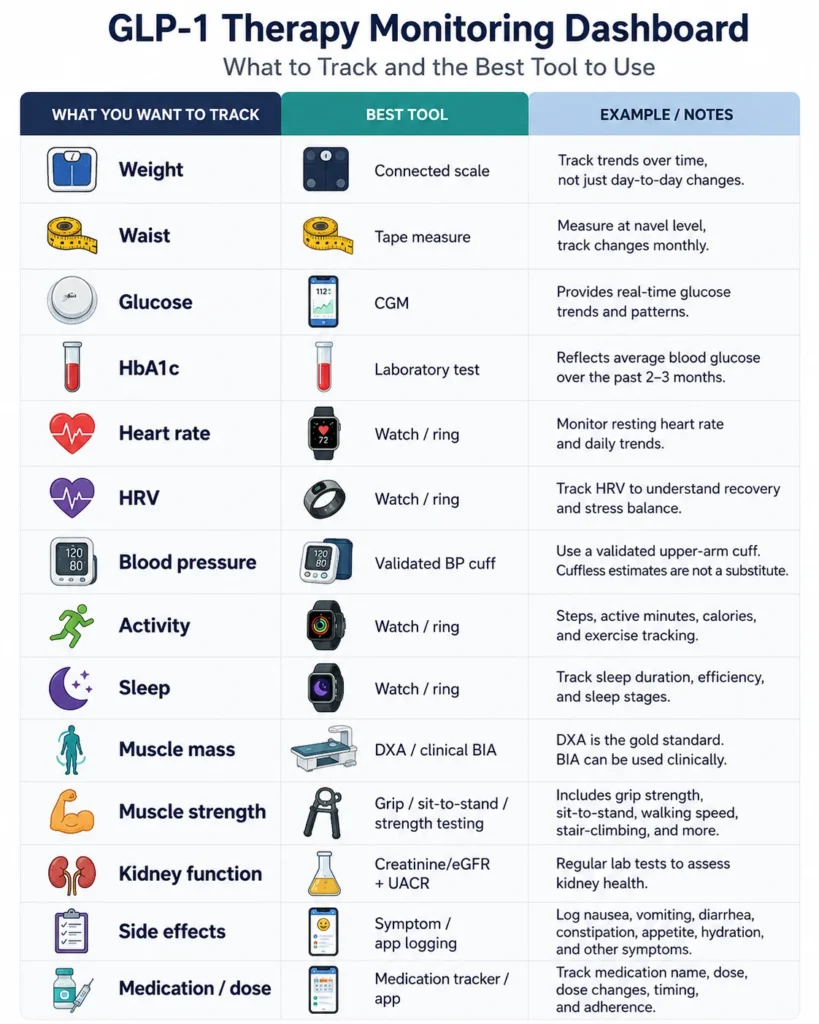
What to Track, and the Best Tool for Each
This is the practical summary: what is worth following during GLP-1 treatment, and which tool actually measures it.
| What you want to track | Best tool | Notes |
|---|---|---|
| Weight | Connected scale | Track trends over time, not just day-to-day changes. |
| Waist | Tape measure | Measure at navel level and track changes monthly. |
| Glucose | CGM | Provides real-time glucose trends and patterns. |
| HbA1c | Laboratory test | Reflects average blood glucose over the past two to three months. |
| Heart rate | Watch or ring | Monitor resting heart rate and daily trends. |
| HRV | Watch or ring | Track HRV to understand recovery and stress balance. |
| Blood pressure | Validated BP cuff | Use a validated upper-arm cuff. Cuffless estimates are not a substitute. |
| Activity | Watch or ring | Steps, active minutes, calories and exercise tracking. |
| Sleep | Watch or ring | Track sleep duration, efficiency and sleep stages. |
| Muscle mass | DXA or clinical BIA | DXA is the gold standard. BIA can be used clinically. |
| Muscle strength | Grip, sit-to-stand or strength testing | Includes grip strength, sit-to-stand, walking speed and stair-climbing. |
| Kidney function | Creatinine, eGFR and UACR | Regular laboratory tests to assess kidney health. |
| Side effects | Symptom or app logging | Log nausea, vomiting, diarrhoea, constipation, appetite, hydration and other symptoms. |
| Medication and dose | Medication tracker or app | Track medication name, dose, dose changes, timing and adherence. |
The best way to use wearable technology during GLP-1 treatment is therefore not as a replacement for clinical measurement, but as an additional layer of information that helps you recognise meaningful trends and act on them appropriately.
Key Takeaways
- No consumer smartwatch, ring or fitness band directly measures skeletal-muscle mass. DXA or a clinical body-composition assessment is what actually measures it.
- Smart-scale readings for body fat and “muscle mass” are bioelectrical impedance estimates. They are useful as trends under similar conditions, not as equivalents to DXA.
- In a 12-week study of 66 people starting GLP-1 medications, resting heart rate rose by 3.2 beats per minute and HRV fell by 6.2 milliseconds despite roughly 10% weight loss.
- Wearables cannot assess kidney function. That relies on serum creatinine, eGFR and, where appropriate, urine albumin-to-creatinine ratio.
- Take a two-week baseline before the first dose, follow trends over weeks rather than daily scores, and use clinical testing when a real measurement is needed.
Frequently Asked Questions
1. Can a smartwatch or ring measure muscle loss on a GLP-1?
No. No consumer smartwatch, ring or fitness band directly measures skeletal-muscle mass. If muscle preservation is a major concern, DXA or an appropriate clinical body-composition assessment is far more informative.
2. Why has my resting heart rate gone up while I am losing weight?
A 12-week study of 66 people starting GLP-1 medications found resting heart rate rose by 3.2 beats per minute and heart rate variability fell by 6.2 milliseconds, despite about 10% weight loss. GLP-1 receptor agonists have a known modest heart-rate-raising effect that, in the short term, appeared to outweigh the effect expected from weight loss.
3. Are the “muscle mass” readings on a smart scale accurate?
They are estimates produced by bioelectrical impedance analysis, not direct measurements. Hydration, food intake and measurement conditions all influence them. They are useful for observing trends when taken under similar conditions, but they should not be treated as equivalent to DXA.
4. Can a wearable tell me whether my kidneys are affected?
No. Clinical assessment of kidney function relies on laboratory measurements such as serum creatinine and estimated glomerular filtration rate, and where appropriate the urine albumin-to-creatinine ratio. A wearable can track related factors — blood pressure, weight, activity, sleep — but it cannot determine whether dehydration has affected kidney function.
5. Do I need a continuous glucose monitor if I am taking a GLP-1 for weight loss?
Not necessarily. A CGM’s primary value is understanding glucose patterns and metabolic control. Hypoglycemia monitoring matters most when a GLP-1 medicine is combined with insulin or a sulfonylurea. For many people taking a GLP-1 without those medications, a CGM is not a tool for detecting muscle loss or for judging whether treatment is working.
6. Can GLP-1 treatment improve sleep apnea?
It can. In the SURMOUNT-OSA trials, tirzepatide reduced the apnea-hypopnea index by approximately 55% to 63% over 52 weeks, and roughly 43% to 51.5% of participants met criteria for disease resolution. Wearable estimates of sleep-disordered breathing are not equivalent to polysomnography, so diagnosis still needs a clinical assessment.
7. When should I speak to a doctor rather than watch the numbers?
A persistent or substantial rise in resting heart rate, or a decline in activity — especially alongside dizziness, palpitations, fainting, unusual exercise intolerance, or significant difficulty maintaining food and fluid intake — should be discussed with a healthcare professional rather than managed through the wearable.
References
- Neeland IJ, et al. Changes in lean body mass with GLP-1-based therapies and mitigation strategies. Diabetes, Obesity and Metabolism. 2024. https://dom-pubs.onlinelibrary.wiley.com/doi/10.1111/dom.15728
- Muscle mass and GLP-1 receptor agonists: adaptive or maladaptive response to weight loss? Circulation.https://www.ahajournals.org/doi/10.1161/CIRCULATIONAHA.124.067676
- Body composition changes during weight reduction with tirzepatide in the SURMOUNT-1 study of adults with obesity or overweight. https://pubmed.ncbi.nlm.nih.gov/39996356/
- Weight loss with GLP-1 medicines does not result in a disproportionate loss of muscle mass or function in obese mice and humans. https://pubmed.ncbi.nlm.nih.gov/41850248/
- Wearables for health monitoring: body composition estimates of commercial smartwatch and clinical bioelectrical impedance device. https://pubmed.ncbi.nlm.nih.gov/41341278/
- American Diabetes Association Professional Practice Committee. Standards of Care in Diabetes—2026. Diabetes Care. 2026.
- Heart and health behaviour responses to GLP-1 receptor agonists: a 12-week study using wearable technology and causal inference. American Journal of Physiology—Heart and Circulatory Physiology. 2024. https://pubmed.ncbi.nlm.nih.gov/39705534/
- Kidney Disease: Improving Global Outcomes (KDIGO) CKD Work Group. KDIGO 2024 Clinical Practice Guideline for the Evaluation and Management of Chronic Kidney Disease. Kidney International.2024;105(Suppl 4S):S117–S314.
- Eli Lilly and Company. Tirzepatide reduced obstructive sleep apnea severity—SURMOUNT-OSA results.https://investor.lilly.com/news-releases/news-release-details/lillys-tirzepatide-reduced-obstructive-sleep-apnea-osa-severity
- Tirzepatide for the treatment of obstructive sleep apnea (SURMOUNT-OSA). New England Journal of Medicine. https://pubmed.ncbi.nlm.nih.gov/38547961/; https://pubmed.ncbi.nlm.nih.gov/38912654/
- Are Wearable Sleep-Tracking Devices Reliable Alternatives to Polysomnography? A Systematic Review and Meta-Analysis. https://pubmed.ncbi.nlm.nih.gov/42175611/
- Validity of Estimating the Maximal Oxygen Consumption by Consumer Wearables: A Systematic Review with Meta-analysis and Expert Statement of the INTERLIVE Network.https://pubmed.ncbi.nlm.nih.gov/35072942/
- Accuracy and Safety of Dexcom G7 Continuous Glucose Monitoring in Adults with Diabetes https://pmc.ncbi.nlm.nih.gov/articles/PMC9208857/
- Accuracy of the Third Generation of a 14-Day Continuous Glucose Monitoring System https://pubmed.ncbi.nlm.nih.gov/36877403/
- Evaluation of Accuracy and Safety of the 365-Day Implantable Eversense Continuous Glucose Monitoring System: The ENHANCE Study https://pubmed.ncbi.nlm.nih.gov/39869118/
- Large-Scale Assessment of a Smartwatch to Identify Atrial Fibrillation https://www.nejm.org/doi/full/10.1056/NEJMoa1901183
- Comparison of the Omron HeartGuide to the Welch Allyn ProBP 3400 blood pressure monitor https://pubmed.ncbi.nlm.nih.gov/37702590/
- Accuracy of Fitbit Devices: Systematic Review and Narrative Syntheses of Quantitative Data https://pmc.ncbi.nlm.nih.gov/articles/PMC6107736/
- MUSE-S Headband System for Improving Anxiety and Insomnia Among Breast Cancer Survivors https://clinicaltrials.gov/study/NCT06274034
- Selecting a sleep tracker from EEG-based, iteratively improved, low-cost multisensor, and actigraphy-only devices https://pubmed.ncbi.nlm.nih.gov/38087674/
- Exercise decreases among people taking GLP-1 medication https://www.endocrine.org/news-and-advocacy/news-room/2026/maharjan-press-release-endo-2026
Disclaimer
This article is educational and does not replace medical advice. Wearable and smart-scale readings are not diagnostic. Always discuss changes in your treatment, persistent symptoms or any new measurement concern with your healthcare professional.