
Article 1 of the HiGood Health Reproductive Wellness Series | This is your master roadmap. Bookmark it.
At a Glance: Pregnancy Planning, in the Order That Matters
Start folic acid before you start trying. 400 micrograms a day, at least a month ahead. The neural tube closes about 28 days after conception — usually before a pregnancy test turns positive — so starting after confirmation misses most of the benefit. This is the highest-value thing on the page and it costs almost nothing.
Book a preconception appointment. Haemoglobin, thalassaemia carrier screening for both partners, rubella immunity, thyroid, blood sugar, B12 and vitamin D. Every one of those is easier to deal with before conception than during, and thalassaemia screening in particular is a single blood test that India’s carrier rate makes worth doing.
The fertile window is about six days — the five days before ovulation and the day of it. Sex every two to three days through the middle of the cycle reaches it without turning conception into a scheduling problem.
Give it a year before worrying, or six months if you are over 35. That is the standard threshold for investigating, and most couples conceive well within it. If cycles are irregular — PCOS being the commonest reason in India — seek advice earlier, because the usual waiting rule assumes you can find your fertile window.
This pregnancy planning guide is the map of the whole journey, from fertility preservation through to the decisions taken in the delivery room. The stages below run in order, and each links to the detail.
You Plan Everything Else. Why Not This?
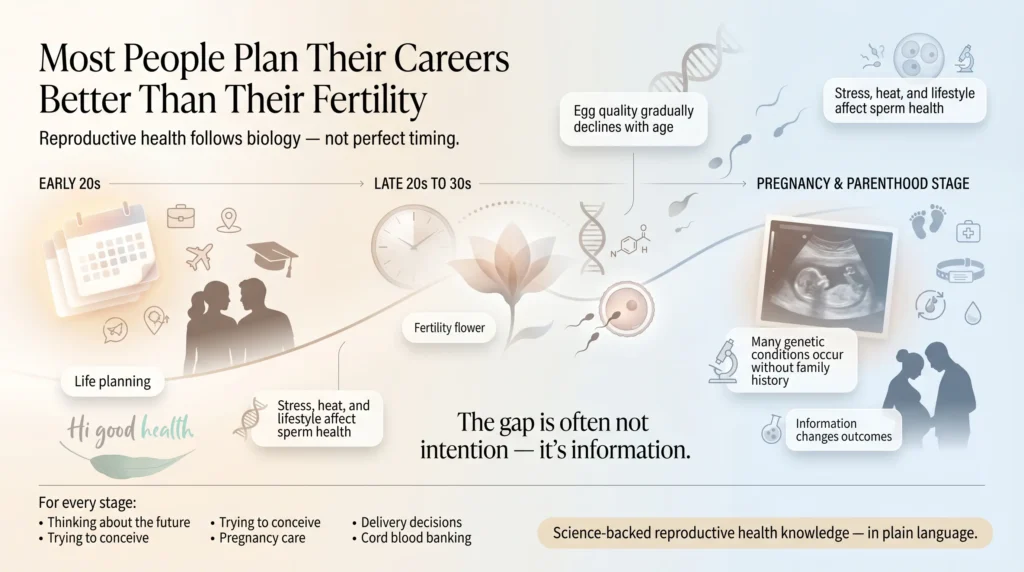
You plan your career. You plan your finances. You plan your vacations. But most people spend more time researching a smartphone purchase than understanding the biological timeline that determines whether — and how — they become a parent.
Here’s the uncomfortable truth: reproductive health doesn’t wait for you to be “ready.” Egg quality begins declining in a woman’s late 20s. Sperm health is quietly affected by stress, heat, and lifestyle long before a man thinks about fatherhood.
And most inherited genetic diseases in babies? They show up in families with no prior history whatsoever. The gap isn’t willpower or intention — it’s information.
That’s exactly why this series exists. At HiGood Health, our mission is to give you clean, credible, science-backed health knowledge in plain language — so you can make better decisions for yourself and the people you love. This guide is the starting point.
Whether you’re in your 20s and not thinking about kids yet, actively trying to conceive, navigating a difficult pregnancy, or standing in a delivery room about to make a one-time decision about cord blood banking — there is a stage in this series written specifically for you.
Stage 1: Should You Preserve Your Fertility?
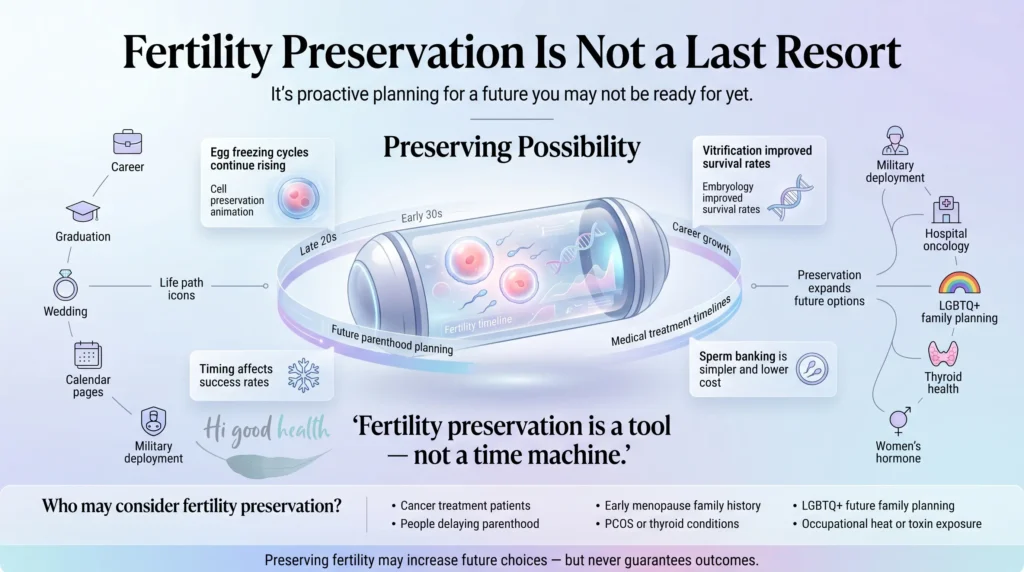
Most people think egg or sperm freezing is a medical last resort. It’s not — it’s proactive insurance. Egg freezing cycles in the U.S. have surged nearly 40% year-over-year as more people recognize that biology doesn’t align neatly with life timelines.
A landmark 2025 study found that live birth rates from frozen eggs decline meaningfully with each passing year — making the decision of when to preserve just as important as whether to do it at all.
Who should seriously consider it? Anyone facing cancer treatment, certain autoimmune conditions, individuals not ready for parenthood in their late 20s or early 30s, those with a family history of early menopause, people with thyroid disorders or PCOS, and LGBTQ+ individuals planning future family-building paths.
Sperm banking is simpler, faster, and lower cost — yet most men never consider it. It may be especially relevant for men facing cancer treatment, military deployment, high heat exposure, or occupational toxin exposure. The technology has also evolved dramatically: vitrification (ultra-rapid freezing) now achieves egg survival rates after thaw of nearly 89%, compared to under 60% a decade ago.
Fertility preservation is a tool, not a time machine. It raises your options — it doesn’t guarantee outcomes. Want the full picture — costs, success rates by age, step-by-step process, and what clinics don’t always tell you upfront?
👉 [Read Article 1: Planning for the Future — Why Sperm and Egg Preservation Matters → link]
Stage 2: Before Marriage — Genetic and Health Checks That Could Change Everything
Most couples spend time discussing emotional compatibility, finances, family goals, and lifestyle fit before marriage or long-term commitment. Far fewer talk about the medical and genetic information that could affect fertility, pregnancy, and future children.
Here is a fact that should be part of every pre-marriage conversation: over 80% of babies born with serious inherited genetic diseases have parents who showed no symptoms and had no known family history of that condition.
Carrier screening — a simple blood or saliva test — can identify whether both partners silently carry genes for conditions like cystic fibrosis, sickle cell disease, or spinal muscular atrophy before a pregnancy is ever attempted.
The American College of Obstetricians and Gynecologists (ACOG) recommends carrier screening be offered to all couples regardless of ethnicity or background. Yet expanded carrier screening accounts for only about 14.7% of all reproductive screening orders in the U.S. today. Most couples who could benefit from this information simply never get it.
In India the case is stronger still, because the specific condition that carrier screening most often finds here — beta-thalassaemia — is far more common in this population than in the one that statistic describes.
It is a single blood test for each partner, it is inexpensive, and it only changes anything if both of you turn out to be carriers.
Beyond genetics, pre-marriage health checks — Rh blood group compatibility, thyroid function, vitamin D and folate levels, and infectious disease screening including sexually transmitted infection (STI) panels — create a baseline that protects future pregnancies. This isn’t about fear. It’s about informed choice.
👉 [Read Article 2: Before Marriage — Compatibility and Health Tests That Matter for Future Children → link]
Stage 3: Before You Try to Conceive — The 90-Day Window That Matters Most
There is a preparation window of 3–6 months before conception that most couples overlook entirely. What you do in this window — nutritionally, physically, psychologically, and financially — directly shapes the earliest days of your baby’s development, often before you even know a pregnancy has begun.
Folate intake starting at least one month before conception is one of the most evidence-backed interventions in medicine, reducing neural tube defect risk significantly.
Algae-derived DHA, iron from plant-rich sources, and iodine are equally important yet rarely discussed.
Ovulation tracking — whether through cycle apps, basal body temperature, or LH surge testing — meaningfully improves natural conception odds, particularly after 30. And the often-skipped conversation: financial and emotional readiness. Couples who proactively discuss parenting values, household roles, and financial reserves before conception report measurably lower postpartum stress.
This stage is about removing friction before it becomes a crisis.
👉 [Read Article 3: Before You Try to Conceive — The Right Time, the Right Preparation → link]
Folic Acid Before Pregnancy: When to Start, How Much, and Why It Cannot Wait
If you take one thing from this entire guide, take this one, because it is the single measure with the strongest evidence behind it and the narrowest window in which to act.
The neural tube — which becomes the brain and spinal cord — closes about 28 days after conception. That is roughly two weeks after a missed period, and often before a woman knows she is pregnant at all. By the time a test comes back positive, the window in which folic acid does its most important work has largely closed.
This is why every major guideline says to start before conception rather than after confirmation.
How much, and when to start
- The standard dose is 400 micrograms (0.4 mg) a day for any woman who could become pregnant.
- Start at least one month before you begin trying — two to three months is better — and continue through the first trimester at minimum.
- A higher dose is advised for some women, and that decision belongs to a doctor rather than to a pharmacy shelf. It generally applies after a previous pregnancy affected by a neural tube defect, and is considered in diabetes, obesity, certain epilepsy medications, and some absorption disorders.
- Do not increase the dose on your own. Higher-dose folic acid is a prescription decision partly because it can mask a vitamin B12 deficiency, which is common in vegetarian diets and matters in its own right.
Why food alone is not the plan
Palak, methi, other green leafy vegetables, dals, citrus and fortified cereals all supply folate, and they are worth eating for many reasons.
But natural food folate is absorbed less efficiently than the folic acid in a supplement, cooking destroys a good deal of it, and the amount needed to reliably reach the protective level from diet alone is more than most people eat.
Eat the greens and take the tablet. They are not alternatives to each other.
One India-specific note worth knowing: iron-and-folic-acid tablets are distributed free through government health programmes, and folic acid on its own is inexpensive and available without difficulty. Cost is not the barrier here. Timing is.
The Preconception Check-Up: Which Tests Are Actually Worth Doing
A preconception visit is a short, cheap appointment that most couples skip, and it is the point at which several things are far easier to fix than they will be later. Your doctor will tailor the list, but this is the shape of it in India.
- Haemoglobin and a complete blood count. Anaemia is very common in Indian women of reproductive age, and correcting it before pregnancy is considerably easier than during.
- Thalassaemia carrier screening. India has one of the world’s larger populations of beta-thalassaemia carriers, and two carriers have a one-in-four chance of an affected child in each pregnancy. Both partners need testing, and it is a single blood test. If your community has a known higher carrier rate, this is the test not to skip.
- Blood group and Rh typing for both partners, because Rh-negative mothers need specific management.
- Rubella immunity. Rubella in early pregnancy can cause serious birth defects. If you are not immune, the vaccine is given before conceiving, with a gap afterwards on your doctor’s advice — it cannot be given during pregnancy.
- Thyroid function. Untreated hypothyroidism affects both conception and early foetal brain development, and it is easy to miss and easy to treat.
- Blood sugar. Diabetes controlled before conception, rather than discovered at twelve weeks, changes outcomes materially.
- Vitamin D and vitamin B12. Both are widely low in India, and B12 particularly so on a vegetarian diet.
- Infection screening — HIV, hepatitis B and syphilis — offered routinely and for good reason, since all three are manageable when known about early.
- For the male partner: a semen analysis if you have been trying without success, or if there is a relevant history. Roughly half of fertility difficulty involves a male factor, and this is the one test that is routinely left out.
Also bring your current medicines to that appointment, including anything over the counter and any ayurvedic or herbal preparation. Some are not suitable in pregnancy and a few need switching well in advance rather than on the day a test turns positive.
When Can You Get Pregnant? Understanding the Fertile Window
Conception is possible for a much narrower part of the month than most people assume, and knowing where that window falls removes a great deal of anxiety.
An egg survives about 12 to 24 hours after ovulation. Sperm can survive up to about five days in the reproductive tract. That gives a fertile window of roughly six days: the five days before ovulation and the day of it.
Ovulation typically occurs about 14 days before the next period starts — which is why counting forward from the last period is unreliable if your cycles vary.
The simplest advice that works: have sex every two to three days across the middle of the cycle. It reaches the window without turning the whole thing into a scheduling exercise, and it avoids the stress that rigid timing creates.
If you want to track more precisely, ovulation predictor kits detect the LH surge a day or so before release, and cervical mucus becoming clear and stretchy is a free and reasonably reliable sign.
Basal body temperature confirms ovulation only after it has happened, so it is useful for learning your pattern over a few months rather than for timing this cycle.
PCOS and Getting Pregnant
A note on the name first. In May 2026 an international consensus renamed polycystic ovary syndrome to polyendocrine metabolic ovarian syndrome (PMOS), to reflect that it is a whole-body hormonal and metabolic condition rather than one defined by ovarian cysts.
Both names describe the same thing. Indian clinicians and patients still largely say PCOS during the transition, so that is the term used here — but you may start seeing PMOS on reports and in newer guidance, and it is not a different diagnosis.
PCOS is among the commonest reasons conception takes longer, and it is common in India. The mechanism is straightforward: irregular or absent ovulation means the fertile window is unpredictable or missing, not that pregnancy is impossible.
Most women with PCOS do conceive, and often with fairly ordinary measures. Modest weight loss where weight is a factor — the figure usually quoted is five to ten percent of body weight — can restore ovulation on its own. Beyond that, ovulation induction under a gynaecologist is well established and usually the next step rather than a last resort.
Two things worth raising with your doctor early rather than late: PCOS is associated with insulin resistance, so blood sugar is worth checking before conceiving; and irregular cycles make the fertile window hard to find on your own, which is a practical reason to seek help sooner than the standard advice suggests.
Stage 4: When Pregnancy Doesn’t Come Easily
Infertility is defined as the inability to conceive after 12 months of regular, unprotected intercourse for women under 35 — or 6 months if the woman is over 35.
In the United States, approximately 7.4 million women have received fertility services at some point. And the statistic that surprises most people: male factor infertility contributes to 40–50% of all cases. This is not a women’s issue.
Common but underdiagnosed causes include PCOS, endometriosis, and diminished ovarian reserve in women; low sperm count, poor motility, and varicocele in men; and in 10–15% of cases, “unexplained infertility” where standard tests return normal but conception still doesn’t occur.
IVF cycle starts in the U.S. increased by 234.7% between 2004 and recent years — a reflection of both rising need and expanding treatment access.
The emotional weight of infertility is as real as the medical challenge. Stress levels among people in fertility treatment are clinically comparable to those managing serious chronic illness. You deserve both the medical roadmap and the emotional support framework.
👉 [Read Article 4: Dealing with Fertility Issues — Causes, Tests, Treatment Options, and Costs → link]
Stage 5: During Pregnancy — What Actually Matters, Trimester by Trimester
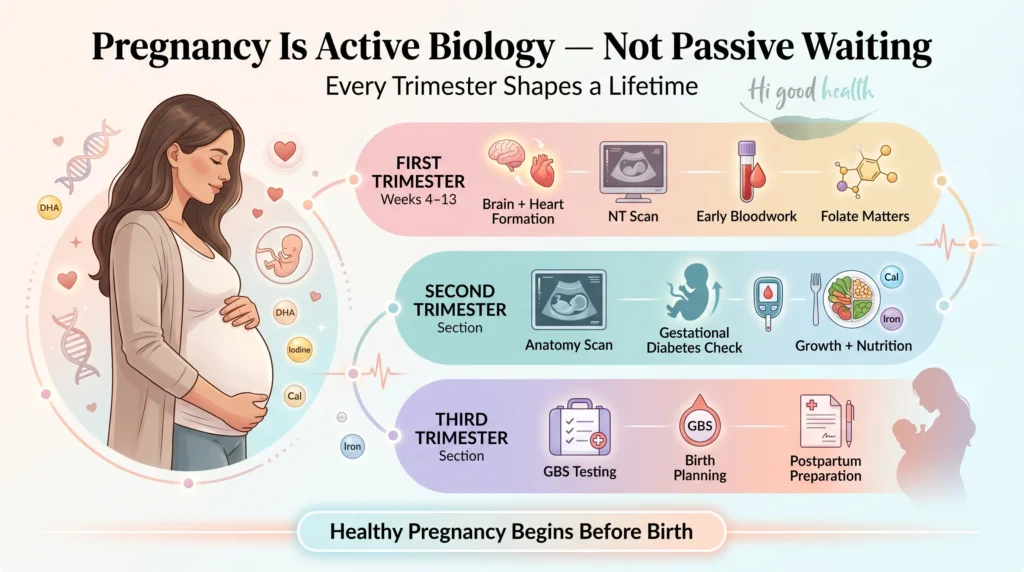
Pregnancy is nine months of active biological collaboration — not passive waiting. The baby’s brain, heart, and major organ systems form in the first trimester, largely before most women even know they’re pregnant. The decisions made in weeks 4 through 13 carry consequences that can last a lifetime.
Each trimester brings specific tests that matter: nuchal translucency ultrasound and early bloodwork in the first trimester; anatomy scan (or anomaly scan) and gestational diabetes screening in the second.
In the third trimester: Group B Streptococcus testing and birth planning.
Nutritional needs shift throughout — calcium, iron, iodine, DHA, and folate remain critical across all three phases. And postpartum planning — including mental health screening for postpartum depression — should begin before birth, not after, because the transition from pregnancy to new parenthood is one of the most underestimated health events a woman experiences.
👉 [Read Article 5: During Pregnancy — Diet, Precautions, Tests, and Postpartum Care → link]
Stage 6: After Birth — Postpartum Recovery, Feeding Support, and Newborn Care
Once your baby arrives, the focus shifts quickly from pregnancy to recovery, feeding, and the first days of newborn care. This period can feel overwhelming because parents are expected to learn a new set of medical, emotional, and practical skills almost immediately.
For the birthing parent, early postpartum care includes monitoring bleeding, pain, mood, sleep, blood pressure when relevant, incision or wound healing, and signs of complications such as infection or postpartum depression. For the baby, the first days often include newborn screening, feeding assessment, weight checks, safe-sleep guidance, and early paediatric follow-up.
Feeding support matters more than many families expect. Lactation consultants can help with latch problems, nipple pain, low milk transfer, milk supply concerns, pumping plans, and questions about whether issues such as tongue-tie may be affecting feeding.
Parents should also understand that newborn care is not just about getting through the first week. It includes knowing when to call a paediatrician, following the recommended vaccine and well-baby visit schedule for your provider, and watching developmental milestones over time without turning every variation into panic.
👉 [Read Article 6: After Birth — Postpartum Recovery, Feeding Support, Newborn Tests, and Early Milestones → link]
Stage 7: The One-Time Decision at Birth — Cord Blood and Stem Cell Banking
In the minutes after your baby is born, there is a biological opportunity that can never be recreated: collecting stem cells from the umbilical cord blood. These cells are already used in certain blood and immune system disorders, which is why some families consider either public donation or private banking before delivery.
These hematopoietic stem cells have been used in over 40,000 transplants worldwide to treat more than 80 diseases — including leukemia, sickle cell disease, and severe immune disorders. Research is also expanding into potential future applications for cerebral palsy and metabolic conditions, though many remain in clinical trial stages.
Parents face two paths: public donation, which is free and altruistic, or private banking.
In India the private banks typically quote a substantial one-time enrolment fee covering storage for a term of years, and prices vary widely enough between operators that a direct comparison is worth doing rather than accepting the first quote. Confirm the figure with the bank directly, since it changes.
The American Academy of Pediatrics recommends public donation for most families, with private banking considered reasonable when there is a specific known family medical history treatable by stem cell therapy. The decision window is narrow — it must be arranged before your due date.
👉 [Read Article 7: Preserving Stem Cells at Birth — What Cord Blood and Placenta Banking Really Means → link]
How to Use This Series
This isn’t a collection of isolated health articles. It’s a step-by-step roadmap designed to meet you wherever you are in your reproductive journey — and walk with you through every critical decision point.
Start here based on where you are right now:
Your Situation | Your Starting Point |
|---|---|
In your 20s, not ready yet | Article 1 — Fertility Preservation |
Planning marriage or long-term partnership | Article 2 — Genetic & Health Checks |
Actively trying to conceive | Article 3 — Preconception Preparation |
Struggling to conceive | Article 4 — Fertility Challenges |
Currently pregnant | Article 5 — Pregnancy Care |
Recently gave birth or preparing for newborn care | Article 6 — Postpartum and Newborn Care |
Third trimester and deciding about cord blood banking | Article 7 — Cord Blood Banking |
Every article in this series follows the same trusted format:
- why it matters →
- who should consider it →
- key tests or actions →
- what results mean →
- when to see a specialist.
That consistency is intentional — because navigating reproductive health is hard enough without inconsistent information.
When to See a Specialist
Across every stage of this journey, certain signs should prompt a conversation with a qualified specialist sooner rather than later:
- Reproductive endocrinologist or fertility specialist: No conception after 12 months of trying (6 months if over 35); two or more miscarriages; known or suspected PCOS, endometriosis, or low ovarian reserve.
- Genetic counselor: Abnormal carrier screening results; family history of inherited disease; advanced maternal age (35+).
- OB-GYN or maternal-foetal medicine specialist: Existing health conditions entering pregnancy; abnormal prenatal screening results; symptoms like unusual bleeding, severe nausea, or reduced foetal movement.
- Postpartum care provider, paediatrician, or lactation consultant: Difficulty feeding, concerns about milk supply, postpartum mood changes, newborn weight concerns, jaundice, fever, dehydration, or uncertainty about early recovery and newborn care.
- Cord blood consultant: Ideally by week 28–30 of pregnancy to make a timely, informed decision.
“The best time to ask these questions is before you need the answers.” — a principle that runs through every article in this series.
Key Takeaways
- Folic acid, 400 mcg daily, starting at least a month before you try. The neural tube closes around day 28 — before most women know they are pregnant. Starting after a positive test misses the point of it.
- Do not raise the dose yourself. Higher-dose folic acid is a prescription decision, partly because it can mask a B12 deficiency.
- Both partners should be screened for thalassaemia. One blood test each. Two carriers face a one-in-four risk per pregnancy, and India’s carrier rate makes this worth doing rather than assuming.
- Rubella vaccination has to happen before conception, not during. Check immunity early enough to act on the answer.
- Thyroid, blood sugar, haemoglobin, B12 and vitamin D are all easier to correct before pregnancy than during it, and all are commonly out of range in India.
- The fertile window is about six days. Sex every two to three days through the middle of the cycle covers it without the stress of precise timing.
- Male factors account for roughly half of fertility difficulty, and a semen analysis is the test most often skipped.
- Most women with PCOS do conceive. Irregular ovulation makes the window hard to find, which is a reason to seek help earlier than the usual one-year rule.
- Take your current medicines to the preconception appointment — including over-the-counter and ayurvedic preparations. Some need changing well in advance.
A Note from HiGood Health
At HiGood Health, we believe that health education is one of the most powerful tools a community can share. We’re here to bust the myths, simplify the science, present best practices from across the world, and give you information you can actually use — in language that doesn’t require a medical degree.
If this guide helped you, share it with someone who’s at one of these life stages. And if there’s a topic you’d like us to cover — reproductive health or beyond — tell us in the comments. Your questions literally shape what we write next.
Frequently Asked Questions
When should I start taking folic acid before pregnancy?
At least one month before you start trying, and two to three months is better. The reason is timing rather than dosage: the neural tube, which becomes the brain and spinal cord, closes about 28 days after conception. That is roughly two weeks after a missed period, and usually before a pregnancy test has turned positive. If you wait for confirmation, the window in which folic acid does its most important work has largely passed. Continue through the first trimester at minimum, and follow your doctor beyond that.
How much folic acid do I need before pregnancy?
The standard recommendation is 400 micrograms, or 0.4 mg, a day for any woman who could become pregnant. A substantially higher dose is advised for some women, most clearly after a previous pregnancy affected by a neural tube defect, and it is also considered in diabetes, obesity, certain epilepsy medications and some absorption disorders. That is a decision for your doctor, not a self-prescription. High-dose folic acid can mask a vitamin B12 deficiency, which matters particularly on a vegetarian diet, so it is not a case of more being safer.
What tests should we do before planning a baby in India?
Your doctor will tailor the list, but the usual shape is haemoglobin and a complete blood count, thalassaemia carrier screening for both partners, blood group and Rh typing, rubella immunity, thyroid function, blood sugar, vitamin D and vitamin B12, and screening for HIV, hepatitis B and syphilis. Thalassaemia screening deserves particular mention in India: it is a single blood test, the carrier rate here is among the higher ones globally, and two carriers face a one-in-four risk of an affected child in each pregnancy. Rubella matters for a different reason — if you are not immune, the vaccine has to be given before conceiving, because it cannot be given during pregnancy.
When can a woman get pregnant during her cycle?
There is a window of roughly six days: the five days before ovulation and the day of ovulation itself. An egg survives about 12 to 24 hours after release, while sperm can survive up to about five days, which is why the days before matter more than the day after. Ovulation usually happens about 14 days before the next period begins, so counting forward from the last period is unreliable if your cycles vary. The practical approach that works for most couples is sex every two to three days across the middle of the cycle, which reaches the window without turning conception into a scheduling exercise.
How long should we try before seeing a doctor?
The conventional threshold is one year of regular unprotected sex without conceiving, or six months if the woman is over 35. Most couples conceive well within that. But the rule assumes you can find your fertile window, so there are good reasons to go earlier: irregular or absent periods, known PCOS, endometriosis, a history of pelvic infection or surgery, previous miscarriages, or a known issue on the male side. Going early is not impatience. It is often the difference between a simple intervention and a complicated one.
Can I get pregnant if I have PCOS?
Yes, and most women with PCOS do. You may also see this condition called PMOS — polyendocrine metabolic ovarian syndrome — which international consensus adopted as the new name in May 2026. It is the same condition, and Indian clinicians largely still say PCOS. The obstacle is usually irregular or absent ovulation, which makes the fertile window unpredictable rather than absent. Where excess weight is a factor, losing five to ten percent of body weight is often enough to restore ovulation on its own. Where it is not, ovulation induction under a gynaecologist is well established and is generally the next step rather than a last resort. Two things worth raising early: PCOS is associated with insulin resistance, so blood sugar is worth checking before conceiving, and irregular cycles are a reason to seek advice sooner than the standard one-year rule.
What should I eat when planning a pregnancy?
Nothing exotic, and no single food makes the difference. A diet with enough protein, iron and calcium, plenty of vegetables and fruit, whole grains rather than only refined flour, and dairy or its equivalents covers most of it. Iron and B12 deserve particular attention on a vegetarian diet, and vitamin C alongside iron-rich food improves absorption. What matters more than any addition is what should stop: alcohol, tobacco in every form including gutka, and a review of your caffeine intake. Food alone will not deliver enough folate reliably, which is why the supplement is separate from the diet rather than a substitute for it.
Does the male partner need any tests?
Yes, and this is the part most commonly skipped. Roughly half of fertility difficulty involves a male factor, so treating conception as solely a female concern wastes time and money on the wrong investigations. A semen analysis is inexpensive, non-invasive and quick, and it is the sensible first test if you have been trying without success. Thalassaemia carrier screening also applies to both partners, because the risk only arises when both carry the trait. Where there is a relevant medical history, your doctor may suggest more.
Glossary
- ART — Assisted Reproductive Technology (IVF, IUI, etc.)
- ACOG — American College of Obstetricians and Gynecologists
- cfDNA — Cell-free foetal DNA; a non-invasive prenatal screening test
- DHA — Docosahexaenoic acid; omega-3 fatty acid vital for foetal brain development
- ECS — Expanded Carrier Screening
- GBS — Group B Streptococcus
- Hematopoietic stem cells — Blood-forming master cells found in cord blood
- IVF — In Vitro Fertilization
- LH surge — The hormonal trigger for ovulation
- PCOS / PMOS — Polycystic Ovary Syndrome, renamed Polyendocrine Metabolic Ovarian Syndrome (PMOS) by international consensus in May 2026, to reflect that it is a whole-body hormonal and metabolic condition rather than one defined by ovarian cysts. The two names mean the same thing, and the change is being phased in over about three years. Indian clinicians and patients still largely use PCOS, which is the term used through this article. It is a common cause of irregular or absent ovulation, one of the commonest reasons conception takes longer, and most women who have it do conceive.
- Vitrification — Ultra-rapid egg/embryo freezing that prevents ice crystal damage
- Newborn screening — Routine tests done shortly after birth to check for certain serious but treatable conditions
- Lactation consultant — A trained professional who helps with breastfeeding or pumping challenges
- Tongue-tie — A condition in which the tissue under the tongue may restrict movement and sometimes affect feeding
References
- ACOG Carrier Screening Guidelines: acog.orgacog
- US Fertility — 2025 Egg Freezing Outcomes: usfertility.comusfertility
- Parent’s Guide to Cord Blood: parentsguidecordblood.orgparentsguidecordblood
- PMC — Preconception Carrier Screening 2025: ncbi.nlm.nih.govpmc.ncbi.nlm.nih
- PMC — Cord Blood Banking Update: ncbi.nlm.nih.govpmc.ncbi.nlm.nih
- PMC — Declining IVF Efficiency in the USA: ncbi.nlm.nih.govpmc.ncbi.nlm.nih
- Starpearls (Internet) – Routine Newborn Care.https://www.ncbi.nlm.nih.gov/books/NBK539900/
⚠️ Disclaimer: This article is for general health education only and does not constitute medical advice, diagnosis, or treatment. Always consult a qualified healthcare provider, reproductive endocrinologist, or genetic counselor before making any medical decisions. HiGood Health does not endorse any specific clinic, product, or service referenced in this article.