
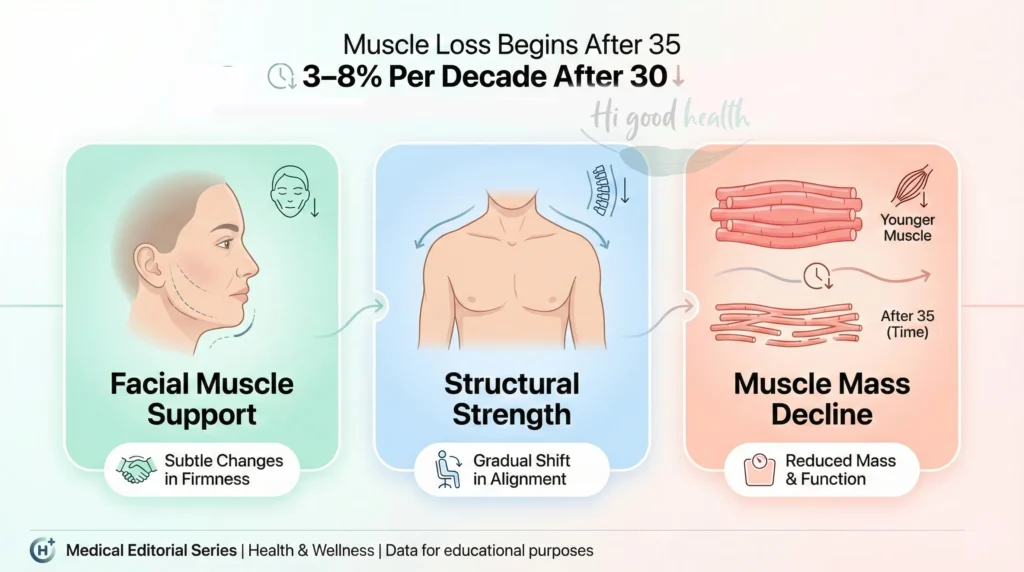
Most women notice it quietly — a softer jawline, less definition in the face, a change in how their body holds itself. The instinct is to reach for a new serum, try a firming cream, or wonder about cosmetic procedures.
But here’s what most beauty articles won’t tell you: what you’re often seeing is muscle loss — not just ageing skin.
What’s actually happening inside your body after 35
From your mid-30s onward, adults can lose 3–5% of their muscle mass per decade. This isn’t just about looking less toned. The muscles beneath your face provide structural scaffolding for your skin. When the underlying muscle in your cheeks and jaw begins to shrink, skin has less support — and that’s when you start seeing the softening and droop that creams simply cannot address.
The same principle applies to breast and gluteal changes. Supporting musculature matters — and losing it changes how the body looks and feels, regardless of weight. According to a 2025 Indian Consensus on Sarcopenia, approximately 4 in 10 elderly Indians and 3 in 100 younger adults are already affected — making this a genuinely significant public health concern, not just a cosmetic one.
Why your late 30s to mid-40s are the most important window
This decade is a biological turning point. Hormones that support muscle repair — testosterone, oestrogen, and growth hormone — begin to decline. A sedentary lifestyle, low protein intake, poor sleep, and chronic stress all accelerate the process. The encouraging reality: muscle loss at this stage is not inevitable. Small, consistent actions taken now can change your trajectory for the next 30 years.
The two most evidence-backed interventions are also the most accessible:
- Resistance training 2–3 times per week — squats, push-ups, planks, resistance bands. Even sessions as short as 10–15 minutes, when done consistently, show meaningful benefits in studies.
- Protein at every meal — aim for 25–30g per meal from dal, paneer, tofu, tempeh, soy, peanuts, or lentils. The 2024 ICMR-NIN Dietary Guidelines for Indians specifically emphasise protein variety from plant foods for muscle health across age groups.
One nutrient most Indians overlook: leucine
Leucine is the amino acid that actually signals your body to start building muscle. It’s found in soybeans, tofu, lentils, peanuts, and tempeh. Research suggests around 2.5–3g of leucine per meal can meaningfully support muscle protein synthesis, especially in adults over 35. Pair this with amla (one of nature’s richest sources of Vitamin C, which fights oxidative stress that degrades muscle) and you have a powerful, affordable, entirely Indian approach to muscle maintenance.
Want to understand exactly which exercises are most effective for each age group, how hormonal changes in women specifically affect muscle tone, and what India’s latest sarcopenia guidelines recommend for your diet?
Read the full article on HiGoodHealth — Sagging Face or Breasts After 35? It Might Be Muscle Loss Playing a Role
All reference links valid and accessible on 1 May 2026
[1] WebMD. (2024). Sarcopenia With Aging. WebMD Health Information.
