
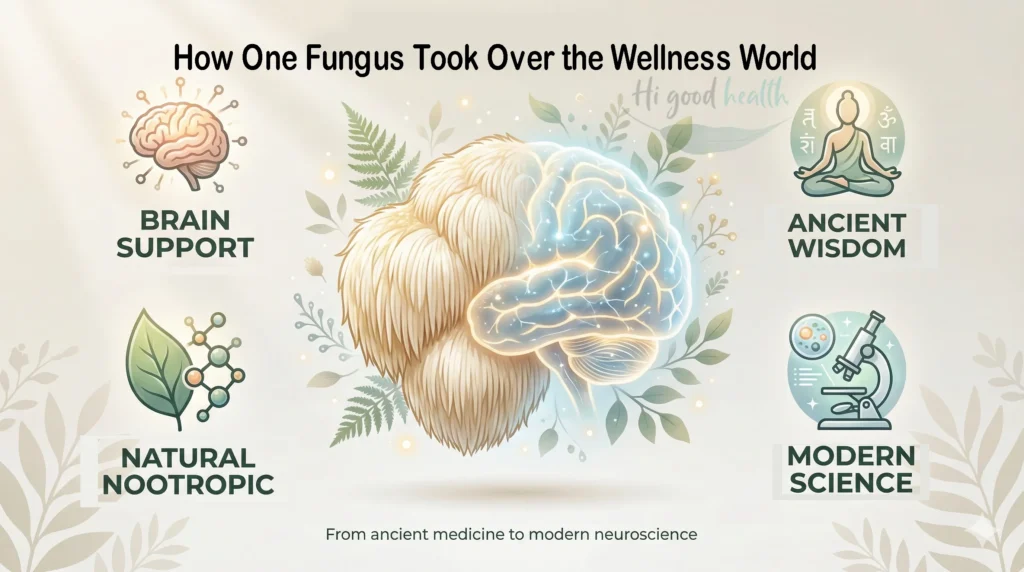
For centuries, Zen Buddhist monks reportedly consumed a strange, white, shaggy mushroom before long meditation sessions — not for flavour, but for focus. They called it the “Mountain Priest Mushroom.” Today, scientists call it Hericium erinaceus, and the wellness world knows it as Lion’s Mane.
It’s now quietly showing up in supplements, functional coffees, and health stores across Mumbai, Delhi, and Bengaluru. But is the science actually there — or is this just another overhyped trend?
The honest answer: it’s somewhere in between, and the nuance is worth knowing.
What makes Lion’s Mane different from every other supplement
Most brain supplements just provide nutrients your body already uses. Lion’s Mane does something more specific: it contains two unique compounds — hericenones and erinacines — that laboratory studies show can stimulate your body’s own production of Nerve Growth Factor (NGF), a protein critical for the growth, maintenance, and survival of brain cells.
Think of NGF as your brain’s personal maintenance crew. As we age, NGF activity naturally declines — and researchers have linked this to memory loss, brain fog, and early neurodegeneration. This is why Lion’s Mane has attracted serious scientific interest, not just wellness influencers.
What human studies have actually found
A Japanese clinical study gave older adults with mild cognitive impairment 3 grams of Lion’s Mane daily for 16 weeks. Their cognitive test scores improved significantly compared to placebo — though the benefits gradually faded after supplementation stopped, suggesting consistent use matters.
A separate small study found reduced anxiety and irritation in women after just four weeks. More recent exploratory research has looked at Lion’s Mane for brain fog and mental fatigue — with early but promising results.
The important caveat: most studies so far have been small (under 50 participants) and short. Larger long-term trials are underway, with results expected in 2026–2027. Lion’s Mane is not a treatment for Alzheimer’s, dementia, or any diagnosed neurological condition.
Especially relevant for Indians over 60
For older adults experiencing mild forgetfulness or mental fatigue, Lion’s Mane offers a gentle, non-stimulating option — no jitteriness, no sleep disruption. It works best as part of a broader approach: paired with omega-3s, B12, regular exercise, and quality sleep.
A typical starting dose is 500–1,000 mg daily, taken with meals in the morning. Give it 6–8 weeks before judging results — neural support is a slow process, not an overnight fix.
Important: Anyone on blood thinners, diabetes medications, or immunosuppressants should check with their doctor first. And if you have a mushroom allergy, avoid it entirely.
One thing to always check before buying in India
Mushrooms absorb whatever is in their growing environment — including heavy metals and toxins. Always choose FSSAI-certified products from fruiting body extracts (not just mycelium), with third-party lab testing certificates available. Avoid unbranded bulk powders with no sourcing transparency.
Want the full breakdown of how NGF works, the latest 2025 clinical trial updates, and a complete buyer’s guide for Indian consumers? Read the full article on HiGoodHealth — Lion’s Mane — The Secret Brain Booster Used by Buddhist Monks! Hype or Neuroscience Miracle?
