About this series. Oral Hygiene is a sixteen-part series on looking after teeth and gums at every age, from brushing and flossing to children’s teeth, gum disease and toothache.
This is Part 16: Metallic Taste in Mouth.
A metallic taste in the mouth can feel like sucking on a coin or having an unpleasant metal-like flavor that remains even when you are not eating. The cause of a metallic taste in the mouth can range from minor dental problems and medication side effects to acid reflux, respiratory infections, and certain medical conditions.
This symptom is medically known as dysgeusia, which refers to an altered or distorted sense of taste. A metallic taste is often temporary, but persistent or unexplained changes in taste deserve attention. Understanding when it started, whether it occurs after eating or taking medication, and whether other symptoms are present can help identify the cause. [1, 2]
At a Glance
That coin-like, metallic flavor can linger even when you have not eaten anything. Behind it may be something minor, such as gum trouble or a medicine side effect, or something less common such as reflux, a respiratory infection or another medical condition.
Most of the time it is not a sign of serious illness, and it often passes. Its timing is a clue: a taste that starts after a new medicine may be a side effect, bleeding gums may point to the mouth, and heartburn may point to reflux.
See a clinician if the taste lingers, keeps coming back or has no obvious reason. Blood or blood-streaked phlegm, even a small amount, calls for medical care the same day, and trouble swallowing or breathing is an emergency.
What helps depends on the cause. Sensible first steps are twice-daily brushing with fluoride toothpaste and gentle tongue cleaning. Ask a professional before stopping a prescribed medicine or taking supplements such as zinc.
Metallic Taste in Mouth: What Does It Mean?
A metallic taste does not automatically mean that there is a serious health problem. It may develop because of changes in saliva, oral bacteria, the sense of smell, or the way taste signals are processed.
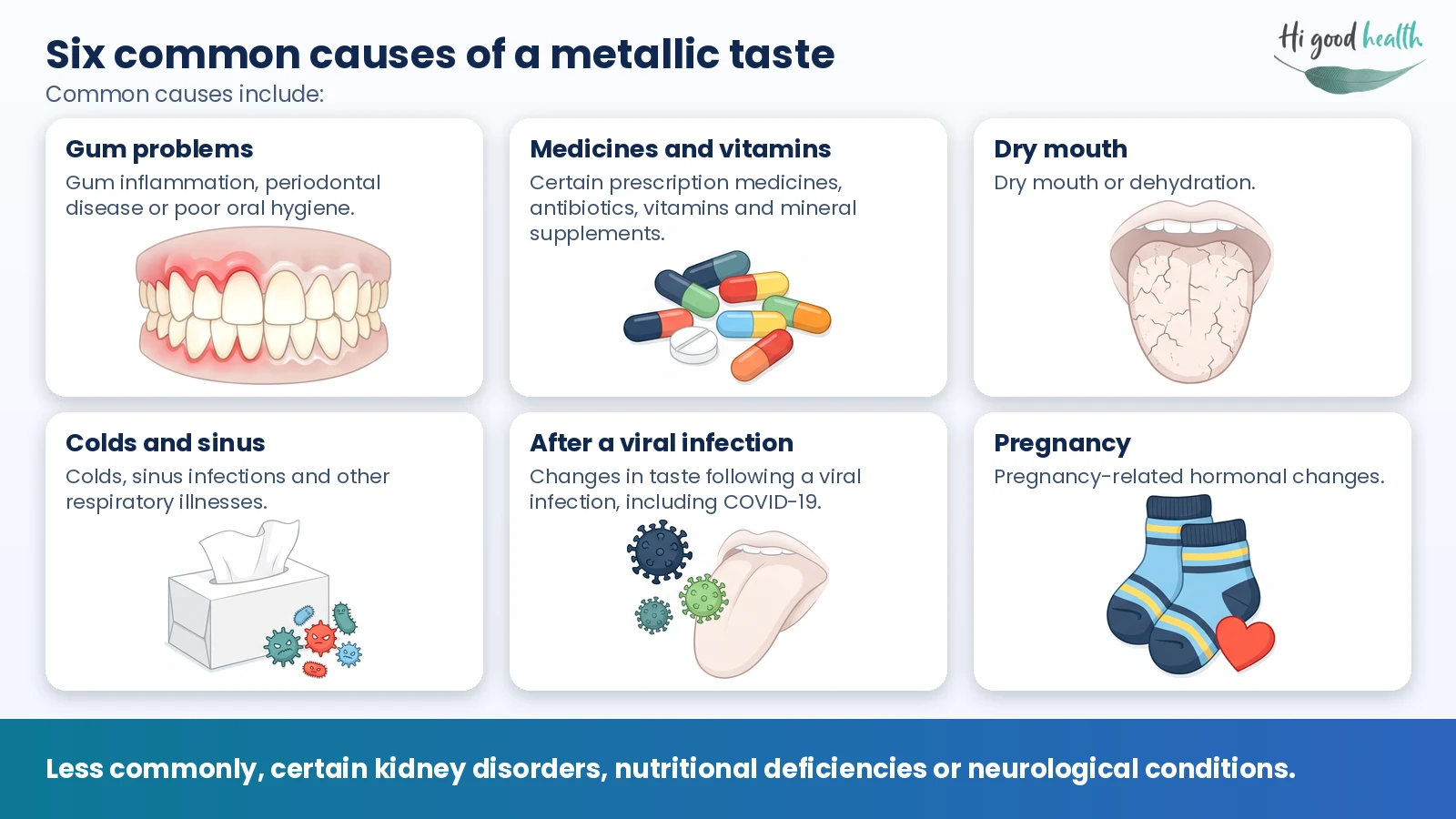
Common causes include:
- Gum inflammation, periodontal disease, or poor oral hygiene.
- Certain prescription medicines, antibiotics, vitamins and mineral supplements.
- Acid reflux or indigestion.
- Colds, sinus infections and other respiratory illnesses.
- Pregnancy-related hormonal changes.
- Dry mouth or dehydration.
- Changes in taste following a viral infection, including COVID-19.
- Less commonly, certain kidney disorders, nutritional deficiencies, or neurological conditions.
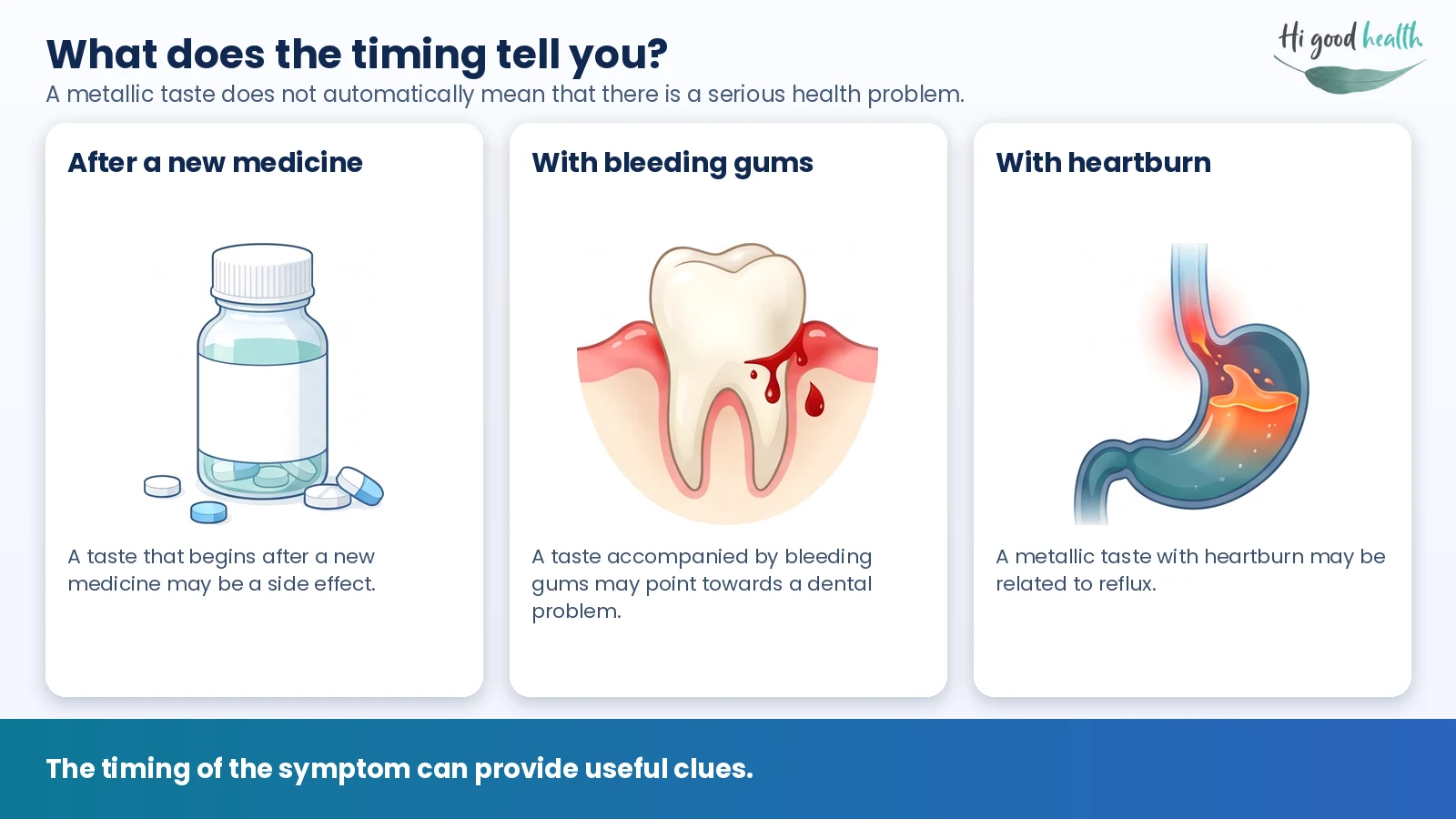
The timing of the symptom can provide useful clues. A taste that begins after a new medicine may be a side effect, while a taste accompanied by bleeding gums may point towards a dental problem. A metallic taste with heartburn may be related to reflux.
Sudden Metallic Taste in Mouth: What Could Cause It?
A sudden metallic taste in the mouth can develop over minutes or hours. Although it is not usually an emergency on its own, associated symptoms help determine how urgently you need medical attention.
Possible causes include:
- A new medicine or supplement: Some antibiotics, antihistamines, multivitamins, iron supplements and other medicines can alter taste. If the symptom begins shortly after starting a product, check its information leaflet and speak with a pharmacist or prescriber.
- A respiratory infection: Colds, sinus infections and other viral illnesses can affect smell and taste. COVID-19 can also cause a change in taste or smell, although a metallic taste alone cannot diagnose the infection.
- Acid reflux: Stomach contents moving into the esophagus and sometimes towards the mouth can leave an unpleasant taste, particularly after meals or when lying down.
- Oral bleeding: A small amount of blood from irritated gums, a mouth injury or recent dental treatment can produce a metallic or blood-like taste.
- Less common medical causes: Certain metabolic, kidney or neurological conditions may affect taste. A sudden change accompanied by facial weakness, difficulty speaking, confusion, or other new neurological symptoms requires emergency assessment.
If the taste persists, keeps returning, or has no clear explanation, arrange a medical or dental assessment rather than assuming it will resolve on its own.
Metallic Taste From Tooth: Dental Causes You Should Know
A metallic taste from tooth-related problems may originate in the gums, tongue, saliva, or dental restorations. A dental examination is particularly useful if you also notice bleeding, pain, swelling, bad breath, or a recent change in your dental work.
Gum disease and poor brushing
Gingivitis causes inflamed gums that may bleed during brushing or flossing. Periodontitis, a more advanced form of gum disease, can cause persistent bad breath, gum recession, loose teeth, and an unpleasant taste.
Inadequate brushing and cleaning between teeth allow plaque to accumulate. Improving oral hygiene can help, but established periodontal disease may require professional treatment.
Fillings, crowns and dentures
Some people notice an unusual taste after receiving a filling, crown or denture. Metal-containing dental restorations may occasionally contribute to a metallic sensation, but the presence of a metal filling or crown does not automatically mean it is causing the problem.
A persistent taste after dental treatment may instead be associated with gum inflammation, trapped food, a leaking or damaged restoration, infection, or dry mouth. Dentures that do not fit properly can also trap plaque and irritate the tissues.
Do not remove or replace a filling or crown solely because of a metallic taste. A dentist can check the restoration and surrounding tissues to identify the likely cause.
Mouth infections and dry mouth
Dental abscesses, infected gums and other oral infections may cause an unpleasant taste, sometimes accompanied by pus, pain, swelling or fever. Reduced saliva can also make the mouth feel sticky and affect taste.
Facial swelling, fever with dental pain, or spreading oral infection needs urgent assessment. Difficulty swallowing or breathing requires emergency care.
Bitter Taste Mouth: Why Does Everything Taste Bitter?
A bitter taste sensation may occur alongside a metallic taste, but the two are not identical. Some people describe food, water, or even their own saliva as bitter.
Possible causes include medication side effects, gum disease, dry mouth, smoking, respiratory infections, and acid reflux. Reflux may be more likely when the taste occurs after meals, with heartburn, or when lying down.
If the bitterness is persistent, review any recently started medicines or supplements with a healthcare professional. Do not stop prescribed treatment without medical advice.
Bad Taste in Mouth: Could It Be More Than a Dental Problem?
A bad taste in the mouth may result from plaque accumulation, gum disease, tooth decay, oral infections, or food trapped between teeth. However, not every unpleasant taste begins in the mouth.
Sinus infections can cause mucus to drain into the throat, while reflux can bring stomach contents towards the mouth. Certain medicines and changes in smell can also distort flavor.
Brush twice daily with fluoride toothpaste, clean between your teeth daily, gently clean your tongue, and drink water regularly. If the taste continues despite good oral hygiene, arrange an assessment to investigate other causes.
Sour Taste in Mouth: Is It Acid Reflux?
A sour taste in the mouth is commonly associated with gastroesophageal reflux disease (GERD), in which stomach contents flow back into the esophagus. The taste may be more noticeable after a large meal, when bending over, or when lying down.
Other possible symptoms include heartburn, regurgitation, a sensation of fluid rising into the throat, and persistent throat irritation.
To reduce reflux symptoms, try eating smaller meals, avoiding foods that consistently trigger symptoms, and not lying down for about three hours after eating. If symptoms are frequent, persistent or accompanied by difficulty swallowing, seek medical advice. Chest pain that is severe or accompanied by breathlessness, sweating, or faintness needs emergency assessment rather than being assumed to be reflux.
Blood-Like Taste in Mouth: When Do You Need a Doctor the Same Day?
A blood-like taste in the mouth can occur when a small amount of blood enters the saliva. Common sources include inflamed gums, mouth ulcers, brushing too aggressively, a mouth injury, or recent dental treatment.
However, the taste alone cannot establish where the blood is coming from.
Arrange same-day medical assessment if:
- Your gums bleed spontaneously, bleed heavily, or continue bleeding despite applying gentle, steady pressure with clean gauze.
- You have unexplained oral bleeding, particularly if you take blood-thinning medicines or have a known bleeding disorder.
- You notice blood in your saliva without an obvious dental cause, especially if it recurs.
- You cough up even a small amount of blood or blood-streaked mucus.
Occasional light gum bleeding during brushing often reflects gingivitis and warrants a dental appointment, especially if it persists. It does not always require same-day emergency care. However, heavy, spontaneous, or persistent bleeding should not be ignored.
Seek emergency care immediately if bleeding is substantial, you have difficulty breathing, chest or upper-back pain, a very rapid heartbeat, faintness, or rapidly worsening symptoms. Coughing up blood can arise from respiratory infections but can also indicate a serious lung or blood-vessel condition. [3]
Metallic Taste While Coughing: What Does It Suggest?
A metallic taste while coughing may occur when irritated airways produce mucus, when a respiratory infection affects smell and taste, or when a small amount of blood is present in the sputum.
If the taste occurs only during a cough, pay attention to what you bring up. Clear mucus without other symptoms may accompany a minor respiratory illness, but the taste itself cannot identify the cause.
If you see blood or blood-streaked phlegm, seek same-day medical assessment even if the amount is small. If you cough up more than a few spots or streaks of blood, or have breathing difficulty or chest pain, seek emergency care. Do not assume that blood is coming from your gums without an examination. [3]
Metallic Taste in Mouth: Could It Be COVID?
COVID-19 can affect taste and smell, and some people experience a distorted or unpleasant taste during or after infection. A metallic taste may occur as part of this change, but it is not specific to COVID-19.
Other symptoms may include cough, fever, sore throat, congestion, fatigue, and a reduced sense of smell. If you have compatible symptoms or a relevant exposure, follow current local testing and infection-control guidance.
A persistent taste change after an infection may need assessment, particularly if it affects eating or drinking. Do not assume that every metallic taste is caused by COVID-19; dental disease, medicines and reflux remain possible explanations. [4, 5]
Kidney Disease and Metallic Taste in Mouth: Is There a Connection?
A metallic taste can sometimes occur in people with advanced kidney disease, particularly when kidney function is severely impaired, and waste products accumulate in the blood. Changes in saliva, medication effects, and other associated health problems may also affect taste.
However, a metallic taste alone is not a reliable sign of kidney disease and cannot be used to diagnose it. Kidney disease may have few noticeable symptoms in its early stages.
If you have known kidney disease and develop a persistent taste change, discuss it with your treating clinician, especially if you also notice reduced urine output, new swelling, nausea, marked fatigue or other changes in your health. New or severe symptoms require prompt assessment.
People without a known kidney condition should not assume that a metallic taste means their kidneys are failing. A clinician can decide whether blood tests, urine tests or other investigations are appropriate. [6]
How to Get Rid of a Metallic Taste in Mouth
The right treatment depends on the cause. There is no single medicine that works for every person with a metallic taste.
You can try the following measures while arranging an assessment if needed:
- Brush twice daily with fluoride toothpaste and clean your tongue gently.
- Floss or use an appropriate interdental cleaner daily.
- Drink water regularly, particularly if your mouth feels dry.
- Chew sugar-free gum to stimulate saliva if appropriate.
- Avoid smoking and limit alcohol.
- If reflux seems to trigger the taste, avoid lying down immediately after meals.
- Review new medicines and supplements with a pharmacist or clinician.
Do not stop prescribed medication or start supplements such as zinc without advice. If the metallic taste persists, returns repeatedly or has no obvious cause, consult a dentist or primary care clinician. Depending on your symptoms, they may recommend an oral examination, medication review, or selected blood tests.

The Oral Hygiene Series
Sixteen articles on looking after your teeth and gums, at every age.
- Complete Oral Hygiene Guide for Every Age — the whole routine, age by age
- Brushing Technique: Bass, Modified Bass and Fones — which method suits which mouth, and how long two minutes really is
- Electric vs Manual Toothbrush — what the evidence shows, rather than what the manufacturers claim
- How to Floss Correctly — step by step, including the C-shape wrap and how far below the gumline to go
- Water Flosser for Tonsil Stones — what pressure is safe, and when not to try it at all
- Interdental Brushes and Bleeding Gums — choosing the right size, and why bleeding usually stops within two weeks
- Early Childhood Caries — causes, symptoms, prevention and treatment in children under six
- Milk Teeth Falling Out — the age, order and timeline, and what parents should know
- Pyorrhea (Gum Disease) — causes, symptoms, treatment and prevention
- Gum Swelling, Bleeding and Dry Mouth — how underlying diseases affect your gums and oral health
- Medicine for Toothache — what to take, what causes the pain, and how it is treated
- Pacifier Teeth — how pacifiers affect growing teeth and the bite, and when to stop
- 6 Year Molars — the first permanent molars, when they come in and how to protect them
- Tooth Cavities (Dant Me Kida) — what a “tooth worm” really is, how cavities form and how they are treated
- Can Cavities Spread? — whether cavities pass between people or from tooth to tooth, and how to prevent them
- Metallic Taste in Mouth — what causes it, what helps and when to see a doctor (you are here)
Key Takeaways
A metallic taste is not automatically serious, and it is frequently short-lived. A taste that sticks around or has no clear cause is worth getting checked.
When it began and what came with it help narrow down the cause: a new medicine, bleeding gums or heartburn each point in a different direction.
No single medicine fixes every metallic taste, because treatment follows the cause. If it persists, returns or stays unexplained, see a dentist or your primary care clinician.
Blood or blood-streaked phlegm needs same-day medical assessment, however little there is. Go for emergency care if bleeding is heavy, if you struggle to breathe, have chest or upper-back pain, a racing heartbeat or faintness, or if symptoms worsen fast.
Frequently Asked Questions
Is a metallic taste in the mouth serious?
Usually not. Gum disease, medicines, indigestion or a respiratory infection are common reasons. Get it assessed if it persists or comes with unexplained bleeding, facial swelling or other new symptoms.
Can dehydration cause a metallic taste?
Indirectly, yes: being short of fluid lowers saliva and leaves the mouth dry, which can change taste. Many other things cause a metallic taste, so dehydration should not be assumed to be the reason.
Can vitamin or iron supplements cause a metallic taste?
They can. Certain iron products, multivitamins and mineral supplements change how things taste. If the taste started after you began one, ask a pharmacist or clinician whether it could be to blame and whether there is a better alternative.
Can pregnancy cause a metallic taste?
It can. Hormone shifts in pregnancy sometimes alter taste, often early on. Mention a lasting or severe change to your clinician, especially with other symptoms or worries.
Why do I have a metallic taste when I wake up?
Overnight dry mouth, plaque, inflamed gums, reflux or a medicine may be responsible. If it happens often, a dental check and a look at any other symptoms can pinpoint the cause.
Can acid reflux cause a metallic or sour taste?
Yes. When stomach contents rise into the esophagus and towards the mouth, they can leave a sour or unpleasant taste. Frequent symptoms deserve medical assessment and treatment.
Does a metallic taste mean kidney disease?
No. Advanced kidney disease can alter taste, but a metallic taste on its own does not reliably point to a kidney problem. A clinician can say whether kidney function tests are needed.
When should I worry about a blood-like taste in my mouth?
Get same-day medical assessment if you cough up blood, find unexplained blood in saliva or have gum bleeding that starts by itself or keeps going. Heavy bleeding, trouble breathing, chest pain or faintness may need emergency care.
Glossary
Dysgeusia: an altered or distorted sense of taste.
Gingivitis: inflamed gums that may bleed during brushing or flossing.
Periodontitis: a more advanced form of gum disease that can cause persistent bad breath, gum recession, loose teeth, and an unpleasant taste.
Gastro-esophageal reflux disease (GERD): a condition in which stomach contents flow back into the esophagus.
References
- NHS. Metallic Taste. Accessed October 30, 2026. Available at: https://www.nhs.uk/symptoms/metallic-taste/
- National Institute of Dental and Craniofacial Research (NIDCR). Taste Disorders. Accessed October 30, 2026. Available at: https://www.nidcr.nih.gov/health-info/taste-disorders
- NHS. Coughing Up Blood. Accessed October 30, 2026. Available at: https://www.nhs.uk/symptoms/coughing-up-blood/
- Centers for Disease Control and Prevention (CDC). Symptoms of COVID-19. Accessed October 30, 2026. Available at: https://www.cdc.gov/covid/signs-symptoms/
- World Health Organization (WHO). Coronavirus Disease (COVID-19). Accessed October 30, 2026. Available at: https://www.who.int/news-room/fact-sheets/detail/coronavirus-disease-%28covid-19%29
- MedlinePlus, US National Library of Medicine. Acute Kidney Failure. Accessed October 30, 2026. Available at: https://medlineplus.gov/ency/article/000501.htm
All reference links checked on October 30, 2026 (all six opened).
Disclaimer
This content is for educational purposes only and is not a substitute for professional medical or dental advice. Speak to a doctor or dentist about your own symptoms.
