About this series. Oral Hygiene is an eleven-part series on looking after teeth and gums at every age, from brushing and flossing to children’s teeth, gum disease and toothache.
This is Part 6: Interdental Brushes and Bleeding Gums.
At a Glance
An interdental brush is a small bristled brush that cleans the space between two teeth, where a toothbrush cannot reach. Used once a day alongside brushing, it removes the plaque that causes gingivitis, bleeding gums and, if left, periodontitis.
The single rule that matters most: the brush must pass between the teeth without being forced. A brush that is too large injures the gum; one that is too small does nothing. Most people need more than one size.
Interdental brushes are preferred to floss where the space is wide enough to take one. Where contacts are tight, floss remains the better tool.
What Are Interdental Brushes?
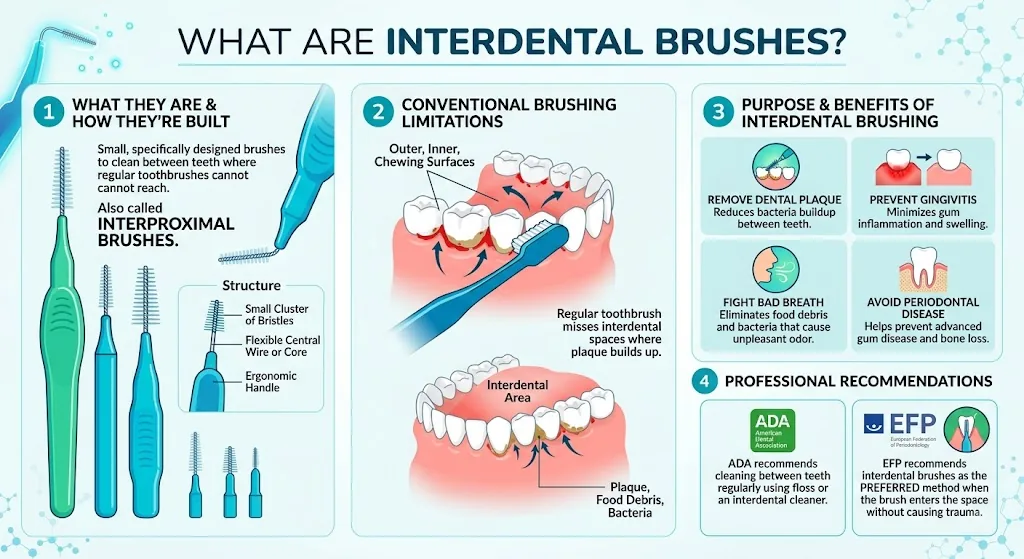
Interdental brushes are small brushes specifically designed to clean between the teeth, where a regular toothbrush cannot reach effectively. Also called interproximal brushes, they consist of a small cluster of bristles attached to a central wire or flexible core, usually with a handle for easier grip.
Unlike conventional toothbrushes, which primarily clean the outer, inner, and chewing surfaces of teeth, interdental brushes are designed to remove dental plaque, food debris, and bacteria from the spaces between teeth and around the gumline.
Interdental cleaning is an important part of daily oral hygiene because plaque can accumulate between teeth and contribute to gingivitis, gum bleeding, bad breath, and eventually periodontal disease if it is not adequately removed. The American Dental Association (ADA) recommends cleaning between the teeth regularly using floss or another interdental cleaner.
The European Federation of Periodontology (EFP) recommends interdental brushes as the preferred method of interdental cleaning when the brush can enter the space without causing trauma.
Why Is Interdental Cleaning Important?
A toothbrush cannot adequately clean every surface between two teeth. These areas can therefore become plaque-retentive sites.
When plaque remains around the teeth and gums, it can trigger an inflammatory response. This may initially appear as:
- Red or swollen gums
- Bleeding during brushing or cleaning
- Gum tenderness
- Bad breath
- Plaque accumulation between teeth
If gingivitis is not controlled, susceptible individuals may develop periodontitis, a more serious inflammatory disease that can lead to periodontal attachment and bone loss.
Therefore, brushing twice daily should be combined with an appropriate interdental cleaning method.
The EFP recommends cleaning between the teeth at least once daily and notes that different interdental brush sizes may be necessary for different spaces.
Gum Disease, Gingivitis and Bleeding Gums: What Interdental Cleaning Is Actually For
Interdental brushes are not an end in themselves. They exist to prevent and control a specific disease process, and it is worth naming that process plainly, because it is what most people are actually worried about when they start cleaning between their teeth.
Gingivitis
Gingivitis is inflammation of the gum caused by plaque sitting undisturbed along and between the teeth. It shows as redness, swelling, tenderness and bleeding during brushing or cleaning. It is common, and at this stage it is reversible: remove the plaque consistently and the inflammation settles.
Bleeding gums
Bleeding is a symptom, not a normal consequence of cleaning. Gums that are already inflamed may bleed a little when they are first cleaned properly, and that usually settles within one to two weeks of daily interdental cleaning. Bleeding that is heavy, or that persists beyond that, needs a dental assessment rather than more scrubbing.
Periodontitis, and why the stage matters
If gingivitis persists in a susceptible person it can progress to periodontitis, in which the inflammation reaches the supporting attachment and bone. That damage is not reversible by cleaning alone. Interdental brushes remain part of daily plaque control at this stage, but they are not a treatment for it.
In India this whole disease group is more often called pyorrhoea in everyday speech, and less often periodontitis. The words describe the same problem: gum disease that has moved beyond the surface.
This distinction is the reason the guidance in this article is repeatedly conditional. What an interdental brush can do depends on where a person already is on that path, which is a judgement for a dentist rather than an article.
What Are Interdental Brushes Used For?
Interdental brushes have several important applications in preventive and periodontal oral care.
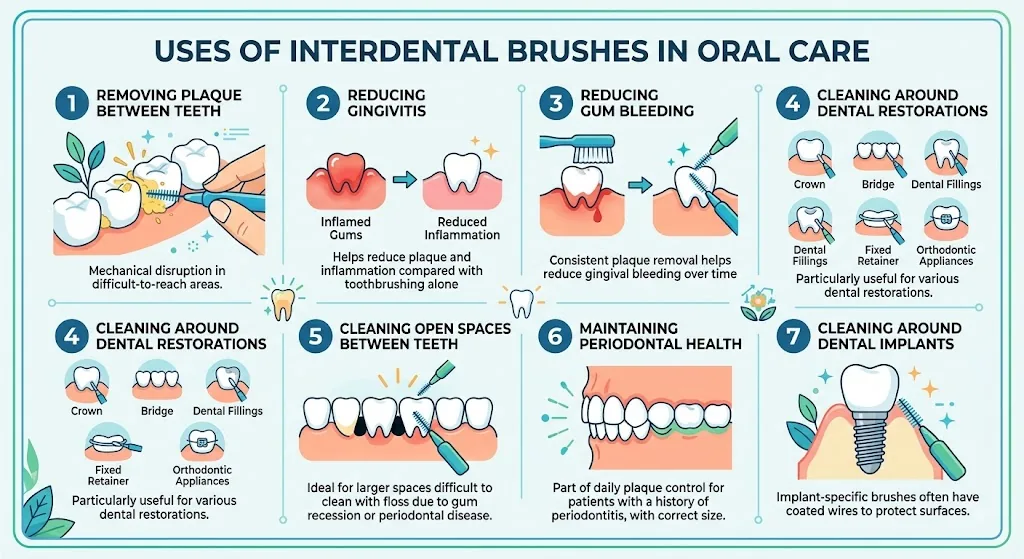
1. Removing plaque between teeth
Their bristles mechanically disrupt plaque in areas that are difficult to reach with a conventional toothbrush.
2. Reducing gingivitis
Regular interdental cleaning can help reduce plaque and inflammation of the gums. Evidence suggests that interdental brushes used alongside toothbrushing can reduce gingivitis and plaque compared with toothbrushing alone.
3. Reducing gum bleeding
Bleeding during interdental cleaning is often associated with gingival inflammation. Consistent plaque removal can help reduce gingival bleeding over time.
4. Cleaning around dental restorations
Interdental brushes can be particularly useful around:
- Crowns
- Bridges
- Dental fillings
- Fixed retainers
- Orthodontic appliances
5. Cleaning open spaces between teeth
People with gum recession or previous periodontal disease may have larger spaces between their teeth. These spaces can be difficult to clean effectively with conventional floss.
6. Maintaining periodontal health
Interdental brushes are particularly useful as part of daily plaque control for patients with a history of periodontitis, provided the brush is appropriately sized and used correctly.
7. Cleaning around dental implants
Specially designed interdental brushes may be used around dental implants. Some implant-specific brushes have coated wires designed to reduce the risk of damaging implant surfaces.
What Are the Benefits of Interdental Brushes?
1. Effective plaque removal
Interdental brushes can physically contact the surfaces around the interdental space, helping disrupt and remove plaque.
A systematic review found that interdental brushes, when used in addition to toothbrushing, may reduce plaque more effectively than toothbrushing alone.
2. May be more effective than floss in suitable spaces
Research suggests that interdental brushes may provide greater reductions in gingivitis and gingival bleeding than floss in people whose interdental spaces can accommodate a brush.
A network meta-analysis also found interdental brushes to rank highly among interdental cleaning methods for reducing gingival inflammation.
3. Easy to use
For many people, interdental brushes are easier to manipulate than traditional dental floss, particularly individuals with reduced hand dexterity.
4. Useful for periodontal patients
Patients with periodontal disease often have widened interdental spaces due to changes in the supporting tissues. Interdental brushes can be particularly useful in these situations.
5. Helpful with braces
Orthodontic appliances create additional plaque-retentive areas. Small interdental brushes can help clean around brackets, wires, and other orthodontic components.
6. Available in multiple sizes
Interdental spaces are not identical throughout the mouth. Brushes are therefore available in multiple diameters, allowing different sizes to be selected for different areas.
7. Can improve daily oral hygiene
Because interdental brushes can be relatively simple to use, they may improve adherence to an interdental cleaning routine.
Types of Interdental Brushes
Interdental brushes can be classified according to their shape, design, core material, handle, and size.
1. Cylindrical Interdental Brushes
These brushes have bristles arranged relatively evenly around a central core.
Best suited for: Relatively uniform interdental spaces.
They can provide good contact with the tooth surfaces when the space is sufficiently open.
2. Tapered or Conical Interdental Brushes
These brushes have a narrower tip and gradually become wider toward the base.
Best suited for:
- Variable interdental spaces
- Areas with different levels of embrasure opening
- Certain posterior regions
Their tapered design can make it easier to access spaces that are narrower at the entrance and wider deeper within the interdental area.
3. Angled Interdental Brushes
The brush head or wire is angled relative to the handle.
Advantages:
- Easier access to posterior teeth
- Better reach around molars
- Helpful for patients who find straight brushes difficult to position
4. Straight Interdental Brushes
These have a straight handle and brush.
They are commonly used in anterior regions and areas that are relatively easy to access.
5. Flexible Interdental Brushes
Some modern interdental brushes have flexible handles or cores.
They can be useful for reaching difficult areas and may improve comfort and maneuverability.
6. Rubber or Elastomeric Interdental Cleaners
Instead of traditional nylon bristles around a wire, these products use soft rubber or elastomeric projections.
They may be preferred by people who find conventional wire brushes uncomfortable. However, traditional interdental brushes remain an important evidence-supported option, particularly when properly sized.
7. Implant-Specific Interdental Brushes
These are designed specifically for cleaning around dental implants and implant-supported restorations.
Some have specially coated wires intended to reduce the risk of scratching implant components. The appropriate design should be selected according to the implant restoration and advice from the treating dental professional.
Interdental Brush Sizes: Why Size Matters
Size is one of the most important factors when choosing an interdental brush.
Interdental spaces vary from one area of the mouth to another. Therefore, using the same brush size throughout the mouth may not be appropriate.
A brush should:
- Enter the interdental space comfortably
- Provide gentle contact with the tooth surfaces
- Clean the area effectively
- Not require force
- Not cause significant pain or trauma
The EFP specifically notes that different brush sizes may be needed for different interdental spaces.
What happens if the brush is too small?
A very small brush may pass through the space without adequately contacting the tooth surfaces. This can reduce its plaque-removing effectiveness.
What happens if the brush is too large?
A brush that is too large may be difficult to insert and can cause discomfort or trauma to the gums.
Never force an interdental brush into a tight space.
The ADA also advises against forcing an incorrectly sized brush between teeth because this may injure the gums.
How to Choose the Best Interdental Brush Size
The ideal size is not determined simply by age or the overall size of the teeth.
Your dentist or dental hygienist can assess the size of your interdental spaces and recommend appropriate brush sizes.
A patient may require:
- Small brush → tightly spaced areas
- Medium brush → moderately open areas
- Large brush → wider interdental spaces
- Different sizes → different areas of the same mouth
This is why buying a large pack containing several sizes can be more practical than using one universal brush size.
How to Use an Interdental Brush Correctly
Correct technique is essential for effective plaque removal and to prevent unnecessary gum trauma.
Step 1: Choose the correct size
Select a brush that fits the interdental space without force.
Step 2: Position the brush
Place the brush gently between the teeth at the gumline.
Step 3: Insert gently
The brush should pass through the space with gentle pressure.
If it does not enter easily, do not force it.
Step 4: Move it back and forth
Once positioned correctly, gently move the brush in and out a few times.
The bristles should contact the tooth surfaces and the interdental area.
Step 5: Clean every suitable interdental space
Work systematically around the mouth so that no areas are missed.
Step 6: Rinse the brush
Rinse the brush during use to remove accumulated debris.
Step 7: Replace the brush when worn
Replace it when the bristles become worn, damaged, or distorted, or according to the manufacturer’s instructions.
Should You Use Interdental Brushes Before or After Brushing?
Interdental cleaning can be performed before brushing.
The EFP recommends cleaning between the teeth before toothbrushing.
However, the most important factor is consistent and effective daily cleaning. The ADA notes that either sequence can be acceptable as long as interdental cleaning and toothbrushing are performed thoroughly.
Interdental Brushes vs Dental Floss
Both interdental brushes and dental floss have a role in oral hygiene, but they are not interchangeable for every person.
The EFP recommends interdental brushes when they can pass through the space without causing trauma; floss may be appropriate when the space is too tight for a brush.
Therefore, interdental brushes do not completely replace floss for everyone.
Disadvantages of Interdental Brushes
Although interdental brushes have several advantages, they are not perfect for every patient.
1. They cannot fit every interdental space
Very tight contacts may not accommodate even the smallest brush.
In these areas, floss or another interdental cleaning method may be more appropriate.
2. Incorrect sizing can cause trauma
Using a brush that is too large or forcing it through a tight space can cause gum irritation or injury.
3. Multiple sizes may be required
Because interdental spaces differ throughout the mouth, patients may need more than one brush size.
4. The wire can be uncomfortable
Some traditional interdental brushes contain a metal core that may feel uncomfortable, particularly if used incorrectly.
5. They need regular replacement
The bristles can become worn or distorted with repeated use.
6. Technique still matters
Simply pushing a brush between the teeth does not guarantee adequate plaque removal. Proper size selection and technique are important.
7. They may not be ideal for certain dental conditions
Patients with particular restorations, implants, orthodontic appliances, severe sensitivity, or other oral conditions may need individualized advice from their dentist.
Can Interdental Brushes Damage Gums?
They can if they are used incorrectly.
An appropriately sized interdental brush should not require force. Excessive pressure, an oversized brush, or aggressive back-and-forth movements can traumatize the gingival tissues.
The goal is not to make the gums bleed by force.
Some bleeding may occur initially in people with inflamed gums. As plaque control improves, bleeding should generally decrease. However, persistent or heavy bleeding should not simply be attributed to “normal cleaning.”
If gums continue to bleed regularly despite good oral hygiene, a dental examination is advisable because bleeding can be a sign of gingivitis or periodontitis.
Are Interdental Brushes Better Than Floss?
For many people with open or moderately open interdental spaces, evidence suggests that interdental brushes may provide greater reductions in gingivitis and plaque than floss.
A Cochrane review found that interdental brushes may be more effective than floss for reducing gingivitis, although the certainty of evidence was generally low.
The EFP recommends interdental brushes as the preferred interdental cleaning method when they can be inserted without trauma. For very tight spaces, floss may still have a role.
Therefore, the answer is:
Interdental brushes are often preferable when the interdental space is large enough to accommodate them safely—but floss remains useful for spaces that brushes cannot enter.
What Is the Best Interdental Brush for Gum Health?
There is no single best interdental brush brand or size for everyone.
The best interdental brush for gum health is the one that:
- Fits the interdental space correctly
- Cleans the tooth surfaces effectively
- Does not require force
- Does not cause significant trauma
- Is comfortable enough to encourage daily use
- Is appropriate for the patient’s dental condition
For people with gingivitis or a history of periodontitis and sufficiently open interdental spaces, a correctly sized interdental brush is one of the most evidence-supported choices for daily interdental plaque control.
Rather than choosing a brush solely based on brand, look for appropriate sizing, quality construction, comfortable bristles, and a design suitable for the specific areas of your mouth.
Who May Benefit Most From Interdental Brushes?
Interdental brushes can be particularly useful for:
- People with gingivitis
- People with a history of periodontitis
- People with open interdental spaces
- Patients with gum recession
- Patients with orthodontic braces
- People with dental bridges
- People with dental implants
- Patients with reduced manual dexterity
- People who find conventional floss difficult to use
However, the correct brush size and technique are particularly important in patients with periodontal disease or dental restorations.
Who Should Avoid Forcing an Interdental Brush?
You should not force an interdental brush into:
- Very tight contacts
- Areas with severe pain
- Areas where the brush repeatedly catches
- Sites where significant bleeding or trauma occurs
- Areas where a restoration prevents safe insertion
Instead, consult a dentist or dental hygienist about an alternative interdental cleaning method.
How Often Should You Use Interdental Brushes?
For most people, interdental cleaning should be performed at least once daily.
The EFP recommends daily interdental cleaning, while the ADA recommends cleaning between teeth once a day using floss or another interdental cleaner.
Consistency is more important than occasionally performing an elaborate cleaning routine.
Can Interdental Brushes Prevent Gum Disease?
Interdental brushes can contribute to the prevention and control of gingivitis by removing plaque from between teeth.
However, they should not be considered a stand-alone treatment for established periodontitis.
Patients with periodontitis may require professional periodontal assessment, periodontal instrumentation, individualized oral-hygiene instruction, and ongoing maintenance.
The EFP’s evidence-based periodontal guidelines emphasize individualized treatment and professional management of periodontitis.
The Oral Hygiene Series
Eleven articles on looking after your teeth and gums, at every age.
- Complete Oral Hygiene Guide for Every Age — the whole routine, age by age
- Brushing Technique: Bass, Modified Bass and Fones — which method suits which mouth, and how long two minutes really is
- Electric vs Manual Toothbrush — what the evidence shows, rather than what the manufacturers claim
- How to Floss Correctly — step by step, including the C-shape wrap and how far below the gumline to go
- Water Flosser for Tonsil Stones — what pressure is safe, and when not to try it at all
- Interdental Brushes and Bleeding Gums — choosing the right size, and why bleeding usually stops within two weeks (you are here)
- Early Childhood Caries — causes, symptoms, prevention and treatment in children under six
- Milk Teeth Falling Out — the age, order and timeline, and what parents should know
- Pyorrhea (Gum Disease) — causes, symptoms, treatment and prevention
- Gum Swelling, Bleeding and Dry Mouth — how underlying diseases affect your gums and oral health
- Medicine for Toothache — what to take, what causes the pain, and how it is treated
Key Takeaways
Interdental brushes are small cleaning devices designed to remove plaque and debris from between the teeth and along areas that a conventional toothbrush cannot adequately reach. They are particularly useful for people with open interdental spaces, gingivitis, periodontal disease, braces, bridges, implants, or other plaque-retentive areas.
Current evidence indicates that interdental brushes can be highly effective for reducing plaque and gingival inflammation when used correctly. However, the best interdental brush is not necessarily the most expensive or the one from a particular brand—it is the correctly sized brush that fits each interdental space comfortably and cleans it without causing trauma.
For very tight spaces where an interdental brush cannot pass safely, dental floss may be a better choice.
If you are unsure which size to use, ask your dentist or dental hygienist to assess your interdental spaces. Professional sizing and instruction can make interdental cleaning safer and more effective.
Frequently Asked Questions About Interdental Brushes
What is an interdental brush?
An interdental brush is a small brush designed to clean the spaces between teeth where a regular toothbrush cannot reach effectively. It consists of fine bristles arranged around a central wire or flexible core and is available in different sizes and shapes.
What are interdental brushes used for?
Interdental brushes are used to remove plaque, bacteria, and food debris from between the teeth and around the gumline. They can also be useful for cleaning around braces, bridges, dental implants, crowns, and other dental restorations.
Are interdental brushes good for gum health?
Yes. When correctly sized and used regularly, interdental brushes can help remove plaque between teeth and reduce gingival inflammation and bleeding. They are particularly useful when interdental spaces are large enough to accommodate a brush without force.
Are interdental brushes better than floss?
Not necessarily for everyone. Interdental brushes may be more effective than floss for reducing plaque and gingival inflammation in interdental spaces that can accommodate them. However, floss may be more suitable for very tight contacts where an interdental brush cannot pass comfortably.
Can interdental brushes replace floss?
They can replace floss in interdental areas where an appropriately sized brush fits safely and cleans effectively. However, some very tight spaces may still require floss or another interdental cleaning method. Your dentist can help determine which method is appropriate for each area.
How often should I use an interdental brush?
Interdental brushes are generally recommended once daily as part of a regular oral-hygiene routine. People with periodontal disease or other specific dental conditions may receive individualized instructions from their dentist or dental hygienist.
Should I use an interdental brush before or after brushing?
Interdental cleaning can be performed before toothbrushing. Cleaning between the teeth first can loosen plaque and debris, which can then be removed during brushing. However, consistency and thoroughness are more important than the exact sequence.
What size interdental brush should I use?
The correct size depends on the width and shape of each interdental space. The brush should fit snugly enough for the bristles to contact the tooth surfaces but should not require force.
You may need different brush sizes for different areas of your mouth.
Can I use the same interdental brush size for all my teeth?
Not necessarily. Interdental spaces vary throughout the mouth. A small brush may be suitable for one area, while a larger brush may be required elsewhere. Using multiple sizes is common and can provide more effective cleaning.
How do I know if my interdental brush is too big?
The brush may be too large if:
- You have to force it between the teeth.
- It repeatedly gets stuck.
- It causes significant discomfort.
- It causes noticeable trauma to the gums.
- The wire bends excessively during insertion.
Do not force a large brush into a tight space. Try a smaller size or ask your dental professional for advice.
How do I know if my interdental brush is too small?
If the brush passes through the space very easily without the bristles contacting the tooth surfaces, it may be too small to clean the area effectively. A properly sized brush should provide gentle resistance while allowing comfortable insertion.
Is it normal for gums to bleed when using interdental brushes?
Some bleeding may occur when interdental cleaning is first introduced, particularly when the gums are already inflamed. As plaque control improves, bleeding should generally decrease.
However, persistent, heavy, or spontaneous gum bleeding should be evaluated by a dentist, as it can be a sign of gingivitis or periodontal disease.
Can interdental brushes cause gum recession?
Interdental brushes used correctly and with an appropriate size should not normally cause gum recession. However, aggressive brushing, excessive pressure, or repeatedly forcing an oversized brush into the interdental space can traumatize the gums.
Can interdental brushes damage teeth?
When used correctly, interdental brushes are designed to clean between teeth without damaging them. However, excessive force or incorrect technique can potentially cause discomfort or damage to soft tissues and, in certain circumstances, dental restorations.
Are interdental brushes safe for sensitive gums?
They can be, provided the correct size and gentle technique are used. If your gums are very sensitive, painful, or bleed excessively, consult a dentist before continuing aggressive interdental cleaning.
Can I use interdental brushes if I have braces?
Yes. Interdental brushes can be particularly helpful for people wearing braces because brackets and wires create additional areas where plaque can accumulate.
A smaller brush can often be used around orthodontic brackets and under wires, but the specific size and technique should be discussed with your orthodontist or dentist.
Can I use interdental brushes around dental implants?
Yes. Interdental brushes can be used as part of implant maintenance when appropriate. Depending on the implant restoration, an implant-specific brush may be recommended.
Patients with implants should follow the cleaning instructions provided by their dentist or implant specialist.
Can interdental brushes be used with dental bridges?
Yes. Interdental brushes can help clean around and underneath certain fixed dental bridges. The appropriate design and size depend on the bridge and the amount of space available.
Specialized brushes or other interdental cleaning aids may sometimes be required.
Are interdental brushes good for people with gum disease?
Yes. They can be particularly useful for people with gingivitis or a history of periodontitis because periodontal disease can result in larger interdental spaces that are difficult to clean with conventional floss.
However, interdental brushes are not a substitute for professional periodontal treatment when periodontitis is present.
Can interdental brushes remove tartar?
No. Interdental brushes can remove plaque and food debris, but they cannot reliably remove hardened tartar (dental calculus).
Once plaque mineralizes into calculus, professional dental cleaning is generally required.
Can interdental brushes help with bad breath?
They may help when bad breath is related to plaque and trapped food between the teeth. Removing bacteria and debris from interdental areas can improve oral cleanliness and may reduce some causes of oral malodor.
Persistent bad breath, however, can have several causes and should be evaluated if it does not improve with good oral hygiene.
Can interdental brushes whiten teeth?
No. Interdental brushes are designed for plaque and debris removal, not tooth whitening. They may make the areas between teeth appear cleaner by removing surface debris, but they do not change the natural color of teeth.
How long does an interdental brush last?
The lifespan depends on the brush design, frequency of use, and how it is handled. Replace the brush when the bristles become worn, bent, damaged, or less effective, or according to the manufacturer’s instructions.
Can I reuse an interdental brush?
Many interdental brushes are designed for repeated use for a limited period. Rinse the brush thoroughly after use and allow it to dry. Replace it when it becomes worn, damaged, or according to the manufacturer’s recommendations.
Should I use toothpaste on an interdental brush?
Generally, toothpaste is not necessary. The primary purpose of an interdental brush is mechanical plaque removal. Adding toothpaste is usually unnecessary unless specifically recommended by a dental professional.
Can I use an interdental brush if my teeth are very close together?
If the brush cannot pass through the contact without force, do not push it through. Floss or another appropriately sized interdental cleaner may be more suitable for very tight spaces.
Why do I need different interdental brush sizes?
Interdental spaces are different throughout the mouth. Gum recession, periodontal disease, tooth position, missing teeth, restorations, and natural tooth anatomy can all affect the size of these spaces.
Using the correct size for each area improves cleaning effectiveness and reduces the risk of trauma.
Are rubber interdental brushes as effective as traditional interdental brushes?
Rubber or elastomeric interdental cleaners can be convenient and comfortable for some users. However, traditional interdental brushes with bristles have substantial evidence supporting their use for interdental plaque and gingival inflammation control. The most appropriate option depends on the individual and the specific interdental space.
What is the best interdental brush for gum health?
There is no single best interdental brush for everyone. The best interdental brush is the one that is correctly sized for the interdental space, cleans effectively, feels comfortable, and can be used consistently without causing trauma.
For people with open interdental spaces, gingivitis, or a history of periodontitis, a correctly fitted interdental brush is often an excellent choice for daily interdental cleaning.
How do I choose the best interdental brush?
Consider:
- The size of your interdental spaces
- Whether you have gum recession or periodontal disease
- Whether you have braces, bridges, or implants
- The shape and accessibility of the spaces
- The comfort and flexibility of the brush
- The recommendation of your dentist or dental hygienist
If you are unsure about sizing, professional assessment is preferable to choosing a brush based only on its packaging.
When should I see a dentist about bleeding gums?
See a dentist if your gums:
- Continue to bleed regularly despite improved oral hygiene
- Bleed heavily
- Are swollen or painful
- Appear persistently red
- Recede noticeably
- Have pus or discharge
- Are associated with loose teeth
- Cause persistent bad breath
These symptoms may indicate gingivitis or periodontitis and require professional evaluation.
Can interdental cleaning prevent gum disease?
Regular interdental cleaning can help control plaque and reduce gingival inflammation, which are important components of preventing gum disease. However, oral hygiene is only one part of maintaining periodontal health. Regular dental examinations, professional cleaning when required, healthy lifestyle habits, and management of risk factors are also important.
What is the most important rule when using an interdental brush?
Never force the brush into an interdental space.
The brush should fit comfortably and allow the bristles to contact the tooth surfaces. If it does not fit, use a smaller brush or another interdental cleaning method.
References
1. American Dental Association. Dental Floss/Interdental Cleaners. ADA Oral Health Topics. Updated April 30, 2026. ada.org
2. Worthington HV, MacDonald L, Poklepovic Pericic T, et al. Home use of interdental cleaning devices, in addition to toothbrushing, for preventing and controlling periodontal diseases and dental caries. Cochrane Database of Systematic Reviews. 2019;4:CD012018.
3. Sanz M, et al. Efficacy of inter-dental mechanical plaque control in managing gingivitis – a meta-review. Journal of Clinical Periodontology. Evidence summarized by the European Federation of Periodontology.
4. Kotsakis GA, Lian Q, Ioannou AL, Michalowicz BS, John MT, Chu H. A network meta-analysis of interproximal oral hygiene methods in the reduction of clinical indices of inflammation. Journal of Periodontology. 2018.
5. Slot DE, Dörfer CE, Van der Weijden GA. The efficacy of interdental brushes on plaque and parameters of periodontal inflammation: a systematic review. Evidence summarized in reviews of interdental cleaning methods.
6. American Dental Association. Choosing an interdental cleaning method. ADA News.
7. European Federation of Periodontology. Gum disease: Prevention. EFP Patient Information.
8. European Federation of Periodontology. What is periodontitis? EFP Patient Information.
9. European Federation of Periodontology. Guideline on treatment of stage I–III periodontitis. EFP S3-level Clinical Practice Guideline.
10. American Dental Association. ADA Seal of Acceptance: Category Requirements for Manual Interdental Cleaners.
