Part of the HiGoodHealth peptides series.
- Our pillar guide, Peptides: What They Are, How They Work, and Where They Stand in 2026, covers the science and the landscape.
- FDA Advisory Committee Votes on Peptides: What Changed—and What Didn’t reports what happened at the July 2026 advisory meeting.
- This article takes the single question readers ask most — are peptides legal? — and answers it properly: what the law actually says, what the 2026 vote did and didn’t change, and where that leaves buyers, athletes, patients and prescribers.
- The full series is listed at the end of this article.
At a glance
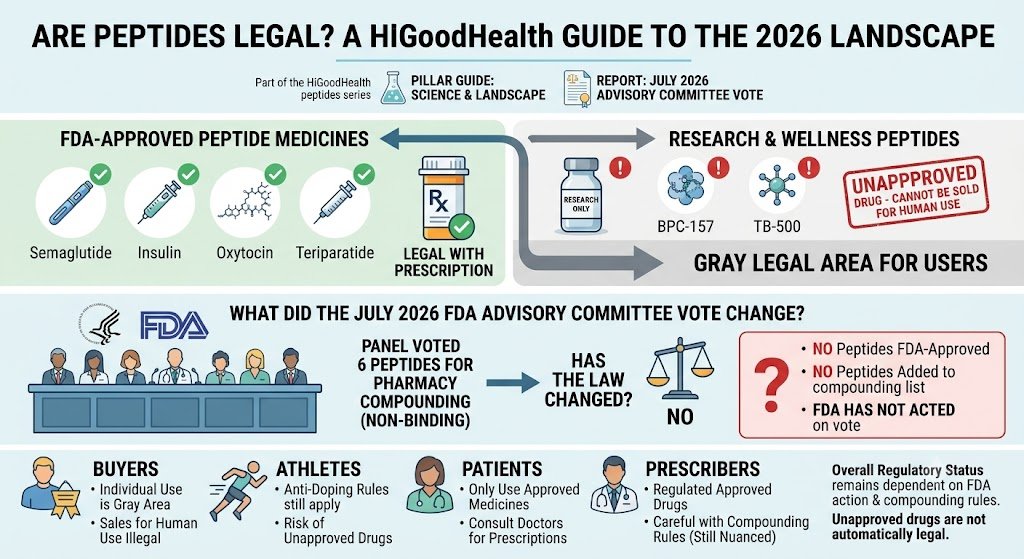
Some peptides are legal prescription medicines; others are unapproved drugs that cannot lawfully be marketed for human use. The FDA’s July 2026 advisory vote did not make BPC-157, TB-500, MOTS-c or the other recommended peptides FDA-approved or automatically legal to sell. Their regulatory status remains dependent on FDA action and the applicable compounding rules.
There is no single answer, because “peptides” covers two different things. FDA-approved peptide medicines — insulin, semaglutide, oxytocin, teriparatide and others — are fully legal with a prescription.
Research and wellness peptides such as BPC-157, TB-500 and MOTS-c are not FDA-approved, cannot legally be sold for human use, and sit in a gray area for the people who buy them anyway.
July 2026 changed the conversation but not the law. An FDA advisory panel voted narrowly to recommend six peptides for pharmacy compounding. That vote was non-binding, the FDA has not acted on it, and none of these peptides has been added to the compounding list or approved as a drug.
The ‘research use only’ label is often misunderstood; FDA has clarified in multiple warning letters that it does not provide legal protection.
Individual buyers have seldom faced prosecution; however, this reflects enforcement discretion rather than a legal exemption. “Rarely prosecuted” is a risk profile, not a legal status, and the practical consequences for consumers are real: seized imports, unregulated vials, and — for athletes and service members — a ban that has nothing to do with the FDA.
What peptides are, and why the legal question is so confusing
Peptides are short chains of amino acids that act as signaling molecules in the body. Some have been made into approved medicines through decades of clinical trials. Others exist only as laboratory compounds sold online.
Both get called “peptides,” which is why the legality question keeps producing contradictory answers.
The word describes a chemical class, not a legal category — much as “plant extract” tells you nothing about whether something is a prescription drug. (To learn more about the science, read our full guide: Peptides: What They Are, How They Work, and Where They Stand in 2026.)
Everything below depends on keeping those two worlds apart.
How the FDA actually regulates peptides
Approval versus compounding
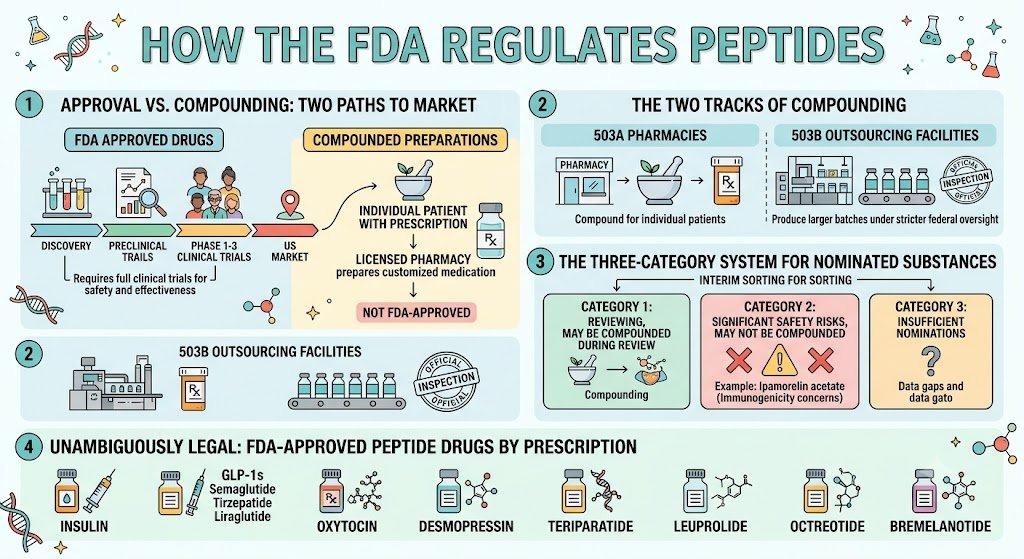
A drug reaches the US market in one of two ways. FDA approval requires full clinical trials for safety and effectiveness. Compounding is different: a licensed pharmacy prepares a customized medication for an individual patient with a prescription. Compounded preparations are not FDA-approved and never go through that trial process.
Compounding runs on two tracks. 503A pharmacies compound for individual patients. 503B outsourcing facilities produce larger batches under stricter federal oversight. A bulk substance must sit on the 503A bulks list before a 503A pharmacy may legally compound with it.
The three-category system
While it evaluates nominated substances, the FDA sorts them into interim categories. Category 1 substances may be compounded during review. Category 2 substances “may present significant safety risks” and may not. Category 3 covers insufficient nominations.
As of the FDA’s April 2026 update, ipamorelin acetate remains in the active Category 2 table over immunogenicity concerns.
Peptides that are already approved
Plenty of peptide drugs cleared the full process and are unambiguously legal on prescription: insulin, the GLP-1s (semaglutide, tirzepatide, liraglutide), oxytocin, desmopressin, teriparatide, leuprolide, octreotide and bremelanotide.
These peptide drugs are clearly FDA-approved and legally available by prescription — though how people obtain the GLP-1s has become its own problem, which we cover in The GLP-1 Telehealth Boom.
The 2026 FDA ruling: what changed, and what didn’t
In April 2026, the FDA announced it would remove twelve peptides from Category 2 — a procedural step that opened a gray zone rather than granting permission.
On 23–24 July 2026, the FDA’s Pharmacy Compounding Advisory Committee reviewed seven peptides and recommended six for the 503A bulks list: BPC-157, KPV, TB-500 and MOTS-c on the first day, Semax and Epitalon on the second. It rejected emideltide.
The margins were thin — BPC-157, KPV and TB-500 passed 8–6 — and the panel voted against the advice of the FDA’s own staff scientists, who found the supporting studies short, small and insufficient to establish safety or effectiveness.
Important safety note: the recommendation is non-binding. None of these peptides has been added to the 503A bulks list, and none is an FDA-approved drug. Formal notice-and-comment rulemaking would have to follow, which observers put at roughly 8–12 months.
As of now, the legal status remains unchanged from June 2026. (Full breakdown, including the politics and the panel’s reported industry ties: FDA Advisory Committee Votes on Peptides: What Changed—and What Didn’t.)
The gray market and the “research use only” myth
Most unapproved peptides are sold with a “research use only” (RUO) or “not for human consumption” label. Buyers read that as a legal workaround. The FDA does not recognize these disclaimers as exemptions from drug regulation.
What matters legally is intended use, which the agency reads from website copy, marketing claims and product context — not from the disclaimer. In its June 2026 warning letter to a Florida vendor, the FDA wrote that “evidence obtained from your product labeling… establishes that your products are intended to be drugs for human use,” despite the RUO wording.
The same reasoning appears in letters to Gram Peptides and Pink Pony Peptides earlier that year.
The same pattern plays out one step up the supply chain, where online prescribing has raced ahead of oversight — see The GLP-1 Telehealth Boom for how that works with weight-loss drugs.
The market is growing regardless. Blockchain analytics firm Chainalysis tracked cryptocurrency payments to gray-market peptide vendors crossing a $100 million annual run rate by mid-2026, up from roughly $1 million a quarter in 2024 — and that figure captures only crypto, so the real total is higher.
Can you get in trouble for peptides?
If you are a buyer
We found no publicly documented federal prosecution, as of the date of publication, focused solely on an individual’s personal purchase of a non-controlled research peptide. That does not establish that personal possession or importation is lawful in every circumstance.
The FD&C Act’s prohibited acts are built around introducing drugs into interstate commerce, delivery for pay and importation — seller conduct. FDA’s exercise of enforcement discretion for some personal imports should not be confused with a legal exemption from the underlying drug or importation requirements.
Three real exceptions cut against the “buyers are safe” story. Federal law provides separate criminal penalties for certain unauthorized distribution or possession-with-intent-to-distribute of human growth hormone. It carries individual criminal liability under 21 U.S.C. §333(e).
Adulterated vials are a documented problem — gray-market peptide products have tested positive for testosterone, a Schedule III controlled substance you can be prosecuted for possessing. (For what the evidence says about harms, see the “Are Peptides Safe? Side Effects and Risks” section of our Peptides: What They Are, How They Work, and Where They Stand in 2026.)
And imports get seized: FDA’s personal-importation allowance is explicitly enforcement discretion, with the agency’s own manual stating it “should not be interpreted as a license to individuals to bring in such shipments.”
If you are a seller or a practitioner
This is where enforcement actually lands. In July 2026, the owner of Paradigm Peptides was sentenced to 70 months in federal prison for introducing unapproved new drugs into interstate commerce with intent to defraud — roughly 54,000 customers, $5 million forfeited, and products that tested positive for testosterone.
In April 2026 a Utah osteopathic physician was indicted for allegedly supplying peptides sourced from China to more than 200 patients; that case is an allegation and he is presumed innocent.
State boards are moving too. Ohio’s Board of Pharmacy summarily suspended four med-spa practice licenses in June 2025 over unapproved, RUO-labeled products.
Are peptides a steroid?
No. Anabolic steroids are synthetic derivatives of testosterone and are DEA Schedule III controlled substances. Peptides are amino acid chains and are generally not DEA-scheduled. But not being a controlled substance is a narrow point — an unapproved new drug is still illegal to sell for human use.
Will peptides fail a drug test?
Standard employment tests
Almost certainly not. The federal SAMHSA panel and the common 5- and 10-panel screens test for marijuana, cocaine, opiates, amphetamines, PCP, benzodiazepines, fentanyl and similar small molecules. Peptides are not analytes on any of them, and detecting them takes purpose-built LC-MS/MS methods developed in specialist labs.
Sport and the military
Here the answer flips completely, and FDA status is irrelevant. A substance does not need to appear on a routine drug screen to be prohibited under anti-doping rules. On the 2026 WADA Prohibited List, BPC-157 is named under S0 (non-approved substances); TB-500 under S2.3; CJC-1295, sermorelin, ipamorelin and the GHRPs under S2.2; MOTS-c under S4.4.1.
These substances are prohibited under the applicable WADA categories, including outside competition where the relevant category applies — there is no off-season allowance. The NCAA bans the whole peptide-hormone class and names BPC-157 and TB-500 explicitly. BPC-157 also appears on the DoD Prohibited Dietary Supplement Ingredients List.
Important safety note: “not on the panel” is not “permitted.” Sport and military bodies prohibit substances they do not routinely screen for, and use targeted testing.
What peptides are legal in the US right now?
| Current US regulatory status | Examples | What it means |
|---|---|---|
| Legal with a prescription | Insulin, semaglutide, tirzepatide, oxytocin, desmopressin, teriparatide, leuprolide, bremelanotide | FDA-approved and lawfully available by prescription for approved indications |
| Pending FDA rulemaking | BPC-157, KPV, TB-500, MOTS-c, Semax, Epitalon | Advisory panel recommended for compounding; not yet added, not approved |
| Rejected by the panel | Emideltide | Recommendation went against it |
| Still restricted | Ipamorelin acetate | Remains in FDA’s active Category 2 |
| Gray market | Anything sold online “for research use only” | Not legal to sell for human use; unregulated quality |
Does your state matter?
Mostly less than you would think. Peptide regulation is essentially federal: the FDA and the Food, Drug and Cosmetic Act set a floor no state can fall below. States matter through three narrower channels — pharmacy-board compounding rules, medical-board action against licensees, and attorney-general consumer-protection suits.
Where states have acted, most of it has been aimed at compounded GLP-1 weight-loss drugs — the subject of The GLP-1 Telehealth Boom — not at BPC-157-style research peptides.
Ohio’s Board of Pharmacy told pharmacies plainly that “research use only” products “may not be used for compounding in any circumstance.” Washington and New Jersey issued similar sourcing requirements for semaglutide.
California adopted meaningfully stricter compounding regulations in June 2025. Connecticut’s attorney general sued a “research grade” GLP-1 seller; Illinois issued a consumer alert and cease-and-desist letters to five med spas.
Two states go further, in opposite directions. Alabama’s Board of Medical Examiners issued a notice in May 2026 stating that “under no circumstances is it permissible for a physician to compound, administer, or dispense a non-FDA approved or research grade peptide to a patient” — a rule binding physicians, not a ban on sales.
Mississippi’s three health boards issued near-identical language in August 2026. Louisiana, by contrast, enacted Act 374 effective 1 August 2026, barring its licensing boards from prohibiting providers from prescribing peptides in defined circumstances.
Most states, including Texas and Florida, have no peptide-specific rule at all. That does not mean peptide prescribing or compounding is unrestricted; general pharmacy, medical-practice, prescribing and consumer-protection laws may still apply.
If you are considering peptides
- Start with the approved list. If an approved peptide medicine fits your condition, that is the only route with proven safety data behind it.
- Ask where it comes from. A licensed 503A or 503B pharmacy operating within applicable federal and state requirements is a very different proposition from an anonymous online vendor. A certificate of analysis can provide useful information about testing, but it is not itself proof that a product is FDA-approved, clinically effective or appropriate for human use.
- Treat RUO products as unregulated. Purity, dose accuracy and sterility are unverified — the reason regulators keep raising immunogenicity and contamination. (See the safety section of our Peptides: What They Are, How They Work, and Where They Stand in 2026.)
- Red flags: no prescription required, crypto-only payment, “research use only” alongside dosing advice, claims of FDA approval, or products shipped direct from overseas. The warning signs overlap heavily with those in The GLP-1 Telehealth Boom.
- If you are tested — competitive athlete, NCAA, military, or a job with an extended panel — assume research peptides are off-limits.
- Ask your provider what the FDA status is, where the product is compounded, and what the evidence for your specific indication is.
Key takeaways
Approved peptide medicines are legal on prescription. Research peptides are not legal to sell for human use. The July 2026 advisory vote was a recommendation, not a decision, and nothing has been added to the compounding list — FDA Advisory Committee Votes on Peptides: What Changed—and What Didn’t has the full account.
“Research use only” does not make a purchase lawful; the FDA reads intended use, not stickers. Enforcement targets sellers and prescribers, but seized imports, adulterated vials and hGH’s separate criminal exposure are real consumer risks.
Athletes and service members are governed by WADA, NCAA and DoD rules that are unaffected by anything the FDA decides.
Frequently asked questions
1. Can you get in trouble for peptides?
Prosecutions have targeted sellers, manufacturers and prescribers rather than individual buyers. Consumers more commonly face seized shipments. Human growth hormone is a separate matter, carrying individual criminal liability under federal law.
2. What peptides are legal in the US?
FDA-approved peptide drugs — insulin, GLP-1s such as semaglutide and tirzepatide, oxytocin, desmopressin, teriparatide, leuprolide and bremelanotide — are legal with a prescription.
3. Will peptides fail a drug test?
Not a standard employment screen; peptides are not on those panels. Anti-doping tests are different, and WADA, the NCAA and the DoD all prohibit peptides regardless of detectability.
4. Are peptides a steroid?
No. Steroids are testosterone derivatives and DEA-scheduled; peptides are amino acid chains and generally are not. That does not make unapproved peptides legal to sell.
5. Is BPC-157 legal now?
No. A July 2026 advisory panel recommended it for compounding by an 8–6 vote, but the FDA has not acted, and BPC-157 remains unapproved. It is also prohibited in sport under WADA’s S0 category.
6. Can I buy peptides over the counter?
Most medically used peptide drugs are prescription medicines, not OTC products. Unapproved peptides cannot become legal OTC medicines simply by being sold online with a “research use only” label. If a product is marketed for human treatment, the FDA can evaluate its intended use regardless of the disclaimer.
7. Will insurance cover peptide therapy?
Approved peptide medicines may be covered for approved indications. Compounded and unapproved peptides are generally not covered.
8. Can my doctor prescribe any peptide?
A prescription does not, by itself, mean that the underlying peptide is FDA-approved or that the FDA has determined it to be safe and effective for that use.
9. What happens if I use unregulated peptides?
The product’s identity, purity and sterility are unverified. Documented cases include peptide products contaminated with testosterone. Regulators have also flagged immunogenicity risk.
10. Are peptides legal in my state?
Federal law is the floor everywhere. A handful of states add rules — most aimed at compounded GLP-1s — so check your state medical and pharmacy boards.
The complete peptides series
Peptides are a big subject, so we’ve split it into focused guides rather than one unreadable page. Each is written to the same standard: named medical reviewer, primary sources, and a clear line between what is approved and what is merely marketed.
Published so far
- Peptides: What They Are, How They Work, and Where They Stand in 2026 — the pillar guide. What peptides are, how they work, what they’re used for, and the approved-versus-wellness divide that everything else depends on. Start here if you’re new to the topic.
- FDA Advisory Committee Votes on Peptides: What Changed—and What Didn’t — the news piece. What the Pharmacy Compounding Advisory Committee voted on over 23–24 July 2026, why the margins were narrow, and why a recommendation is not an approval. A living tracker, updated as the FDA acts.
- Are Peptides Legal in the US? The 2026 FDA Peptide Ruling, Explained — you are reading this one. The legal picture in full: FDA categories, the gray market, drug testing, state rules, and practical guidance for patients and providers.
- The GLP-1 Telehealth Boom — the crossover piece. How prescription weight-loss drugs are actually being sold online, and the sourcing questions that overlap with the peptide gray market.
Coming next. Detailed guides on BPC-157, TB-500 and MOTS-c; peptides versus prescription GLP-1 drugs and semaglutide for weight loss; collagen peptides for skin, hair and nails; GHK-Cu and copper peptides; peptides for muscle growth and recovery; nootropic and sleep peptides; peptides in women’s health; and peptide side effects and risks.
Glossary
- 503A pharmacy: compounds customized medications for individual patients with a prescription.
- 503B outsourcing facility: compounds in larger batches under stricter federal oversight.
- 503A bulks list: the list of bulk substances 503A pharmacies may lawfully compound with.
- Category 2: FDA’s interim list of nominated substances that may present significant safety risks; not compoundable during review.
- PCAC: Pharmacy Compounding Advisory Committee, the outside expert panel that advises the FDA.
- RUO (“research use only”): a labeling disclaimer, not a legal exemption.
- Immunogenicity: the risk that a substance triggers an unwanted immune response.
References
All reference links checked and accessible on 24 August 2026.
- FDA — Certain Bulk Drug Substances for Use in Compounding That May Present Significant Safety Risks
- FDA — Pharmacy Compounding Advisory Committee, 23–24 July 2026 meeting
- AJMC — FDA panel backs 6 peptides for compounding
- FDA — Warning letter, Wholesale Peptide (17 June 2026)
- FDA — Warning letter, Gram Peptides (31 March 2026)
- DOJ — Paradigm Peptides owner sentenced to 70 months (30 July 2026)
- DOJ — Utah physician indicted over misbranded drugs from China (1 April 2026)
- FDA — Personal Importation
- FDA — Regulatory Procedures Manual, Chapter 9 (Coverage of Personal Importations)
- 21 U.S.C. §333 — Penalties, including (e) human growth hormone
- WADA — 2026 Prohibited List
- USADA — BPC-157 is a prohibited peptide
- NCAA — 2026-27 Banned Substances list
- DoD Operation Supplement Safety — BPC-157: prohibited peptide and unapproved drug
- Federal Register — Mandatory Guidelines for Federal Workplace Drug Testing Programs (13 March 2026)
- Alabama Board of Medical Examiners — Official notice on research-grade peptides (May 2026)
- Mississippi Boards of Medical Licensure, Nursing and Pharmacy — Joint Statement (19 August 2026)
- Ohio Board of Pharmacy — Compounding of GLP-1 Drug Products in Ohio (17 July 2025)
- Louisiana SB 253 / Act 374 (2026)
- Chainalysis — The gray-market peptide crypto boom (4 June 2026)
- STAT — BPC-157: the science, safety and regulatory questions (3 February 2026)
- Sheppard Mullin — Above the Federal Floor: How States Are Regulating Compounded GLP-1s and Peptides
Disclaimer
This article is for general education and is not legal or medical advice. Regulatory status changes, and the peptides discussed here are largely unapproved as drugs. Consult a qualified healthcare professional before making any health decision, and a qualified attorney for any legal question about your own situation.
