About this series. Oral Hygiene is a sixteen-part series on looking after teeth and gums at every age, from brushing and flossing to children’s teeth, gum disease and toothache.
This is Part 15: Can Cavities Spread?.
If you have a cavity, you may wonder whether you can pass it to someone else or whether the decay will spread to your neighboring teeth. The answer depends on what you mean by “spread.”
At a Glance
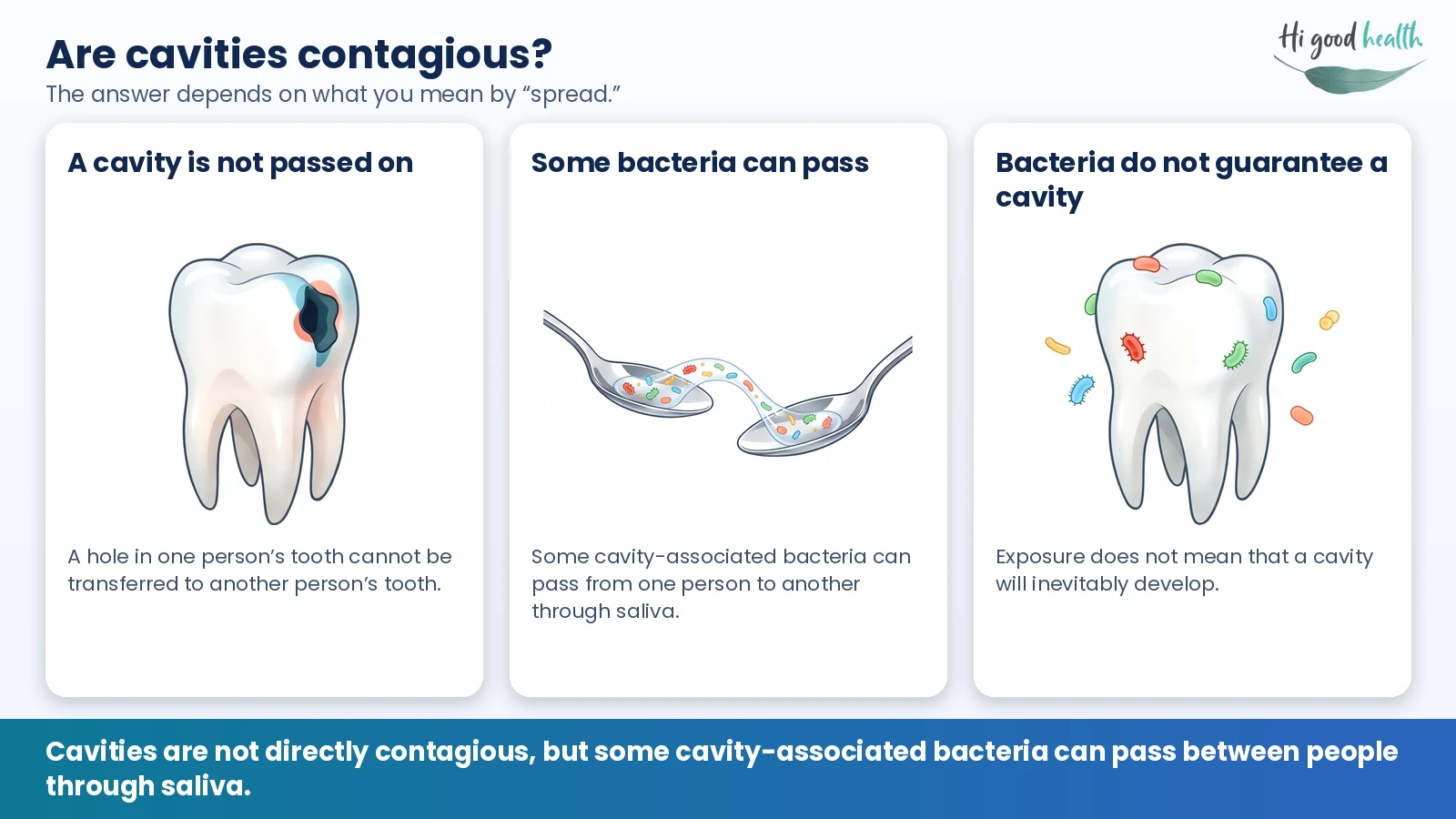
A cavity itself cannot be handed from one person to another. What can travel between people is some of the bacteria linked to decay, and saliva is the route. Kissing, sharing a meal or everyday closeness does not move a hole from one mouth to the next.
Babies are the group to think about most. A caregiver can pass decay-linked bacteria to an infant in saliva, for instance by cleaning a dropped pacifier in their own mouth. That is why early childhood caries prevention starts around the time the first tooth comes in.
Inside one mouth, decay does not hop from tooth to tooth either. Each tooth breaks down on its own when acid keeps stripping minerals from its surface. Several teeth can still decay together, or a new cavity can appear beside an old one, because the same risk factors are acting on all of them.
Steady oral hygiene with brushing and flossing, fluoride, sensible eating and regular dental visits lower the chance of new cavities and slow the ones already there. A very early enamel lesion can sometimes be stopped or rebuilt with preventive care, while a definite cavity may need a filling or other restorative treatment, depending on how deep and wide it is.
To understand the difference, it helps to know how tooth decay develops and what role bacteria play in the process.
Are Tooth Cavities Contagious Between People?
Tooth decay, also called dental caries, is a multifactorial disease involving oral bacteria, fermentable carbohydrates, susceptible tooth surfaces, and time. Certain bacteria, including Streptococcus mutans, can contribute to the development of cavities by metabolizing sugars and producing acids that gradually dissolve tooth enamel.
These bacteria live in dental plaque, a sticky biofilm that forms on tooth surfaces. When acid attacks occur frequently, and the teeth do not have enough time or protection to remineralize, mineral loss can progress and eventually produce a cavity.
Some cavity-associated bacteria can pass from one person to another through saliva. This is particularly relevant for babies and young children, whose oral microbiomes are still developing.
How can cavity-causing bacteria spread?
Saliva-sharing activities may transfer oral bacteria between people. Common examples include:
- Sharing spoons, forks, cups, or drinking bottles.
- Cleaning a baby’s pacifier by putting it in your mouth.
- Tasting a child’s food with the same spoon used to feed them.
- Sharing toothbrushes.
- Other direct saliva-contact activities.
These behaviors can transfer bacteria, but exposure does not mean that a cavity will inevitably develop. Tooth decay depends on several factors, including the child’s diet, fluoride exposure, oral hygiene, saliva and the frequency of acid attacks.
It is also important to distinguish bacterial transmission from the transmission of an established cavity. A hole in one person’s tooth cannot be transferred to another person’s tooth through kissing, sharing food, or ordinary social contact.
Can a parent pass cavities to a baby?
Yes, parents and other caregivers can pass cavity-associated bacteria to babies through saliva. This is one reason early childhood caries prevention begins before or soon after the first tooth erupts.
For example, a caregiver who puts a pacifier in their mouth before returning it to a baby may transfer oral bacteria. Sharing feeding utensils can have a similar effect.
However, parents should not feel guilty or become fearful of normal affection. The aim is to reduce avoidable saliva-sharing while establishing healthy oral care habits for the entire family.
To reduce a baby’s risk of tooth decay:
- Avoid cleaning pacifiers in your mouth; wash them according to the manufacturer’s instructions.
- Use a clean spoon for feeding and avoid sharing utensils that have been in your mouth.
- Maintain your own dental health and seek treatment for untreated cavities.
- Begin brushing as soon as the first tooth appears, using an age-appropriate amount of fluoride toothpaste.
- Arrange the child’s first dental visit when the first tooth erupts or by the first birthday.
Can Cavities Spread From One Tooth to Another?
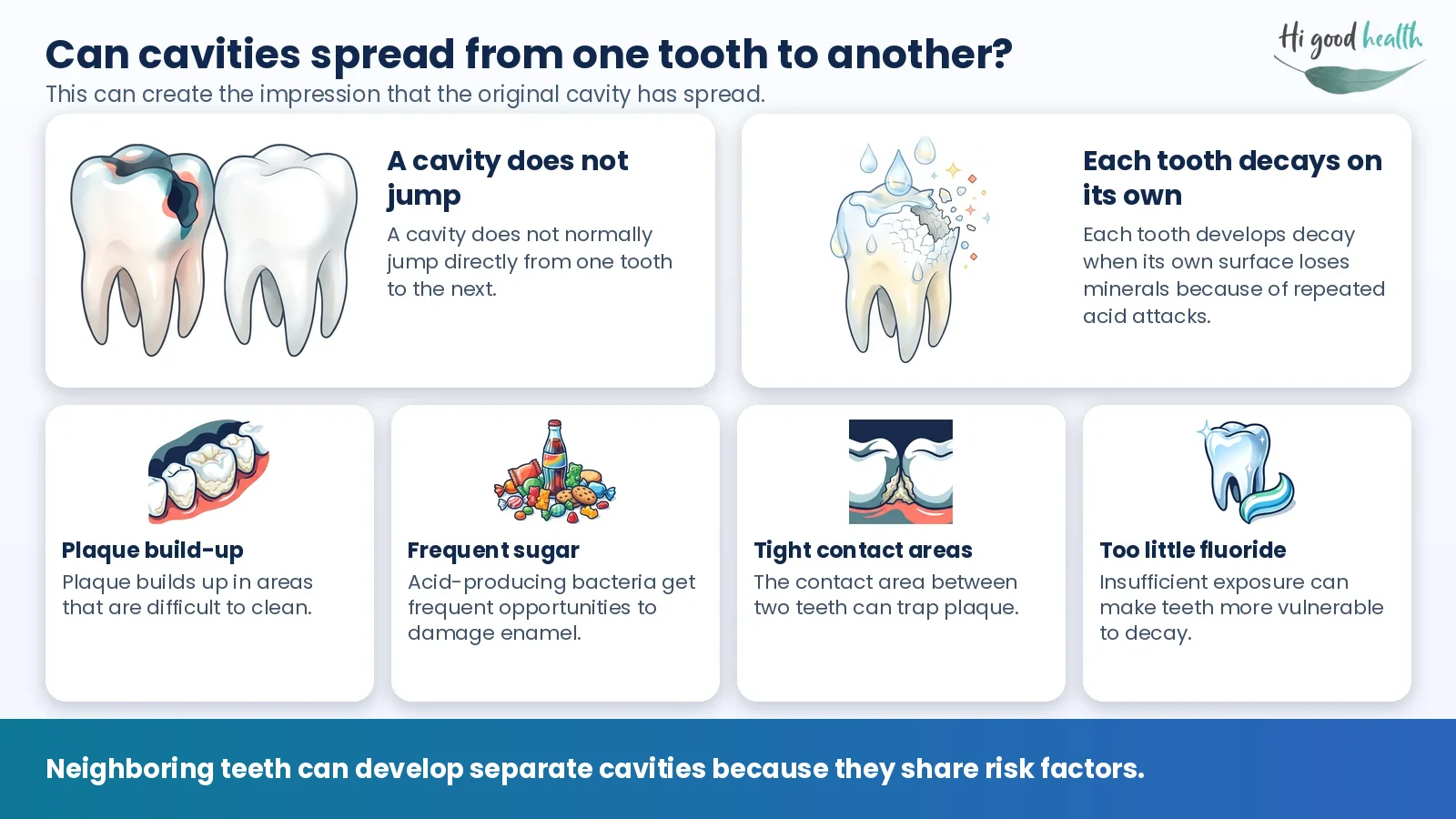
A cavity does not normally jump directly from one tooth to the next. Each tooth develops decay when its own surface loses minerals because of repeated acid attacks.
However, it is possible to develop cavities in several teeth at the same time or to notice a new cavity near an existing one. This can create the impression that the original cavity has spread.
Why do neighboring teeth develop cavities?
- Plaque accumulation: Dental plaque can build up on several teeth, particularly in areas that are difficult to clean. The bacteria in this biofilm produce acids that damage tooth surfaces.
- Frequent sugar exposure: Repeatedly consuming sugary snacks, sweetened drinks, or other fermentable carbohydrates gives acid-producing bacteria frequent opportunities to damage enamel.
- Cavities between adjacent teeth: The contact area between two teeth can trap plaque and is often difficult to clean with a toothbrush alone. Decay may develop on either or both neighboring surfaces. Sometimes, one lesion is detected first while the other remains unnoticed.
- Inadequate fluoride exposure: Fluoride helps strengthen enamel and supports remineralization. Insufficient exposure can make teeth more vulnerable to decay.
- Shared risk factors: Dry mouth, poor oral hygiene, certain medications, and frequent acid attacks can increase the risk of decay across multiple teeth.
Can an untreated cavity damage nearby teeth?
An untreated cavity can become larger and progress deeper into the affected tooth, moving from enamel into dentin and, in advanced cases, reaching the pulp. This is progression within the same tooth, not direct transfer of the cavity to a neighboring tooth.
If decay develops on the contact surface between adjacent teeth, both teeth may be affected by the same plaque-retentive environment. A dentist may also discover additional lesions during an examination or on appropriate dental X-rays.
A deep cavity can lead to pulp infection or a dental abscess. Although this infection may spread into surrounding tissues, that is different from a cavity simply transferring from one tooth to another.
Early diagnosis and treatment help prevent further destruction of the affected tooth and reduce the risk of complications.
How Can You Prevent Cavities From Spreading or Developing?
Whether you are concerned about transmitting bacteria to a child or developing additional cavities, prevention focuses on controlling plaque, reducing frequent sugar exposure, and protecting enamel.
- Brush twice daily: Brush for two minutes with fluoride toothpaste, including before bedtime.
- Clean between teeth daily: Use dental floss or another suitable interdental cleaning aid to remove plaque from areas a toothbrush cannot reach.
- Limit frequent sugar exposure: Keep sugary foods and drinks to a minimum, especially repeated snacking between meals.
- Drink water regularly: Water helps maintain hydration and can support normal saliva function.
- Address dry mouth: If you frequently experience dry mouth, discuss possible causes and preventive options with your dentist.
- Attend regular dental check-ups: Your dentist can identify early lesions, assess cavity risk, and recommend fluoride treatment or other preventive measures when appropriate.
- Protect children’s teeth early: Start brushing with fluoride toothpaste when the first tooth erupts, using a smear no larger than a grain of rice for children younger than three years.

Early enamel lesions may sometimes be arrested or remineralized with appropriate preventive care. Once a definite cavity has formed, restorative treatment may be necessary depending on its depth and extent.
When Should You See a Dentist?
Arrange a dental appointment if you notice a visible hole, a persistent dark or brown area, food repeatedly getting trapped between teeth, sensitivity to hot or cold, or pain while eating.
Seek urgent dental care if you develop facial or gum swelling, fever with dental pain, pus, or a bad taste associated with a suspected infection. Difficulty swallowing or breathing, or rapidly spreading swelling, requires emergency medical attention.
Do not wait for pain before seeking assessment. Early decay can be painless, and a dentist can determine whether an area represents active caries, staining, a non-cavitated lesion, or another condition.
The Oral Hygiene Series
Sixteen articles on looking after your teeth and gums, at every age.
- Complete Oral Hygiene Guide for Every Age — the whole routine, age by age
- Brushing Technique: Bass, Modified Bass and Fones — which method suits which mouth, and how long two minutes really is
- Electric vs Manual Toothbrush — what the evidence shows, rather than what the manufacturers claim
- How to Floss Correctly — step by step, including the C-shape wrap and how far below the gumline to go
- Water Flosser for Tonsil Stones — what pressure is safe, and when not to try it at all
- Interdental Brushes and Bleeding Gums — choosing the right size, and why bleeding usually stops within two weeks
- Early Childhood Caries — causes, symptoms, prevention and treatment in children under six
- Milk Teeth Falling Out — the age, order and timeline, and what parents should know
- Pyorrhea (Gum Disease) — causes, symptoms, treatment and prevention
- Gum Swelling, Bleeding and Dry Mouth — how underlying diseases affect your gums and oral health
- Medicine for Toothache — what to take, what causes the pain, and how it is treated
- Pacifier Teeth — how pacifiers affect growing teeth and the bite, and when to stop
- 6 Year Molars — the first permanent molars, when they come in and how to protect them
- Tooth Cavities (Dant Me Kida) — what a “tooth worm” really is, how cavities form and how they are treated
- Can Cavities Spread? — whether cavities pass between people or from tooth to tooth, and how to prevent them (you are here)
- Metallic Taste in Mouth — what causes it, what helps and when to see a doctor
Key Takeaways
Cavities do not spread the way a cold does. Bacteria tied to decay can pass between people in saliva, mostly from caregivers to small children, but a hole in a tooth cannot be handed on. In one mouth, teeth decay separately; what they share is the cause: plaque left on the teeth, constant sugar and too little fluoride.
Daily brushing with fluoride toothpaste, cleaning between the teeth, careful eating and dental check-ups keep new cavities away and stop current ones from getting worse.
Frequently Asked Questions (FAQs)
Are cavities contagious through kissing?
Kissing can pass saliva, and with it some of the bacteria tied to decay. That alone does not give anyone a cavity, though. Whether decay starts depends on diet, how well plaque is removed, fluoride and each person’s own susceptibility.
Can I get a cavity by sharing a spoon with someone who has tooth decay?
A shared spoon can carry saliva and the bacteria in it, including types linked to decay, but you will not necessarily get a cavity from it. With babies and toddlers, simply do not share utensils that have been in your mouth.
Can a mother pass cavities to her baby?
Yes. A mother or another caregiver can pass decay-linked bacteria to a baby in saliva. Looking after the caregiver’s own teeth, avoiding needless saliva-sharing and starting dental care when the first tooth appears all lower the child’s risk.
Can a cavity spread to the tooth next to it?
Not directly. A cavity does not leap across, yet the tooth next door can get its own cavity because the same plaque build-up, frequent sugar and hard-to-clean contact points affect both.
Does brushing prevent cavities from spreading?
Brushing twice a day with fluoride toothpaste clears plaque and toughens enamel. You get more protection from cleaning between the teeth every day, cutting back on frequent sugar and seeing a dentist regularly. Brushing cannot repair every cavity that has already formed, so a dentist may still need to look.
Can a cavity heal on its own?
A very early enamel spot with no hole can be stopped or rebuilt with fluoride and good plaque control. Once there is a true hole, the tooth cannot grow back on its own and usually needs restorative treatment.
Can I use the same toothbrush as my partner if neither of us has symptoms?
No. Sharing a toothbrush moves saliva and microorganisms from one mouth to the other, and nobody needs to take that on, even when both people feel fine.
Does a cavity always cause tooth pain?
No. Early decay is often painless. Sensitivity or pain tends to appear as the cavity gets deeper, and having no symptoms does not mean your teeth are healthy, which is why regular check-ups help find problems sooner.
Glossary
Dental caries (tooth decay): a multifactorial disease involving oral bacteria, fermentable carbohydrates, susceptible tooth surfaces, and time.
Dental plaque: a sticky biofilm that forms on tooth surfaces.
Streptococcus mutans: one of the bacteria that can contribute to the development of cavities by metabolizing sugars and producing acids that gradually dissolve tooth enamel.
Fluoride: helps strengthen enamel and supports remineralization.
References
- Centers for Disease Control and Prevention (CDC). About Cavities (Tooth Decay). Accessed October 30, 2026. Available at: https://www.cdc.gov/oral-health/about/cavities-tooth-decay.html
- American Dental Association (ADA), MouthHealthy. Tooth Decay with Baby Bottles. Accessed October 30, 2026. Available at: https://www.mouthhealthy.org/all-topics-a-z/tooth-decay-with-baby-bottles
- American Dental Association (ADA). Caries Risk Assessment and Management. Accessed October 30, 2026. Available at: https://www.ada.org/resources/ada-library/oral-health-topics/caries-risk-assessment-and-management
- University of Nebraska–Lincoln, University Health Center. Are Cavities Contagious? March 11, 2025. Available at: https://health.unl.edu/news/are-cavities-contagious/
- Merck Manual Consumer Version. Cavities. Accessed October 30, 2026. Available at: https://www.merckmanuals.com/home/mouth-and-dental-disorders/tooth-disorders/cavities
- National Institute of Dental and Craniofacial Research (NIDCR). Dental Caries Proven Transmissible and Infectious. Accessed October 30, 2026. Available at: https://www.nidcr.nih.gov/about-us/timeline/dental-caries-proven-transmissible-infectious
- American Academy of Pediatrics. Maintaining and Improving the Oral Health of Young Children. Pediatrics. 2014;134(6):1224–1229. Available at: https://publications.aap.org/pediatrics/article/134/6/1224/33112/Maintaining-and-Improving-the-Oral-Health-of-Young DOI: 10.1542/peds.2014-2984
- National Library of Medicine. Early Childhood Caries: Causes, Diagnoses, and Treatments. Colak H, et al. Early childhood caries update: A review of causes, diagnoses, and treatments. J Nat Sci Biol Med. 2013;4(1):29–38. Available at: https://pmc.ncbi.nlm.nih.gov/articles/PMC3633299/
Reference links checked on October 30, 2026.
Disclaimer
This content is for educational purposes only and is not a substitute for professional medical or dental advice. Speak to a dentist about your own or your child’s teeth.
