At a Glance
- A fall detection watch for seniors is the feature that most often justifies the purchase for a senior living alone. It is the one thing a watch does that a family member cannot do from another city.
- The strongest clinical evidence is for atrial fibrillation, in over-65s who already have raised stroke risk. In the EQUAL trial (JACC, January 2026), six months of smartwatch wear found new AF in 9.6% against 2.3% on usual care — and 43% of those cases had no symptoms.
- An alert being right is not the same as the watch being accurate. When the Apple Watch flags an irregular pulse it is confirmed about 84% of the time. How much it misses has never been measured.
- Below about ₹8,999 you are buying a step counter, not a heart monitor. Budget bands do not do ECG. If rhythm is the reason for buying, that tier will not deliver it.
- No Indian health insurer covers the device itself. PM-JAY pays for hospitalisation, so the financial case rests on avoiding an admission — not on being reimbursed for the watch.
- This page is about general health monitoring — heart rhythm, falls, activity, vitals. For sleep scores, apnoea notifications and sleep-stage accuracy, see our guide to wearable sleep tech.
Introduction: Seniors & the Digital Health Boom
In 2026, wearable health technology adoption among seniors continues to grow rapidly. From Apple Watches that can call 112 if you fall to Fitbits tracking sleep and heart rate, the promise is substantial: greater independence, potential for early health issue detection, and peace of mind for families [1].
India’s smart wearable market is valued at USD 3.62 billion in 2026 and is growing at a CAGR of 23.17%, projected to reach USD 10.26 billion by 2031 — one of the fastest-growing wearable markets globally.
[India-W1] India’s wearable medical devices market specifically reached USD 1.2 billion in 2025, projected to reach USD 4.4 billion by 2034 at a CAGR of 14.91%. [India-W2].
With close to 15 crore (149 million) elderly citizens and a rapidly growing urban middle class managing chronic diseases, the adoption of health wearables among seniors is accelerating rapidly.
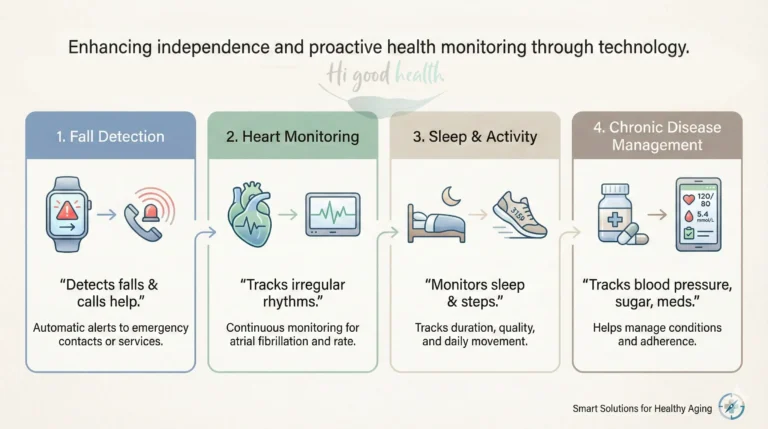
But with enthusiasm comes confusion. Do these devices actually help reduce hospitalisations, or are they just expensive step counters? Let’s separate fact from fiction.
A Fall Detection Watch for Seniors, and What Else Wearables Promise
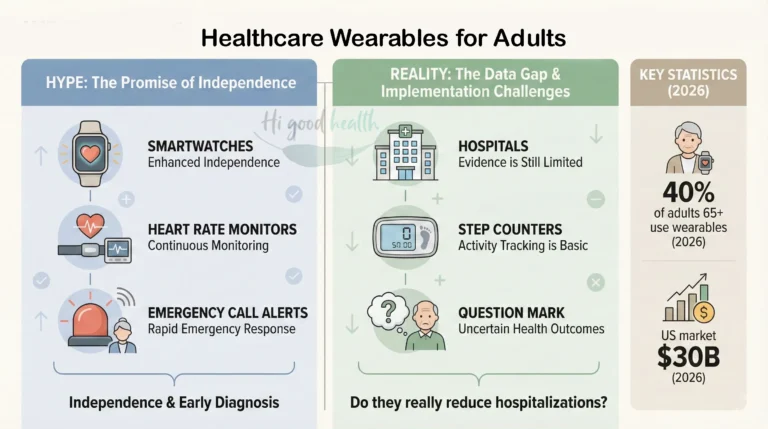
1. Fall Detection & Emergency Alerts
- Apple Watch, Samsung Galaxy Watch, and Medical Guardian devices are designed to automatically detect falls and contact emergency contacts [3]
- Emergency alert features may reduce response time to falls, potentially preventing complications
- Falls represent a serious and growing health concern for seniors: falls are among the leading causes of injury-related hospitalisation in India’s elderly population of close to 15 crore. With India’s senior population projected to reach 34.7 crore by 2050 — more than a fifth of the country, falls-related emergency care will become an increasingly significant burden on families and the healthcare system. [India-W3]
India-made wearables for senior safety include WachMe Senior Safety Watch — an Indian device with fall detection (waist and wrist mode), geofencing, real-time location tracking, emergency SOS, and scam call blocking, designed specifically for elderly users. Available at accessible price points for the Indian market. [India-W4]
Want to go beyond gadgets? Discover proven, real-world strategies in our detailed guide: “Fall Prevention That Actually Works — Protecting Seniors in 2026.”
2. Heart Monitoring
- Advanced models can detect irregular heart rhythms, specifically atrial fibrillation (AFib) [5]
- Early detection of AFib may help prevent strokes when followed by proper medical evaluation and treatment [5]
- Important: These devices are screening tools, not diagnostic devices. A healthcare professional should always review any abnormal reading.
Smart tech data should always be cross-referenced with professional clinical evaluations. Learn how to navigate frequent diagnostic tests and advocate for your medical needs, for detailed information, read our article
3. Sleep & Activity Tracking
- Encourage daily walking goals and activity awareness
- Monitor potential sleep apnea risk through SpO2 (blood oxygen) sensors
- Data may help healthcare providers identify patterns worth investigating
4. Chronic Disease Management
- Many devices integrate with smartphone apps for tracking blood sugar, blood pressure, and medication reminders
- In India, some corporate group health insurance plans are beginning to explore wearable integration. The Insurance Regulatory and Development Authority of India (IRDAI) has already formed working groups to examine the use of wearable and portable device data in insurance.
- Ayushman Bharat–PM-JAY now covers all senior citizens above 70 years for up to ₹5 lakhs/year for hospitalisation — making preventive tools like wearables a financially meaningful complement to government coverage. [India-W5][India-W6]
- These tools work best when data is shared with healthcare providers as part of comprehensive care
The real secret to staying strong as you age is actually on your dinner plate. Nutrition plays a key role in healthy ageing — explore the latest science in our blog: “Senior Nutrition 2026: Prevent Muscle Loss with the Latest Science.“
The Reality Check
1. Accuracy Issues
- Most consumer wearable devices are not medical-grade diagnostic tools [7]
- In the Stanford Apple Heart Study, when the watch sent an irregular-pulse notification, atrial fibrillation was confirmed on a simultaneous ECG patch 84% of the time (95% CI 0.76–0.92). That figure is the positive predictive value, not the specificity — the two are routinely confused. The study could not measure sensitivity at all, because only people who received a notification were followed up. It tells you how often an alert is right, and nothing about how many cases the watch misses [5][7]
- False positive alerts in arrhythmia detection may cause unnecessary anxiety and healthcare visits
- Sleep tracking and calorie burn estimates can have significant margins of error
2. Cost Barriers
- Apple Watch models: (₹41,900–₹89,900)
- Fitbit devices: (₹8,999–₹20,999); Budget Indian alternatives: Noise, boAt, Fire-Boltt (₹1,499–₹8,999)
- Subscription add-ons: (₹850–₹2,500/month)
- Most devices are not yet covered by standard Indian health insurance policies, though IRDAI is exploring this [India-W5]
3. Data Overload
- Seniors may find it challenging to interpret complex health metrics
- Healthcare providers are often overwhelmed with patient-generated data and may lack time to review it comprehensively
- Too much data without context can lead to confusion or inappropriate self-diagnosis
4. Privacy Concerns
- Health data may be shared with technology companies according to user agreements
- In India, IRDAI has explored using wearable and portable device data for insurance risk assessment; regulations are still evolving and users should stay informed about data-sharing policies [India-W5]
- Always review privacy policies before purchasing and using wearable devices
Using data to improve your daily movements can significantly lower your risk of balance-related injuries. Explore the latest breakthrough strategies for effective fall prevention in seniors, for detailed information, read our article
Case Studies
Case 1: Girish, 78, Bengaluru
Lives alone. His Apple Watch detected a nighttime fall and automatically initiated an emergency call to his son. An ambulance arrived within 15 minutes, providing timely medical assessment.
Health experts have found that chronic loneliness can be just as deadly as smoking 15 cigarettes a day. Senior isolation is more serious than it seems — explore its hidden health impact in our blog: “Senior Loneliness — A Growing Global Health Crisis Silently Affecting Our Elderly.“
Case 2: Meena, 70, Chennai
Received an irregular heart rhythm alert from her smartwatch while working in her kitchen garden. After consulting her cardiologist at a leading hospital in Chennai, she was diagnosed with atrial fibrillation and began appropriate medical treatment early.
Case 3: Harish, 82, Delhi
Purchased a feature-rich smartwatch but found the notifications and interface overwhelming. He switched to a simpler SOS pendant device with fall detection — better suited to his comfort level and tech familiarity.
Learning: The “best” device depends on individual needs, tech comfort, and specific health concerns — not just features.
Short-Term vs Long-Term Impact
Short-Term Benefits:
- Potential peace of mind for seniors and family members
- Increased awareness of daily activity levels (walking challenges, movement reminders)
- Quicker emergency response in fall situations when devices function properly
Long-Term Considerations:
- May contribute to reduced ER visits for falls and undetected arrhythmias when used consistently [9]
- Could potentially delay nursing home / old-age home placement by supporting independent living with monitoring
- Benefits depend heavily on consistent device use, proper interpretation of data, and integration with healthcare provider oversight
- Long-term clinical outcome studies are still emerging
Costs: Prevention vs Emergencies
| Item | Cost Range |
| Wearable devices | ₹1,499–₹65,000 (one-time) |
| Subscription plans | ₹850–₹2,500/month |
| Average hospitalisation after fall (private hospital) | ₹50,000–₹2,50,000 |
| Stroke hospitalisation (private hospital) | ₹1,50,000–₹5,00,000+ |
Table 1: Cost comparison of wearable devices vs emergency medical care
Financial Perspective: While upfront costs exist, preventing even one serious fall-related hospitalisation could potentially offset years of wearable device costs. However, devices should be viewed as one component of fall prevention — not a complete solution.
Under Ayushman Bharat–PM-JAY, senior citizens above 70 are entitled to up to ₹5 lakhs/year for hospitalisation, making wearable-assisted early detection all the more valuable for reducing claims and improving outcomes. [India-W6]
Evidence-Based Research
- EQUAL trial (JACC, January 2026): 437 patients aged 65 and over, all with raised stroke risk and no known atrial fibrillation, randomised to an Apple Watch or to usual care for six months. New atrial fibrillation was found in 9.6% of the smartwatch group against 2.3% of controls — a hazard ratio of 4.40. 43% of the cases the watch found caused no symptoms at all, which is the whole point: those are the ones ordinary follow-up misses.
- Stanford Apple Heart Study (2019): 419,297 participants. Only 0.52% ever received an irregular-pulse notification, and among those who returned a usable ECG patch, atrial fibrillation was confirmed in 84% (95% CI 0.76–0.92). Sensitivity was never established. The design followed only the people who were notified, so how much atrial fibrillation the watch missed is simply unknown [5][7]
- Research on Fall Detection: Studies suggest fall detection systems may reduce emergency response times when functioning properly, though real-world effectiveness varies by device and user factors [9]
- NIH-funded activity trials: Research indicates wearables can increase daily physical activity among sedentary seniors by providing reminders and tracking progress [11]
Important Research Limitation: Many wearable device studies are funded by manufacturers. Independent, long-term clinical outcome studies are still needed to fully understand real-world health impacts.
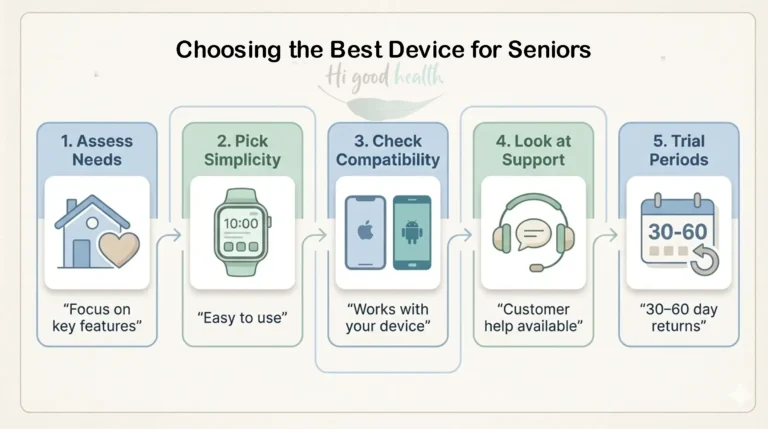
Step-by-Step: How Seniors Can Choose the Right Device
Assess Your Specific Needs
- Living alone? Fall detection and emergency calling features should be priorities
- Known heart condition? Devices with ECG features may be worth considering (after consulting your cardiologist)
- Just want activity tracking? Simpler, less expensive devices may be sufficient
Prioritise Simplicity Over Features
- Devices with too many features and complex apps often discourage consistent use
- Choose devices with clear, readable displays and intuitive interfaces
- Consider your comfort level with technology honestly
Check Device Compatibility
- Verify compatibility with your smartphone (iPhone vs Android)
- Some devices require specific phone models or operating system versions
- Confirm whether a smartphone is required at all (some medical alert pendants work independently)
Evaluate Customer Support
- Does the company offer senior-friendly customer service?
- Are setup assistance and technical support available?
- What are warranty terms and return policies?
Take Advantage of Trial Periods
- Choose devices with 30–60 day return windows
- Test daily usability before committing
- Ensure you can actually operate the device independently
Discuss with Your Healthcare Provider
- Ask your doctor which features might be most relevant for your health conditions
- Determine how your provider wants to receive data (if at all)
- Clarify what symptoms should prompt immediate medical attention regardless of device readings
To explore what’s next in sleep tracking innovation, read our detailed blog: “The Future of Wearable Sleep Tech — Beyond Smartwatches.”
What the Experts Say
- American Geriatrics Society: Notes that wearables have potential to extend independence but emphasises they work best with family or caregiver support and should complement — not replace — regular medical care [12]
- Mayo Clinic: Acknowledges benefits for arrhythmia screening but stresses that wearable alerts do not replace formal medical evaluation and diagnostic testing [13]
- Consumer Reports (2024): Found seniors reported higher satisfaction with simpler devices focused on fall detection compared to multi-feature fitness trackers, citing ease of use as the primary factor [14]
Key Takeaways
- A consumer smartwatch is a screening aid, not a diagnosis. The Apple Heart Study showed that when the watch raises an alert it is right about 84% of the time — but it has never been shown how much it misses, because only the people who were alerted were followed up.
- The strongest evidence is for atrial fibrillation in over-65s at raised stroke risk. In the EQUAL trial, six months of smartwatch wear found new AF in 9.6% against 2.3% on usual care, and 43% of those cases had no symptoms.
- A fall detection watch for seniors is the feature that most often justifies the purchase for a senior living alone — more than step counts or sleep scores.
- Bands under ₹8,999 do not do ECG. They count steps and estimate sleep. If the reason for buying is heart rhythm, the cheaper tier does not deliver it.
- Nothing here is covered by insurance. PM-JAY pays for hospitalisation, not devices — so the case for a wearable rests on avoiding an admission, not on being reimbursed for the watch.
Frequently Asked Questions
Does health insurance cover the cost of smartwatches in India?
Standard health insurance policies in India (private or government) generally do not yet cover consumer smartwatches or wearable devices. However, Ayushman Bharat–PM-JAY covers all senior citizens above 70 years for hospitalisation up to ₹5 lakhs/year — making it critical to use wearables for early detection that avoids hospitalisation costs.
IRDAI has formed working groups to explore integrating wearable device data into insurance plans; some corporate group health plans are beginning to explore wellness-linked coverage. Check with your insurer for the latest benefits under your policy. [India-W5][India-W6]
Can a wearable detect a heart attack or stroke?
No. Consumer wearables cannot detect heart attacks or strokes in progress. They are designed to identify irregular heart rhythms (specifically atrial fibrillation), which is a risk factor for future strokes.
If you experience symptoms of a heart attack (chest pain, shortness of breath) or stroke (sudden weakness, confusion, vision problems), call 112 (national emergency number) immediately — do not rely on your wearable device.
Next-gen sensors are now capable of monitoring cardiovascular health without the discomfort of traditional tools. Understand understanding the game-changing technology of cuffless blood pressure monitors, for detailed information, read our article.
Do I need a smartphone to use a health watch?
Most smartwatches (like Apple Watch, Samsung Galaxy Watch, and Fitbit devices) require a compatible smartphone for initial setup, app access, and full functionality. If you do not own or use a smartphone, consider simpler medical alert pendants that operate independently and connect directly to monitoring services.
How often does the battery need charging?
Battery life varies significantly by device type:
Apple Watches: typically 1–2 days between charges
Fitbit devices: generally 5–7 days depending on model and usage
Dedicated medical alert pendants: often several weeks to months between charges
Consider your ability to remember regular charging when selecting a device
Are these devices safe for seniors with pacemakers?
Most modern wearables are generally safe to use with pacemakers, but some smartwatches contain magnets that can potentially interfere with certain medical implants. It is essential to consult your cardiologist before using any wearable device if you have a pacemaker or implantable cardioverter-defibrillator (ICD). Most manufacturers recommend keeping the device at least 6 inches away from implanted medical devices. Always follow your doctor’s specific guidance.
Are cheaper fitness trackers worth buying?
Possibly, depending on your goals. While devices under ₹5,000–₹15,000 (such as Noise, boAt, and Fire-Boltt fitness bands) typically lack advanced ECG monitoring and medical-grade sensors, they can effectively track steps, general activity, and sleep patterns.
Research shows seniors often rate simpler, less expensive devices higher for satisfaction because they are easier to operate consistently. Consider whether you need medical features or just activity motivation.
Is my health data private?
Privacy is a legitimate concern. Health data collected by wearables is often shared with technology companies to provide services and improve products. Privacy policies vary significantly by manufacturer.
In India, IRDAI has explored the use of wearable data for insurance risk assessment; specific regulations are still evolving. [India-W5]
Always: Read privacy policies before purchasing; Review data-sharing settings; Understand what data is collected and how it may be used; Be aware you may be sharing more information than you realise.
Do wearables actually motivate seniors to exercise?
Research suggests they can. Wearables can increase physical activity among sedentary seniors through features like step goals, movement reminders, and progress tracking.
An umbrella review covering about 300 primary studies confirmed that wearables increase daily activity by a median of 1,312 steps per day and roughly 58 minutes of moderate-to-vigorous activity per week.
Another meta-analysis of 12 randomised controlled trials found that the most effective strategy for reducing sedentary time is a “wearable + online” intervention (human or digital support) rather than just the device alone.
However, motivation varies individually — some seniors find tracking helpful while others find it stressful or discouraging. The key is finding an approach that matches your personality and preferences.
Final Thoughts
In 2026, wearable health technology is neither pure hype nor a magic solution. For American seniors, the value depends on matching the right device to individual needs, capabilities, and health circumstances.
Key Takeaways:
- For tech-comfortable seniors with specific health concerns: smartwatches with ECG and fall detection may provide valuable monitoring when used alongside regular medical care
- For those prioritising simplicity: dedicated medical alert pendants (including Indian options like WachMe Senior Safety Watch) offer focused fall protection and emergency calling without complexity [India-W4]
- For families: wearables may provide reassurance and potentially help identify health concerns earlier, but they don’t replace attentive care and regular check-ins
The bottom line: Wearables are most effective when integrated into a comprehensive health strategy that includes regular exercise, balanced nutrition, routine medical check-ups, and social engagement. They are tools — not replacements for medical care or human connection.
Remember: Any health alerts from wearable devices should be discussed with your healthcare provider. These devices are screening tools that may identify potential concerns worth investigating — they are not diagnostic devices and should never delay seeking emergency medical care when symptoms warrant immediate attention.
Glossary
- ECG (Electrocardiogram): A recording of the heart’s electrical activity used to detect rhythm abnormalities
- Fall Detection: Accelerometer and gyroscope sensors that attempt to identify fall patterns and trigger automatic alerts
- Atrial Fibrillation (AFib): An irregular, often rapid heart rhythm that increases stroke risk
- Medicare Advantage: → Ayushman Bharat–PM-JAY: India’s government health insurance scheme — covers all senior citizens above 70 for hospitalisation up to ₹5 lakhs/year across empanelled government and private hospitals. [India-W6]
- SpO2 Sensor: Measures blood oxygen saturation percentage; may indicate respiratory issues
- Positive Predictive Value: The probability that a positive test result accurately indicates the condition is present
- Sensitivity: The ability of a test to correctly identify those with a condition (true positive rate)
- Specificity: The ability of a test to correctly identify those without a condition (true negative rate)
- IRDAI (Insurance Regulatory and Development Authority of India): India’s insurance regulator, which has explored the use of wearable device data for health and life insurance risk assessment. [India-W5]
- 112: India’s national emergency number (equivalent to 911 in the US) — call immediately for medical emergencies, police, or fire services.
All reference links valid and accessible on 1 May 2026
[1] Statista – US Wearable Market 2026.
[2] Statista – Wearable Technology Market Size
[3] Apple Inc. — Apple Watch Safety Features; Samsung — Galaxy Watch Health Features
[4] CDC — Falls Among Older Adults.
[5] Stanford Medicine — Apple Heart Study.
[6] Centers for Medicare & Medicaid Services — Medicare Advantage Benefits
[7] NEJM — Apple Heart Study Full Results.
[8] Various state insurance regulations regarding wearable data use
[9] JMIR Research — Wearable Health Technology Studies.
[10] Healthcare Cost and Utilization Project (HCUP) — Emergency Department Visit Costs
[11] NIH — Physical Activity Intervention Studies
[12] American Geriatrics Society — Position Statements on Health Technology
[13] Mayo Clinic — Guidance on Consumer Health Devices
[14] Consumer Reports — Wearable Device Reviews and User Satisfaction Studies (2024)
Additional Reading
- FDA Guidance on Wearable Medical Devices
- American Heart Association — Atrial Fibrillation Resources
- National Institute on Aging — Fall Prevention Guidelines
India-Specific web sources accessed April 2026.
[India-W1] India Smart Wearable Market Size and Share — Mordor Intelligence.
[India-W2] India Wearable Medical Devices Market Size & Share 2033 — IMARC Group.
[India-W3] Elderly Care Market Size in India | Growth Outlook 2026 — 6W Research.
[EQUAL] Aronsson Dahlqvist H, et al. Enhanced Detection and Prompt Diagnosis of Atrial Fibrillation Using Apple Watch: A Randomized Controlled Trial (EQUAL). Journal of the American College of Cardiology, 21 January 2026. 437 patients aged 65+, six months, new AF 9.6% vs 2.3%, HR 4.40, 43% asymptomatic.
[AHS] Perez MV, et al. Large-Scale Assessment of a Smartwatch to Identify Atrial Fibrillation (Apple Heart Study). New England Journal of Medicine, 2019;381:1909–1917. 419,297 participants; 0.52% notified; PPV 0.84 (95% CI 0.76–0.92). Sensitivity not determinable by design.
[UNFPA] India Ageing Report 2023. UNFPA India. Population aged 60+ rising from 149 million (2022) to 347 million by 2050 — over 20% of the population.
[India-W7] Wearable Health Monitoring India Market — SecondMedic, 2025.
Disclaimer
The content provided on higoodhealth.com is for general informational purposes only. While we strive to offer accurate and up-to-date content, much of the information is derived from publicly available sources and personal research. We do not make any warranties about the completeness, reliability, or accuracy of this information.
