
Having good health is in our hands

Is Wheat or Rice Really Healthy? Meet the World’s Best Grain

You’ve eaten wheat and rice your whole life. But what if they aren’t the healthiest grains on your plate? 

Most of us grew up thinking rice and wheat were the gold standard of healthy eating. And they can be — but only when eaten whole. The moment they’re refined into white rice or white bread, up to 17 key nutrients disappear. What’s left spikes your blood sugar, leaves you hungry faster, and contributes to higher risks of type 2 diabetes and heart disease, according to Harvard T.H. Chan School of Public Health.  

Whole vs. Refined: The Difference That Changes Everything 

Whole wheat packs 10–15g of fiber per cup and solid amounts of iron, magnesium, and B vitamins. Brown rice is naturally gluten-free and rich in manganese. But white rice has a glycemic index of 73 — and there’s another catch: rice absorbs arsenic from soil, with brown rice carrying more. The fix? Cook rice in a 6:1 water ratio and drain it, which removes up to 60% of arsenic.  
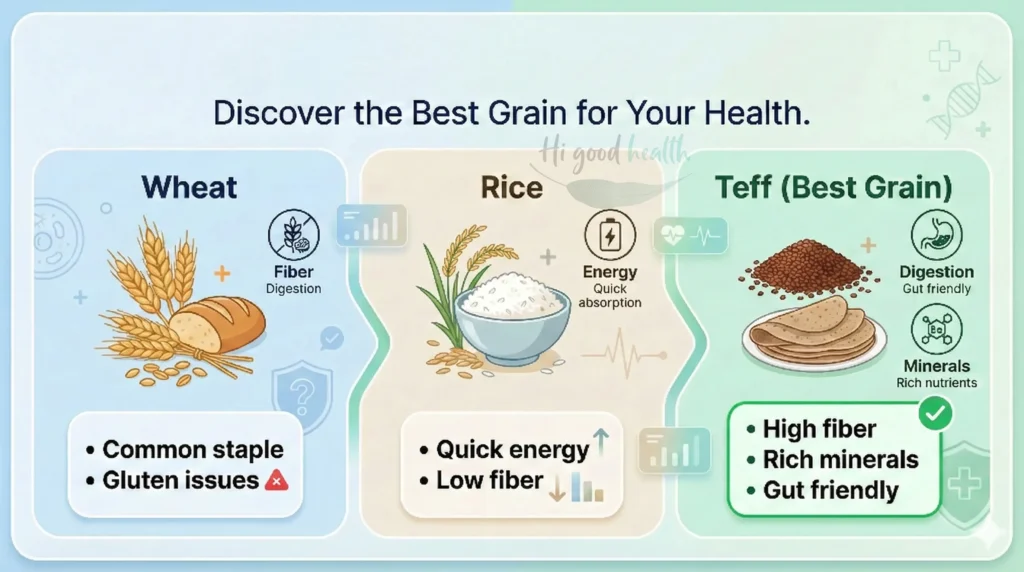
Comparison of wheat, rice, and teff grains highlighting healthier grain choices for daily nutrition

The Grain You’ve Probably Never Heard Of 

Enter teff — a tiny ancient grain from Ethiopia that’s quietly one of the most nutrient-dense foods on earth. It has 5× more calcium than wheat, double the iron of wheat, 8g of fiber per cup, and a complete amino acid profile. It’s 100% naturally gluten-free, and because it’s too small to refine, every serving is always whole grain. Research published in the Journal of Diabetes Research found teff injera produces significantly lower blood sugar responses compared to other grains — making it a standout for diabetes management.  

What Should You Actually Eat? 

No single grain wins for everyone. The smartest approach: prioritize whole grains, rotate between teff, quinoa, oats, barley, and brown rice, and always check labels for “100% whole grain.” 

All reference links valid and accessible on 30 May 2026

 Journal of Diabetes Research. (2019). “Glycemic Index and Load of Selected Ethiopian Foods: An Experimental Study.”  

PMC – PubMed Central. (2025). “Nutritional Characteristics, Health-Related Properties, and Food Applications of Teff.”  

📖 Want the full breakdown — Are Wheat & Rice Truly Healthy Grains for Your Well-being? Discover the Best Grain in the World for Your Health Goals 

Authors

  • Dr. Laura Mitchell, DDS, MS

    Oral & Maxillofacial Surgeon

    Job Role: Author

    Bio:
    Dr. Laura Mitchell is an Oral and Maxillofacial Surgeon with experience in dental surgery, trauma management, and craniofacial procedures. She has worked on complex oral surgical treatments including dental implants, mandibular fracture management, cyst surgeries, and other advanced dental procedures. She is also actively involved in clinical research and scientific publications related to oral and maxillofacial surgery.

    Special Skills:
    Oral surgery, dental implants, maxillofacial trauma management, surgical procedures, clinical research.

    Role:
    Dental Surgery Consultant & Medical Contributor

    Linkedin: https://www.linkedin.com/

  • Dr. Hannah Wilson, MBBS, MS(ENT), MRCS(UK)

    ENT Surgeon & Clinical Research Contributor

    Job Role : Reviewer

    Bio:
    Dr. Hannah Wilson is a licensed medical practitioner specializing in ENT (Ear, Nose, and Throat) and Head & Neck Surgery. She is registered to practice medicine and has experience in diagnosis and surgical management of ENT conditions, emergency airway care, and patient-centered treatment planning. She is also involved in academic teaching and clinical research.

    Special Skills:
    ENT surgery, clinical diagnosis, surgical procedures, evidence-based treatment planning, medical research.

    Role:
    Clinical Health Expert & Medical Content Reviewer

    Linkedin: https://www.linkedin.com/

Leave a Comment