Updated: 16 September 2026
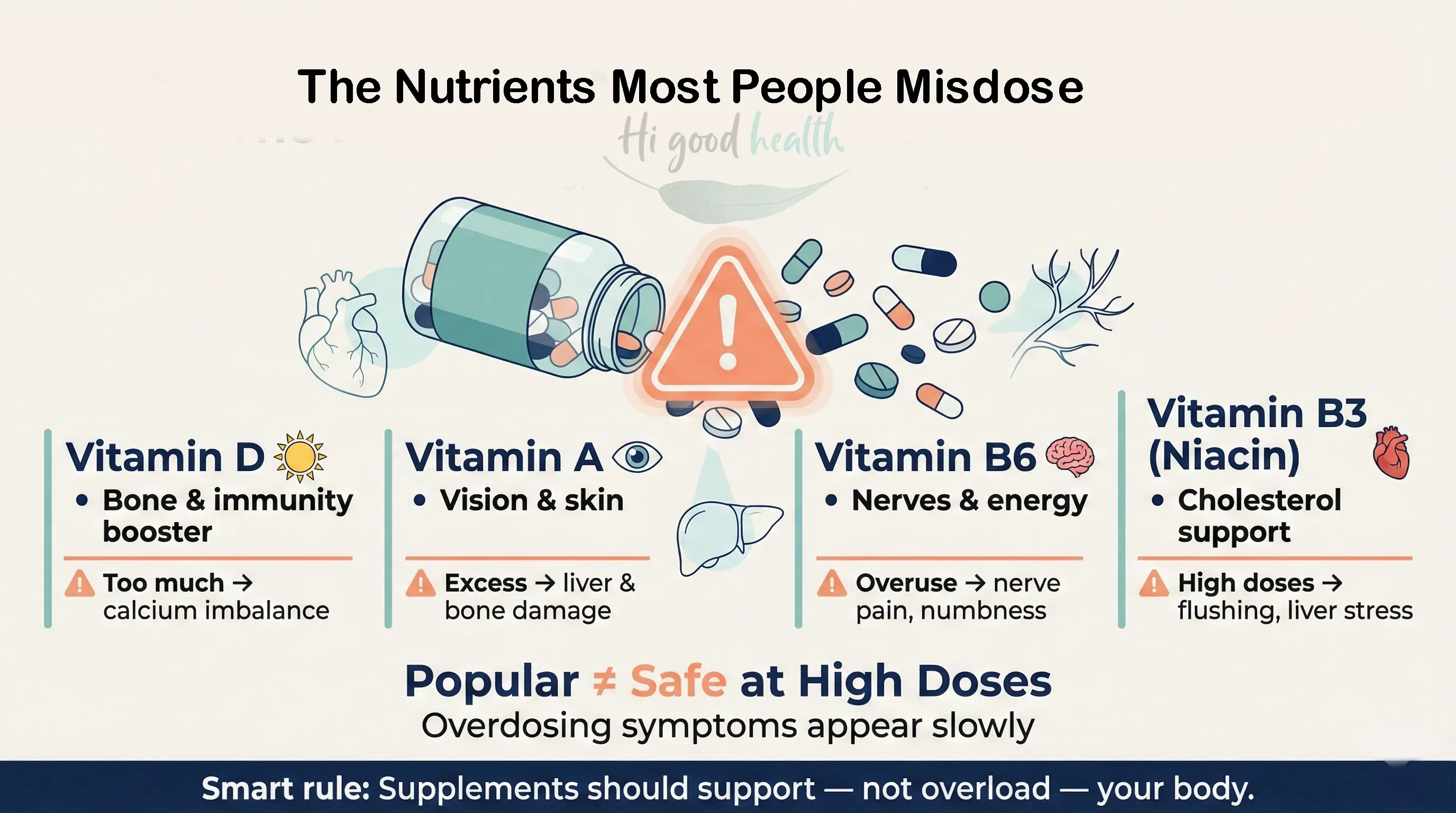
We all know vitamins are good for us, but did you know some are frequently taken in the wrong amounts? Nutrients such as Vitamin D, Vitamin A, Vitamin B6 (pyridoxine), and Vitamin B3 (niacin) are among the most commonly misdosed.
They are easy to buy, widely recommended, and often assumed to be harmless at any dose, so people stack supplements hoping for more energy, stronger immunity, or better skin, without realizing that too much can backfire.
At a glance: What Are the Signs of Vitamin Overdose in Adults?
The most common early signs of vitamin overdose in adults are nausea, vomiting, headache, fatigue, and dizziness. Fat-soluble vitamins (A, D, E, K) are the riskiest because the body stores them, while high-dose Vitamin B6 can cause nerve tingling and niacin can cause skin flushing.
Most adults need far less than the safe ceiling. The recommended daily intake of vitamin D is 600 IU and the ceiling is 4,000 IU, so there is a wide margin — trouble usually comes from stacking several products, not from one sensible dose.
According to the NIH Office of Dietary Supplements, staying within the Tolerable Upper Intake Level (UL) for each vitamin and confirming a true deficiency with a blood test before supplementing are the safest ways to avoid toxicity. If you notice severe symptoms, stop the supplement and contact a clinician or U.S. Poison Control (1-800-222-1222).
The tricky part is that the signs of vitamin overdose in adults are often subtle and build up slowly, which makes them easy to miss.
Depending on the nutrient, an excess can strain the liver, the nervous system, or your calcium balance. Knowing which vitamins are most often misdosed, and the early warning signs, helps you supplement safely. Here is what to watch for.
Before choosing your supplements, it is worth reading our blog: Which Vitamins Are Commonly Non-Vegetarian?
What Are the Most Commonly Misdosed Vitamins?
Not all vitamins are misdosed equally. Some are far more likely to be taken in the wrong amount, and the risk climbs when people combine food, fortified products, and supplements without adding up the totals. Here are the nutrients most often involved, with the signs of overdose to watch for.
Each entry gives two numbers: the amount an average adult actually needs each day, and the ceiling above which harm becomes possible. The gap between them is usually wide.
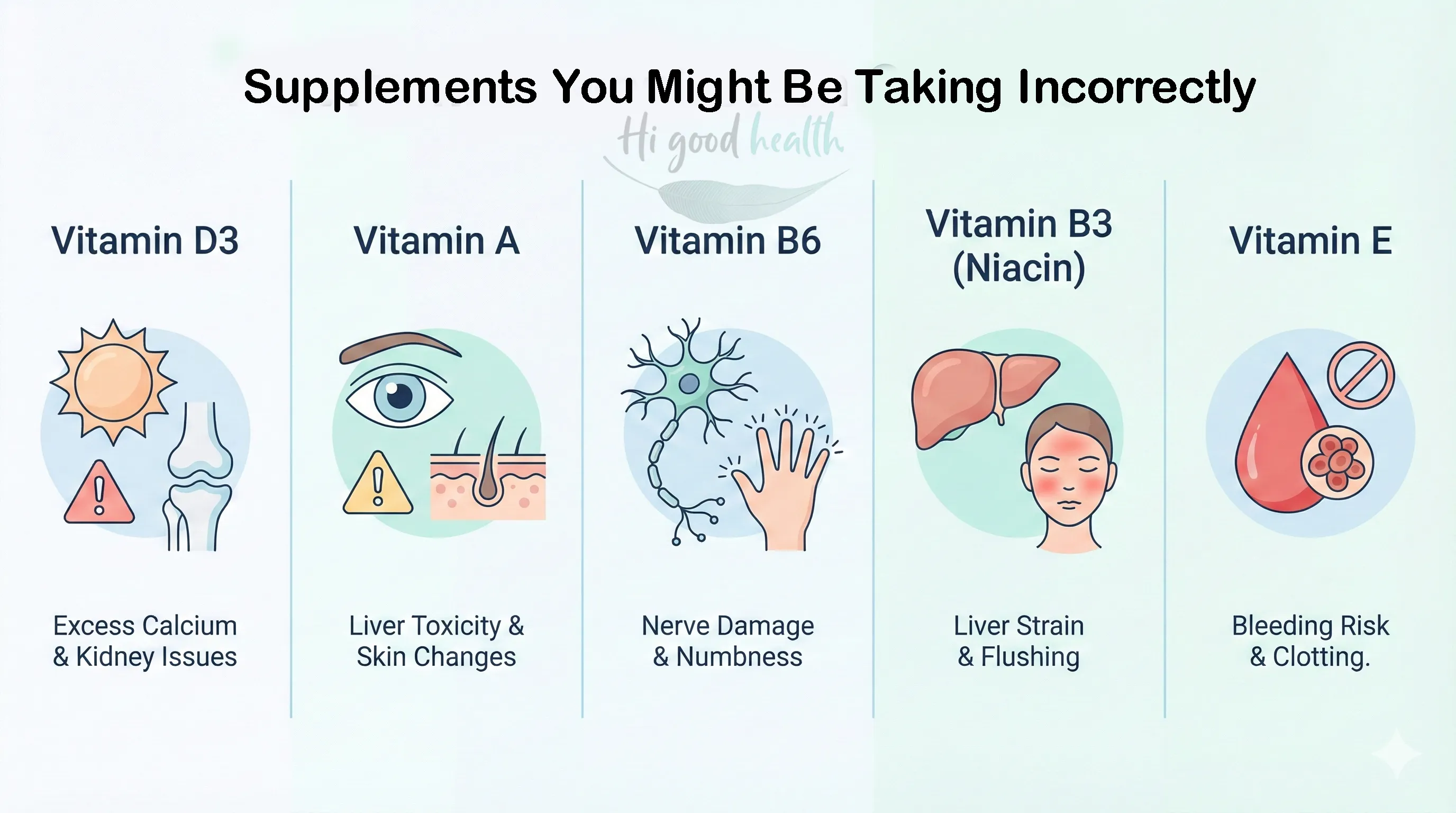
- Vitamin D3: Widely used for bone health and immune support, Vitamin D3 is one of the most over-supplemented nutrients. The signs of vitamin D overdose mostly come from hypercalcemia (too much calcium in the blood) and include nausea, vomiting, frequent urination, kidney problems, and, in severe cases, calcium deposits in soft tissues. Most adults need 600 IU (15 mcg) a day, rising to 800 IU (20 mcg) after 70. The NIH Office of Dietary Supplements sets the adult Tolerable Upper Intake Level at 100 mcg (4,000 IU) per day [1].
Misdosing fat-soluble vitamins can place a heavy burden on your kidneys' filtration capacity. For insights on kidney-friendly foods and dietary habits that support kidney health, read our detailed article.
- Vitamin A: Common in vision and skin supplements, preformed Vitamin A (retinol) is fat-soluble and builds up in the body. The signs of vitamin A overdose from chronic excess (hypervitaminosis A) include headaches, liver damage, dizziness, and blurred vision. Adults need 900 mcg RAE a day for men and 700 mcg RAE for women. The NIH Office of Dietary Supplements sets the adult UL for preformed Vitamin A at 3,000 mcg RAE (10,000 IU) per day [1]. That ceiling applies to retinol only, not to the beta-carotene in vegetables — see the next section.
- Vitamin B6 (Pyridoxine): Important for nerve function and metabolism, B6 is often taken for mood and energy. The signs of vitamin B6 overdose appear after prolonged high doses as peripheral neuropathy — tingling, numbness, or nerve damage in the hands and feet. Adults need 1.3 mg a day up to age 50, and 1.5 to 1.7 mg after that. The adult UL is 100 mg per day (NIH Office of Dietary Supplements) — roughly seventy times the requirement, which is why B6 neuropathy comes from high-dose products rather than from food.
- Vitamin B3 (Niacin): Sometimes used to help manage cholesterol, niacin can cause flushing (warmth and redness of the skin) even at moderate doses. Higher doses may lead to liver toxicity, digestive upset, and impaired glucose tolerance. Adults need about 16 mg NE a day for men and 14 mg NE for women. The adult UL for niacin (from supplements and fortified foods) is 35 mg per day (NIH Office of Dietary Supplements).
- Vitamin E: Known for its antioxidant properties, Vitamin E is popular for skin and heart health. The signs of vitamin E overdose are easy to miss: excess raises the risk of bleeding, especially for people on blood thinners, and some studies link very high intake to a higher risk of hemorrhagic stroke. Adults need 15 mg a day. The adult UL from supplements is 1,000 mg per day (NIH Office of Dietary Supplements).
- Vitamin K: Named alongside A, D and E as a fat-soluble vitamin but rarely the cause of a supplement problem — there is no upper limit set for it, because toxicity from food or ordinary supplements is not seen. Adults need about 120 mcg a day for men and 90 mcg for women. Its real significance is a medicine interaction: vitamin K is what warfarin works against. Anyone on warfarin should keep their intake of leafy greens and vitamin K supplements steady rather than avoiding them, and tell the clinician managing their dose before changing either.
These vitamins are essential, but they are also the easiest to misdose. The point is simple: more is not always better, especially with fat-soluble vitamins that linger in your system.
Protecting your body from oxidative damage needs a careful balance of antioxidant-rich nutrients. To understand how antioxidants act as your body's first line of defense against disease, read our detailed article.
Read more (NIH/NCBI hypervitaminosis overview): https://www.ncbi.nlm.nih.gov/books/NBK538510/
Beta-Carotene Is Not the Same as Vitamin A
This distinction matters more than almost anything else on this page, because without it a reader can come away afraid of vegetables.
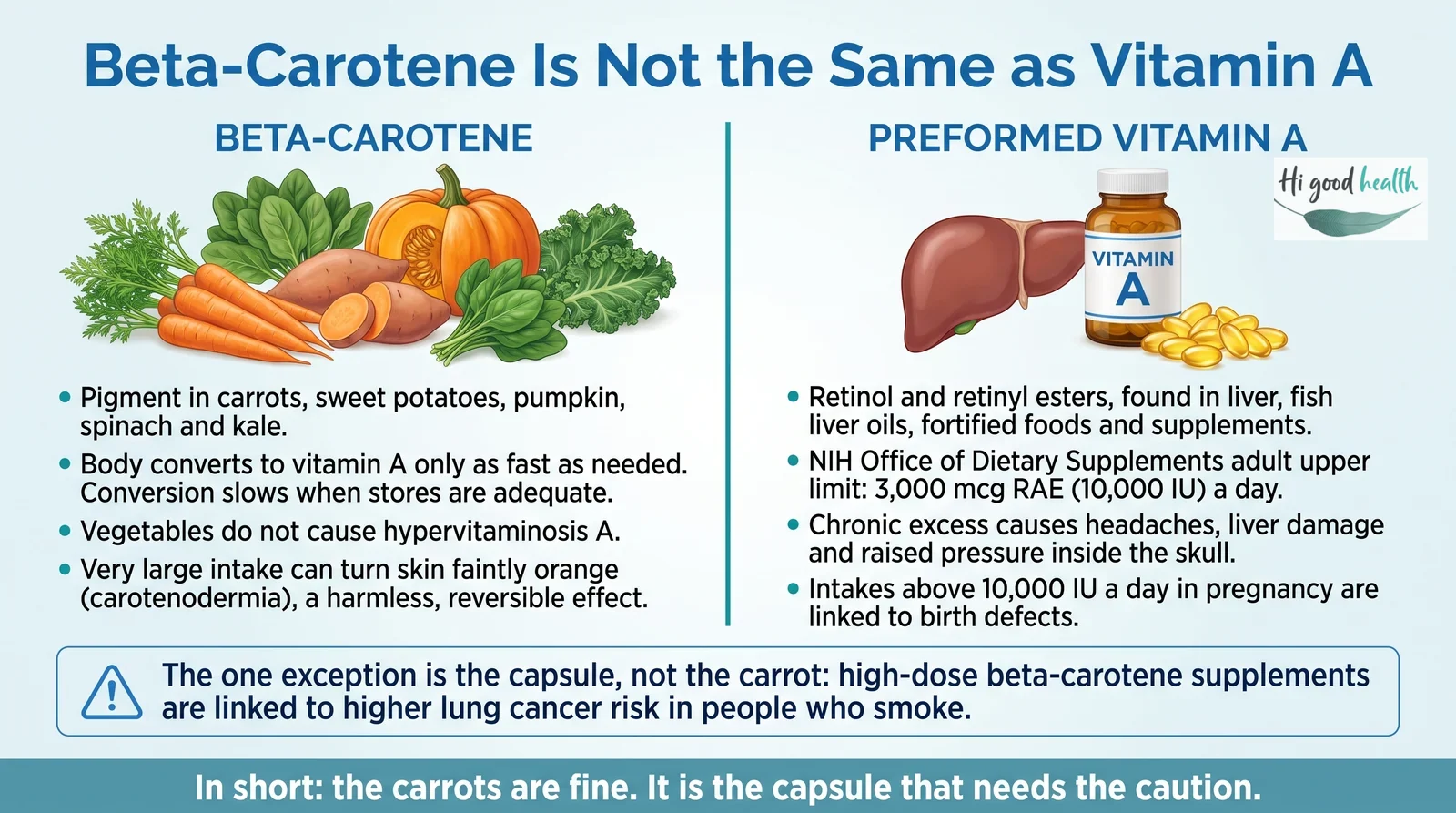
The vitamin A ceiling above applies to preformed vitamin A — retinol and retinyl esters, found in liver, fish liver oils, fortified foods and most vitamin A supplements. It does not apply to beta-carotene, the orange pigment in carrots, sweet potatoes, pumpkin, spinach and kale.
Your body converts beta-carotene into vitamin A only as fast as it needs it, and slows the conversion down when stores are adequate. That regulation is why eating carotenoid-rich vegetables does not cause hypervitaminosis A.
A very large intake can turn the skin faintly orange, a harmless and reversible effect called carotenodermia, but it does not produce the liver damage or raised skull pressure seen with too much retinol.
One important exception applies to supplements rather than food. High-dose beta-carotene supplements have been linked in large trials to a higher risk of lung cancer in people who smoke or who have been exposed to asbestos. Beta-carotene from vegetables carries no such signal.
In short: the carrots are fine. It is the capsule that needs the caution.
Water-Soluble vs. Fat-Soluble: Why It Matters
Vitamins fall into two groups: water-soluble and fat-soluble. That difference shapes how your body absorbs, uses, and clears them, and it explains why some overdoses are far more dangerous than others.
Water-soluble vitamins, like Vitamin C and the B-complex group, dissolve in water and are not stored in large amounts. Your body passes the extra out through urine, so a small surplus is usually flushed away. The flip side is that you need them regularly to keep levels steady.
Fat-soluble vitamins (A, D, E, and K) are absorbed with dietary fat and stored in the liver and fat tissue. Because they stick around, taking too much over time can let them build up and tip into toxicity. That is why fat-soluble vitamins need extra care.
Why Water-Soluble Vitamins Are Safer (But Not Risk-Free)
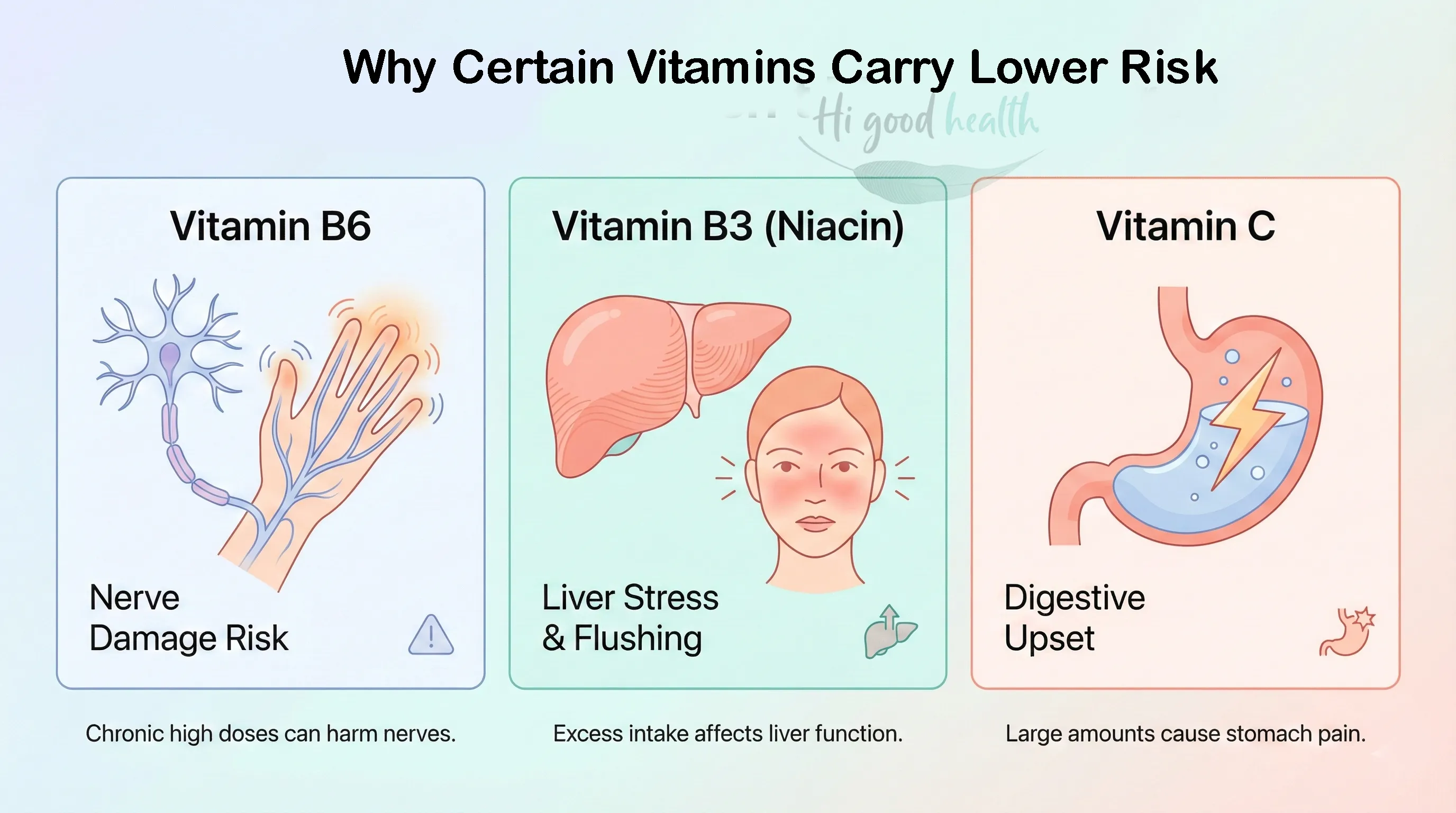
Water-soluble vitamins leave the body through urine, but that does not make them completely safe. High doses of Vitamin B6 (pyridoxine) over long periods have been linked to sensory neuropathy, with numbness, tingling, and trouble walking — one of the clearest overdose signals in adults who take large B-complex doses.
Niacin (Vitamin B3) at doses above 1–3 grams per day can cause liver toxicity and severe flushing, sometimes with nausea and abdominal pain.
Even Vitamin C, often seen as harmless, has its own overdose signals. The signs of vitamin C overdose can include diarrhea, cramps, and nausea at doses over 2,000 mg per day — which the NIH Office of Dietary Supplements also lists as the adult UL.
The daily requirement is 90 mg for men and 75 mg for women, with an extra 35 mg for smokers. In rare cases, very high doses may trigger headaches.
There is also a water-soluble vitamin whose risk is not toxicity at all. High doses of folic acid can correct the anaemia caused by a vitamin B12 deficiency while leaving the nerve damage to progress unnoticed, so a real B12 problem is found late.
Adults need 400 mcg DFE of folate a day, and the ceiling for folic acid from supplements and fortified foods is 1,000 mcg. Anyone taking a high-dose B-complex should have B12 checked rather than assumed.
So while your body usually clears extra water-soluble vitamins, repeatedly going over the recommended amounts can still cause real harm. Dosing guidelines matter even for these “safer” vitamins.
Fat-Soluble Vitamins: Small Overdose, Big Trouble
Unlike water-soluble vitamins, even small, repeated excesses of fat-soluble vitamins can cause serious problems because they accumulate over time.
Claim: Too much Vitamin A is dangerous, especially in pregnancy. Evidence: Vitamin A overdose can cause headaches, nausea, dizziness, and in severe cases liver damage, bone pain, and raised pressure inside the skull; intakes above 10,000 IU/day in pregnancy are linked to birth defects. Source: NIH Office of Dietary Supplements [1] and the Penniston & Tanumihardjo (2006) review [4].
Anyone who is pregnant or planning a pregnancy should check the vitamin A content of every supplement they take, including multivitamins and fish liver oils, and should not take a separate vitamin A product without medical advice.
Overconsumption of Vitamin D can cause hypercalcemia, leading to nausea, vomiting, weakness, kidney problems, and, in severe cases, irregular heartbeat and soft-tissue calcification [2][3].
Excess Vitamin E can interfere with normal blood clotting, raising the chance of bleeding and stroke, especially if you take blood thinners.
Because these vitamins are stored in the liver and fat tissue, taking even slightly more than recommended for long stretches can slowly build toward toxicity. Careful dosing matters. If you are unsure, a clinician can confirm whether you actually need a supplement before you start one.
Two Minerals That Belong in the Same Conversation
This article is about vitamins, but two minerals are so often taken alongside them, and so often overdone, that leaving them out would be misleading.
- Iron. Adults need 8 mg a day, and women aged 19 to 50 need 18 mg. The ceiling is 45 mg. Iron is different from the vitamins above in one important way: a large single dose is an acute emergency rather than a slow accumulation, and iron tablets are a leading cause of poisoning in young children. Keep them out of reach, in child-resistant packaging, and never take an iron supplement without a blood test showing you need one.
- Calcium. Adults need 1,000 mg a day, rising to 1,200 mg for women over 50 and men over 70. The ceiling is 2,500 mg, and 2,000 mg after age 50. Because calcium is usually taken with vitamin D, and because vitamin D increases calcium absorption, the two can push blood calcium up together. Excess from supplements has been linked to kidney stones; the same amount from food has not.
Vitamins That Interact With Medicines
A supplement that is safe on its own can still be a problem alongside a prescription. These are the interactions worth knowing about; none of them means you cannot take the vitamin, and all of them are reasons to tell the person who prescribes for you.
| Vitamin or mineral | Interacts with | What happens |
|---|---|---|
| Vitamin K | Warfarin | Vitamin K opposes warfarin's effect. Keep intake steady rather than avoiding it, and tell the clinician managing your dose before you change either |
| Vitamin E | Warfarin, aspirin and other blood thinners | Adds to the anti-clotting effect and raises bleeding risk |
| Vitamin B6 | Levodopa (taken without carbidopa) | Can reduce the medicine's effect |
| Niacin, at cholesterol doses | Statins | Raises the risk of muscle injury when the two are combined |
| Calcium and iron | Levothyroxine, and some antibiotics | Bind the medicine in the gut and reduce absorption. Separate the doses by several hours |
What to Do If You Think You Have Taken Too Much
Stop taking the supplement. That is the first step and it is often the only one needed, because most vitamin problems come from a dose taken repeatedly rather than from a single large one.
Keep the bottles. The label tells a clinician the dose and the form, which matters more than the brand, and having them saves a great deal of guesswork.
Do not try to make yourself vomit, and do not take anything else to counteract it.
Be prepared to say how much, how long. “Two capsules a day for eight months” is far more useful than “a lot”.
When a prescribed course finishes, stop for eight weeks and then retest. Seeing where your level has actually landed is what keeps a correction from turning into an overdose.
Expect fat-soluble vitamins to take time to clear. Because they are stored in the liver and fat tissue, levels fall over weeks to months after stopping, not overnight. Water-soluble vitamins clear much faster, though nerve damage from long-term high-dose B6 may recover slowly or incompletely.
If you notice signs of vitamin overdose such as severe nausea, confusion, irregular heartbeat, or other concerning symptoms, seek medical care or contact the U.S. Poison Control hotline at 1-800-222-1222 (available 24/7).
Read More: NIH / NCBI Vitamin D toxicity overview
Check out the verified normal blood test reference ranges:
| Vitamin | Typical Reference Range | Units | Notes |
| Vitamin D3 (25(OH)D) | 20 – 50 (sometimes 30 – 100) | ng/mL | Levels <20 ng/mL usually indicate deficiency; some labs set sufficiency at >30 ng/mL. |
| Vitamin A | 20 – 60 | mcg/dL | Serum retinol; some labs report in µmol/L (0.7–2.2 µmol/L). |
| Vitamin B6 | 5 – 50 | ng/mL | Measured as pyridoxal 5′-phosphate (PLP), the active form of B6. |
| Vitamin E | 5.5 – 17 | mg/L | Typically measured as alpha-tocopherol. |
| Vitamin B12 | 200 – 900 | pg/mL | Levels <200 pg/mL generally suggest a deficiency. |
Important Notes:
- Vitamin D: Serum 25-hydroxyvitamin D [25(OH)D] is the standard test. Below 20 ng/mL is generally accepted as deficient. Above that, expert bodies genuinely disagree: some treat 20 ng/mL as sufficient for bone health, others set the threshold at 30 ng/mL. A result between 20 and 30 is therefore not a clear answer on its own, and is worth discussing rather than treating. [6].
- Vitamin A: measured as serum retinol. Units can vary (mcg/dL or µmol/L), so match your lab's units [5]. Serum retinol is held steady by the liver until stores are badly depleted, so a normal result does not rule out a low store.
- Vitamin B6: the active form, pyridoxal 5′-phosphate (PLP), is typically tested.
- Vitamin E: labs measure alpha-tocopherol; values vary by lab and population.
- Vitamin B12: deficiency is generally below 200 pg/mL. Extra markers (methylmalonic acid or homocysteine) may confirm it.
How to Know How Much Vitamin You Really Need
Not everyone needs the same amount. Your ideal dose depends on your age, diet, medical conditions, and whether a true deficiency is present.
Requirements also shift across life stages. Vitamin D rises after 70; iron falls after menopause; calcium rises for women over 50 and men over 70; folate requirements rise in pregnancy. Children have their own, much lower ceilings, which is why an adult supplement should never be split for a child.
Leaning on supplements based on product labels or trends can mislead you, and sometimes harm you. Taking extra without a confirmed deficiency raises the risk of side effects or toxicity. The safest way to find out what your body needs is to get tested. The table below maps common nutrients to the blood tests that flag a deficiency.
| Nutrient | Blood Test | Deficiency Signs |
| Vitamin D | 25(OH)D (25-hydroxyvitamin D) | Weak bones, fatigue, and low immunity |
| Vitamin B12 | Serum B12 | Tingling hands/feet, memory issues |
| Iron | Ferritin, Iron, TIBC | Fatigue, pale skin, short breath |
| Folate (B9) | Serum folate | Mouth sores, poor concentration |
| Magnesium | Serum magnesium | Muscle cramps, irregular heartbeat |
| Calcium | Serum calcium | Muscle spasms, brittle nails |
| Zinc | Plasma zinc | Hair loss, slow wound healing |
| Omega-3 | Omega-3 Index or RBC EPA/DHA | Dry skin, brain fog, joint pain |
| Iodine | Urinary iodine concentration | Thyroid issues, weight gain |
Looking for the right supplement guidance as you age? Explore our blog.
Read more: https://www.betterhealth.vic.gov.au/health/healthyliving/vitamin-and-mineral-supplements-what-to-know
How to Avoid Vitamin Misdosing in Daily Life
Vitamin overdosing is more common than people think, and it usually happens by accident. To stay safe and still get the benefit of your supplements, here are a few medically sound habits.
Before any of them, do the one thing almost nobody does: add up what you are already getting. Lay out every product you take — multivitamin, single supplements, protein powders, fortified cereal and juice — and total each nutrient across all of them. Most accidental overdoses are found in that pile rather than in any single product.
1. Consult a healthcare professional
Before starting any supplement, talk to a clinician. Your doctor may order blood tests to check what you actually need so you do not take more than necessary.
Use objective data to see which markers your body is actually lacking. To understand which diagnostic tests you really need, read our detailed article.
2. Avoid high-dose supplements unless prescribed
More is not better. High doses of fat-soluble vitamins (A, D, E, K) can build up and cause toxicity, so save them for cases your doctor has confirmed.
3. Track your supplement intake
Keep a log of every vitamin, multivitamin, mineral, and herbal product you take. Overlapping ingredients can quietly push you over safe limits.
Curious about what your multivitamin might be missing? Read our blog: 60+ Essential Minerals That Protected Our Ancestors but Are Missing from Your Multivitamin.
4. Check for fortified foods
Many packaged foods — cereals, juices, and snacks — are fortified with extra vitamins. Stacked on top of supplements, they can push your daily total past recommended limits.
5. Read labels carefully
Watch the % Daily Value (%DV). Anything over 100% should raise a flag unless your doctor told you to take it. The U.S. FDA requires supplement labels to show %DV for this reason.
6. Reassess regularly
Your needs shift with age, health conditions, diet, and lifestyle. Checking in periodically keeps your supplement routine appropriate and necessary.
7. Tell every prescriber what you take
Supplements are not usually listed on a medicines record, so the person prescribing for you may not know about them. Bring the list to appointments, including before surgery — vitamin E and other supplements that affect clotting matter there.
Key Takeaways
- The early signs of an overdose are usually subtle — nausea, headache, fatigue, and dizziness — and they build up gradually.
- Fat-soluble vitamins (A, D, E, K) are the most dangerous to overdo because the body stores them.
- Even “safe” water-soluble vitamins can harm you: high-dose B6 causes nerve damage and niacin causes flushing and liver stress.
- Know both numbers, not one. The amount you need and the ceiling you must not cross are usually far apart — 600 IU against 4,000 IU for vitamin D — and the gap is where sensible supplementing lives.
- Beta-carotene from vegetables is not the same as retinol and does not cause vitamin A toxicity. Carrots are not the problem.
- Stay within the NIH Office of Dietary Supplements upper limits (for example, 4,000 IU/day for Vitamin D and 100 mg/day for B6).
- Test before you supplement, track everything you take, and reassess with a clinician over time.
- If you think you have taken too much, stop the supplement first, keep the bottles, and be ready to say how much and for how long.
- Once a course is finished, keep levels up from food rather than a bottle. A carrot and red pepper soup with a teaspoon of butter is a good example — the fat is what lets the carotenoids absorb.
FAQ
If you prefer a more visual version, check out our YouTube video here:
1. Can taking vitamins actually be harmful?
Yes. While vitamins are essential, too much can be harmful. High doses, especially of fat-soluble vitamins, can build up in the body and cause toxicity, organ damage, or long-term health problems.
2. Which vitamins are most dangerous to overdose on?
Fat-soluble vitamins like A, D, E, and K are the riskiest because they are stored in fat tissue. Water-soluble vitamins like B6 and niacin can also cause nerve or liver damage at high doses.
3. What are the common symptoms of vitamin overdose?
Symptoms often creep in slowly and can include nausea, headaches, weakness, and digestive upset. High doses of Vitamin B6 can specifically cause tingling or numbness in the hands and feet.
4. Is it safe to take Vitamin C or B vitamins in large amounts?
Not necessarily. The body flushes excess water-soluble vitamins, but high doses are not risk-free. Vitamin C over 2,000 mg can cause cramps and nausea, while long-term high B6 intake is linked to nerve damage.
5. Can I get too much vitamin A from eating carrots?
No. Carrots and other orange and green vegetables contain beta-carotene, which your body converts to vitamin A only as fast as it needs. Very large amounts can tint the skin slightly orange, which is harmless and reverses. Vitamin A toxicity comes from retinol — in liver, fish liver oils and supplements — not from vegetables.
6. I take warfarin. Should I avoid vitamin K?
Not avoid — keep it steady. Warfarin works by opposing vitamin K, so what causes problems is a sudden change in intake rather than the vitamin itself. Eat leafy greens consistently rather than in bursts, and tell the clinician managing your dose before starting or stopping any supplement containing vitamin K.
7. How do I know if I actually need supplements?
The safest way to find out what your body needs is to get tested rather than guessing. Blood tests like 25(OH)D for Vitamin D can confirm a real deficiency, so you do not take supplements you do not need.
8. Can I take supplements if I eat fortified foods?
Be cautious. Many cereals, juices, and snacks are fortified with extra vitamins. Combined with supplements, they can push you over safe limits, so read labels carefully.
9. Should I take a supplement every day?
Not everyone needs the same amount. Your ideal dose depends on your age, diet, medical conditions, and deficiency status. Talk to a doctor to tailor your intake rather than following general trends.
10. What should I do if I suspect a vitamin overdose?
If you have severe symptoms like confusion, irregular heartbeat, or severe nausea after taking vitamins, seek medical care. You can also contact the U.S. Poison Control hotline at 1-800-222-1222, available 24/7. Stop the supplement and take the bottles with you.
The earliest signs of vitamin overdose in adults are usually nausea, vomiting, headache, fatigue, and dizziness. With high-dose Vitamin B6 you may notice tingling or numbness in the hands and feet, and with niacin you may get skin flushing. These signs often build gradually, so if they persist after starting a supplement, stop and check with a clinician.
Vitamin D overdose mainly causes hypercalcemia, meaning too much calcium in the blood. Signs include nausea, vomiting, poor appetite, frequent urination, excessive thirst, weakness, and confusion. In severe cases it can affect the kidneys and heart rhythm.
The NIH Office of Dietary Supplements sets the adult upper limit at 4,000 IU (100 mcg) per day, and toxicity is almost always linked to high-dose supplements rather than food or sunlight.
For most healthy adults, a standard daily multivitamin that stays near 100% of the Daily Value is generally safe.
Problems start when you stack a multivitamin with single high-dose supplements and fortified foods, which can push fat-soluble vitamins or B6 over their upper limits. Check the %DV on every label, avoid doubling up, and ask a clinician before adding high-dose products.
This article is for general education and is not a substitute for professional medical advice. Talk to a qualified clinician before starting, stopping, or changing any supplement, especially if you are pregnant, nursing, taking medication, or managing a health condition.
References (all links valid and accessible on 29 April 2026)
- National Institutes of Health, Office of Dietary Supplements. Vitamin and mineral fact sheets (Vitamin D, Vitamin A, Vitamin B6, Niacin, Vitamin E, Vitamin C, Vitamin K, Folate, Iron, Calcium). https://ods.od.nih.gov/factsheets/list-all/
- Hathcock, J. N., Shao, A., Vieth, R., & Heaney, R. (2007). Risk assessment for vitamin D. The American Journal of Clinical Nutrition, 85(1), 6–18.
- Marcinowska-Suchowierska, E., Kupisz-Urbanska, M., Lukaszkiewicz, J., Pludowski, P., & Jones, G. (2018). Vitamin D toxicity — A clinical perspective. Nutrients, 10(3), 1–14.
- Penniston, K. L., & Tanumihardjo, S. A. (2006). The acute and chronic toxic effects of vitamin A. The American Journal of Clinical Nutrition, 83(2), 191–201.
- Institute of Medicine (US) Panel on Micronutrients. (2000). Dietary Reference Intakes for Vitamin A, Vitamin K, Arsenic, Boron, Chromium, Copper, Iodine, Iron, Manganese, Molybdenum, Nickel, Silicon, Vanadium, and Zinc. National Academies Press.
- Institute of Medicine (US) Panel on Calcium and Vitamin D. (2011). Dietary Reference Intakes for Calcium and Vitamin D. National Academies Press.
- The Alpha-Tocopherol, Beta-Carotene Cancer Prevention Study Group (1994) and Omenn, G. S. et al., CARET (1996) — beta-carotene supplementation and lung cancer risk in smokers and asbestos-exposed workers.
