A Healthcare Revolution or Hype?
In 2026, artificial intelligence (AI) is no longer a futuristic idea in American healthcare – it is here, shaping everything from hospital workflows to personal wellness apps. Algorithms now help radiologists detect cancer, predict cardiac events, and even draft patient records. Telehealth platforms use AI-powered chatbots to triage patients before they ever speak with a doctor. The use of AI in healthcare has grown fast, and most patients now meet it without even knowing.
At a glance
The use of AI in healthcare helps doctors read scans faster, flag patients at risk, and cut paperwork – and studies show AI in medical diagnosis can match specialists on some imaging tasks when used as a support tool [1]. The pros of AI in healthcare are real, but so are the risks: bias against some groups, privacy gaps, and over-trust in “black-box” systems [2]. AI works best as a second set of eyes for a human clinician, not a replacement. Ask your provider if AI was used in your care, how your data is protected, and always escalate severe or worsening symptoms to a real doctor.
Supporters call AI the biggest leap in medicine since antibiotics, promising faster, more accurate, and more affordable care. Critics warn of bias, privacy breaches, and a loss of the human touch in healing. For patients, the stakes are high: AI can save lives, but without proper oversight it can also lead to serious errors.
Where AI Shows Real Promise
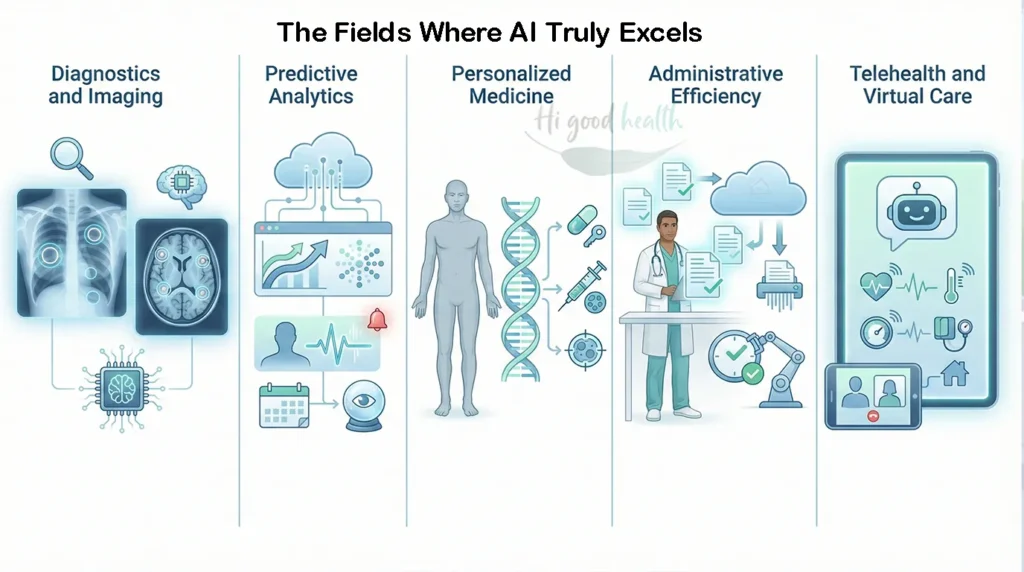
1. Diagnostics and Imaging
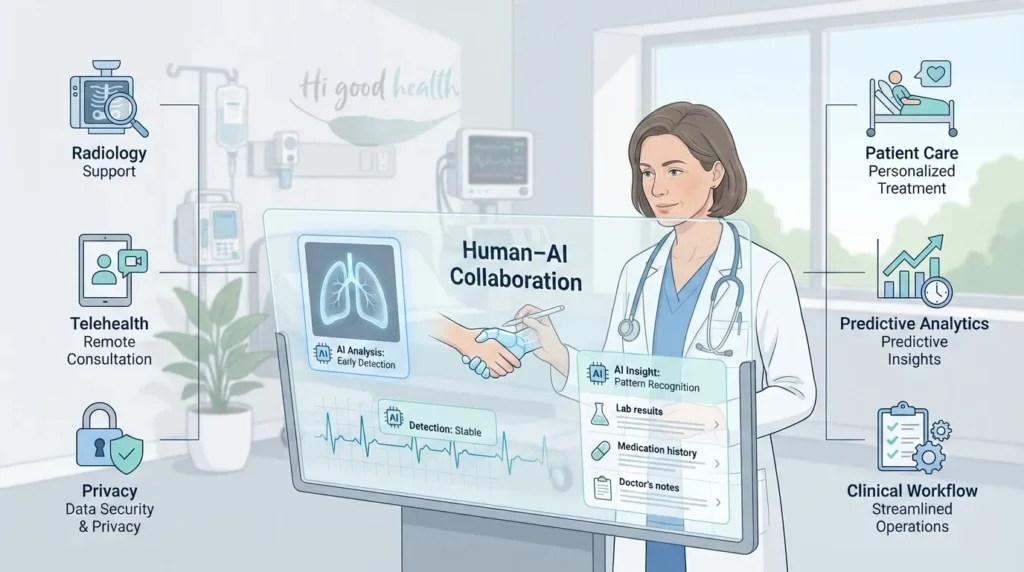
Radiology: AI tools analyze X-rays, CT scans, and MRIs for tumors, fractures, and lung disease. This is one of the clearest examples of AI in medical diagnosis working today, and the FDA recently cleared Aidoc’s comprehensive triage solution for exactly this kind of use [3].
Accuracy: In some research settings, AI systems for breast and lung imaging have matched or, in certain cases, modestly exceeded radiologists’ performance for specific tasks – when used as assistive tools rather than stand-alone replacements [1].
2. Predictive Analytics
- AI models crunch data from EHRs (electronic health records) to flag patients at risk of heart failure, sepsis, or readmission.
- Hospitals use predictive dashboards to allocate resources and prevent ER overcrowding – a fast-growing use of AI in healthcare behind the scenes.
- These systems help clinicians prioritize care, but they should always be paired with medical judgment.
To learn how AI-powered wearable diagnostic devices may cut down on repeat tests, read our detailed guide: Are Frequent Blood and Other Diagnostic Tests Really Necessary?
3. Personalized Medicine
- AI tailors treatments based on genetic profiles.
- Oncology uses machine learning in healthcare to match patients with the most effective targeted therapies.
- This approach, often called “precision medicine,” aims to find the right treatment for each individual patient.
4. Administrative Efficiency
- AI reduces paperwork by generating visit summaries and insurance codes.
- Doctors reclaim time for patients, which lowers burnout.
- Early studies show up to a 25% cut in administrative tasks at hospitals using AI documentation tools.
5. Telehealth and Virtual Care
- AI chatbots triage symptoms before a telemedicine consult.
- Remote monitoring tools alert clinicians when vitals drift outside safe ranges.
Important note: These tools should never replace in-person assessment when symptoms are severe, persistent, or worrying.
To learn more about AI-powered blood pressure monitoring, read our detailed guide: The Best Cuffless Blood Pressure Monitors of 2026 – Are These a Game Changer?
Case Studies: Americans and AI-Driven Care
Case 1: Lisa, 48, California
Her mammogram flagged “normal,” but an AI tool spotted subtle anomalies. A biopsy confirmed early-stage breast cancer, caught months earlier than a human eye alone might have. Treatment was successful.
Case 2: James, 62, Florida
With congestive heart failure, James wore a patch that sent real-time data. AI algorithms predicted a possible flare-up and alerted his doctor, preventing a hospital stay.
Case 3: Maria, 35, New York
When Maria logged into her insurer’s app for abdominal pain, an AI chatbot suggested “acid reflux.” But her condition got worse. At the ER, she was diagnosed with appendicitis. The delayed triage could have led to serious complications if she had not sought further care.
Case studies are illustrative examples based on documented AI capabilities and risks, not actual patient cases.
The Pitfalls Patients Face
1. Bias and Inequity
- AI trained on biased datasets may produce inaccurate results for certain groups.
- Example: Algorithms predicting kidney function have been shown to underestimate disease severity in Black patients, which can delay needed treatment [2].
- The concern: if training data mainly comes from one demographic group, the AI may not work as well for others. This is one of the leading ethical concerns of AI in healthcare.
2. Privacy Concerns
- While many healthcare AI systems use de-identified data, re-identification risks still exist.
- Real-world breaches like the 2023 HCA Healthcare hack exposed millions of patient records.
- Patients should ask their providers how their data is protected and who has access to it.
- Important: HIPAA protects patient data in traditional healthcare settings, but gaps exist when technology companies handle de-identified information.
3. Overreliance on Algorithms
- Risk of “automation bias,” where doctors may trust AI recommendations even when they conflict with clinical judgment.
- Research confirms this as a real concern – clinicians may over-trust “black-box” algorithms despite transparency worries [2].
- Patients often don’t know when AI is behind their diagnosis, which makes informed consent harder.
4. Gaps in Regulation
- The FDA has cleared dozens of AI tools, but oversight is evolving and struggles to keep pace with rapid development [4].
- There is still no unified national standard that ensures all AI tools are rigorously tested across diverse populations – existing frameworks are still developing.
- This means some AI tools may reach patients before they have been tested on populations that reflect real-world diversity.
5. Loss of the Human Touch
- Patients value empathy, nuance, and trust – qualities that AI cannot replicate.
- Overuse of chatbots risks alienating vulnerable groups like seniors, non-English speakers, or those with complex conditions.
- Healthcare works best when technology supports, rather than replaces, the human connection between patients and clinicians.
The Economics of AI in US Healthcare
Potential cost savings: Consulting firm Accenture estimated that AI could help reduce U.S. healthcare spending by up to $150 billion a year by 2026, mainly through administrative automation, better diagnostics, and more efficient care delivery [5].
While we have reached that target year, the full savings haven’t materialized – though early adopters are seeing 15-30% efficiency gains and 25% administrative cost cuts, which suggests the shift is underway but slower than first forecast.
Rising investment: Market analysts estimate that the U.S. healthcare AI market could reach $40-50 billion by 2030 [6], reflecting fast adoption across hospitals, insurers, and digital health companies.
Impact on patient bills: In some cases, AI-enabled diagnostics and automation may lower costs for patients. But advanced AI-driven therapies, robotic systems, and precision medicine tools often carry high price tags, and savings are not always passed on to patients [7].
To learn more about advanced AI-driven health tech, read our guide: The Future of Wearable Sleep Tech: Beyond Smartwatches in 2026
Key concern: If insurers and health systems deploy AI mainly to boost profits rather than improve access and affordability, patients may see little financial benefit – even with system-wide efficiency gains. This will vary a lot by hospital, insurance plan, and location.
The Science: How AI Actually Works (In Simple Terms)
Understanding the basics helps you ask better questions about your care and the use of AI in healthcare you may encounter:
Machine Learning (ML): This is teaching computers to recognize patterns. ML algorithms “learn” from thousands of scans to spot tumors, the same way you learn to spot a familiar face in a crowd over time.
Natural Language Processing (NLP): This helps computers understand medical notes written by doctors. Instead of reading each record by hand, AI can quickly find key details across thousands of patient charts.
Generative AI: The newest type – it can write summaries, draft letters to insurance companies, or answer patient questions based on medical knowledge.
The catch: AI is only as good as the data it learns from. If the training data has gaps or errors – “garbage in, garbage out” – the AI will too.
To learn more about wearable health tech for seniors, read our guide: Wearable Health Tech for Seniors – Hype vs Reality
Short- vs Long-Term Impacts for Patients
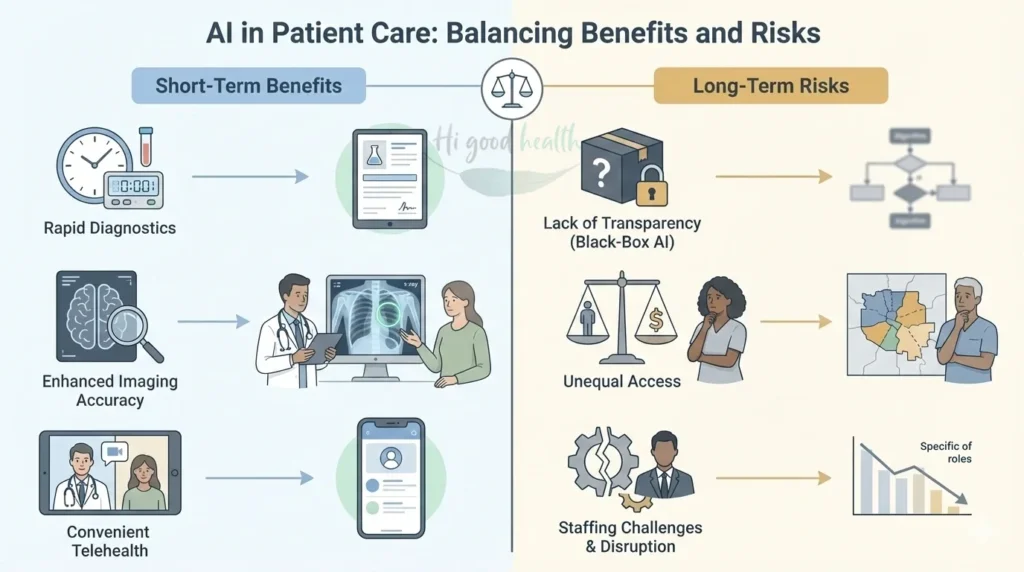
Short-Term Benefits (What You Might Notice Now):
- Faster test results and lab reports
- Fewer missed diagnoses in radiology and imaging
- Easier access to virtual care appointments
- Less waiting as administrative tasks speed up
Long-Term Risks (What Could Happen Over Time):
- Overdependence on “black-box” systems that patients and even some doctors don’t fully understand
- Widening health gaps if AI tools don’t serve diverse communities equally
- Possible job displacement that affects the supply of healthcare workers in your area
- Loss of the personal connection that makes healthcare feel human
How Patients Can Protect Themselves in the Age of AI
1. Ask Questions
- “Was AI used in my diagnosis or treatment plan?”
- “How accurate is this AI tool, and has it been tested on people like me?”
- “How is my health data being stored and protected?”
- You have every right to understand how technology is being used in your care.
2. Know Your Rights
- Under HIPAA [8], patients must be informed if personal health data is shared with third parties.
- Some states (for example, California) have stricter AI and data privacy laws that give you extra protections.
- You can request copies of your medical records and ask who has accessed them.
3. Balance Convenience with Caution
- Telehealth AI tools are handy for minor issues, but trust your instincts.
- If an AI chatbot’s suggestion doesn’t feel right, get a second opinion from a licensed clinician.
- Red-flag any persistent, worsening, or severe symptoms – always escalate to a human doctor.
4. Support Transparency
- Choose providers and hospitals that openly discuss their use of AI in patient care.
- Ask if they publish performance data showing how well their AI tools work across different patient groups.
- Patient advocacy can push the whole healthcare system toward more responsible AI use.
5. Stay Human-Centered
- Use AI as a tool to enhance care, not as a replacement for the doctor-patient relationship.
- The best outcomes happen when technology assists skilled, empathetic clinicians – not when it makes decisions alone.
What Experts Say
Leading health organizations stress cautious, ethical AI adoption:
American Medical Association (AMA): Warns that “equity and transparency must guide AI adoption” and publishes principles for responsible AI in healthcare [9].
FDA (2024): Acknowledges gaps in regulation and has pledged “continuous oversight” of adaptive AI tools that learn and change over time [4].
World Health Organization (WHO): Calls for “responsible AI” that puts patient safety, fairness, and human rights first in healthcare [10].
These guidelines exist to protect patients, but enforcement and real-world rollout of AI in healthcare are still catching up with the technology.
Key Takeaways
- The use of AI in healthcare is already routine in 2026 – in imaging, risk prediction, paperwork, and telehealth triage.
- AI in medical diagnosis, and AI in healthcare diagnosis more broadly, can match specialists on some imaging tasks, but only as a support tool a doctor reviews.
- The pros of AI in healthcare include faster results and fewer missed findings; the risks include bias, privacy gaps, and over-trust in “black-box” systems.
- Ethical concerns of AI in healthcare center on fairness, transparency, and informed consent.
- Protect yourself: ask if AI was used, know your HIPAA rights, and always escalate severe or worsening symptoms to a human clinician.
Frequently Asked Questions
1. Will AI replace my doctor?
No. AI handles tasks like paperwork, data analysis, and scan interpretation, but it cannot replace human empathy, judgment, or the personal connection you have with your doctor. Experts across the medical field emphasize that AI should be a tool to assist doctors, not replace the patient-doctor relationship. Your doctor’s expertise in understanding your unique situation remains irreplaceable.
2. Can AI detect cancer earlier than human doctors?
In certain research studies, AI tools analyzing X-rays, mammograms, and CT scans have matched or, in some cases, exceeded radiologists’ performance for specific tasks – but only when used as an assistive tool. These tools are most effective when they help doctors catch issues they might miss, not when they work alone. AI is best viewed as a second set of eyes rather than a replacement for skilled radiologists.
3. Is my health data safe if my doctor uses AI?
Not always. AI systems require massive amounts of data, which increases the risk of privacy breaches and leaks. While laws like HIPAA exist to protect your information, cyberattacks can still expose millions of patient records. Additionally, some AI companies may use de-identified data that could potentially be re-identified. Always ask your healthcare provider how your data is protected, who has access, and whether it’s shared with third parties.
4. Can AI make mistakes in diagnosis?
Yes. AI is not perfect and has made serious diagnostic errors, such as mistaking life-threatening conditions like appendicitis for mild issues like acid reflux. There is also a documented risk of automation bias, where doctors may trust AI outputs too much, even when they conflict with clinical judgment. This is why AI should always be used alongside – never instead of – experienced medical professionals.
5. Is medical AI biased against certain groups?
It can be. If algorithms are trained primarily on data from one demographic group (for example, mostly white, male patients), they may produce less accurate results for women, minorities, and other underrepresented groups. Some algorithms have underestimated kidney disease severity in Black patients, leading to delayed treatment. Researchers and regulators are working to address these biases, but the problem persists in many current AI tools.
6. Will using AI lower my medical bills?
Not necessarily. While AI could save the healthcare industry billions of dollars, those savings often don’t reach patients directly. Some AI-driven diagnostics may cost less, but advanced AI-powered therapies and robotic systems can be very expensive. Whether you see lower bills depends on your hospital, insurance plan, and geographic location. It’s important to ask your provider about costs upfront.
7. What should I do if an AI chatbot diagnosis feels wrong?
Trust your instincts and your body. If an AI tool or chatbot suggests your symptoms are mild but you feel worse or something seems off, do not rely solely on the AI assessment. Always seek evaluation from a human doctor, especially for persistent, worsening, or severe symptoms. AI should never be the final word on your health – your own judgment and a clinician’s expertise matter most.
8. What are the pros of AI in healthcare for patients?
The main pros of AI in healthcare are faster test results, fewer missed diagnoses in imaging, easier access to virtual care, and shorter waits as paperwork speeds up. Used well, AI in patient care acts as an extra layer of checking that supports your medical team. The benefits are strongest when AI assists a trained clinician rather than working on its own.
9. What are the ethical concerns of AI in healthcare?
The biggest ethical concerns of AI in healthcare are bias against underrepresented groups, weak transparency around when AI is used, patient privacy, and informed consent. Many patients are never told that an algorithm helped shape their diagnosis. Leading bodies like the AMA and WHO ask that fairness, transparency, and human oversight guide every use of AI in medicine.
10. What are examples of AI in medical diagnosis?
Common examples of AI in medical diagnosis include software that reads mammograms and CT scans for early cancer signs, models that flag sepsis or heart-failure risk from electronic health records, and chatbots that triage symptoms before a telehealth visit. In each case, AI in healthcare diagnosis works best as a support tool that a human doctor reviews before any decision is made.
Final Thoughts
AI is reshaping American healthcare in 2026, offering real chances to catch disease earlier, streamline care, and personalize treatment. But the risks are real too: algorithmic bias, privacy threats, regulatory gaps, and the possible loss of human-centered care.
For patients, the wisest approach is informed balance – welcome AI’s promise where it genuinely helps, but demand transparency, equity, and strong safeguards from providers and policymakers. Ask questions, know your rights, and never let technology replace the human connection at the heart of healing.
The future of healthcare should be tech-assisted, not tech-dominated.
To learn how AI may help you live better and longer, read our guide: Longevity Lifestyle and “Augmented Biology” – Living Better, Longer
Glossary
AI (Artificial Intelligence): Computer systems designed to mimic human decision-making and problem-solving.
ML (Machine Learning): A type of AI where algorithms learn from data patterns without being explicitly programmed for every scenario.
NLP (Natural Language Processing): AI technology that analyzes and understands human language, such as doctors’ medical notes.
EHR (Electronic Health Records): Digital versions of patients’ medical charts.
HIPAA (Health Insurance Portability and Accountability Act): US federal law that protects patient health information from being disclosed without consent.
Automation Bias: The tendency to trust computer outputs over human judgment, even when the computer may be wrong.
Algorithm: A set of rules or instructions that a computer follows to solve a problem or make a decision.
All reference links valid and accessible as of 4 July 2026.
- National Cancer Institute – Artificial Intelligence in Cancer Research. cancer.gov
- Journal of Medical Internet Research (2025) – Bias and automation-bias in clinical AI. jmir.org
- Aidoc Secures FDA Clearance for Healthcare’s First Comprehensive Foundation Model AI (PR Newswire). prnewswire.com
- U.S. Food and Drug Administration – Artificial Intelligence and Machine Learning in Software as a Medical Device. fda.gov
- Accenture – AI will lead to $150 billion in annual savings. icthealth.org
- MarketsandMarkets – US Artificial Intelligence in Healthcare Market. marketsandmarkets.com
- Aalpha – Cost of Implementing AI in Healthcare. aalpha.net
- U.S. Department of Health and Human Services – HIPAA for Individuals. hhs.gov
- American Medical Association – Principles for AI in Healthcare. ama-assn.org
- World Health Organization – Ethics and Governance of Artificial Intelligence for Health. who.int
