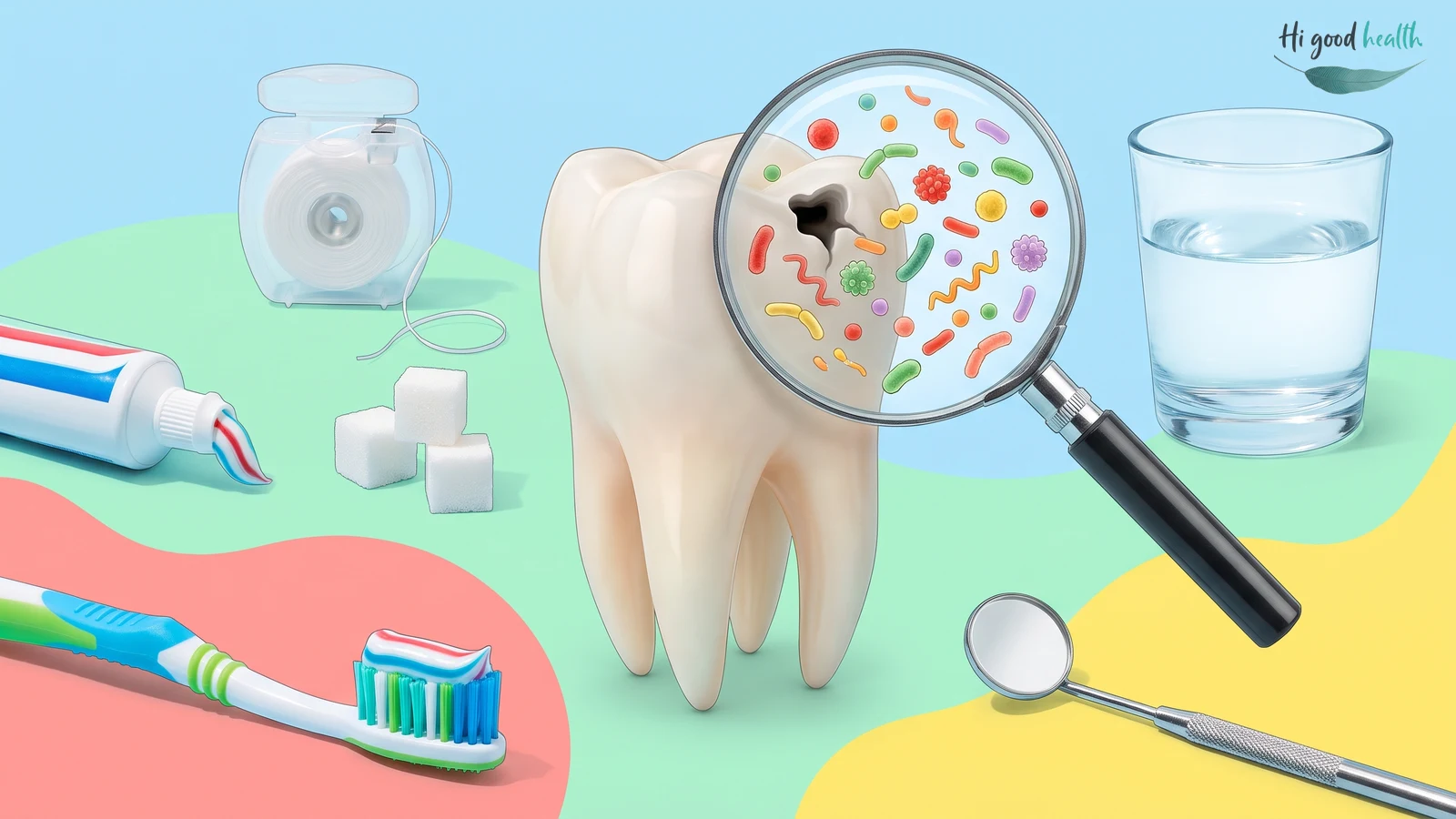
About this series. Oral Hygiene is a sixteen-part series on looking after teeth and gums at every age, from brushing and flossing to children’s teeth, gum disease and toothache.
This is Part 14: Tooth Cavities (Dant Me Kida).
What Does “Dant Me Kida” (Tooth Worm) Actually Mean?
Many Hindi speakers, including many South Asian families in the United States, say dant me kida (literally “worm in the tooth”) when they notice a black spot, a hole in a tooth, or a persistent toothache.
It is a familiar expression, but it does not mean that an actual worm is living inside the tooth.
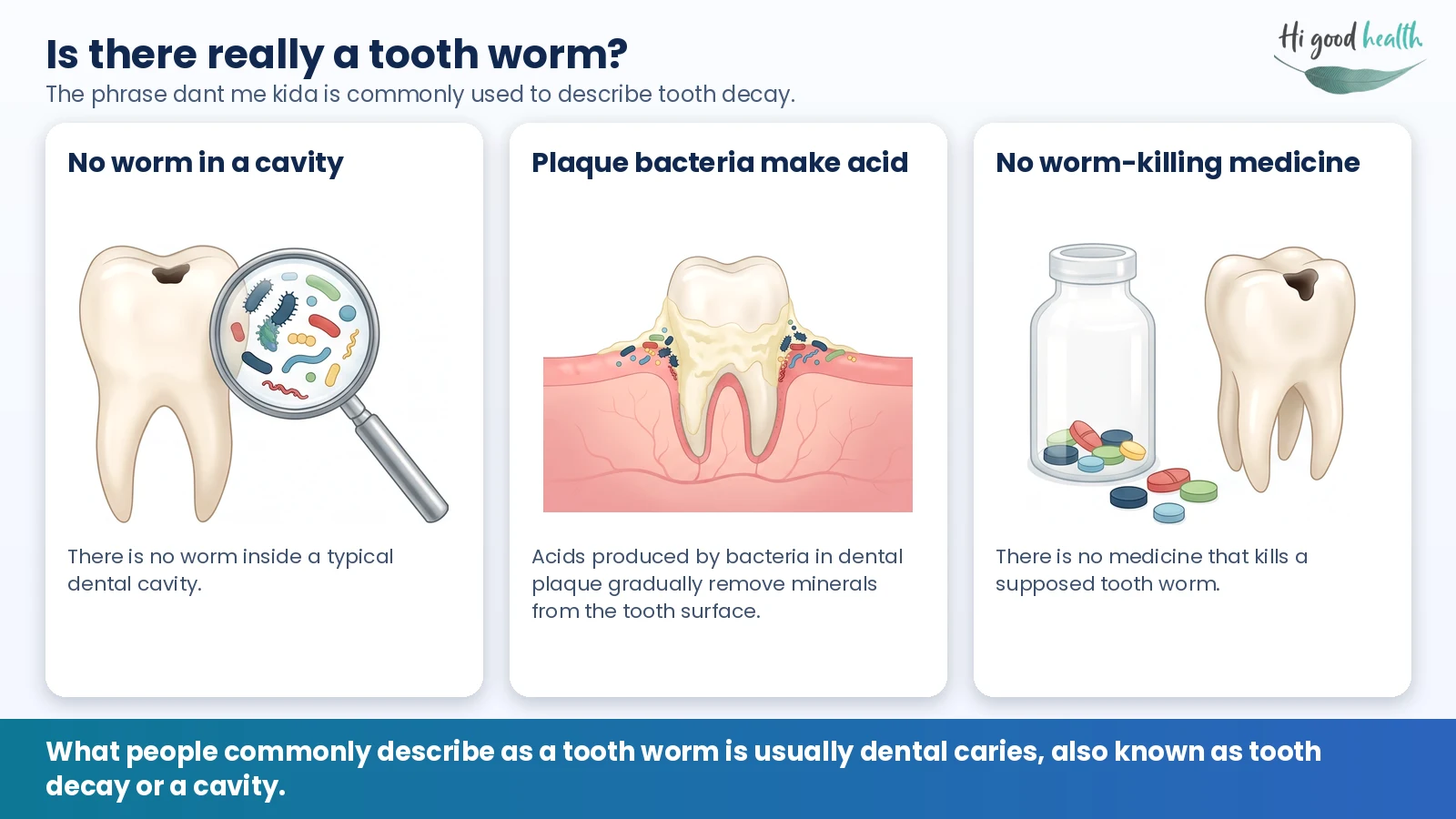
There is no worm inside a typical dental cavity, and there is no medicine that kills a supposed tooth worm. What people commonly describe as a tooth worm is usually dental caries, also known as tooth decay or a cavity.
Tooth decay is a disease in which acids produced by bacteria in dental plaque gradually remove minerals from the tooth surface. Over time, this damage can weaken the enamel and create a hole in the tooth.
Understanding the actual cause is important because the right treatment can prevent further damage, relieve pain, and, in many cases, save the affected tooth.
At a Glance
Despite the name, a tooth worm is not a real animal. The damage people blame on one is dental caries, the medical term for tooth decay and cavities. Bacteria in plaque turn sugar into acid, and over time that acid dissolves minerals from the enamel until a hole forms.
Caught at the chalky white-spot stage, a tooth can sometimes recover with fluoride, careful cleaning and fewer sugary snacks. Once a hole has formed, no home remedy can fill it, and a dentist has to decide between a filling and other care.
No pill, oil or paste can kill a tooth worm, because there is none to kill. Pain relievers only quiet the symptoms for a while, and antibiotics are not a routine fix for a simple cavity unless a clinician prescribes them.
Cavities often start to hurt only late, so a painless tooth can still be decayed. Get urgent dental care for severe pain, a swollen gum or face, pus, or fever with tooth pain. Swelling that interferes with breathing or swallowing is an emergency: call 911 or go to the nearest ER.
Why Does a Tooth Develop a Cavity?
Tooth decay develops through the interaction of bacteria, dietary sugars, tooth structure, saliva and time. It is not simply caused by eating candy once or failing to brush on a single occasion.
Here is how the process works:
- Plaque builds up on the teeth. Dental plaque is a sticky film containing bacteria that collects on tooth surfaces, particularly around the gumline and in grooves between teeth.
- Bacteria produce acids. When oral bacteria break down sugars from food and drinks, they release acids that attack the enamel.
- The enamel loses minerals. Repeated acid attacks cause demineralization. In the early stages, the tooth may develop a chalky white spot without forming a hole.
- A cavity develops. If mineral loss continues, the enamel can break down. Once a physical hole forms, the damage usually requires professional dental treatment.
Common causes and risk factors
Several factors can increase the likelihood of developing cavities:
- Frequent consumption of candy, cookies, chocolate, sweetened tea or coffee, soda, and other sugar-containing foods or drinks.
- Brushing inadequately or missing areas where plaque accumulates.
- Not cleaning between teeth regularly.
- Inadequate fluoride exposure.
- Dry mouth or reduced saliva production.
- Deep grooves in teeth that retain plaque.
- Untreated decay in other teeth or a history of frequent cavities.
Cavities can affect children and adults. Baby teeth are also vulnerable to decay and should not be neglected simply because they will eventually fall out.
What Are the Signs and Symptoms of Dental Decay (Dant Me Kida)?
The symptoms depend on how far the decay has progressed. Early tooth decay may not cause any pain, which is why a person can have a cavity without knowing it.
Common signs include:
- White, brown, or black spots on a tooth.
- A visible hole or rough area on the tooth surface.
- Food getting trapped in a particular tooth.
- Sensitivity to cold drinks, hot food, or sugary foods.
- Pain while chewing.
- Persistent or throbbing toothache when decay becomes advanced.
- Gum swelling, pus, or facial swelling if an infection develops.
A black spot does not always mean active decay, and not every cavity is black. Staining and other dental conditions can look similar. A dentist can examine the tooth and recommend an X-ray if necessary.
Can Dant Me Kida Be Cured at Home?
This is one of the most important questions for anyone searching for a home remedy for tooth decay.
An early white-spot lesion, before a hole has formed, can sometimes be remineralized and arrested with appropriate fluoride exposure, good plaque control, and dietary changes. However, an established cavity with a physical hole cannot heal or regrow naturally through home remedies. A dentist must assess the damage and determine whether a filling or another treatment is needed. [1,2]
At home, you can reduce the risk of further decay by:
- Brushing twice daily for two minutes with fluoride toothpaste.
- Cleaning between the teeth daily with floss or an appropriate interdental cleaner.
- Reducing how often you consume sugary snacks and drinks.
- Drinking water regularly and maintaining adequate hydration.
- Avoiding tobacco products, including chewing tobacco and betel quid (paan), which can harm oral health.
- Keeping dental appointments even when the tooth is not painful.
These steps help control the disease process, but they cannot replace a filling when tooth structure has already been lost.
Do cloves, salt water, or oil pulling remove a cavity?
Clove oil is traditionally used to relieve toothache, and a warm salt-water rinse may provide temporary comfort in some situations. Neither removes decay or repairs a hole in a tooth. Oil pulling has not been established as a treatment that cures cavities.
Clove oil can irritate or burn oral tissues if used incorrectly, particularly when applied undiluted. Avoid placing aspirin, concentrated oils, tobacco, lime, or other irritating substances directly on the tooth or gums.
If you have pain, a dentist can identify its cause and recommend appropriate treatment. Do not use temporary pain relief as a reason to postpone an examination.
Is There Any Medicine to Kill the Worm in a Tooth?
There is no tooth worm to kill, so there is no medicine specifically for killing a tooth worm.
Treatment depends on the actual condition:
- Early enamel decay: Fluoride-based preventive treatment and changes in oral hygiene and diet may stop or reverse the earliest mineral changes.
- A cavity or hole: A filling is commonly needed to restore the damaged tooth.
- Deep decay involving the pulp: Root canal treatment may be required to remove infected or irreversibly inflamed tissue and preserve the tooth.
- A tooth that cannot be saved: Extraction may be necessary in selected cases.
- A dental abscess: Prompt professional treatment is essential. Antibiotics are indicated only in selected circumstances and do not replace treatment of the source of infection.
Painkillers may help control symptoms temporarily, but they do not remove decay. Antibiotics should not be taken without appropriate clinical advice, and they are not a routine treatment for an uncomplicated cavity.
The best treatment is determined by the depth of decay, the condition of the pulp, the restorability of the tooth and the patient’s overall dental health.

How Can You Prevent Dental Decay (Dant Me Kida)?
Preventing cavities is easier than treating advanced decay. A consistent oral hygiene routine and sensible dietary habits can significantly reduce risk.
- Brush twice daily. Use fluoride toothpaste and a soft-bristled toothbrush. Brush before bed and clean all tooth surfaces carefully.
- Limit frequent sugar intake. The frequency of sugar exposure matters as well as the total amount consumed. Avoid repeatedly sipping sugary drinks or snacking on candy throughout the day.
- Clean between your teeth. Floss or use suitable interdental cleaning aids to remove plaque from areas the toothbrush may miss.
- Protect children’s teeth early. Start brushing as soon as the first tooth erupts. For children younger than three years, use a smear of fluoride toothpaste about the size of a grain of rice, with caregiver assistance.
- Visit a dentist regularly. The appropriate interval depends on your oral health and cavity risk. People who develop decay frequently may need more frequent reviews.
- Seek care early. Do not wait for severe pain. Treating decay before it reaches the pulp may help avoid more extensive procedures.

When Should You See a Dentist?
Book a dental appointment if you notice a hole in a tooth, persistent sensitivity, pain while chewing or a suspicious spot that does not go away.
Seek urgent dental care for severe or worsening toothache, gum swelling, pus, fever associated with dental pain or swelling of the face or jaw. If swelling makes breathing or swallowing difficult, go to an emergency room or call 911 immediately.
Remember that a cavity can progress without causing pain. A painless tooth is not necessarily a healthy tooth.
The Oral Hygiene Series
Sixteen articles on looking after your teeth and gums, at every age.
- Complete Oral Hygiene Guide for Every Age — the whole routine, age by age
- Brushing Technique: Bass, Modified Bass and Fones — which method suits which mouth, and how long two minutes really is
- Electric vs Manual Toothbrush — what the evidence shows, rather than what the manufacturers claim
- How to Floss Correctly — step by step, including the C-shape wrap and how far below the gumline to go
- Water Flosser for Tonsil Stones — what pressure is safe, and when not to try it at all
- Interdental Brushes and Bleeding Gums — choosing the right size, and why bleeding usually stops within two weeks
- Early Childhood Caries — causes, symptoms, prevention and treatment in children under six
- Milk Teeth Falling Out — the age, order and timeline, and what parents should know
- Pyorrhea (Gum Disease) — causes, symptoms, treatment and prevention
- Gum Swelling, Bleeding and Dry Mouth — how underlying diseases affect your gums and oral health
- Medicine for Toothache — what to take, what causes the pain, and how it is treated
- Pacifier Teeth — how pacifiers affect growing teeth and the bite, and when to stop
- 6 Year Molars — the first permanent molars, when they come in and how to protect them
- Tooth Cavities (Dant Me Kida) — what a “tooth worm” really is, how cavities form and how they are treated (you are here)
- Can Cavities Spread? — whether cavities pass between people or from tooth to tooth, and how to prevent them
- Metallic Taste in Mouth — what causes it, what helps and when to see a doctor
Key Takeaways
The expression dant me kida points to tooth decay, not a worm. Acid made by plaque bacteria slowly wears away minerals in the tooth, and that is how a cavity forms.
No medicine can kill a tooth worm, and home care cannot rebuild a tooth that already has a hole. Fluoride and better habits can help very early damage, while a hole may call for a filling, a root canal or, sometimes, removal of the tooth.
Seeing a dentist early is the best way to keep your own teeth and avoid pain and complications later.
Frequently Asked Questions (FAQs)
Is there really a tooth worm?
No. When people say tooth worm they mean a cavity. The damage comes from acid made by bacteria, not from a creature living inside the tooth.
What is the best treatment for tooth decay?
It depends on the stage. Fluoride care can help the earliest changes, a filling treats a hole, and a root canal or extraction is kept for deeper damage. Since there is no worm, there is no special drug to kill one.
Can tooth decay be cured with home remedies?
Only the very first chalky spots can improve, and that takes fluoride and good brushing. A hole cannot grow back by itself, so a dentist needs to treat it.
Does applying cloves kill tooth worms?
No. Clove oil may dull pain for a short time but leaves the decay in place, and used the wrong way it can irritate the gums and the lining of the mouth.
Is a root canal necessary if there is tooth decay?
Not for every cavity. A small one often needs just a filling. A root canal comes into play when decay reaches the pulp and the tooth can be saved that way.
Is there always pain when there is tooth decay?
No. Early cavities are often painless, and by the time a tooth hurts, the decay may already be deep. Regular checkups catch problems sooner.
Does a black spot mean tooth decay?
Not always. A dark spot might be a cavity, a surface stain or something else, so only a dentist’s exam can tell which.
Do baby teeth get cavities too?
Yes. Baby teeth can decay as well, and they need treatment. Left alone, decay can bring pain, infection, trouble eating and early tooth loss.
Glossary
Dant me kida: a Hindi expression, literally “worm in the tooth,” that people use for tooth decay or a cavity; it does not refer to a real worm.
Dental caries (tooth decay): a disease in which acids produced by bacteria in dental plaque gradually remove minerals from the tooth surface.
Dental plaque: a sticky film containing bacteria that collects on tooth surfaces, particularly around the gumline and in grooves between teeth.
Demineralization: mineral loss from the enamel caused by repeated acid attacks; in the early stages, the tooth may develop a chalky white spot without forming a hole.
Root canal treatment: treatment that removes infected or irreversibly inflamed tissue from inside the tooth and preserves the tooth.
References
- National Institute of Dental and Craniofacial Research (NIDCR). Tooth Decay. Accessed October 30, 2026. Available at: https://www.nidcr.nih.gov/health-info/tooth-decay
- National Institute of Dental and Craniofacial Research (NIDCR). The Tooth Decay Process: How to Reverse It and Avoid a Cavity. Accessed October 30, 2026. Available at: https://www.nidcr.nih.gov/health-info/tooth-decay/more-info/tooth-decay-process
- American Dental Association (ADA). Caries Risk Assessment and Management. Accessed October 30, 2026. Available at: https://www.ada.org/resources/ada-library/oral-health-topics/caries-risk-assessment-and-management
- NHS. Tooth Decay. Accessed October 30, 2026. Available at: https://www.nhs.uk/conditions/tooth-decay/
- National Institute of Dental and Craniofacial Research (NIDCR). Dental Fillings. Accessed October 30, 2026. Available at: https://www.nidcr.nih.gov/health-info/dental-fillings
- NHS. Dental Abscess. Accessed October 30, 2026. Available at: https://www.nhs.uk/conditions/dental-abscess/
All reference links checked on October 30, 2026.
Disclaimer
This content is for educational purposes only and is not a substitute for professional medical or dental advice. Talk to a dentist about your own or your child’s teeth.
