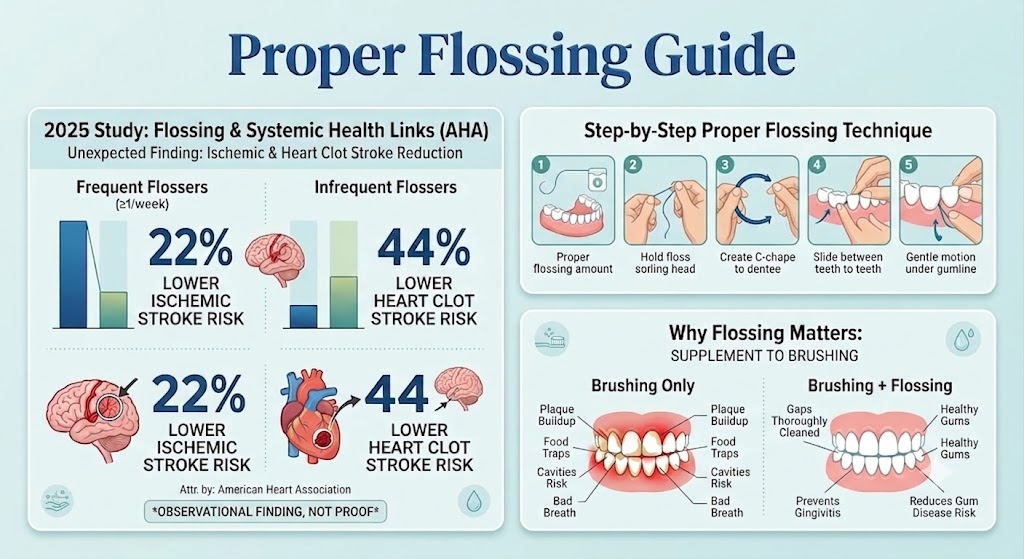
In 2025, researchers who had followed more than 6,000 American adults for 25 years reported something unexpected: people who flossed at least once a week had a 22% lower risk of ischemic stroke, and a 44% lower risk of stroke caused by a clot from the heart (American Heart Association).
It is an observational finding, not proof, but it is a striking result for a habit most people skip entirely.
And most people do skip it.
Learning how to floss correctly takes about five minutes, and it changes what the habit actually does for your gums. If you’re one of them, you’re not alone.
Studies consistently show that while brushing is a common habit, daily flossing is often neglected. Unfortunately, brushing alone cannot effectively clean all tooth surfaces. The tight spaces between teeth and along the gumline are areas where plaque and food particles can remain trapped.
Over time, this buildup can contribute to cavities, bad breath, gingivitis, and gum disease. The good news is that flossing is simple, inexpensive, and highly effective when done correctly.
At a glance
Curve the floss into a C shape against the side of each tooth, slide it gently just beneath the gumline, then move to a fresh section before the next gap. Once a day is enough, and the whole mouth takes two to three minutes.
Technique does the work here, not the product, which is why how to floss correctly matters more than which brand you buy.
- Flossing removes plaque and food debris from areas your toothbrush cannot reach.
- Daily flossing helps reduce the risk of cavities and gum disease.
- Proper technique is more important than the type of floss you use.
- Flossing should be performed at least once per day.
- The American Dental Association (ADA) recommends cleaning between teeth daily.
- Interdental brushes may work even better than floss for some people; more on that below.
Why Flossing Matters: The Benefits for Teeth and Gums
Your mouth contains hundreds of different types of bacteria. Throughout the day, these bacteria combine with food particles and saliva to form a sticky film called plaque.
Plaque accumulates not only on the visible surfaces of your teeth but also between them and beneath the gumline.
If plaque is not removed regularly, it can lead to:
- Tooth decay (cavities)
- Gingivitis (early gum disease)
- Periodontitis (advanced gum disease)
- Persistent bad breath
- Gum recession
- Tooth loss over time
While brushing cleans the front, back, and chewing surfaces of teeth, flossing targets the areas between teeth where plaque often accumulates first. Those surfaces are roughly a third of each tooth, and the NIDCR notes that plaque left in place hardens into tartar, which no amount of home cleaning will shift.
What Happens If You Don’t Floss?
Skipping flossing occasionally is unlikely to cause immediate damage. However, consistently neglecting interdental cleaning can allow plaque and bacteria to remain in hard-to-reach areas. The usual sequence is bleeding gums first, then tartar you cannot remove at home, then decay starting between the teeth where you cannot see it.
Many dental problems begin between the teeth, making flossing an essential part of preventive oral care. If your gums already bleed, start with Bleeding Gums: Causes and Treatment.
Wait – Didn’t the News Say Flossing Doesn’t Work?
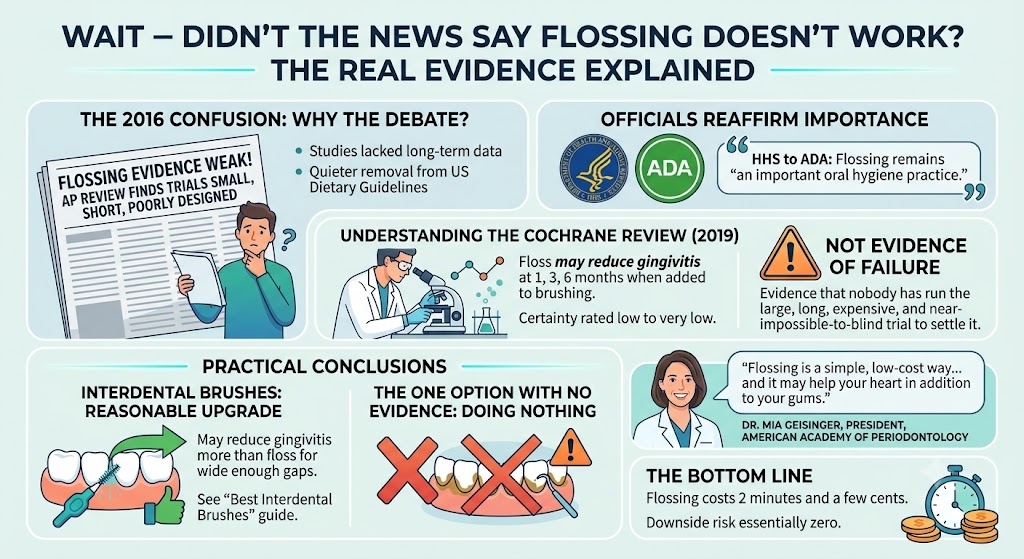
If you remember headlines claiming the evidence for flossing was thin, you remember correctly, and it deserves an honest answer. In 2016, an Associated Press review found the trials behind flossing were mostly small, short, and poorly designed, and flossing was quietly dropped from the US Dietary Guidelines.
The Department of Health and Human Services then reaffirmed to the ADA that flossing remains “an important oral hygiene practice.”
Here is what that argument actually means. A 2019 Cochrane review found floss may reduce gingivitis at one, three and six months when added to brushing but rated the certainty low to very low.
That is not evidence that flossing fails. It is evidence that nobody has run the large, long trial that would settle it, because such a trial is expensive and nearly impossible to blind.
Two practical conclusions follow. First, the same review found that interdental brushes may reduce gingivitis more than floss, so if your gaps are wide enough to take one, they are a reasonable upgrade (see Best Interdental Brushes for Gum Health).
Second, doing nothing between your teeth is the one option with no supporting evidence at all.
“Flossing is a simple, low-cost way to take care of your smile and it may help your heart in addition to your gums,” said Dr. Mia Geisinger, President of the American Academy of Periodontology. That is roughly where I land with patients: flossing costs two minutes and a few cents, and the downside risk is essentially zero.
How to Floss Correctly: Step-by-Step
Ten steps sounds like a lot. In practice, how to floss correctly comes down to three things: enough floss to keep a clean section going, the C shape against each tooth, and getting just under the gumline. The rest is sequence.
Step 1: Use the Right Amount of Floss
Break off approximately 18 to 24 inches (45–60 cm) of dental floss. This length provides enough clean floss to use a fresh section for each tooth.
Step 2: Wrap the Floss Around Your Fingers
Wind most of the floss around the middle finger of one hand. Wrap the remaining floss around the middle finger of the opposite hand.
One finger will hold the clean floss, while the other collects the used floss as you move through your mouth.
Step 3: Hold the Floss Properly
Grip the floss firmly between your thumbs and index fingers. Leave about 1 to 2 inches of floss between your hands for better control.
Step 4: Gently Guide the Floss Between Teeth
Carefully slide the floss between two teeth using a gentle back-and-forth motion. Avoid snapping the floss into the gums, as this can cause irritation and injury.
Step 5: Form a “C” Shape Around the Tooth (C-Shaped Flossing)
Once the floss reaches the gumline, curve it around one tooth in a “C” shape. This allows the floss to wrap around the tooth surface and clean more effectively. This is the step most people skip, and it is the one that does the work; a straight up-and-down sawing motion cleans almost nothing.
Step 6: Clean Below the Gumline
Gently slide the floss slightly beneath the gumline. Move it up and down several times against the tooth surface. This helps remove plaque and bacteria that brushing often misses.
Step 7: Repeat on the Adjacent Tooth
Before removing the floss, curve it around the neighboring tooth and repeat the cleaning motion. Both sides of the space between teeth need to be cleaned.
Step 8: Use a Fresh Section of Floss
Move to a clean section of floss before cleaning the next tooth. This prevents transferring plaque and bacteria from one area to another.
Step 9: Continue Around the Entire Mouth
Repeat the process for every tooth, including: front teeth, back teeth, and the areas behind the last molars. These hard-to-reach locations often accumulate significant plaque.
Step 10: Rinse Your Mouth
After flossing, rinse with water or an antimicrobial mouthwash. This helps remove loosened debris and leaves your mouth feeling fresh. One caveat: if you brush after flossing, don’t rinse again afterwards — spit out the toothpaste and leave the fluoride on your teeth.
Should You Floss Before or After Brushing?
Dentists generally agree that either order works, but there is now evidence favouring one. A 2018 trial published in the Journal of Periodontology tested both sequences in the same people and found that flossing before brushing removed significantly more interdental plaque and left more fluoride between the teeth.
Flossing first loosens the debris; the brush sweeps it away.
The most important factor is consistency. Choose the order that helps you floss every day. Whatever order you settle on, brush and floss on the same trip to the sink. Pairing the two is what makes the habit survive a busy week.
How Often Should You Floss?
Once a day is the standard answer, and it is the one the American Dental Association gives. Flossing more often does not clean better, and being heavy-handed about it can irritate the gum margin.
Time of day matters less than people expect. Pick the slot you will actually keep; for most people that is at night, when nothing else is competing for the two minutes.
| Oral Health Situation | How often | Why |
|---|---|---|
| Healthy mouth | Once a day | Plaque takes roughly a day to re-form between the teeth |
| Braces or a permanent retainer | Once a day, allow longer | More surfaces to reach; a floss threader saves most of the time |
| Dental Bridges or implants | Once a day | Debris collects underneath, where no toothbrush reaches |
| Gum disease under treatment | As your dentist directs | Usually daily flossing plus interdental brushes |
So if you are wondering how many times a day you should floss: once, done properly, beats three rushed attempts.
Types of Dental Floss
Several floss options are available.
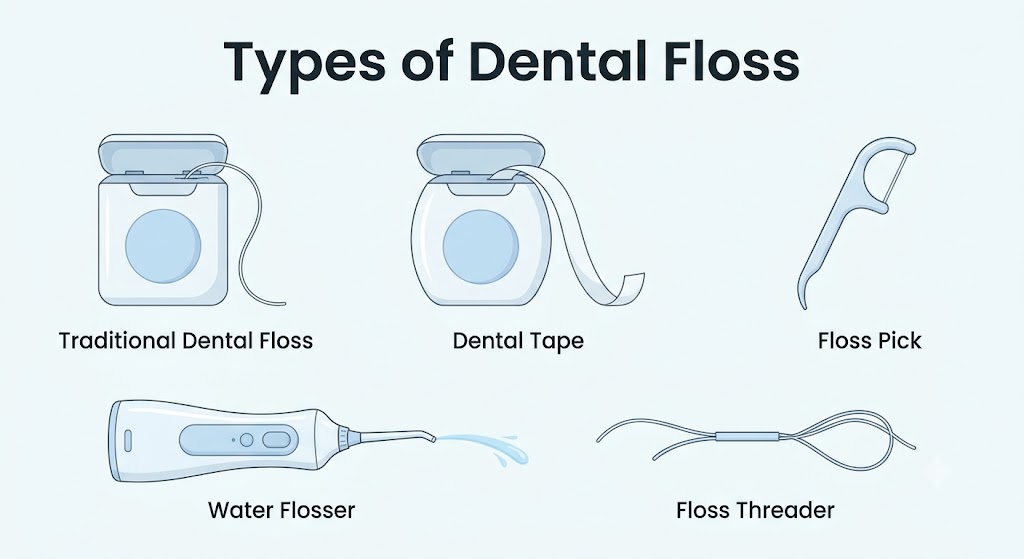
- Traditional Dental Floss: The most common and affordable option, sold waxed, unwaxed or flavoured. Waxed slides more easily through tight contacts.
- Dental Tape: Broader and flatter than traditional floss. Often more comfortable for people with larger spaces between teeth.
- Floss Picks: Small plastic tools that hold a short piece of floss. Convenient for travel and quick use. They make the “C” shape harder to form, so treat them as the version you’ll actually use rather than the ideal one.
- Water Flossers: Devices that use a stream of water to clean between teeth and along the gumline. They can be particularly helpful for: braces, dental implants, bridges, and anyone with limited dexterity.
Do water flossers work? For gum inflammation and for cleaning around braces or implants, the evidence says yes, though it is not strong enough to call them a straight replacement for floss on tight contacts.
If you are learning how to use a water flosser: lean over the sink, start on the lowest setting, and trace along the gumline rather than aiming straight into the gap.
- Floss Threaders: A short stiff loop that carries floss where it cannot be pushed — under a bridge, a permanent retainer, or an orthodontic wire. How to use a floss threader: pass the floss through the loop, slide the loop under the wire or bridge, then pull the floss through and clean as normal.
Common Flossing Mistakes
Even people who floss regularly may use improper technique. Avoid these common mistakes: Each of these is a small deviation from how to floss correctly, and each one costs you most of the benefit.
- Snapping the Floss Into the Gums: Aggressive flossing can irritate or damage gum tissue.
- Using the Same Section Repeatedly: Always advance to a clean section of floss.
- Skipping Back Teeth: Molars are common sites for plaque accumulation and cavities.
- Flossing Too Quickly: Rushing reduces cleaning effectiveness.
- Flossing Only When Food Gets Stuck Flossing should be a daily preventive habit, not an occasional solution.
For the brushing-side equivalents, see Common Brushing Mistakes That Damage Your Teeth.
Gums Bleed When Flossing: Should You Stop?
No. It usually means the opposite. Many people experience mild bleeding when they first begin flossing regularly. This is often a sign of gum inflammation caused by plaque buildup. With consistent daily flossing, bleeding usually improves within one to two weeks.
Sore or puffy gums after flossing in the first week are part of the same picture: inflamed tissue is tender, and it settles as the plaque along the margin clears.
However, if bleeding persists, becomes severe, or is accompanied by pain, consult your dentist. In practice, the patients who quit are almost always the ones who stopped in week one, right before it would have settled.
Who Should Floss Daily?
Everyone with natural teeth can benefit from flossing. It is especially important for:
- People with a history of cavities
- Individuals with gingivitis or gum disease
- Orthodontic patients with braces
- People with dental bridges or implants
- Adults at increased risk of periodontal disease
Children can start as soon as two teeth touch, with an adult helping until around age ten. Teaching a child how to floss correctly early is far easier than correcting a sawing habit at thirty.
One last thing no floss can do: gum tissue is largely collagen, and collagen needs vitamin C. If your gums bleed easily, look at your plate as well as the gaps between your teeth – see Best Vegetarian Foods for Healthy Teeth and Gums.
The Bottom Line
Flossing is one of the simplest and most effective ways to improve oral health.
While brushing removes plaque from visible tooth surfaces, flossing reaches the tight spaces between teeth and beneath the gumline where dental problems often begin. That only holds if the technique is right, which is why how to floss correctly is worth the five minutes it takes to learn.
The best flossing routine is the one you can maintain every day.
Key Takeaways
- Floss at least once daily.
- Use approximately 18 to 24 inches of floss.
- Gently guide floss between teeth without snapping it.
- Curve the floss into a “C” shape around each tooth.
- Clean slightly beneath the gumline.
- Use a fresh section of floss for each tooth.
- Don’t skip back teeth.
- Consistent flossing helps prevent cavities and gum disease.
- A floss threader gets floss under bridges, implants, and permanent retainers.
Frequently Asked Questions
How often should I floss?
Most dental professionals recommend flossing once daily to remove plaque and food debris between teeth.
Is flossing really necessary if I brush twice a day?
Yes. Toothbrush bristles cannot effectively clean the tight spaces between teeth. Flossing removes plaque from these areas and helps prevent cavities and gum disease.
Can flossing damage my gums?
Proper flossing should not damage healthy gums. Avoid snapping the floss forcefully into the gum tissue.
What should I do if flossing hurts?
Discomfort may occur when starting a new flossing routine. If pain persists or worsens, consult your dentist to rule out underlying dental problems.
Is a water flosser as effective as traditional floss?
Water flossers can be highly effective, especially for people with braces, implants, or limited dexterity. However, traditional floss remains one of the most effective tools for physically removing plaque between teeth.
Is an interdental brush better than floss?
For people whose gaps are wide enough to fit one, possibly yes; the 2019 Cochrane review found interdental brushes may reduce gingivitis more than floss. For tight contacts, floss is still the tool that fits.
How does dental floss actually work?
It scrapes. Floss does not dissolve or rinse plaque away; it physically drags the bacterial film off the side of the tooth, which is why the C shape and the contact with the tooth surface matter so much more than the material the floss is made of.
Why are my gums sore after flossing?
In the first week or two, usually because they were already inflamed and are now being disturbed. That settles. Soreness that appears later, in one specific spot, is more likely to be technique — floss being forced down rather than eased in — or something wedged between the teeth. If it persists, have a dentist look.
Take Action Tonight
Don’t try to floss all 28 teeth tonight. Do the back molars top and bottom, both sides. That is where decay starts most often and where almost everyone gives up first. Add a few more each night until you’ve covered the whole mouth. A habit you keep beats a perfect routine you abandon by Thursday.
At HiGood Health, we share credible health information in simple language and bust the myths in between. Explore our Complete Oral Hygiene Guide for Every Age , Electric vs Manual Toothbrush: Which Is Better? or Interdental Brushes next and tell us which topic you’d like covered.
Glossary
- Interdental/interproximal: The surfaces between two adjoining teeth, roughly a third of each tooth, and unreachable by a toothbrush.
- Dental tape: A wider, flatter form of floss, easier to use where gaps between teeth are larger.
- Water flosser (oral irrigator): A device that directs a pulsing stream of water between the teeth and along the gumline.
- Cardioembolic stroke: A stroke caused by a blood clot that forms in the heart and travels to the brain.
Disclaimer
This article is for general education only and is not a substitute for advice from a qualified dental specialist or physician who knows your history. If gum bleeding persists beyond two weeks, or you have pain, loose teeth, or a sore that does not heal, see a licensed health professional.
HiGood Health may earn a small commission from qualifying purchases through links on this site, at no extra cost to you.
References
- American Dental Association (ADA). Dental Floss / Interdental Cleaners. ada.org
- American Dental Association (ADA). MouthHealthy: Flossing. mouthhealthy.org
- National Institute of Dental and Craniofacial Research (NIDCR). Gum (Periodontal) Disease. nidcr.nih.gov
- Worthington HV, MacDonald L, Poklepovic Pericic T, et al. Home use of interdental cleaning devices, in addition to toothbrushing, for preventing and controlling periodontal diseases and dental caries. Cochrane Database of Systematic Reviews. 2019. cochrane.org
- Sen S, et al. Regular dental flossing and risk of ischemic stroke, cardioembolic stroke and atrial fibrillation: ARIC cohort, 25-year follow-up. Presented at the American Stroke Association International Stroke Conference, 2025 (abstract; observational, not yet peer-reviewed). American Heart Association
- Centers for Disease Control and Prevention (CDC). Oral Health Basics. cdc.gov
- American Academy of Periodontology. New study suggests the ideal sequence for removing plaque (flossing before brushing). Journal of Periodontology, 2018. perio.org
- American Academy of Periodontology. Flossing may reduce the risk of stroke (statement from AAP President Dr. Mia Geisinger). perio.org
