Two people brush twice a day for eleven years. One ends up keeping more teeth. In a study that tracked nearly 2,900 adults over a decade, part of the difference came down to something small: the toothbrush they picked.
Should you choose an electric toothbrush or stick with a manual toothbrush?
It is one of the most common questions in dental care, and the electric vs manual toothbrush comparison has more hard evidence behind it than most people expect.
Walk through any pharmacy or browse online, and you’ll find electric toothbrushes promising superior plaque removal, healthier gums, and a brighter smile. At the same time, dentists continue to remind patients that a simple manual toothbrush can be highly effective when used correctly.
So who is right?
The truth is that both electric and manual toothbrushes can help maintain excellent oral health. However, the best choice depends on your brushing habits, oral health needs, dexterity, and willingness to invest time and money in your dental care routine.
At a glance
For most people, an electric toothbrush has a small but real edge over a manual one for plaque removal and gum health. The gap is modest, and a manual toothbrush used correctly for 2 minutes, twice a day, still keeps teeth and gums healthy.
In the electric vs manual toothbrush decision, your technique, your timing and your consistency matter more than the motor.
- Both electric and manual toothbrushes can effectively remove plaque when used properly.
- Electric toothbrushes often show a modest advantage in plaque removal and gum health in clinical studies, around 21% less plaque and 11% less gum inflammation after three months.
- Manual toothbrushes remain an affordable and highly effective option for people with good brushing technique.
- The American Dental Association (ADA) recommends brushing twice daily for two minutes with a fluoride toothpaste, regardless of toothbrush type.
- Consistency and proper technique matter more than the price of your toothbrush.
Why Choosing the Right Toothbrush Matters?
Your toothbrush is your first line of defense against dental plaque. Plaque is a sticky bacterial biofilm that forms continuously on your teeth and along the gumline.
If it isn’t removed regularly, it can contribute to:
- Tooth decay (cavities)
- Gingivitis (early stage gum disease)
- Periodontitis (advanced stage of gum disease)
- Bad breath
- Tooth loss over time (if left untreated)
The goal of any toothbrush is simple: remove plaque effectively while protecting the teeth and gums from unnecessary damage. The NIDCR notes that plaque left in place hardens into tartar, which only a dental professional can remove.
The question is whether electric toothbrushes do that job better than manual brushes.
What Is a Manual Toothbrush?
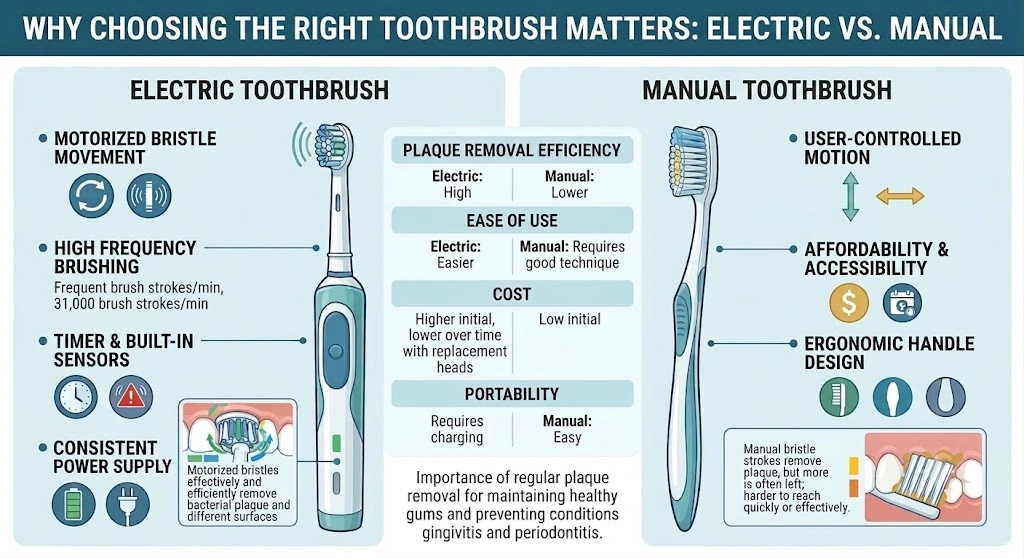
A manual toothbrush is the traditional toothbrush most people grew up using. It consists of a handle and a head with bristles that require hand movement to clean the teeth and gums.
Advantages of Manual Toothbrushes
- Affordable and widely available
- No batteries or charging required
- Lightweight and travel-friendly
- Available in many sizes and bristle types
- Gives users complete control over brushing pressure
Potential Limitations: It relies heavily on proper technique, which can make it easier to miss areas, and may be less effective for those with limited dexterity. Most people also brush for well under the recommended two minutes.
A manual toothbrush can provide excellent oral hygiene when paired with good brushing techniques such as the Modified Bass method, which we cover step by step in Best Tooth Brushing Technique: Bass vs Modified Bass vs Fones.
What Is an Electric Toothbrush?
An electric toothbrush uses battery-powered or rechargeable technology to move the brush head automatically. Most modern electric toothbrushes use either:
- Oscillating-Rotating Technology
The brush head rotates back and forth to disrupt plaque.
- Sonic Technology
The brush head vibrates at very high frequencies, creating rapid bristle movement and fluid action around the teeth and gums. You will also see powered brushes sold as power toothbrushes or automatic toothbrushes. They are the same category of product, and the research below applies to all of them.
Many electric toothbrushes also include built-in timers, pressure sensors, multiple brushing modes, smartphone connectivity, and replacement head reminders. Two of these do most of the work — the timer and the pressure sensor. The rest is convenience.
Electric vs Manual Toothbrush: What Does Research Say?
One of the most frequently studied questions in preventive dentistry is whether electric toothbrushes outperform manual brushes.
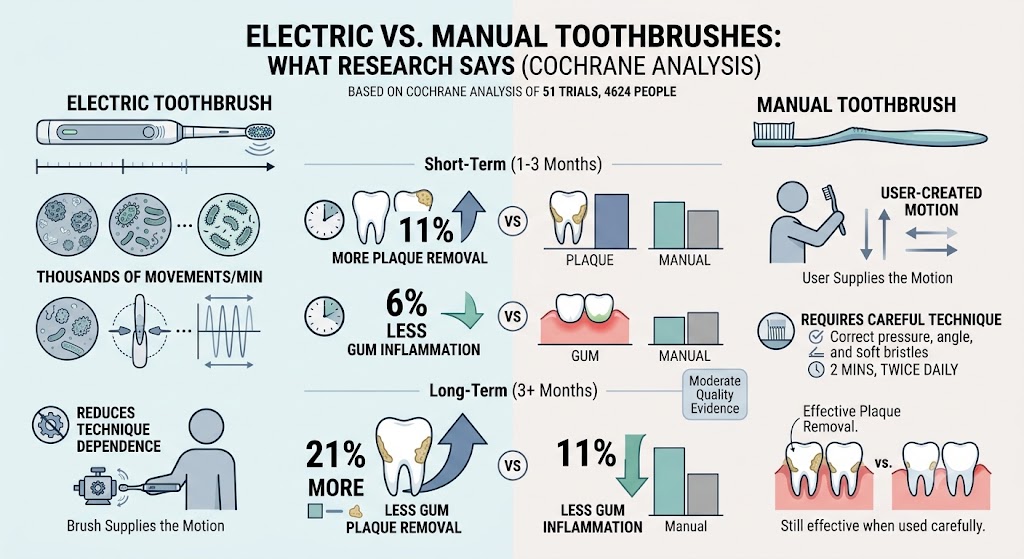
The largest review of the evidence, a Cochrane analysis of 51 trials involving 4,624 people, found powered brushes removed 11% more plaque at one to three months and 21% more after three months, with 6% and 11% less gum inflammation over the same periods.
The evidence was rated moderate quality.
Why?
Because electric toothbrushes perform thousands of brush movements per minute, they reduce the amount of technique required from the user. Instead of manually creating the brushing motion, users simply guide the brush slowly around the mouth. That is the practical case in the electric versus manual toothbrush comparison: the brush supplies the motion, so less depends on you.
Studies do not show that manual toothbrushes are ineffective. A person who brushes carefully with a soft-bristled manual toothbrush for two minutes twice daily can achieve excellent oral health outcomes.
What the Latest Studies Show?
Most trials run only a few weeks, which has always been the gap: less plaque today does not prove you keep your teeth tomorrow. A German study closed that gap by following 2,819 adults for eleven years (Pitchika et al., 2019).
Powered-brush users showed 22% less progression in gum pocket depth, about 18% less decay progression, and retained roughly 0.36 more teeth.
Newer reviews point the same way for specific groups: a 2024 review found the advantage held in adults over 55, and a 2025 meta-analysis found it in children. The pattern is consistent: the more difficulty you have brushing well by hand, the more a powered brush is worth.
Plaque Removal: Does an Electric Toothbrush Remove More Plaque?
When it comes to plaque removal, electric toothbrushes generally have the advantage. Plaque buildup on teeth starts within hours of brushing, so the question is not whether a brush can remove it but whether it does so reliably, twice a day, for years.
For individuals who struggle to clean along the gumline or consistently remove plaque, an electric toothbrush may provide noticeable benefits.
Gum Health: Is an Electric Toothbrush Better for Gum Disease?
Gum disease typically begins at the gumline, where plaque accumulates first. Because many electric toothbrushes maintain consistent movement and pressure, they can help improve gumline cleaning.
Some electric models also include pressure sensors that alert users when they are brushing too hard. This is important because aggressive brushing may contribute to gum irritation, gum recession, tooth sensitivity, and enamel wear, and recession does not grow back. Receding gums from brushing too hard are one of the few brushing injuries that cannot be undone.
People with gingivitis or early gum disease often benefit from improved plaque control, making electric toothbrushes an attractive option. See also Bleeding Gums: Causes and Treatment. The evidence for an electric toothbrush and gingivitis is strongest here: better gumline cleaning is what reverses early inflammation, and a powered brush makes that easier to achieve day after day.
Cost Comparison
Cost is one of the biggest differences between the two options.
| Feature | Manual Toothbrush | Electric Toothbrush |
|---|---|---|
| Initial Cost | Low | Higher |
| Maintenance | Minimal | Replacement heads required |
| Batteries/Charging | None | Required |
| Travel Convenience | Excellent | Moderate |
| Typical price (US) | $2–$6 per brush | $25–$250 per handle |
| Cost per year | $10–$25 | $25–$50 (replacement heads) |
| Approximate 5-year cost | $50–$125 | $150–$500 |
The replacement heads, not the handle, are where the long-term cost sits. And a $40 brush with a timer and pressure sensor delivers most of the benefit of a $250 one; the evidence is for powered brushing generally, not premium tiers.
For budget-conscious households, manual toothbrushes remain an excellent choice.
Winner: Manual Toothbrush
Are Electric Toothbrushes Worth the Extra Money?
For many people, yes. However, if you already maintain excellent oral hygiene with a manual toothbrush, the benefits may be relatively modest.
Amy Cooper, a registered dental hygienist at UAB Dentistry, sums it up: “The best toothbrush is the one you use consistently and accurately.” In my own practice, the patients whose gum scores improve most are rarely the ones who bought the most expensive brush — they are the ones who started aiming at the gumline.
Electric vs Manual Toothbrush for Children
Children often struggle with brushing long enough and reaching all tooth surfaces effectively. Electric toothbrushes can help because timers encourage adequate brushing time, the built-in movement improves cleaning, and many designs are simply more fun.
That said, younger children can still achieve good results with a soft manual toothbrush under parental supervision.
Best Choice: Electric toothbrushes often make brushing easier and more enjoyable for children.
Electric vs Manual Toothbrush for Braces
Braces create additional surfaces where plaque can accumulate. Electric toothbrushes may help remove plaque around brackets, wires, and other orthodontic appliances, which is why many orthodontists recommend them.
Whichever you use, a soft-bristle toothbrush for braces is kinder to the gum tissue packed around the brackets.
Best Choice: Electric toothbrush.
Common Mistakes Regardless of Toothbrush Type
No toothbrush can compensate for poor habits. The biggest are brushing for under two minutes, pressing too hard, missing the gumline, and keeping a worn brush past three months, each covered in Common Brushing Mistakes That Damage Your Teeth.
Remember: even the best electric toothbrush cannot replace proper oral hygiene habits. Nor can it clean between teeth – see How to Floss Correctly Step by Step. Brushing and flossing are two separate jobs, and only one of them is done by a brush.
How Often Should You Change Your Toothbrush?
Whichever type you use, the bristles are the part that actually cleans, and they wear out. The American Dental Association recommends replacing a toothbrush or an electric brush head every three to four months, or sooner if the bristles look frayed.
A worn brush is one of the few things that cancels out the electric vs manual toothbrush difference altogether. Splayed bristles clean badly whatever is driving them, so a three-month-old manual brush will out-clean a year-old electric one.
| What you are replacing | How often | Why |
|---|---|---|
| Manual toothbrush | Every 3–4 months | Bristles soften and splay, and stop lifting plaque off the tooth surface |
| Electric brush head | Every 3 months | Shorter bristles wear faster under powered motion |
| Any brush with flared or bent bristles | Straight away | Splayed bristles slide over the gumline instead of cleaning into it |
| After flu, a cold or a throat infection | Straight away | A sensible precaution while your immune system recovers |
| Children’s brushes | Every 3 months or sooner | Children press harder and chew the bristles, so they wear out faster |
If you are wondering how long a toothbrush should last in practice, look at the brush rather than the calendar. Bristles that have started to fan outwards have already lost most of their cleaning ability.
One Thing No Toothbrush Can Do
Brushing is half the story. In a randomised trial, people with gingivitis who ate more fibre, vitamin C, antioxidants and plant nitrates had significantly less gum bleeding after four weeks, even though their plaque barely changed.
“Study results clearly demonstrate the possibility to naturally reduce gingivitis by an optimized diet,” said lead researcher Dr. Johan Woelber. More in Best Vegetarian Foods for Healthy Teeth and Gums.
Which Toothbrush Should You Choose?
Choose a Manual Toothbrush If:
- You have excellent brushing technique.
- You are on a budget.
- You prefer simplicity.
- You travel frequently.
- You consistently brush for two minutes.
Choose an Electric Toothbrush If:
- You struggle with plaque control.
- You have gum disease or gingivitis.
- You wear braces.
- You have limited hand dexterity.
- You want built-in timers and pressure sensors.
- You prefer a more automated brushing experience.
Clinical Bottom Line: Electric vs Manual Toothbrush
So, are electric toothbrushes better than manual ones?
For most people, electric toothbrushes have a modest advantage in plaque removal and gum health because they make effective brushing easier and more consistent.
A manual toothbrush used twice a day correctly with proper technique can still provide outstanding oral health.
The best toothbrush is not necessarily the most expensive one. It is the one you use correctly, gently, and consistently every day.
Key Takeaways
- Electric toothbrushes generally remove slightly more plaque than manual toothbrushes.
- Both options can maintain excellent oral health when used properly.
- Electric brushes are especially helpful for children, older adults, people with braces, and those with limited dexterity.
- Manual toothbrushes remain affordable, effective, and widely recommended.
- Brush twice daily for at least two minutes using fluoride toothpaste.
- Clean between teeth daily with floss, interdental brushes, or a water flosser.
- Regular dental checkups remain essential regardless of the toothbrush you choose.
- Replace a manual toothbrush or an electric brush head every three to four months, or sooner if the bristles splay.
Frequently Asked Questions
Do dentists recommend electric toothbrushes?
Many dentists recommend electric toothbrushes because they can improve plaque removal and make proper brushing easier.
Can a manual toothbrush clean as well as an electric toothbrush?
Yes. A manual toothbrush can clean very effectively if you use proper technique, brush for two minutes, and clean along the gumline thoroughly.
Are electric toothbrushes better for sensitive gums?
They can be. Many electric toothbrushes include pressure sensors that help prevent aggressive brushing, reducing gum irritation and enamel wear.
Is a sonic toothbrush better than a rotating toothbrush?
Both types are effective. Current research has not established a clear winner for every person. Personal comfort and consistent use are more important.
Do I still need floss if I use an electric toothbrush?
Yes. Even the best toothbrush cannot effectively clean the tight spaces between teeth. Daily interdental cleaning remains essential.
Is an expensive electric toothbrush better than a cheap one?
Not by much. The evidence supports powered brushing as a category, not premium price tiers. A model with a two-minute timer and a pressure sensor captures most of the measured benefit.
Is an electric toothbrush better for gum disease?
It can help. Better plaque control right at the gumline is what settles early gum inflammation, and an electric toothbrush makes that easier for most people to do consistently. It is not a treatment on its own, though. Established gum disease needs a dentist or hygienist.
Can brushing too hard cause receding gums?
Yes. Sustained heavy pressure wears the gum margin back, and receding gums from brushing too hard do not grow back on their own. A pressure sensor helps, but easing off and angling the bristles into the gumline helps more.
Take Action Tonight
Before you buy anything, try this: set a timer for two minutes, angle the bristles toward the gumline, and brush gently. Most people are surprised how long two minutes really is, and that alone often does more than a new brush.
At HiGood Health, we share credible health information in easy language and bust the myths in between. Explore our Complete Oral Hygiene Guide for Every Age, and tell us which topic you’d like covered next.
Glossary
ADA Seal of Acceptance: An American Dental Association mark showing a product has passed independent review for safety and effectiveness.
Oscillating-rotating: An electric brush with a small round head that rotates back and forth.
Sonic toothbrush: An electric brush that cleans by very high-frequency vibration rather than rotation.
Disclaimer
This article is for general education only and is not a substitute for advice from a qualified dentist or physician who knows your history. If you have bleeding gums, persistent pain, or loose teeth, contact a licensed professional.
HiGood Health may earn a small commission from qualifying purchases through links on this site, at no extra cost to you.
References
1. Yaacob M, Worthington HV, Deacon SA, et al. Powered/electric toothbrushes compared with manual toothbrushes for maintaining oral health. Cochrane Database of Systematic Reviews. 2014. cochrane.org
2. Pitchika V, Pink C, Völzke H, et al. Long-term impact of powered toothbrush on oral health: 11-year cohort study. Journal of Clinical Periodontology. 2019. Full text
3. American Dental Association (ADA). Toothbrushes.ada.org
4. National Institute of Dental and Craniofacial Research (NIDCR). Gum Disease. nidcr.nih.gov
5. Saroya S, et al. Powered versus manual toothbrushes for plaque removal and gingival health amongst 55 and older individuals. Special Care in Dentistry. 2024. Wiley
6. Dağdeviren D, et al. Power versus manual toothbrushes on plaque removal and gingival health in children. International Journal of Dental Hygiene. 2025. Wiley
7. Cooper A, RDH. The truth about electric toothbrushes vs manual. UAB School of Dentistry. uab.edu
8. Woelber JP, et al. The influence of an anti-inflammatory diet on gingivitis: a randomized controlled trial. Journal of Clinical Periodontology. 2019. Summary
