About this series. Oral Hygiene is a thirteen-part series on looking after teeth and gums at every age, from brushing and flossing to children’s teeth, gum disease and toothache.
This is Part 12: Pacifier teeth.
Is Your Baby’s Pacifier Habit a Problem?
For many parents, a pacifier is a lifesaver. It can soothe a crying baby, help them settle to sleep, and provide comfort during unfamiliar situations. But as your baby grows, you may start wondering about pacifier teeth: Can pacifiers affect my baby’s teeth? Will my child develop crooked teeth or a problem with their bite?
At a Glance
Pacifier use during infancy is generally considered normal. However, prolonged use can influence the development of the teeth, jaws, and surrounding oral structures.
The main concern is not occasional pacifier use during infancy. It is the repeated pressure that prolonged sucking can place on the developing teeth and jaws.
The American Academy of Pediatric Dentistry (AAPD) recommends helping children discontinue non-nutritive sucking habits by around 36 months of age.
Choose a safe pacifier, avoid sweet coatings and unsafe attachments, follow safe-sleep guidance, and gradually reduce dependence during toddlerhood.
The answer depends largely on how often your child uses a pacifier, how strongly they suck, and how long the habit continues.
Pacifier use during infancy is generally considered normal. However, prolonged use can influence the development of the teeth, jaws, and surrounding oral structures. The American Academy of Pediatric Dentistry (AAPD) recommends helping children discontinue non-nutritive sucking habits by around 36 months of age, with attention to the potential effects of continued use after infancy.
The good news? Parents do not need to panic if their baby uses a pacifier. Understanding when to use one, how to keep it safe, and when to begin weaning can help protect your child’s developing smile.
What Is a Pacifier, and Why Do Babies Need One?
A pacifier, also called a dummy or soother, is designed to satisfy a baby’s natural urge to suck without providing milk or other nutrition.
Sucking is an important infant reflex. Beyond feeding, non-nutritive sucking can help babies feel calm and secure, particularly when they are tired, overstimulated, or settling down for sleep.
Pacifiers may also provide comfort during minor medical procedures. Offering a pacifier at naps and bedtime is recommended by the American Academy of Pediatrics (AAP) as one measure associated with a reduced risk of sudden infant death syndrome (SIDS).
For breastfed babies, parents are generally advised to wait until breastfeeding is well established before introducing a pacifier. This means feeding is going well, the baby latches effectively, milk transfer is adequate, and weight gain is appropriate. For babies who are not directly breastfed, a pacifier may be introduced earlier if desired.
A pacifier should never replace a feed or be used to postpone feeding when a baby is hungry.
How Do Pacifiers Affect Teeth?
The main concern is not occasional pacifier use during infancy. It is the repeated pressure that prolonged sucking can place on the developing teeth and jaws.
A baby’s mouth is growing rapidly. Frequent sucking can influence how the upper and lower teeth meet and how the dental arches develop.
1. Anterior open bite (pacifier open bite)
An anterior open bite occurs when the upper and lower front teeth do not meet when the back teeth are together.
With prolonged pacifier use, the continued presence of the pacifier between the front teeth can interfere with their normal eruption and alignment. This may create a visible gap between the upper and lower front teeth.
2. Posterior crossbite
A posterior crossbite occurs when some upper back teeth bite inside the corresponding lower teeth instead of outside them.
Persistent sucking habits may affect the shape and width of the developing dental arches, contributing to this type of bite problem in some children.
3. Increased overjet (“buck teeth”)
Overjet describes the horizontal distance between the upper and lower front teeth. Prolonged pacifier use may contribute to the upper front teeth becoming more prominent relative to the lower front teeth.
The likelihood and severity of these changes vary. Not every child who uses a pacifier develops a dental problem, and the intensity, frequency, and duration of the habit all matter.
4. Does pacifier use cause cavities?
A clean pacifier does not directly cause tooth decay. However, dipping it in honey, sugar, syrup, or other sweet substances exposes the teeth to sugars that can promote cavities.
Once teeth erupt, regular brushing with fluoride toothpaste and avoiding frequent sugary exposures are essential, whether or not your child uses a pacifier.
At What Age Should a Child Stop Using a Pacifier?
There is no single day when every child must stop, but age is an important consideration.
- Birth to 6 months: Pacifiers can provide comfort and may be offered at sleep times, following safe-use recommendations.
- 6–12 months: Begin considering when and how to reduce unnecessary daytime use, while recognising that pacifiers may still have benefits.
- 12–18 months: Gradually reducing dependence is sensible. Continued use after 12 months is associated with an increased risk of acute middle-ear infections.
- 18–36 months: Work toward discontinuing the habit, as prolonged sucking during this period can affect the developing bite.
- By 3 years: Aim to have the habit stopped, in line with AAPD guidance.
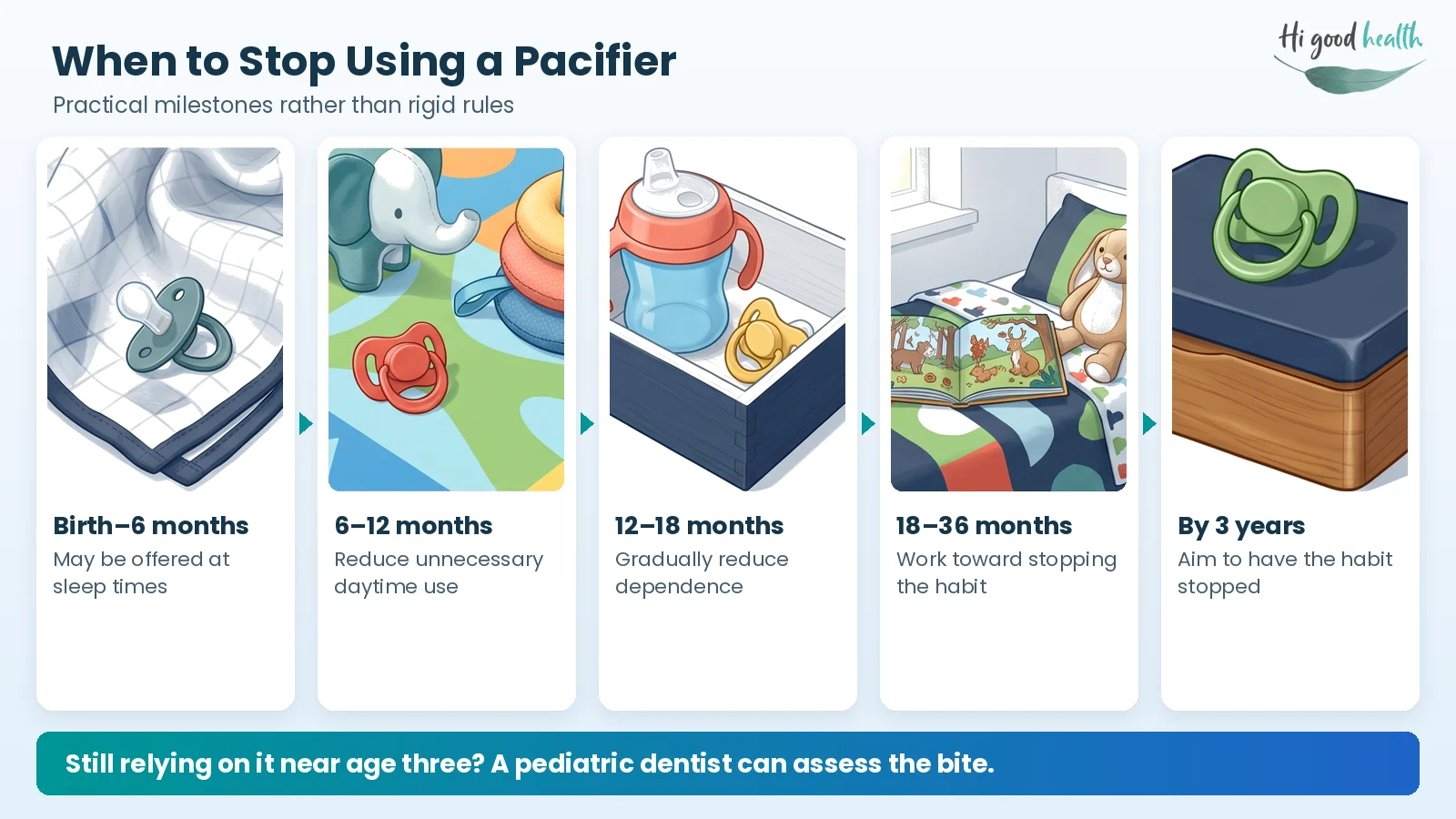
These are practical milestones rather than rigid rules. If your child is approaching three years of age and still relies heavily on a pacifier, a paediatric dentist can assess the bite and help you develop a realistic weaning plan.
Some dental changes may improve after the habit stops, particularly when the child is young. However, improvement is not guaranteed, so an established bite problem should be evaluated rather than left to resolve on its own.
Are Orthodontic Pacifiers Better for Teeth?
Orthodontic pacifiers are marketed with nipple shapes intended to accommodate the tongue and palate differently from conventional pacifiers.
However, the word “orthodontic” does not mean that a pacifier prevents all dental problems. Evidence is insufficient to conclude that a particular pacifier design eliminates the risk of changes to the bite.
If you choose to use a pacifier, select one that is age-appropriate, intact, and manufactured to applicable safety standards. Do not rely on its shape or marketing claims as a substitute for limiting prolonged use.
Pacifiers and Mouth Breathing in Babies: Is There a Connection?
Parents sometimes notice that their baby sleeps with an open mouth, breathes noisily, or appears to prefer breathing through the mouth.
Mouth breathing is not a dental diagnosis, and it should not automatically be blamed on pacifier use.
In infants, persistent mouth breathing may be associated with nasal congestion, enlarged adenoids or other causes of nasal obstruction. Some children also develop oral habits or altered tongue and lip posture that may coexist with breathing difficulties.
Prolonged pacifier use can influence the developing dental arches and bite, but it is not established as a direct cause of every case of mouth breathing.
When should parents seek help?
Arrange a paediatric assessment if your baby regularly breathes through the mouth at rest, has persistent nasal blockage, snores frequently, or seems to struggle to breathe during sleep. A paediatric dentist may also assess the teeth, bite, and oral habits when appropriate.
Seek urgent medical care if your baby has difficulty breathing, blue or grey lips, marked chest retractions, or other signs of respiratory distress.
It is important to assess the cause of mouth breathing instead of simply removing the pacifier and assuming the problem will disappear.
How to Use a Pacifier Safely
A few straightforward precautions can reduce avoidable risks.
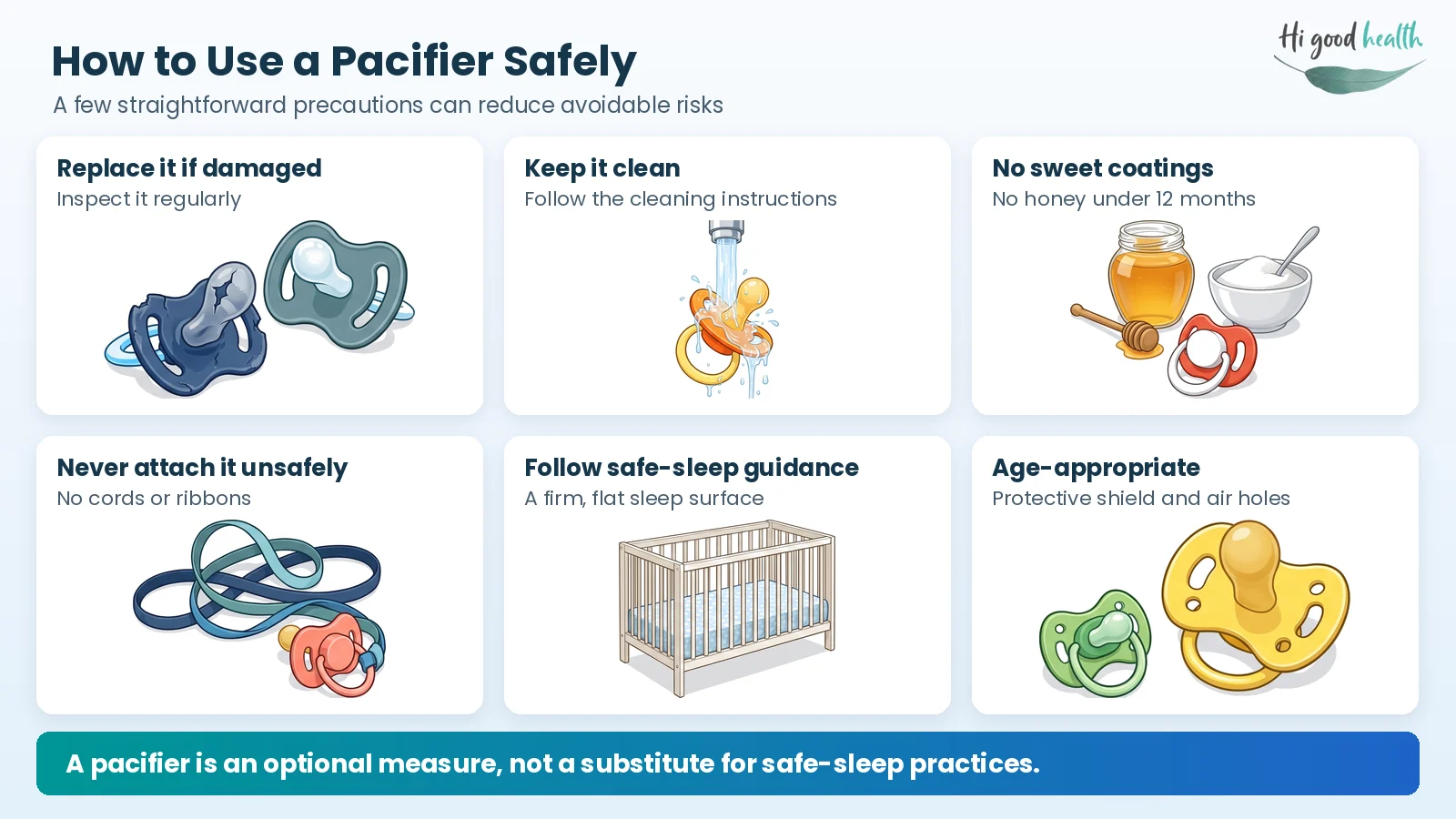
Choose and maintain the pacifier carefully. Use an age-appropriate product with a one-piece or otherwise safety-compliant design, an adequate protective shield, and ventilation holes. Inspect it regularly and replace it if cracked, torn, sticky, or damaged.
Keep it clean. Follow the manufacturer’s cleaning instructions, particularly for young infants. Never clean a pacifier by putting it in your own mouth, as this can transfer germs.
Never coat it with sweet substances. Honey must not be given to children younger than 12 months because of the risk of infant botulism. Sugar, syrup and other sweet coatings should also be avoided.
Never attach it unsafely. Do not tie a pacifier around a baby’s neck, wrist or hand, or attach it to clothing or bedding during sleep. Avoid cords, ribbons, stuffed toys and other attachments that could create strangulation or suffocation hazards.
Follow safe-sleep guidance. Always place babies on their backs on a firm, flat sleep surface without loose bedding or soft objects. A pacifier is an optional measure, not a substitute for other safe-sleep practices. If it falls out after the baby falls asleep, there is no need to put it back.
How to Help Your Child Stop Using a Pacifier
For many children, a pacifier is a source of emotional comfort. Removing it suddenly may lead to frustration or difficulty settling, so a calm and consistent approach can help.
- Reduce daytime use first. Keep the pacifier for sleep or particularly difficult moments rather than offering it automatically.
- Introduce other soothing routines. Try cuddling, gentle rocking, singing, reading, or a familiar bedtime routine.
- Use positive encouragement. Praise your child when they settle without a pacifier. Avoid shaming or punishment.
- Be consistent. Agree on a plan with other caregivers so the rules remain predictable.
- Ask for professional support if needed. A paediatric dentist can help if the habit persists or there are concerns about the developing bite.
Do not cut, puncture, or deliberately damage a pacifier to discourage use, as the damaged product may become unsafe.
When Should You See a Paediatric Dentist?
The AAPD recommends establishing a dental home by the first birthday. Early visits provide an opportunity to discuss pacifier habits before dental changes become established.
Book a dental assessment if you notice:
- A gap between the upper and lower front teeth when the back teeth meet.
- Upper front teeth that appear increasingly prominent.
- Upper and lower back teeth that do not meet normally.
- A pacifier habit that continues beyond three years of age.
- Concerns about the child’s bite, jaw development, or oral habits.
A paediatrician should evaluate persistent mouth breathing, habitual snoring, or suspected nasal obstruction. Dental and medical assessments may both be useful when symptoms overlap.
The oral hygiene series
Thirteen articles on looking after your teeth and gums, at every age.
- Complete oral hygiene guide for every age. The whole routine, age by age.
- Brushing technique: Bass, Modified Bass and Fones. Which method suits which mouth, and how long two minutes really is.
- Electric or manual toothbrush. What the evidence shows, and whether the price gap is worth it here.
- Cleaning between your teeth. Floss, interdental brushes, and why the toothpick is not an option.
- Water flosser for tonsil stones. What pressure is safe, and the cheaper alternative most people should try first.
- Interdental brushes and bleeding gums. Choosing the right size, and why the bleeding usually stops within two weeks.
- Bottle rot and early childhood caries. Causes, white spots, prevention and treatment.
- Milk teeth falling out. Age, order and timeline, and what Indian parents should know.
- Pyorrhea (gum disease). Causes, symptoms, treatment and prevention.
- Gum swelling, bleeding and dry mouth. How underlying diseases affect your gums and oral health.
- Medicine for toothache. What to take, causes and treatment.
- Pacifier teeth. How pacifiers affect growing teeth and the bite, and when to stop. (you are here)
- 6 year molars. The first permanent molars, when they come in and how to protect them.
Key Takeaways
Pacifiers can be useful tools for comforting babies, and their use during infancy is not automatically harmful to dental development. The concern arises when frequent sucking continues as the child grows.
Choose a safe pacifier, avoid sweet coatings and unsafe attachments, follow safe-sleep guidance, and gradually reduce dependence during toddlerhood. Aim to stop the habit by around age three, and seek professional advice if you notice changes in the teeth or persistent mouth breathing.
A pacifier can offer comfort today, but helping your child outgrow the habit at the right time can protect their developing smile for tomorrow.
Frequently Asked Questions
Do pacifiers cause buck teeth?
Prolonged pacifier use may contribute to the upper front teeth becoming more prominent relative to the lower front teeth. The likelihood and severity of these changes vary, and the intensity, frequency, and duration of the habit all matter.
What is a pacifier open bite?
An anterior open bite occurs when the upper and lower front teeth do not meet when the back teeth are together. With prolonged pacifier use, the pacifier between the front teeth can interfere with their normal eruption and alignment.
Can pacifiers cause ear infections?
Pacifier use, particularly when continued beyond infancy, is associated with a higher risk of acute otitis media, or middle-ear infection. The association does not mean every child who uses a pacifier will develop an ear infection.
Does pacifier use cause mouth breathing?
There is no strong evidence that pacifier use alone explains persistent mouth breathing. Nasal obstruction, enlarged adenoids, and other conditions should be considered when mouth breathing is frequent.
Can prolonged pacifier use affect speech?
Evidence about the direct effect of pacifiers on speech development is mixed. If your child has persistent speech difficulties, seek advice from a paediatrician or speech-language professional rather than assuming the pacifier is the only cause.
What if my three-year-old refuses to give up the pacifier?
Use gradual reduction, positive encouragement, and alternative soothing routines. Arrange a paediatric dental visit to assess the bite and discuss an appropriate plan.
Should I force my baby to stop using a pacifier?
No. For infants, pacifier use can provide comfort and sleep-related benefits. During toddlerhood, use a consistent, age-appropriate weaning approach rather than punishment or distress.
Should I see a dentist if my child’s front teeth have a gap?
Yes. A gap may be an anterior open bite, although only an examination can establish the cause. Early assessment helps determine whether monitoring or treatment is appropriate.
Glossary
Non-nutritive sucking: sucking that satisfies a baby’s natural urge to suck without providing milk or other nutrition.
Anterior open bite: the upper and lower front teeth do not meet when the back teeth are together.
Posterior crossbite: some upper back teeth bite inside the corresponding lower teeth instead of outside them.
Overjet: the horizontal distance between the upper and lower front teeth.
Acute otitis media: a middle-ear infection.
Dental home: a regular paediatric dental practice where a child is seen from early childhood.
References
- American Academy of Pediatric Dentistry. Policy on Pacifiers. The Reference Manual of Pediatric Dentistry 2026–2027. Revised 2024. Available at: AAPD – Policy on Pacifiers.
- American Academy of Pediatrics. Baby Pacifiers & Thumb Sucking: What Parents Need to Know. HealthyChildren.org. Updated January 20, 2026. Available at: AAP – Pacifiers and Thumb Sucking.
- Moon RY, Carlin RF, Hand I; Task Force on Sudden Infant Death Syndrome and the Committee on Fetus and Newborn. Sleep-Related Infant Deaths: Updated 2022 Recommendations for Reducing Infant Deaths in the Sleep Environment. Pediatrics. 2022;150(1):e2022057990. Available at: Read the AAP clinical recommendations.
- Meek JY, Noble L; Section on Breastfeeding. Policy Statement: Breastfeeding and the Use of Human Milk. Pediatrics. 2022;150(1):e2022057988. Available at: AAP – Breastfeeding and the Use of Human Milk.
- American Academy of Pediatric Dentistry. Policy on Early Childhood Caries (ECC): Consequences and Preventive Strategies. The Reference Manual of Pediatric Dentistry 2026–2027. Revised 2025. AAPD – Oral Health Policies and Recommendations. Available at: AAPD – Policy on Early Childhood Caries.
- National Health Service. Looking After Your Baby’s Teeth. Last reviewed April 1, 2025. Available at: NHS – Baby Dental Care.
- American Academy of Pediatric Dentistry. Policy on the Dental Home. The Reference Manual of Pediatric Dentistry 2026–2027. Revised 2023. Available at: AAPD – Policy on the Dental Home.
All reference links checked on October 19, 2026.
Disclaimer
This content is for educational purposes only and is not a substitute for professional medical or dental advice. Speak to a dentist or paediatrician about your own child.