Almost nobody in India flosses. That is not a scolding, it is the starting point, and it changes what this article should be.
Brushing twice a day is now normal here. Cleaning between the teeth is not, and gum disease is very common in Indian adults, which is exactly what you would expect when the surfaces where it starts never get cleaned.
So the useful question is not only how to floss perfectly. It is: what is the realistic thing you will actually do between your teeth, every day, for the next twenty years?
For some people that is floss. For a lot of Indian adults, whose gaps are already wider because of gum disease, it is an interdental brush, which is easier, cheaper per use, and may work better.
At a glance
How to floss, in one paragraph: curve the floss into a C shape against the side of each tooth, slide it gently just under the gumline, then move to a fresh section before the next gap. Once a day, two to three minutes for the whole mouth.
Technique does the work, not the brand. A sawing motion up and down cleans almost nothing. The C shape and getting just under the gum is the entire skill.
If your gaps are wide enough to take an interdental brush, use one instead. They are easier to handle, widely sold in India, and the evidence suggests they may reduce gum inflammation more than floss does.
Never use a wooden or plastic toothpick as your daily method. It is the common Indian habit and it damages the gum between the teeth over time.
Why it matters, and why it matters more here
Your mouth holds hundreds of species of bacteria. They combine with food and saliva into plaque, a sticky film that forms on the visible surfaces of teeth, between them, and under the gumline.
Left there, plaque causes decay, gingivitis, periodontitis, persistent bad breath, gum recession and eventually tooth loss.
A toothbrush cleans the front, back and biting surfaces. The surfaces between teeth are roughly a third of each tooth and a brush never touches them. Once plaque hardens into tartar, only a dentist can remove it.
Two Indian reasons this matters more than the international version suggests. Gum disease is widespread here and it arrives quietly, without pain, so it is usually noticed only when teeth start to move. And treatment is paid out of pocket, so a problem prevented is money and a journey saved.
The habit this needs to replace: the toothpick
Walk out of any Indian restaurant and there is a bowl of toothpicks by the door.
A toothpick can shift a piece of food, and for that one job it is fine. As a daily cleaning method it is actively harmful.
It is too thick and too rigid to follow the tooth surface. Instead of scraping plaque off the side of the tooth, it pushes into the small triangle of gum between two teeth and flattens it.
That tissue does not grow back. Once it goes, the gap it leaves traps more food, and the cycle worsens.
If you reach for a toothpick after meals, that is the habit to replace, and an interdental brush is the direct replacement. Same convenience, same pocket, does the actual job.
“Didn’t they say flossing does not work?”
This deserves an honest answer rather than a defensive one.
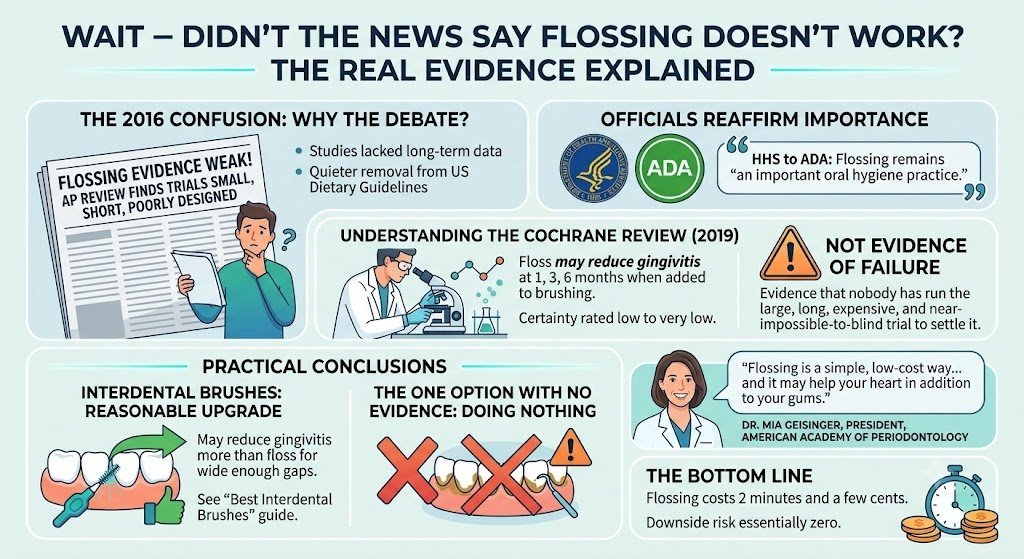
In 2016, a review of the trials behind flossing found them mostly small, short and poorly designed, and flossing was quietly dropped from the US dietary guidelines. A 2019 Cochrane review found floss may reduce gingivitis when added to brushing, but rated the certainty low to very low.
That is not evidence that flossing fails. It is evidence that nobody has run the large, long trial that would settle it, because such a trial is expensive and almost impossible to run blind.
Two things follow, and both are practical.
First, the same review found interdental brushes may reduce gum inflammation more than floss. For anyone whose gaps take one, that is the better tool.
Second, doing nothing between your teeth is the one option with no evidence behind it at all.
Which tool, honestly, for an Indian mouth
| Your situation | Best tool | Why |
|---|---|---|
| Tight contacts, healthy gums | Floss | Nothing else fits the gap |
| Visible gaps, or gum disease | Interdental brush | Easier, cleans more surface, may work better |
| Braces or a permanent retainer | Floss threader, or interdental brush | Floss cannot be pushed under a wire |
| Bridge or implant | Floss threader or interdental brush | Debris collects underneath where a brush never reaches |
| Arthritis or limited hand movement | Interdental brush, or water flosser | Floss needs two hands and fine control |
| Children, once two teeth touch | Floss, with an adult doing it | Small mouths, tight contacts |
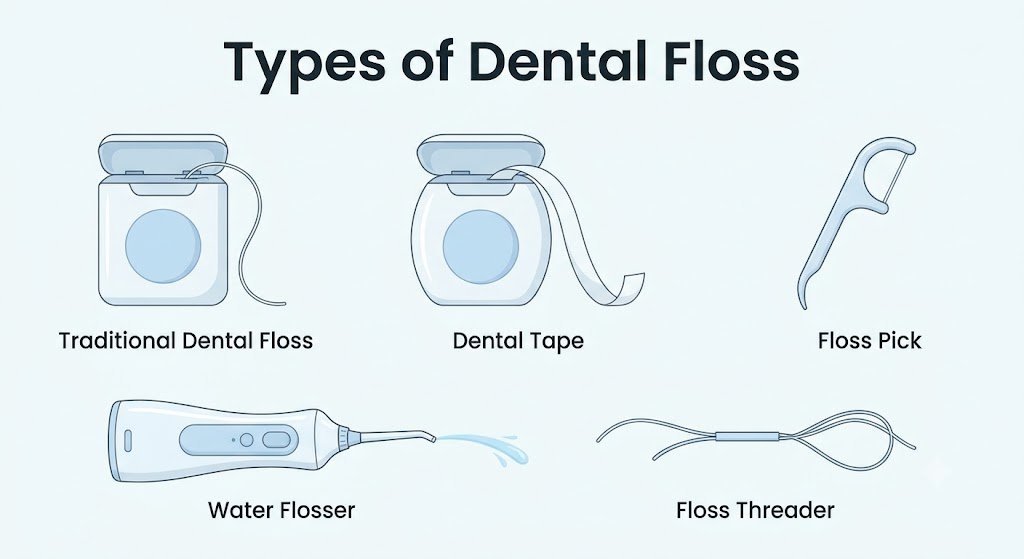
Availability in India: floss and interdental brushes are both sold at chemists and online. Interdental brushes come in several sizes and your dentist can tell you which size fits your gaps, which is worth asking at your next visit. Water flossers are a much bigger purchase and are not necessary for most people.
How to floss correctly, step by step
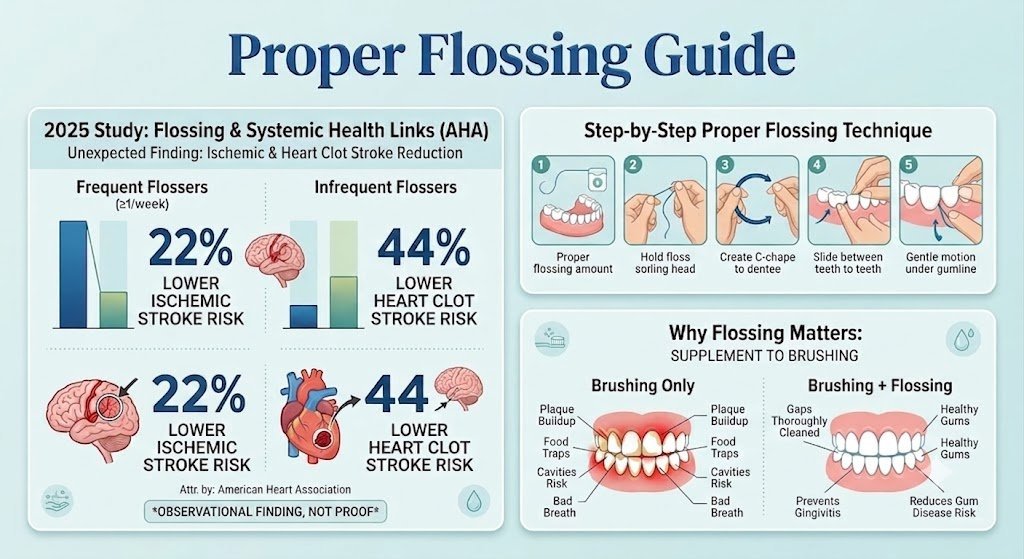
Ten steps sounds like a lot. In practice it is three things: enough floss to keep using a clean section, the C shape against each tooth, and getting just under the gumline. The rest is sequence.
1. Take enough. About 45 to 60 cm, roughly the distance from your fingertips to your elbow. That gives you a fresh section for every gap.
2. Wind it on. Most of it around the middle finger of one hand, the rest around the middle finger of the other. One finger feeds clean floss, the other collects used floss.
3. Hold it short. Grip between thumbs and index fingers with only three to five centimetres between your hands. Short is controllable.
4. Ease it in. Slide it between two teeth with a gentle back-and-forth motion. Never snap it down. Snapping cuts the gum.
5. Make the C. At the gumline, curve the floss around one tooth so it hugs the side of it. This is the step almost everyone skips and it is the one that does the cleaning. Sawing straight up and down removes almost nothing.
6. Go just under the gum. Slide it slightly beneath the gumline and move it up and down a few times against the tooth. This is where plaque hides from a brush.
7. Do the other side too. Before pulling the floss out, curve it around the neighbouring tooth and repeat. One gap, two tooth surfaces.
8. Move to a clean section. Otherwise you carry plaque from one gap to the next.
9. Do every gap, including behind the last molars. The back of the last tooth is where decay starts most often and where everyone gives up first.
10. Rinse. Water is fine. If you brush afterwards, spit the toothpaste out and do not rinse again — leaving the fluoride on the teeth is the point.
Before or after brushing?
Either works, and there is now evidence favouring one. A 2018 trial tested both orders in the same people and found that flossing before brushing removed more plaque between the teeth and left more fluoride there afterwards.
Flossing first loosens the debris; the brush sweeps it away.
The bigger factor is consistency. Do them on the same trip to the basin. Pairing the two is what makes the habit survive a busy week.
How often?
Once a day. More often does not clean better, and being rough about it irritates the gum margin.
Night is easiest for most people, because nothing else is competing for the two minutes.
Once, done properly, beats three rushed attempts.
The mistakes that cost you the benefit
Snapping the floss into the gum, which injures it.
Reusing the same section, which just moves plaque around.
Skipping the back teeth, which is where decay usually starts.
Rushing, which means you never form the C.
Flossing only when something is stuck, which is the most common Indian pattern and turns a preventive habit into an occasional rescue.
My gums bleed when I floss. Should I stop?
No. Bleeding usually means you needed to start.
Gums that bleed on flossing are inflamed from plaque sitting along the margin. With daily cleaning, the bleeding normally settles within one to two weeks. Tenderness in the first week is part of the same picture.
The people who give up almost always stop in week one, just before it would have settled.
But see a dentist if: bleeding continues beyond two weeks, it is heavy, there is pain, a tooth feels loose, or the bleeding comes from one spot only.
And any ulcer, white or red patch, or lump in the mouth that has not healed in two weeks needs to be seen promptly. In India that matters more than anywhere, because of the tobacco burden.
The thing no floss can fix
Two of them, in fact.
Tobacco. Gutkha, khaini, zarda, paan masala and betel quid damage gums and the lining of the mouth in ways no cleaning routine offsets, and they are the main reason oral cancer is so common in Indian men. If you use any of them, stopping is worth more than everything else in this article.
Diet. Gum tissue is largely collagen and collagen needs vitamin C. In a trial, people with gingivitis who ate more fibre, vitamin C and antioxidants bled significantly less after four weeks even though their plaque barely changed. More vegetables, fruit and whole grains; less refined flour, sugar and fried food.
The bottom line
Cleaning between your teeth is the single biggest gap in Indian brushing habits, and it is where gum disease starts.
Do something between your teeth every day. Floss if the gaps are tight, an interdental brush if they are not, a threader if there is a bridge or a wire in the way. Not a toothpick.
And the routine you keep beats the perfect one you abandon by Thursday.
Key takeaways
Clean between your teeth once a day. A toothbrush never touches those surfaces, and they are about a third of each tooth.
How to floss, reduced to one line: the C shape against the side of the tooth, and getting just under the gumline. That is the whole technique. Sawing up and down cleans almost nothing.
If your gaps are wide enough, an interdental brush is easier than floss, is sold everywhere in India, and may reduce gum inflammation more. Ask your dentist which size fits.
Stop using a toothpick as a daily method. It flattens the gum between the teeth and that tissue does not come back.
Bleeding when you start usually means you needed to start, and it settles in one to two weeks. Bleeding that continues, or any mouth ulcer or patch that has not healed in two weeks, needs a dentist.
Frequently asked questions
1. Nobody in my family flosses. Do I really need to learn how to floss?
Something between the teeth is necessary; floss is only one way to do it. A brush cannot reach about a third of each tooth surface, and that is where gum disease and hidden decay usually begin. If floss is not for you, use an interdental brush.
2. Is an interdental brush better than floss?
For people whose gaps are wide enough to take one, quite possibly. The 2019 Cochrane review found they may reduce gum inflammation more than floss. For tight contacts, floss is the tool that fits. Many Indian adults with some gum disease have gaps that suit a brush.
3. Can I just use a toothpick after meals?
For dislodging one piece of food, yes. As a daily method, no. A toothpick is too thick and rigid to clean the side of the tooth, and it pushes into and flattens the gum between the teeth, which does not grow back.
4. Where do I buy floss or interdental brushes in India?
Both are sold at chemists and online, and interdental brushes come in several sizes. Ask your dentist which size suits your gaps at your next visit, because a brush that is too big damages the gum and one that is too small does nothing.
5. My gums bleed. Should I stop flossing?
Usually the opposite. Bleeding means the gums are already inflamed, and it normally settles within one to two weeks of daily cleaning. See a dentist if it continues past two weeks, is heavy, is painful, or comes from one spot only.
6. Should I floss before or after brushing?
Before, on the evidence available: a 2018 trial found flossing first removed more plaque between the teeth and left more fluoride there. But doing it at all matters far more than the order.
7. Is a water flosser worth buying?
For most people, no, at least not first. It helps around braces, bridges and implants and for anyone with limited hand movement. For a healthy mouth with tight contacts it does not replace floss, and the money is usually better spent on a dental check-up.
8. When should children start?
As soon as two teeth touch, with an adult doing it until around age ten. Small mouths have tight contacts, and a child taught early never develops the sawing habit that adults have to unlearn.
Glossary
- Interdental: the surfaces between two adjoining teeth, roughly a third of each tooth, and unreachable by a toothbrush.
- Interdental brush: a small tapered brush on a handle, made in several sizes, used to clean between teeth where the gap allows.
- Floss threader: a stiff loop that carries floss under a bridge, an implant or an orthodontic wire.
- Gingivitis: early gum inflammation, reversible with cleaning.
- Periodontitis: advanced gum disease affecting the bone that holds the teeth. Not reversible, but it can be halted.
References
- Worthington HV, MacDonald L, Poklepovic Pericic T, et al. Home use of interdental cleaning devices, in addition to toothbrushing, for preventing and controlling periodontal diseases and dental caries. Cochrane Database of Systematic Reviews. 2019.
- American Academy of Periodontology. New study suggests the ideal sequence for removing plaque. Journal of Periodontology. 2018.
- Sen S, et al. Regular dental flossing and risk of ischemic stroke and cardioembolic stroke: ARIC cohort, 25-year follow-up. American Stroke Association International Stroke Conference, 2025.
- National Institute of Dental and Craniofacial Research. Gum (Periodontal) Disease.
- Gupta PC, Ray CS. Smokeless tobacco and health in India and South Asia. Respirology.
- Indian Council of Medical Research. National Cancer Registry Programme report.
- Woelber JP, et al. The influence of an anti-inflammatory diet on gingivitis: a randomised controlled trial. Journal of Clinical Periodontology. 2019.
Disclaimer
This article is for general information only and is not a substitute for advice from a qualified dentist who knows your history. See a dentist if gum bleeding lasts beyond two weeks, if you have pain or loose teeth, or if any ulcer, patch or lump in the mouth has not healed within two weeks.