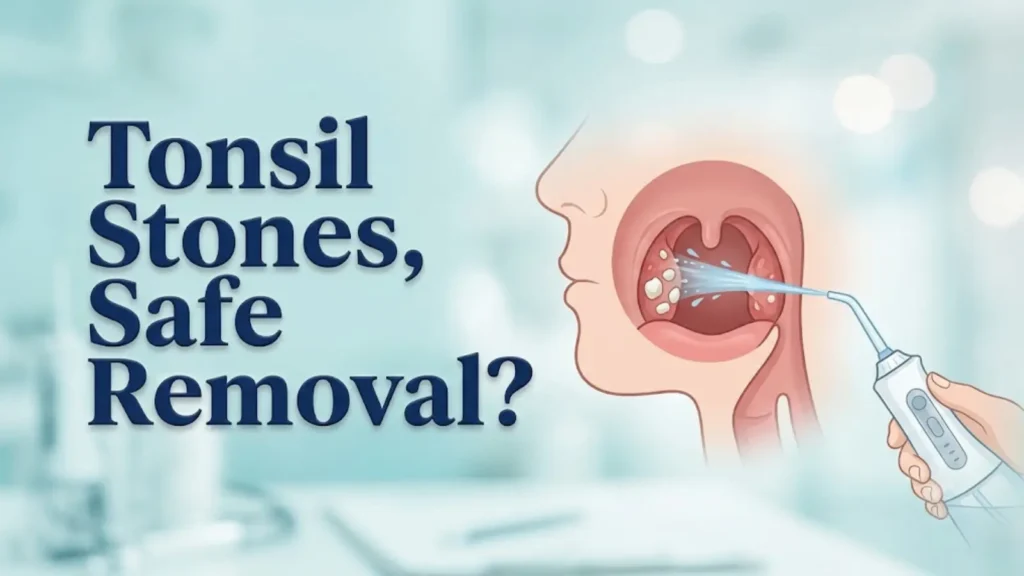
Most people in India meet a tonsil stone the same way: something small and pale falls out while brushing or gargling, it smells far worse than anything that size should, and the internet says the word tonsillolith.
Tonsil stones, or throat stones, are small hard deposits that form in the folds of the tonsils. They are usually harmless. They can also cause bad breath that does not respond to brushing, throat discomfort, difficulty swallowing, and the feeling that something is stuck at the back of the throat.
Searching for a water flosser for tonsil stones has become one of the common ways people look for an answer at home. In India there is an extra wrinkle: a powered water flosser is a fairly expensive purchase for a problem this small, and the cheaper tool sitting in most chemists’ shops does much the same job more gently.
This article covers what tonsils are, why stones form, what a water flosser can and cannot do, the cheaper alternatives, and the point at which you should stop trying at home and see an ENT.
At a glance
A water flosser can wash out small, loosely attached tonsil stones, and it is far safer than poking at your tonsils with a pin or a toothpick. It is not a cure, and it will not shift a stone that is wedged deep in a crypt.
Pressure is the whole risk. Use the lowest setting the device has. Tonsil tissue is delicate lymphoid tissue, not gum, and a strong jet can cause pain, bleeding and swelling.
Before you buy a device, try the two-rupee version. A low-pressure oral irrigation syringe, sold at any chemist, gives you more control than a powered unit and costs a fraction of the price. Warm salt-water gargling, which most Indian households reach for anyway, is the safest first step of all.
And the answer most people do not expect: if your tonsil stones are not troubling you, you do not need to remove them at all.
What are tonsils?
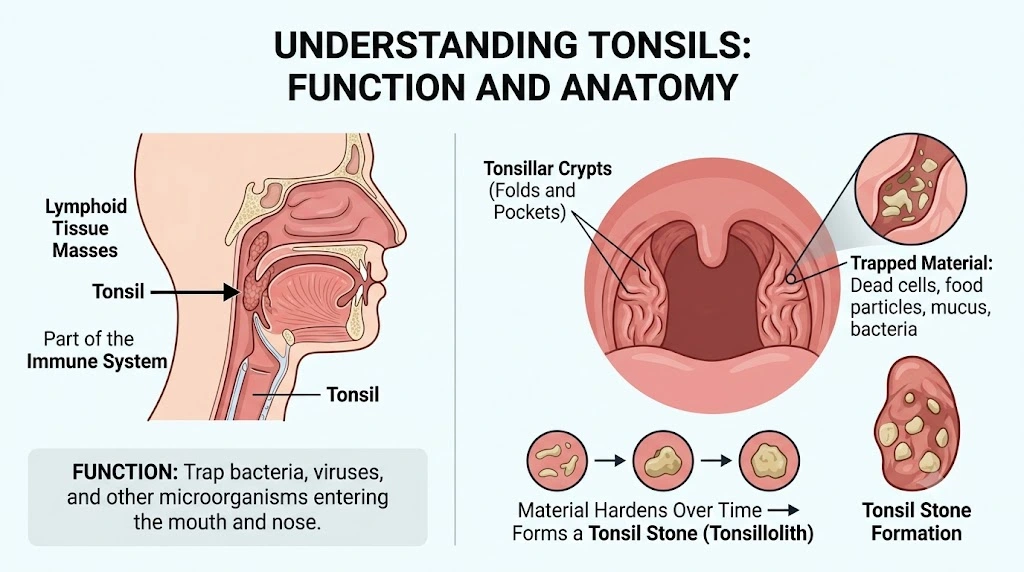
The tonsils are two masses of lymphoid tissue at the back of the throat, one on each side. They are part of the immune system and help trap bacteria and viruses entering through the mouth and nose.
The surface of each tonsil is folded into small pockets called tonsillar crypts. The folds increase the surface area, which helps the tonsil do its job. They also trap dead cells, food particles, mucus and bacteria. When that trapped material sits long enough and hardens, it becomes a tonsil stone.
What are tonsil stones?
Tonsil stones are calcified deposits inside the tonsillar crypts. Tonsillolith is the medical name; people also say throat stones or tonsil rocks.
They range from tiny white or yellow specks to lumps visible at the back of the throat. A stone the size of a small pea is uncommon but not rare, and the larger ones need a doctor rather than a home method.
They are far more common than people think. Plenty of people carry them without ever knowing, and stones often fall out on their own while eating, coughing or gargling.
Common symptoms
Many stones cause nothing at all. When they do, the usual complaints are bad breath that will not go away, sore throat, ear pain, difficulty swallowing, a metallic or foul taste, chronic throat irritation, the sensation of something lodged in the throat, and visible white or yellow specks on the tonsil.
Bad breath is the most common reason people find them. The bacteria inside the stone produce sulphur compounds, which is why a dislodged stone smells so much stronger than its size suggests.
The Indian complication: it is often mistaken for something else
Two things get confused with tonsil stones here often enough to be worth naming.
Recurring tonsillitis. A lot of Indian adults were told as children that they had a “tonsils problem”, and any throat symptom afterwards gets filed under the same heading. Stones and infection are different things and need different handling.
Anything white on the tonsil. A white patch is not automatically a stone. Fungal infection, the aftermath of a throat infection, and more serious causes can all look white to an untrained eye in a bathroom mirror.
If a white patch does not come away and has not changed in a couple of weeks, it needs a doctor’s look, not a water jet.
Who gets tonsil stones? Common risk factors
Tonsil stones are not a punishment for bad hygiene. Some people are simply built for them, because of the shape of their tonsils. Recognised risk factors include deep or enlarged tonsillar crypts, a history of repeated tonsillitis, chronic dry mouth or dehydration, post-nasal drip from ongoing sinus or allergy trouble, being a teenager or young adult, and tobacco use.
Two of those deserve more weight in India than the international version of this article gives them.
Tobacco. Gutka, khaini, zarda, paan masala and cigarettes all dry the mouth, change the bacteria living in it, and irritate the tissue at the back of the throat.
Smokeless tobacco is used very widely here, including by people who would never call themselves smokers. If you use any of it, that is the first thing to deal with, well ahead of buying a device.
Post-nasal drip. Allergic rhinitis and sinus trouble are extremely common in Indian cities, and the constant drip of mucus down the back of the throat feeds the crypts. Treating the nose often does more for recurring stones than anything done to the tonsil.
If several of these apply to you, the stones will come back after removal. That is worth knowing before you spend money on a device: prevention and, if needed, a proper ENT opinion matter more than repeated home removal.
Can a water flosser remove tonsil stones?
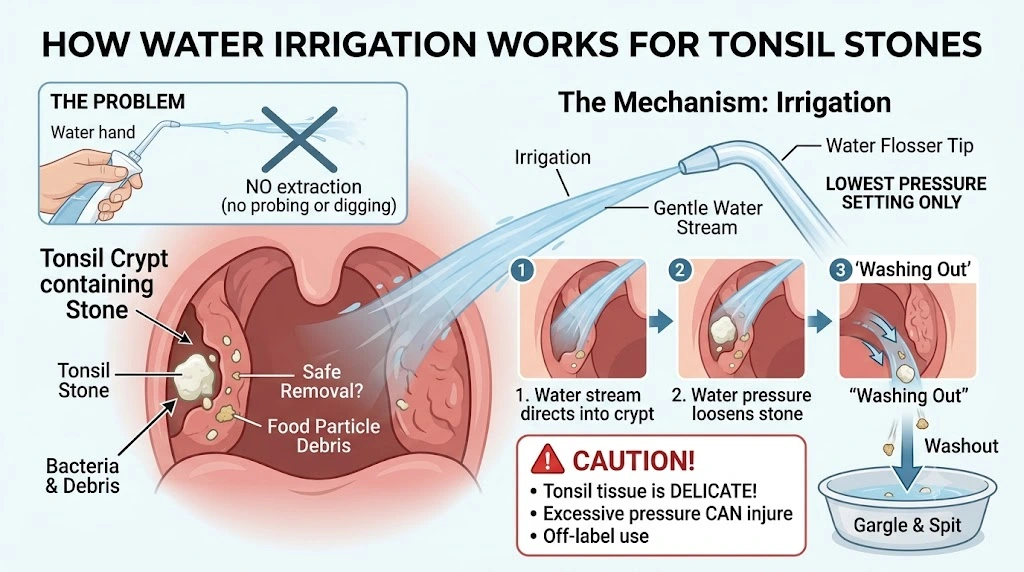
A water flosser is a device that sends a pressurised stream of water between the teeth and along the gumline. Some people point it at a tonsil crypt instead, to wash out a stone.
If the stone is small and loosely sitting, the water may float it out. That is the entire mechanism. It is irrigation, not extraction.
Plenty of users report success. Doctors are more cautious, because the tonsil is delicate tissue that a strong jet can injure.
Be clear about what this device is. It was designed to clean between teeth. Using it on your tonsils is an off-label use. Large clinics do list it among home options, but no manufacturer sells a device for this purpose and there is no clinical trial telling us how well it works.
Is it worth buying one in India?
Honestly, for tonsil stones alone, usually not.
A powered water flosser is a real purchase here, and a countertop unit is a fair bit more. If you already own one for your teeth, or you have braces, bridges or implants and were going to buy one anyway, then trying it on a visible stone at the lowest setting is reasonable.
Buying one only to remove tonsil stones is hard to justify when a low-pressure oral irrigation syringe from a chemist does the same job with more control, and when the stones will probably return regardless.
Advantages of using a water flosser
- Non-invasive. Nothing sharp goes into your throat, which removes the main way people injure themselves doing this.
- Works on small stones. A superficial stone sitting loosely in a crypt can often be floated out with gentle irrigation.
- Better oral hygiene overall. Regular use for the teeth reduces the bacteria and food debris in the mouth, which may make new stones less likely.
- No appointment needed. It can be done at home, which matters if the nearest ENT is a day’s outing.
- Gentler than probing. A stream of water is far less damaging than scraping with whatever is to hand.
Disadvantages and risks
The risks are real but almost all avoidable, and nearly all of them come back to pressure and technique.
- Tissue injury. A high-pressure setting can damage the tonsil, causing pain, inflammation or bleeding.
- Incomplete removal. A deeply embedded stone will not come out with water.
- Pushing debris deeper. Poor aim can force material further into the crypt.
- Gag reflex. Water aimed at the back of the throat makes many people gag.
- Infection risk. A device that is not cleaned properly puts bacteria into irritated tissue. In a humid climate, a reservoir left with water in it grows things quickly.
- Water quality. Use water you would drink. Filtered, boiled and cooled, or bottled, never straight from a tap you would not drink from.
- Choking. Work slowly, keep your head tilted forward over the basin, and pause between bursts to swallow or spit.
- Not for everyone. Avoid this method entirely if you have a bleeding disorder, take blood-thinning medicine, have had recent throat surgery, or have an active tonsil infection. It is not appropriate for young children.
Safety tips for water flosser use
- Start at the lowest pressure setting. This is the single most important precaution.
- Use clean, lukewarm drinking water. Not hot, not straight from the tap.
- Aim beside the stone, not straight at it.
- Stop at once if there is pain or bleeding.
- Empty and dry the reservoir after every use, and clean the device as the manufacturer instructs.
- Do not keep at it. If a stone has not shifted after two or three gentle attempts, leave it and see a doctor.
- Never dig at your tonsils with anything sharp. A pin, a safety pin, an earbud stick, a toothpick, a fingernail: this is how the serious home-removal injuries happen.
Other ways to get rid of tonsil stones
If a water flosser is not for you, the options run from doing nothing to surgery.
| Method | Best for | Risk level | Notes |
|---|---|---|---|
| Doing nothing | Stones causing no symptoms | None | Often the correct choice |
| Warm salt-water gargle | Small stones, throat irritation | Very low | Safest first step, and already a habit in most Indian homes |
| Gentle coughing | Loose, superficial stones | Very low | Costs nothing |
| Oral irrigation syringe | Most people who want to try irrigation | Low | Cheap at any chemist, gentler and more controllable than a powered unit |
| Water flosser, lowest setting | Small, visible, loosely attached stones | Low to moderate | Sensible only if you already own one; off-label use |
| Cotton swab | A single clearly visible stone | Moderate | Gag reflex and bleeding risk |
| ENT removal | Large or embedded stones | Low, professionally managed | Also finds out why they keep forming |
| Laser or coblation cryptolysis | Frequent recurrence | Procedural | Reduces crypt depth; available in larger cities |
| Tonsillectomy | Severe, recurrent cases | Surgical | Permanent, but real surgery with real recovery |
Gargling with warm salt water is the safest home remedy there is. It loosens debris, soothes the throat and reduces bacterial growth. Most Indian households already do this at the first sign of a sore throat, which makes it the easiest thing to start with.
Some small stones come out on their own with a firm cough.
A low-pressure oral irrigation syringe is the tool this article would actually recommend for most Indian readers. It is sold at almost any chemist, it costs very little, and because you control the pressure with your own thumb, it cannot deliver a jet stronger than you intend. Fill it with warm salt water, aim beside the stone, press gently.
A cotton swab can sometimes nudge a visible stone off the tonsil surface. The risks are bleeding, injury and a strong gag reflex.
An ENT specialist can remove a problem stone safely with proper instruments, and can tell you why they keep coming. In most Indian cities an ENT consultation is affordable and does not need a referral, so this is a shorter route than people assume.
Laser cryptolysis reduces the depth of the crypts. Coblation cryptolysis uses radiofrequency energy to smooth the tonsil surface. Both are available in larger Indian cities and both are paid for out of pocket.
A tonsillectomy removes the tonsils altogether. It is the only permanent answer and it is real surgery. In India it is still performed fairly readily, particularly in children with repeated infections, so it is worth asking directly whether the operation is being offered for the stones or for something else.
How to stop them coming back
If you want to know how to prevent tonsil stones rather than just remove them, this is the more useful half of the article, because for most people they will return.
- Brush twice a day.
- Clean between the teeth daily. An interdental brush or floss reduces the bacterial load in the mouth overall. A toothpick after meals does not count and damages the gum.
- Clean the tongue. Most Indian households already own a tongue cleaner, and this is one habit worth keeping.
- Drink enough water. Saliva is the mouth’s own rinse, and a dry mouth lets debris sit. In a hot climate and on a long commute, this is easier said than done and worth being deliberate about.
- Stop tobacco in every form. Gutka, khaini, zarda, paan masala, cigarettes. Nothing else on this list will do as much.
- Treat the nose. Persistent allergic rhinitis or sinus trouble keeps feeding the crypts.
- Use an antibacterial mouthwash when a dentist suggests it, not as a daily habit by default.
- See a dentist once a year. A scaling appointment costs less than most people expect and is the cheapest dentistry there is.
When should you see a doctor?
Most tonsil stones are harmless and can be left alone.
See a doctor if you have frequent or recurring stones, bad breath that persists despite good oral hygiene, significant throat pain or difficulty swallowing, repeated tonsil infections, bleeding from the tonsils, large stones you cannot remove safely, fever, or symptoms that get in the way of daily life.
Swelling on one side only should be seen promptly, and this matters more here than almost anywhere. India carries one of the world’s heaviest burdens of mouth and throat cancer, driven by tobacco and paan, and these cancers are commonly found late. ⚑
A persistent one-sided swelling, a lump that does not settle, an ulcer that will not heal, or pain going to one ear needs an ENT examination. It is very probably nothing. It is also not something to watch and wait on.
Key takeaways
A water flosser can dislodge small, loosely attached stones. It will not remove deep ones and it is not a cure for recurrence.
Use the lowest pressure setting. Pressure is where the real risk lies.
For most Indian readers, a cheap low-pressure oral irrigation syringe and warm salt water is the better first tool than a device purchase.
Never dig at your tonsils with anything sharp.
If the stones cause no symptoms, no treatment is needed.
Recurrence comes from the shape of your tonsils, not from a hygiene failure, though tobacco and an untreated nose make it worse.
Stop and get advice if there is pain, bleeding, fever, difficulty swallowing, or swelling on one side.
Frequently asked questions
Can a Waterpik remove tonsil stones?
Sometimes. A Waterpik is one brand of water flosser. It can work on a small, visible stone sitting loosely in a crypt. Use the lowest pressure setting, aim beside the stone rather than at it, and stop at any pain or bleeding. This is an off-label use of a dental product.
Is a water flosser worth buying in India just for tonsil stones?
For that alone, usually not. It is a significant purchase, and a low-pressure oral irrigation syringe from a chemist costs a fraction of it and gives you more control. If you already own a flosser for your teeth, or need one anyway for braces or implants, then trying it is reasonable.
What pressure setting should I use?
The lowest one available. These units are built for the pressure gums can take, and tonsil tissue is more delicate than gum tissue.
Is it safe to remove tonsil stones at home?
For small, visible stones, gentle methods such as salt-water gargling, coughing or low-pressure irrigation are generally considered safe. What is not safe is digging with a pin, safety pin, toothpick or fingernail, or using a high-pressure jet.
Do tonsil stones go away on their own?
Often, yes. Many come loose while eating, coughing or gargling. If they cause no symptoms, leaving them alone is a reasonable choice.
Why do I keep getting tonsil stones?
Usually the shape of your tonsils, not anything you are doing wrong. Tobacco use and untreated nasal allergy make it worse. If they keep returning, an ENT can discuss cryptolysis or other options that address the cause.
Do tonsil stones cause bad breath?
They can. Bacteria inside the stones produce sulphur compounds, which is why bad breath is the most common reason people discover them.
Can I use tap water in a water flosser?
Use water you would be willing to drink: filtered, or boiled and cooled, or bottled. Empty and dry the reservoir after each use rather than leaving water standing in it.
Can tonsil stones be dangerous?
Rarely. They are generally harmless. Get medical attention for fever, severe throat pain, difficulty swallowing or breathing, bleeding, or swelling on one side of the throat.
Glossary
Tonsillolith: the medical name for a tonsil stone, a calcified deposit in a tonsillar crypt.
Tonsillar crypts: the natural folds and pockets on the tonsil surface where debris collects.
Halitosis: persistent bad breath.
Cryptolysis: a procedure that reduces the depth of the tonsillar crypts, using laser or radiofrequency energy.
Oral irrigator: another name for a water flosser.
Oral irrigation syringe: a simple hand-operated syringe used to rinse the mouth or throat at low pressure.
Conclusion
A water flosser for tonsil stones is a reasonable thing to try on the lowest setting, for a small stone you can see, if you already own one. For most people here the cheaper and gentler starting point is warm salt water and a low-pressure syringe.
None of it is a cure. If the stones keep coming back, the useful conversation is with an ENT about why, and about the tobacco and the nose, rather than with a shopping app about which device to buy.
Disclaimer
This article is for general education only and is not a substitute for individual medical advice, examination or treatment from a qualified doctor. If you have persistent throat symptoms, recurring stones, or any of the warning signs listed above, see a doctor or an ENT specialist rather than managing it at home.
References
- Cleveland Clinic. Tonsil Stones: Symptoms, Causes, Removal and Treatment.
- Mayo Clinic. All about tonsil stones. Mayo Clinic News Network.
- National Health Service (NHS). Tonsil stones (tonsilloliths).
- Indian Council of Medical Research, National Centre for Disease Informatics and Research. National Cancer Registry Programme report. ⚑
- Ferguson M, Aydin M, Mickel J. Halitosis and the tonsils: a review of management. Otolaryngology-Head and Neck Surgery, 2014.
- Mesolella M, Cimmino M, Di Martino M, et al. Tonsillolith: case report and review of the literature. Acta Otorhinolaryngologica Italica.
- Bhat V, Hegde KS. Tonsillolith: a rare clinical entity. Journal of Oral and Maxillofacial Pathology.
- Indian Dental Association. Oral hygiene guidance. ⚑