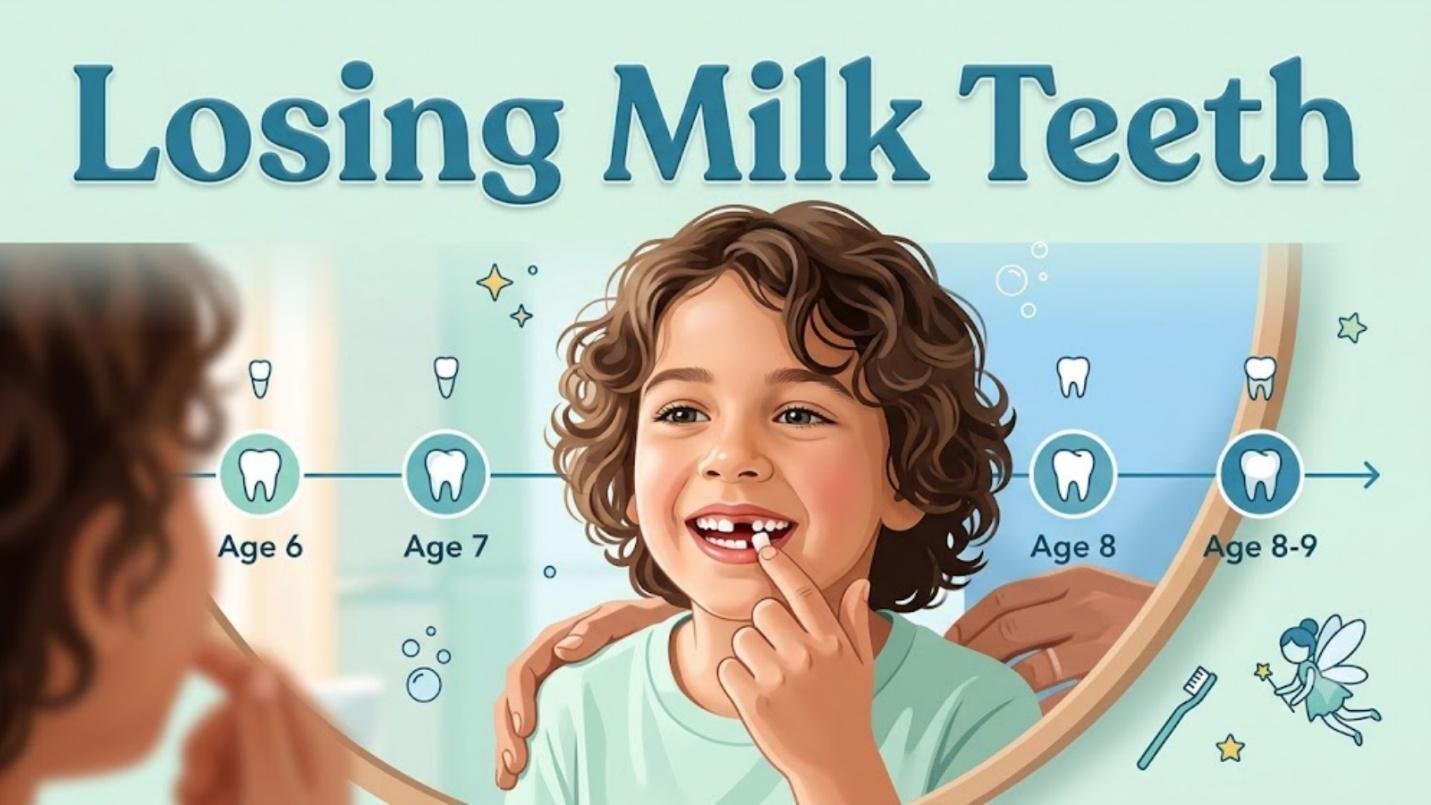
Part of the HiGoodHealth oral health series. Our Complete Oral Hygiene Guide for Every Age covers the whole family; this article is about the years when a child is losing baby teeth.
At a glance
- Most children start losing milk teeth at around six, and finish somewhere between eleven and thirteen. The lower front teeth usually go first. Children have 20 primary teeth, shed a few at a time over six or seven years, not all at once.
- A milk tooth is not pushed out. Its root dissolves from underneath as the permanent tooth develops below it, until too little is left to hold the tooth in place. That is why a tooth that is genuinely ready comes out with almost no fuss.
- Timing varies more than parents expect. The age chart is a range, not a deadline. What is worth watching is the sequence and the symmetry: roughly the usual order, and one side keeping pace with the other.
- Teeth growing behind milk teeth alarm parents more than they should. A permanent tooth comes through behind a baby tooth that has not fallen out, briefly giving two rows. In the lower front, at this age, it usually sorts itself out.
- The exception is a tooth lost early to decay or a knock. That gap can start closing before the adult tooth is ready. In India, where untreated early childhood decay is common, this is the situation that most often needs a dentist sooner rather than later.
What are milk teeth?
Milk teeth are the first set of teeth, also called baby teeth, primary teeth or deciduous teeth. Children normally have 20: ten upper and ten lower. The first usually appears at around six months.
They are not placeholders in any trivial sense. They are used for chewing and speech, they shape jaw development, and they hold the space each permanent tooth will eventually need.
Why do milk teeth fall out?
As the permanent successor develops and moves upward, the root of the primary tooth above it undergoes resorption: it is gradually broken down and absorbed. The crown loosens, comes away, and the permanent tooth erupts into the space.
The clinical name for the process is exfoliation of the primary dentition. It explains the two things parents most often ask about: why a ready tooth comes out easily, and why forcing one that is not ready hurts.
When do milk teeth start falling out?
Most children begin at around six to seven years. There is no exact age for any individual tooth, and paediatric dentistry guidance gives approximate ranges precisely because many healthy children do not follow the schedule closely.
The age chart
| Primary tooth | Upper jaw | Lower jaw |
|---|---|---|
| Central incisor | 7–8 years | 6–7 years |
| Lateral incisor | 8–9 years | 7–8 years |
| Canine | 11–12 years | 9–11 years |
| First molar | 9–11 years | 10–12 years |
| Second molar | 9–12 years | 11–13 years |
These are approximate ranges, not strict deadlines.
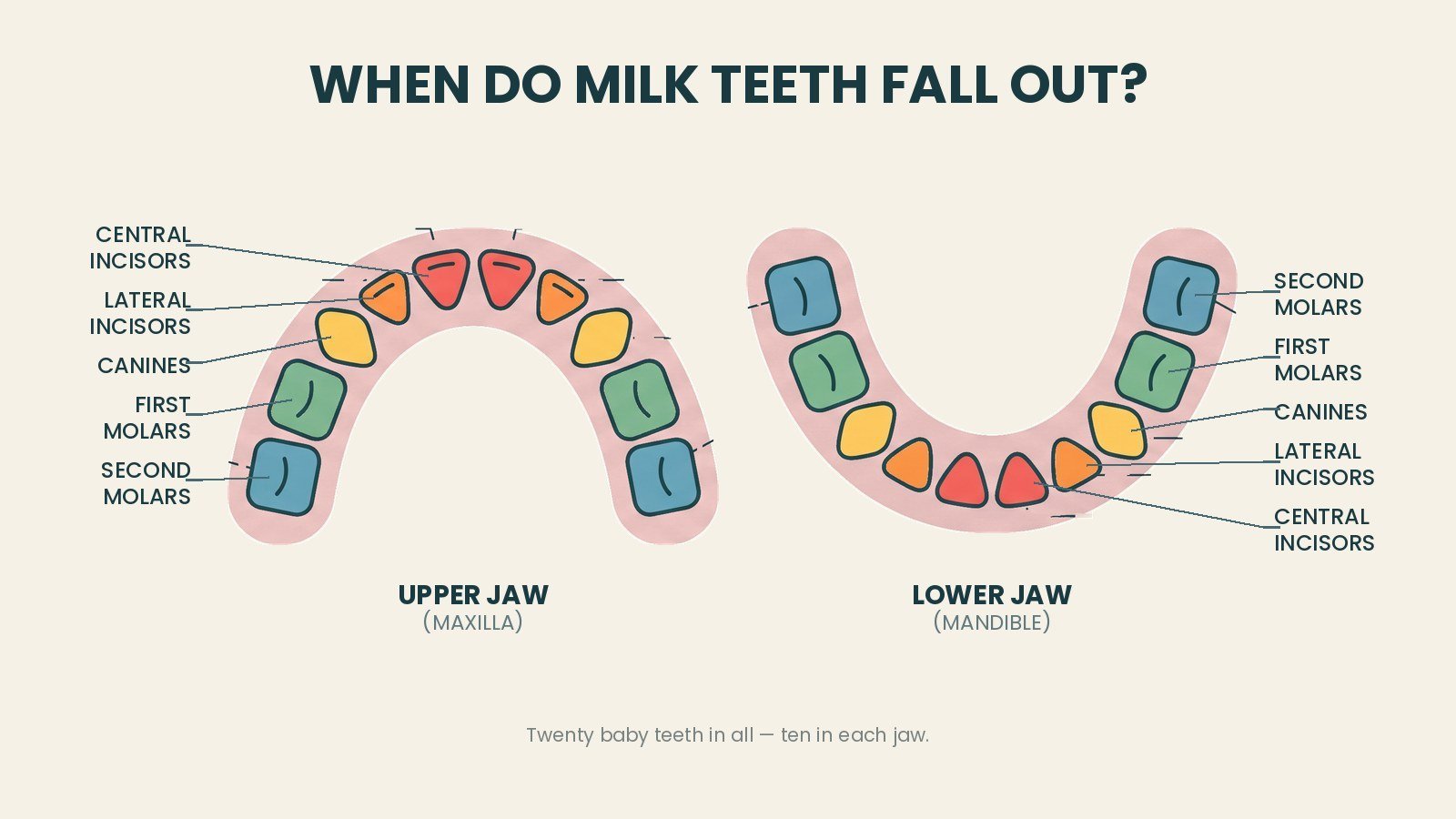
Chart: the twenty baby teeth — ten in the upper jaw and ten in the lower, colour-coded by type. The age at which each one is shed is in the table above.
Which milk tooth falls out first?
Usually the lower central incisors, at around six to seven. After that, roughly: upper central incisors at seven to eight, lateral incisors at seven to nine, then the first molars, canines and second molars between nine and thirteen.
The order varies, particularly between the upper and lower jaws, and a child who does one pair out of sequence is usually not doing anything unusual.
A year-by-year picture
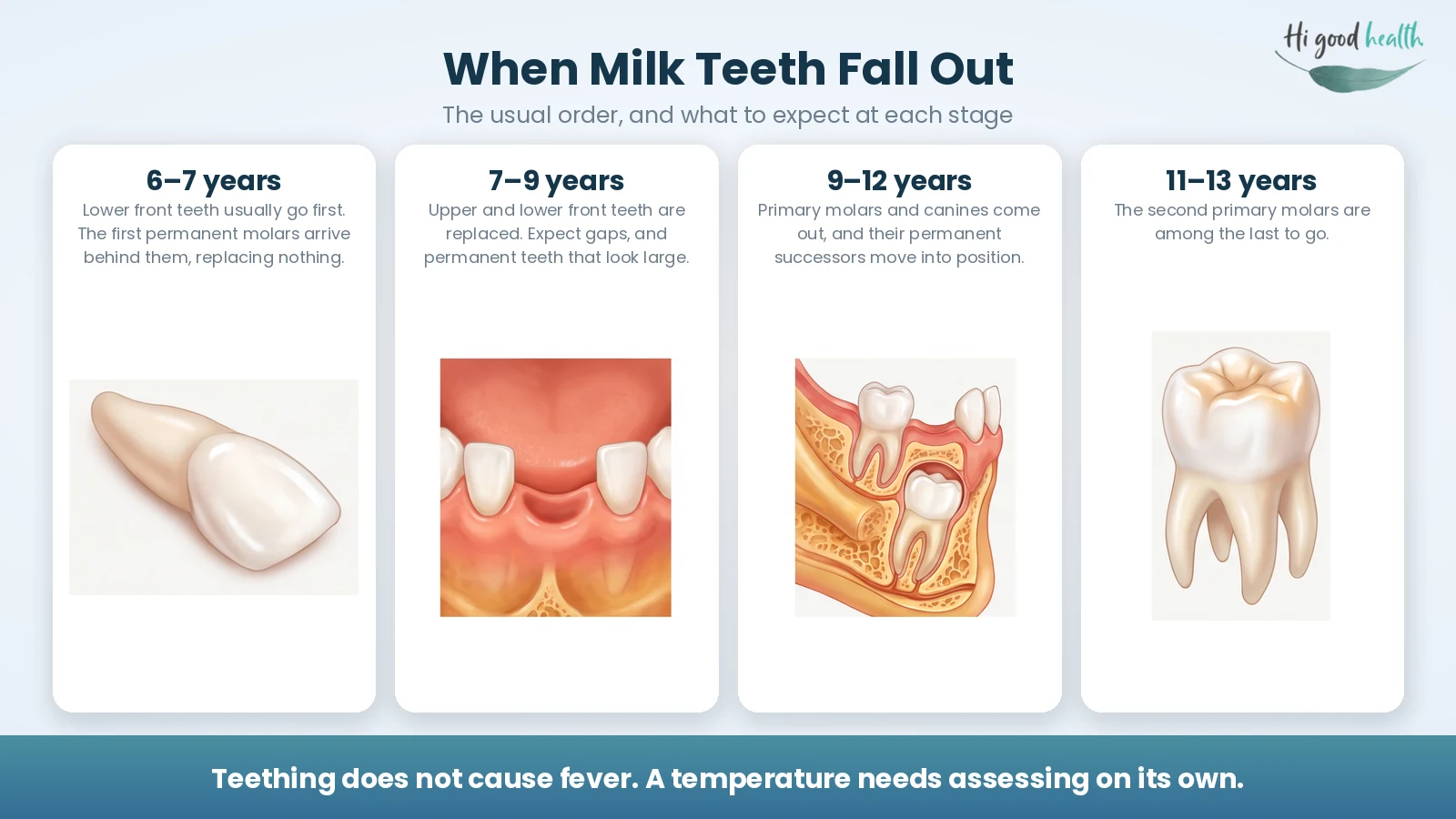
Around 6–7 years
The lower front baby teeth commonly loosen and come out. The first permanent molars also arrive around now, and they catch parents out: they erupt behind the primary molars and do not replace a baby tooth, so nothing falls out to announce them.
Because nothing falls out, the discomfort gets blamed on something else. Sore gums right at the back, a child chewing on things again, one-sided jaw ache and broken sleep at around six are often just a molar coming through.
A fever is not. Teething does not cause fever, and blaming teeth for one delays care for a real infection. In a country where dengue, typhoid and malaria are all part of the picture, a child with a temperature needs assessing for the temperature, whatever their teeth are doing.
Around 7–9 years
The upper and lower front teeth are progressively replaced. Expect loose teeth, small gaps, permanent teeth that look large against a child’s face, and a smile that changes month to month.
Around 9–12 years
Primary molars and canines exfoliate, and their permanent successors move into position.
Around 11–13 years
The second primary molars are among the last to go. By the early teens, most children have largely transitioned to permanent teeth.
What happens when a tooth becomes loose
It moves slightly, becomes steadily more mobile, gets wiggled by a tongue or a finger, and eventually comes away, after which the permanent tooth begins to appear.
A naturally loose tooth does not need forceful removal, and the old thread-and-doorknob trick is best left alone. What warrants a call is significant pain, swelling, pus, bleeding that will not settle, or a permanent tooth erupting while the baby tooth is still firmly in place.
Teeth growing behind milk teeth: do they fix themselves?
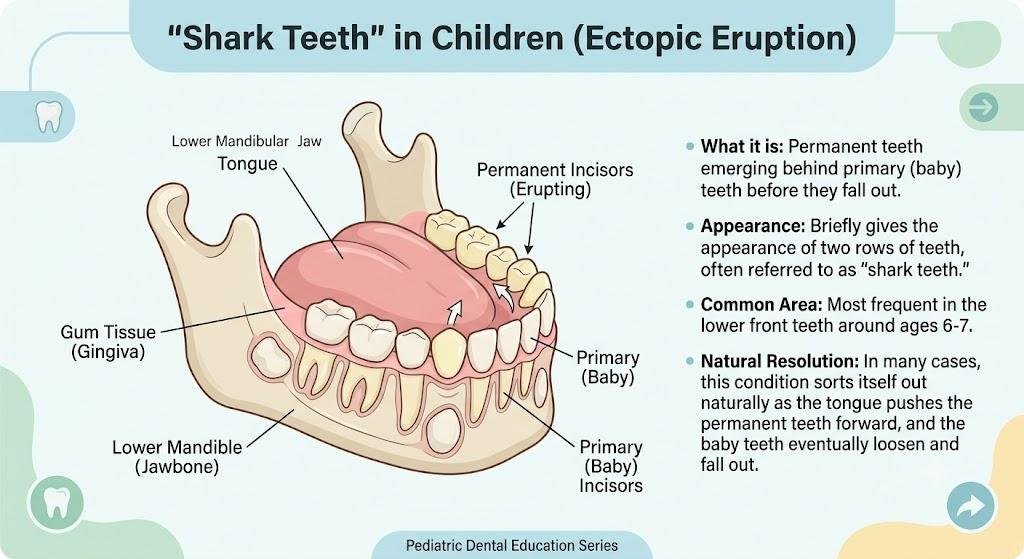
Teeth growing behind milk teeth is one of the commonest worries parents bring to a dentist. A permanent tooth comes through behind a baby tooth that has not fallen out yet, briefly giving a child two rows. It happens most often with the lower front teeth.
Most of the time, yes, they fix themselves. The baby tooth in front is usually already loosening, and once it comes out the permanent tooth drifts forward into the space over the following weeks. The tongue does a surprising amount of that work without anyone helping it.
What decides whether to wait or call is the baby tooth in front, not the second row itself. If it is wobbly, waiting is reasonable.
If it is still firm after several weeks, if the new tooth is coming in noticeably out of position, or if only one side is doing this while the other is well behind, a dentist should look.
Teeth growing behind milk teeth are common in the lower front at around six to eight, and much less usual elsewhere in the mouth. A second row further back is worth an earlier appointment.
Dentists call this ectopic eruption. Abroad it is often called shark teeth, which is the term used on our US edition — the same thing under a different name.
When a milk tooth is lost too early
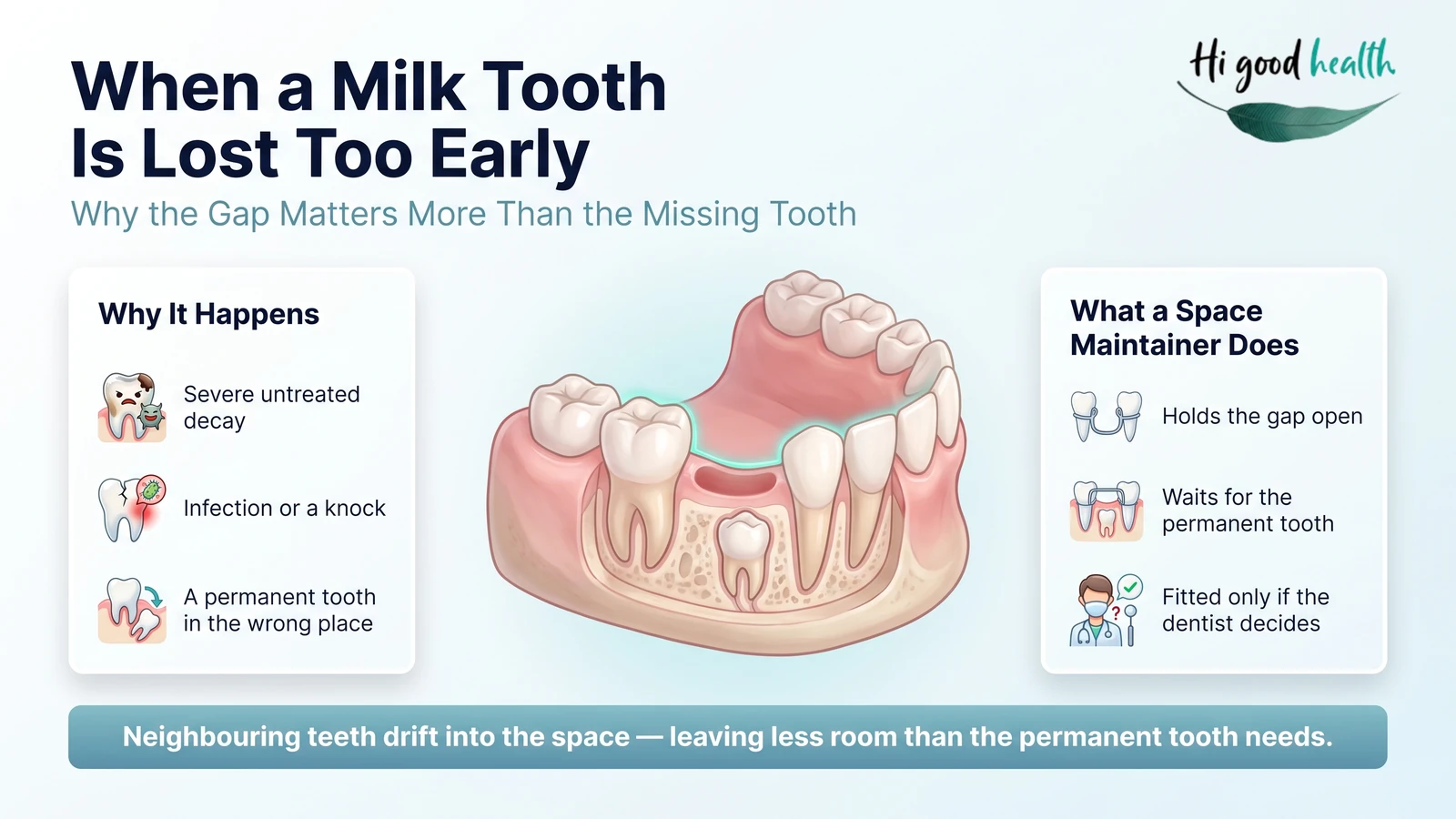
Early loss usually has a cause: severe decay, infection, a knock, or a permanent tooth erupting in the wrong place. Severe untreated decay is the most common of these, and it is preventable; see our guide to bottle rot and early childhood caries.
The problem is not the gap itself but what happens to it. Neighbouring teeth can drift into the space, leaving less room than the permanent successor needs. That can lead to crowding, rotation, or a tooth erupting off its intended path.
This is what a space maintainer is for. It is a small appliance that holds the gap open until the permanent tooth is ready. Whether one is needed depends on which tooth was lost, the child’s age, and how far the permanent successor has developed — a judgement for the dentist, not a default.
Paediatric dentists are concentrated in the larger cities. Where there is no specialist nearby, the paediatric dentistry department of a government dental college is usually the most affordable place to have a space maintainer assessed and fitted.
Fluoride, fluorosis and Indian drinking water
This is the part of the story that differs most in India. Fluoride toothpaste protects the permanent teeth arriving during these years, and it should be used. But large parts of the country also have naturally high fluoride in the groundwater.
Endemic fluorosis has been documented across several states, and the Government of India runs a dedicated National Programme for Prevention and Control of Fluorosis through the Ministry of Health and Family Welfare. Children in affected districts are the group most at risk.
Dental fluorosis is caused by swallowing too much fluoride while the permanent teeth are still forming, which is exactly this age range. It shows up as white flecks, and in more severe cases brown mottling, on teeth that are otherwise sound.
The practical steps are simple. Use a pea-sized amount of toothpaste for a child over three, a smear for a younger one, supervise so it is spat out rather than swallowed, and do not let a child eat toothpaste because it tastes good.
If your drinking water comes from a borewell, or you live in a district known for fluorosis, tell the dentist. That changes the advice on fluoride supplements and mouthrinses. It does not mean stopping fluoride toothpaste, which remains the single most effective thing you can do about decay.
When a baby tooth has not fallen out
A retained primary tooth is not automatically a problem, and plenty of children simply run late.
A dental examination is sensible if a permanent tooth has erupted while the baby tooth remains firmly in place, if eruption is markedly asymmetric or delayed, if there is pain or swelling, or if a tooth appears to be coming through in an abnormal position.
Does it hurt?
Natural exfoliation usually causes little discomfort, some gum tenderness, and a small amount of bleeding at most.
Significant pain before a tooth is loose is a different signal. That points to decay, infection, trauma or abnormal eruption rather than the normal process, and it is worth having looked at.
What to do when a tooth comes out
Do: reassure the child, keep the area clean, carry on brushing normally, use clean gauze with gentle pressure for minor bleeding, and keep regular dental visits.
Avoid: pulling teeth that are not ready, ignoring pain or swelling, stopping brushing around a tender area, and assuming that early tooth loss is harmless.
Looking after teeth during the mixed dentition
The period when a child has both baby and permanent teeth is called the mixed dentition, and it is the point at which brushing quality matters most, because the teeth arriving now are the ones they keep.
Brush twice daily with fluoride toothpaste and keep supervising: most children cannot clean every surface reliably until around seven or eight. Our guide to brushing technique covers the mechanics.
Pay particular attention to the newly erupted permanent molars. They sit right at the back, they have deep grooves, and they are the teeth most often missed. Once teeth are touching, clean between them; see our step-by-step flossing guide.
On sugar, the Indian version of the advice is specific. Mithai at festivals is not the problem. Biscuits with evening tea every day, sweetened milk at bedtime, and juice or soft drinks sipped through the afternoon are, because it is the frequency rather than the quantity that decays teeth.
Seeing a dentist in India
The usual Indian pattern is to see a dentist when something hurts. For a child in these years that is too late, because most of what a dentist would want to catch does not hurt at the stage when it is easy to fix.
Regular visits through these years let a dentist watch eruption, exfoliation, decay, oral hygiene, crowding, space loss and the developing bite while there is still time to influence any of it. Do not wait until all the milk teeth have gone.
Warning signs worth an appointment: a tooth lost much earlier than expected · severe pain · swelling or pus · a permanent tooth erupting while the baby tooth is still firm · a tooth retained unusually long · a marked difference between the two sides · a tooth lost after a significant knock · difficulty eating because of dental pain.
Key takeaways
Most children start losing milk teeth around six and finish in the early teens, beginning with the lower front teeth. All 20 primary teeth do not go at once — they are shed a few at a time across six or seven years, and small variations in timing are usually normal.
Teeth growing behind milk teeth — a second row coming through behind a baby tooth — usually fix themselves once the tooth in front comes out. What decides whether to wait is the baby tooth: wobbly means wait; still firm after several weeks means see a dentist.
The chart is a range, not a schedule. What is worth watching is the sequence and the symmetry rather than any individual birthday. A naturally loose tooth needs no help; a tooth that is not ready should not be pulled.
Loss caused by decay or trauma is a different thing from normal exfoliation. The space a baby tooth was holding can close before the permanent tooth is ready, which is why early loss deserves a dental assessment and sometimes a space maintainer.
In India there is one extra thing to get right: fluoride toothpaste in the correct small amount, spat out and not swallowed, particularly where the groundwater is already high in fluoride. The newly erupted permanent molars need the best brushing of a child’s life so far.
Frequently asked questions
At what age do milk teeth fall out?
Most children begin at around six to seven years, with the last primary teeth shed at roughly eleven to thirteen. Individual timing varies, and standard charts are approximate.
Which baby tooth falls out first, and is my child late?
Usually a lower central incisor, at around six to seven. Some variation either way is normal. What is worth checking is the sequence and whether both sides are keeping pace, rather than the exact age.
Do teeth growing behind milk teeth fix themselves?
Usually, yes. Once the baby tooth in front comes out, the permanent tooth behind it generally moves forward into the space over the following weeks. Ask a dentist if the baby tooth is still firm after several weeks, or if the new tooth is noticeably out of position.
Should I pull my child’s loose tooth?
A naturally loose tooth does not need forceful removal and is best left to come out on its own. A tooth that is not ready still has root attached, so pulling it early means pain and bleeding.
What if a baby tooth falls out too early?
Early loss usually has a cause: decay, infection, or a knock, and the gap can start closing before the permanent tooth is ready. A dentist can assess whether the space needs to be held open with a space maintainer.
What are six-year molars?
The first permanent molars, erupting at around six behind the primary molars. Nothing falls out to announce them, so they are easily missed, and they are often the first permanent teeth to decay. Sore gums and chewing at that age are commonly a molar arriving; a fever is not.
We have borewell water. Is fluoride toothpaste still safe for my child?
Yes, in the correct small amount. Dental fluorosis comes from swallowing fluoride while permanent teeth are forming, not from brushing with it. Use a pea-sized amount, supervise so it is spat out, and tell your dentist about the water source so that supplements and rinses can be adjusted.
When should I worry about delayed eruption?
A dentist should assess significant asymmetry between the two sides, a primary tooth retained unusually long, an abnormal eruption position, or a permanent tooth that seems to be missing.
Glossary
- Primary teeth: the first set of 20 teeth, also called milk, baby or deciduous teeth.
- Exfoliation: the natural shedding of a primary tooth once its root has resorbed.
- Resorption: the gradual breaking down and absorption of a baby tooth’s root as the permanent tooth develops beneath it.
- Mixed dentition: the stage when a child has both primary and permanent teeth, roughly six to twelve.
- Teeth growing behind milk teeth: a permanent tooth erupting behind a baby tooth that has not yet been shed, briefly creating two rows. Clinically called ectopic eruption, and known abroad as shark teeth. Most common in the lower front teeth.
- Space maintainer: a small dental appliance that holds a gap open when a primary tooth is lost early, so the permanent successor has room.
- Six-year molars: the first permanent molars, which erupt at around six behind the primary molars without replacing a baby tooth.
- Dental fluorosis: white flecks or brown mottling on the enamel, caused by swallowing too much fluoride while the permanent teeth are still forming.
References
All reference links checked on 12 September 2026.
- American Academy of Pediatric Dentistry — Dental Growth and Development, The Reference Manual of Pediatric Dentistry: https://www.aapd.org/globalassets/media/policies_guidelines/r_dentalgrowth.pdf
- American Academy of Pediatric Dentistry — Management of the Developing Dentition and Occlusion in Pediatric Dentistry: https://www.aapd.org/research/oral-health-policies–recommendations/management-of-the-developing-dentition-and-occlusion-in-pediatric-dentistry/
- American Dental Association — Baby Teeth Eruption Charts, MouthHealthy: https://www.mouthhealthy.org/all-topics-a-z/eruption-charts/
- American Academy of Pediatrics — Teething symptoms, HealthyChildren.org (teething does not cause fever): https://www.healthychildren.org/English/tips-tools/symptom-checker/Pages/symptomviewer.aspx?symptom=Teething
- Directorate General of Health Services, Ministry of Health and Family Welfare, Government of India — National Programme for Prevention and Control of Fluorosis: https://dghs.gov.in/content/1355_3_NationalProgrammePreventionControl.aspx
- National Health Mission, Government of India — National Programme for Prevention and Control of Fluorosis: https://nhm.gov.in/index1.php?lang=1&level=3&sublinkid=1055&lid=611
- Logan WHG, Kronfeld R. Development of the human jaws and surrounding structures from birth to the age of fifteen years. J Am Dent Assoc. 1933;20(3):379–427.
Disclaimer
This article is for general education and is not medical or dental advice. Eruption and exfoliation ages vary between children, and the ranges given are approximate. Speak to a dentist about your own child, and seek prompt care for significant pain, swelling, pus, or a tooth lost after a knock.