
Almost everyone in India brushes twice a day now. Almost nobody cleans between their teeth. That single gap explains most of what a dentist here sees.
Oral disease in India is not a story of neglect. It is a story of a routine that stops halfway, plus two things the rest of the world does not carry in the same measure: tobacco in every form, and drinking water that in many districts already contains more fluoride than it should.
This guide is the whole routine, by age, with the parts that are different here treated as different rather than translated.
At a glance
Four habits carry almost all of it: brush twice a day for two minutes with a fluoride toothpaste, clean between the teeth once a day, keep sugar to mealtimes rather than all day, and see a dentist once a year. Doing it consistently beats doing it thoroughly once in a while.
Almost every dental problem starts as plaque. Left alone for roughly 24 to 72 hours it hardens into tartar, and then no toothbrush will shift it. That is the point at which cavities and gum disease stop being possible and start being likely.
Two things here matter more than anywhere else. Tobacco in any form is the single largest cause of serious mouth disease in India, including oral cancer. And in fluorosis-endemic districts the water already carries too much fluoride, which changes the fluoride advice for children.
What good oral hygiene looks like changes with age. A parent wiping a baby’s gums, help around a teenager’s braces, dry mouth from medicines in later life. The principle stays the same; the method does not.
Bleeding gums, bad breath that will not go, sensitivity, or pain on biting are all reasons to see a dentist rather than wait. None of them settle on their own.
Why this matters, in Indian terms
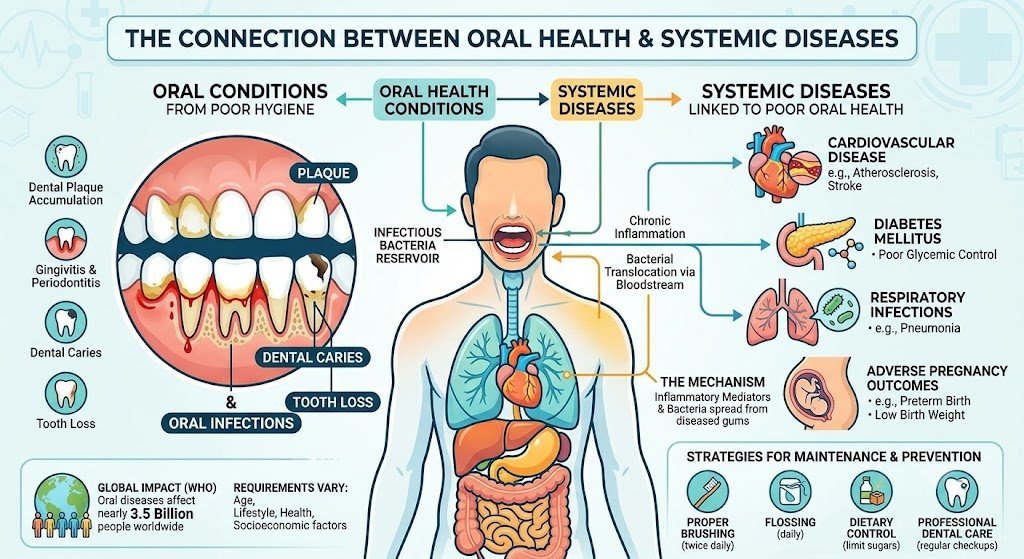
The World Health Organization estimates that oral diseases affect around 3.5 billion people worldwide. India carries a large share of that, and two parts of it are ours in particular.
Gum disease is very common and almost always found late, because its early stage does not hurt. People come in when a tooth moves, which is years after the point where it could have been reversed for the price of a scaling.
India has one of the world’s heaviest burdens of mouth cancer, driven by gutka, khaini, zarda, paan masala and smoking. It is one of the few cancers that a person can be shown in a mirror, and it is still usually caught late.
Add the practical layer: dental treatment is paid out of pocket almost everywhere here. A scaling is cheap. A root canal with a crown is not. An implant is a different order of money altogether. Prevention here is arithmetic, not virtue.
The oral hygiene series
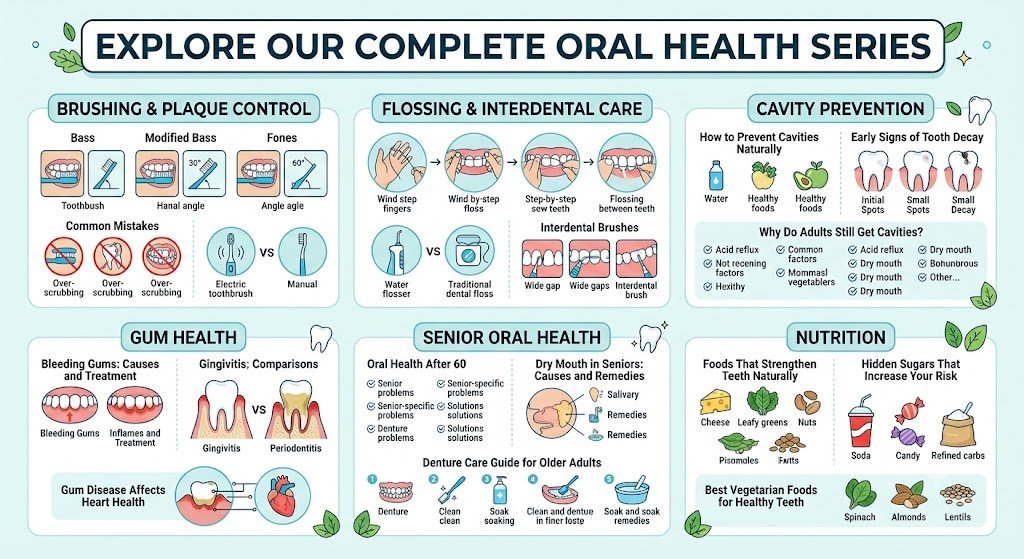
This guide is Part 1. Each part below takes one piece of the routine and covers it properly.
- Complete oral hygiene guide for every age. You are reading this.
- Brushing technique: Bass, Modified Bass and Fones. Which method suits which mouth, and how long two minutes really is.
- Electric or manual toothbrush. What the evidence shows, and whether the price gap is worth it here.
- Cleaning between your teeth. Floss, interdental brushes, and why the toothpick is not an option.
- Water flosser for tonsil stones. What pressure is safe, and the cheaper alternative most people should try first.
- Interdental brushes and bleeding gums. Choosing the right size, and why the bleeding usually stops within two weeks.
The daily routine
Brush twice daily for two minutes with a fluoride toothpaste. Clean between the teeth once a day. Clean the tongue. Keep sugar to mealtimes. Drink enough water. See a dentist once a year.
Consistency matters more than intensity. The point of a daily routine is to break up plaque before it hardens, and that is a matter of frequency rather than effort.
One Indian habit worth keeping and one worth dropping. The tongue cleaner is already in most Indian bathrooms and it is genuinely one of the highest-value things on this list. The toothpick after meals is the one to drop, and an interdental brush goes in the same pocket.
By age: what changes and when
Babies and toddlers, 0 to 3
Start cleaning the mouth before the first tooth appears, with a clean soft cloth over a finger, once a day.
Once teeth come, use a soft baby brush with a smear of fluoride toothpaste, about the size of a grain of rice.
The single biggest preventable problem at this age in India is the bottle at night. Milk, and worse, sweetened milk or juice left in the mouth during sleep, causes early childhood caries. It is common, it is painful, and it often ends in extractions under sedation in a three-year-old.
Feeding practices here make this specific. Honey, gur or sugar given on a finger, sweetened milk in a bottle at bedtime, and prolonged bottle use past the first birthday all feed the same problem. Move to a cup after one year.
Children, 3 to 12
Brush twice daily with fluoride toothpaste, and supervise it until the child can write neatly, which is roughly when the hand control is good enough.
Fluoride needs a local judgement here. In most of India children need fluoride toothpaste. In fluorosis-endemic districts, where the groundwater already carries high fluoride, a pea-sized amount and a child who spits rather than swallows matter more than usual. If you know your area has a fluoride problem in the water, tell your dentist so the advice can be adjusted.
Pit and fissure sealants on the first permanent molars are cheap, quick and among the best-value dental treatments available. Ask about them when the six-year molars come in.
Start cleaning between the teeth once the back teeth touch each other.
Teenagers, 13 to 19
Two minutes, twice a day, and daily cleaning between the teeth.
Braces are increasingly common among Indian teenagers, and they change the routine completely. Interdental brushes and, for some, a water flosser become necessary rather than optional.
This is the age tobacco starts in India, often as gutka or paan masala shared among friends and not thought of as tobacco at all. It is worth being direct about that at home, because almost every adult tobacco user in India started before twenty.
Sugary drinks, energy drinks and the constant grazing that comes with exam months matter more than any single dessert.
Adults, 20 to 60
Brush properly, clean between the teeth daily, change the brush or head every three months.
Get the teeth scaled once a year. Most Indian adults have never had it done, and it is the appointment that catches gum disease while it is still reversible.
Watch for grinding, which shows as flattened teeth and morning jaw ache, for the gum changes that come with pregnancy, and for anything unusual on the cheek, tongue or palate if you use tobacco.
After 60
The problems change: dry mouth from medicines, decay on exposed roots, gum disease that has been quietly running for decades, and denture trouble.
A soft brush or a powered one helps when hands are stiff. Dentures need cleaning daily and taking out at night. Dry mouth needs water, sugar-free chewing, and a doctor’s review of the medicines causing it.
Oral cancer screening matters most in this group, particularly in anyone who has used tobacco. It takes two minutes at a dental visit and it is the difference between an early lesion and a late one.
Plaque and tartar: the 72-hour clock
Plaque is a soft film of bacteria, saliva proteins and food debris. You can feel it with your tongue a few hours after brushing. It re-forms constantly, which is why brushing is a daily job.
While it is soft, a brush and an interdental brush remove it completely. Left alone, minerals from saliva harden it into calculus, the rough yellow-brown deposit most people call tartar.
Once it hardens, nothing you do at home removes it. Only a dentist’s scaling will, and its rough surface then collects new plaque faster than smooth enamel does, so it accelerates.
It builds up first behind the lower front teeth, on the outer surfaces of the upper back molars, along the gum line, and between the teeth where a brush never reaches.
A simple test: plaque is soft and pale and comes off with a brush. Tartar is hard, rough and usually yellow or brown and does not. If you can see a deposit you cannot brush away, that is tartar, and it needs an appointment rather than a stronger toothpaste.
Brushing technique
Technique matters more than the brush.
Bass technique
The standard for cleaning at the gum line. Hold the brush at 45 degrees to the gum, use short gentle vibrating strokes, and let the bristle tips sit just into the crevice between tooth and gum.
Modified Bass
The same, followed by a sweep away from the gum. Slightly better cleaning and easier for most people to keep up.
Fones technique
Simple circles. Taught to young children because it is easy to learn, not because it is the most effective.
Stillman technique
For gums that have receded, with the bristles resting partly on the gum and partly on the tooth.
Charter’s technique
For braces and after gum surgery, with the bristles pointed towards the biting surface.
Two habits to unlearn. Hard horizontal scrubbing wears grooves at the gum line and is the commonest technique fault in Indian adults. And a hard-bristled brush, still widely sold and widely bought here, does more harm than good; soft is the right choice for almost everyone.
The tools worth having
A soft toothbrush. Replace it every three months, or when the bristles splay.
An interdental brush or floss. Interdental brushes suit most Indian adults better because gum disease has already widened the gaps. Floss for tight contacts.
A tongue cleaner. Already in most homes here. Use it gently, back to front, once a day.
Fluoride toothpaste. Check the tube says fluoride; several popular herbal and ayurvedic pastes sold in India do not contain any, and that is the one ingredient that actually prevents decay.
A powered brush, if you want one. It helps most for people with stiff hands, braces, or a habit of brushing for forty seconds. It is not a requirement.
Datun and neem twigs. Widely used and not useless, but they clean only the surfaces they touch, and they do nothing between the teeth. If you use one, the interdental step still has to happen separately.
Cleaning between the teeth
The surfaces between teeth are roughly a third of each tooth and a brush never touches them. This is where gum disease starts and where a large share of adult cavities begin.
Floss: take about 45 centimetres, wrap it round the middle fingers, guide it gently between the teeth, curve it into a C against the side of one tooth, slide just under the gum, then move to a fresh section for the next gap.
Interdental brush: choose the size that passes without force, place it at the gum line, and move it in and out a few times. For most Indian adults with any gum disease, this is the easier and more effective tool.
Never a toothpick as a daily method. It cannot follow the tooth surface, so instead of cleaning it presses into the small triangle of gum between two teeth and flattens it. That tissue does not grow back.
Water flosser or floss?
Floss removes plaque directly from the tooth surface. A water flosser flushes debris and reduces gum inflammation, and it is genuinely useful with braces, implants and stiff hands.
For most people here it is an expensive addition rather than a first purchase. Floss or an interdental brush costs a fraction of it and does the core job.
Cavities: how they happen and how to stop them
Dental caries is caused by acid-producing bacteria feeding on sugars and dissolving the mineral out of enamel. It runs from early demineralisation, to a cavity in enamel, into dentine, into the pulp, and finally to infection at the root tip.
Frequency of sugar matters more than quantity. Each exposure starts an acid attack lasting around twenty minutes. One sweet after lunch does less damage than a cup of sweet tea sipped through the afternoon.
That is the Indian version of the problem, and it is worth being specific about it. Chai with sugar four or five times a day, mithai during festivals, the biscuit habit, sweetened milk at bedtime for children, and toffees kept in a pocket all work the same way: they keep the mouth acidic for most of the waking day.
What actually prevents cavities here:
- Fluoride toothpaste, twice a day, spat out rather than rinsed away with water.
- Fewer sugar occasions, not necessarily less sugar in total.
- Cleaning between the teeth daily.
- Water after sweet food or drink.
- Sealants on children’s first permanent molars.
- A yearly dental check.
The international advice to drink fluoridated water does not apply here. India does not fluoridate its water supply, and large parts of the country have naturally high fluoride instead, which causes dental and in severe cases skeletal fluorosis. If you live in such a district, the fluoride question runs the other way and is worth asking a dentist about directly.
Gum disease, or pyorrhoea
Gum disease is the most under-treated condition in Indian mouths, because its early stage is painless. Most people who have it do not know.
Gingivitis is the reversible stage. Plaque along the gum line inflames the tissue. The gums look redder and puffier and bleed when brushed.
Bleeding when you brush is not normal, and it is not a sign of brushing too hard. It is the most reliable early signal there is, and the usual response, brushing more gently, makes it worse.
At this stage it undoes itself. Daily plaque removal along the gum line plus one professional clean usually settles it within a couple of weeks.
Periodontitis, which almost everyone here calls pyorrhoea, is the stage that does not reverse. The inflammation goes below the gum and destroys the bone holding the teeth. Bone does not grow back.
- Gums receding, so the teeth look longer than they did
- Bad breath or a bad taste that brushing does not fix
- Teeth that feel loose, or a bite that has changed
- Pus or tenderness at the gum margin
- Gaps opening between teeth that used to be tight
Treatment is a deep clean below the gum line, sometimes over more than one visit. It stops the damage; it does not undo it.
Higher risk: tobacco users, people with diabetes, anyone on medicines that dry the mouth, pregnancy and menopause, and a family history of early tooth loss.
Diabetes and gum disease feed each other, and that matters a great deal in India. Poorly controlled sugar makes gum disease worse, and gum inflammation makes blood sugar harder to control. Anyone with diabetes should be having their gums checked, and anyone with stubborn gum disease and no obvious cause should have their blood sugar checked.
Tobacco hides the warning sign. It reduces bleeding, so a chewer or smoker can have advanced disease with gums that look calm. Absence of bleeding is not reassurance in a tobacco user.
Bad breath
Persistent bad breath is a signal, not an embarrassment. Roughly 85 to 90 percent of it starts in the mouth, which means it can usually be fixed once the source is found.
The tongue is the commonest source. The rough surface at the back traps bacteria, dead cells and food residue, and those bacteria release sulphur compounds. Brushing the teeth does not touch it.
This is one place where the common Indian habit is already right. A tongue cleaner used gently from back to front, once a day, removes far more of that coating than a toothbrush does, and it takes ten seconds.
- Gum disease. Bacteria in the pockets produce a characteristic persistent smell.
- Dry mouth. Saliva is the mouth’s own rinse, so anything that reduces it concentrates the smell. This is why morning breath is normal.
- Untreated cavities and food traps, including under bridges and around crowns.
- Tobacco and paan, directly and by drying the mouth and driving gum disease.
- Strongly flavoured food. Garlic, onion and some spices are carried in the blood and come out through the lungs, so they are not a hygiene failure and no amount of brushing removes them.
What does not work: alcohol-based mouthwash masks the smell for twenty minutes and then dries the mouth, which makes the underlying problem worse. Mints and sweetened supari do the same with sugar added. Saunf and elaichi after a meal are pleasant and harmless but they mask rather than treat.
If your cleaning is good, the tongue is clean, and a dentist has ruled out gum disease and decay, persistent bad breath is worth raising with a doctor. Tonsil stones, sinus infection, reflux, uncontrolled diabetes and liver or kidney disease can all present this way.
Mouth cancer: the section this article will not soften
This is the part of oral health where India differs most from the rest of the world, and it deserves its own space rather than a line in a list.
Mouth and throat cancer is among the commonest cancers in Indian men, and tobacco, in chewed far more than smoked form, is behind most of it. Areca nut, or supari, carries risk on its own even without tobacco added.
It is usually found late, which is the reason survival is poor. It does not have to be. The mouth is visible.
Signs that need a dentist or ENT within days, not months:
- An ulcer that has not healed in two weeks
- A white or red patch that does not rub off
- A lump, or a hard area inside the cheek
- Difficulty opening the mouth fully, which can be a sign of oral submucous fibrosis
- Numbness, or pain going to one ear
- A tooth that has loosened with no obvious cause
Reduced mouth opening deserves particular attention here. Oral submucous fibrosis is strongly linked to areca nut and is a precancerous condition. It is common in India and rare almost everywhere else.
If you use tobacco or supari in any form, stopping is the single largest thing you can do for your mouth, and it does more than every other item in this guide combined.
Other conditions linked to poor oral health
Gum bacteria and the inflammation they cause have been associated with cardiovascular disease, and periodontal disease and diabetes worsen each other in both directions.
Oral bacteria can be breathed into the lungs and cause pneumonia, which matters most in bedridden and elderly people.
Gum disease in pregnancy has been associated with preterm birth and low birth weight, which is a reason for a dental check during pregnancy rather than after it.
Diet
Helpful: milk, curd and paneer, which supply calcium and buffer acid. Fibrous vegetables and fruit. Nuts. Water.
Unhelpful in the way they are usually eaten: sweet tea through the day, cold drinks, sticky mithai and toffees, and the sugar-coated saunf kept by the door of every restaurant.
Some traditional habits are worth naming honestly. Jaggery is still sugar as far as the bacteria are concerned. Sugarcane juice is a sugar drink. Paan with sweet fillings is both sugary and, if it contains supari or tobacco, far worse than sugary.
When to see a dentist
Once a year for a check and a scaling, whether or not anything hurts. That is the whole preventive schedule for most adults.
Sooner if there is bleeding that continues past two weeks of good cleaning, pain on biting, sensitivity that is getting worse, a loose tooth, a swelling, or any of the mouth cancer signs listed above.
Cost is the usual reason people delay. Government dental hospitals and dental colleges treat at low cost or free, and a dental college is often the cheapest route to a proper examination in an Indian city.
Key takeaways
Brush twice a day for two minutes with a fluoride toothpaste, clean between the teeth once a day, and keep sugar to mealtimes. Consistency beats intensity.
Everything starts as plaque, and you have 24 to 72 hours. After that it hardens into tartar and only a dentist can remove it.
Gums that bleed when you brush are not being brushed too hard. That is gingivitis, and at that stage it reverses completely. Once it becomes pyorrhoea, the bone loss is permanent.
Most bad breath comes from the tongue. A tongue cleaner, back to front, once a day, does more than any mouthwash.
Frequency of sugar matters more than quantity. Sweet tea five times a day does more damage than one dessert.
Check that your toothpaste actually contains fluoride, and in fluorosis-endemic districts ask a dentist about the right amount for children.
Tobacco and supari are the largest oral health problem in India, and tobacco hides the warning signs. If you use either, that is the first thing to change.
One dental visit a year, for a scaling and a look at the whole mouth, is the cheapest dentistry there is.
Frequently asked questions
How often should I brush?
Twice a day, two minutes each time, with a fluoride toothpaste. Night brushing matters more than morning, because saliva flow drops during sleep and whatever is left on the teeth stays there.
Does my toothpaste have fluoride?
Check the tube. Several popular herbal and ayurvedic brands sold in India contain none, and fluoride is the ingredient that actually prevents decay. If the pack does not say fluoride, it probably does not have it.
Should I rinse with water after brushing?
Better not to. Spit out the excess and leave the thin film of toothpaste on the teeth. Rinsing washes away the fluoride you just applied.
Is a datun or neem twig enough?
It cleans the surfaces it touches, and some people manage well with it. It does not clean between the teeth, so that step still has to happen separately.
Is flossing really necessary?
Cleaning between the teeth is. Whether you do it with floss or an interdental brush depends on your gaps. For most Indian adults with any gum disease, an interdental brush is easier and works better.
Can I just use a toothpick?
No. It moves food, which is fine occasionally, but as a daily method it presses into the gum between the teeth and flattens it permanently.
My gums bleed when I brush. Should I brush more gently?
No. Bleeding is a sign that plaque is sitting at the gum line, and cleaning less makes it worse. Clean thoroughly and gently, add interdental cleaning, and expect it to settle in one to two weeks. If it does not, see a dentist.
I chew gutka but my gums do not bleed. Are they fine?
Not necessarily. Tobacco reduces bleeding, so gum disease can be advanced while the gums look calm. Get examined rather than judging by bleeding.
How often should I get scaling done?
Once a year for most adults, more often if you have gum disease or diabetes. It does not loosen or weaken teeth, which is the common fear; it removes the deposit that was loosening them.
Does scaling damage teeth or create gaps?
No. The gaps that appear afterwards were already there, filled by tartar and swollen gum. Removing the tartar reveals them, it does not create them.
Is mouthwash necessary?
No. It can be a useful addition for a short period if a dentist recommends one, but it does not replace brushing and interdental cleaning, and alcohol-based rinses used daily dry the mouth.
When should my child first see a dentist?
By the first birthday, or within six months of the first tooth. Most people here come far later, which is why early childhood caries is usually found at the painful stage.
Should children use fluoride toothpaste?
Generally yes, in a rice-grain smear under three and a pea size after that, supervised so it is spat out. If you live in a district with high fluoride in the groundwater, tell your dentist so the advice can be adjusted.
What are the mouth cancer signs I should not ignore?
An ulcer that has not healed in two weeks, a white or red patch that does not rub off, a lump inside the cheek, reduced mouth opening, numbness, or pain going to one ear. Any of these needs a dentist or ENT within days.
How much does a dental check-up cost?
An examination and scaling at a private clinic is inexpensive relative to what it prevents, and government dental hospitals and dental colleges charge very little or nothing. Cost is a smaller barrier here than most people assume.
Can gum disease be reversed?
Gingivitis, yes, completely. Pyorrhoea, no. Treatment stops the damage but does not rebuild the bone that has gone, which is why the early signs are worth acting on.
Glossary
Plaque: the soft, colourless film of bacteria that forms constantly on teeth.
Calculus, or tartar: hardened plaque, firmly attached, removable only by a dentist.
Dental caries, or cavities: tooth decay caused by acid-producing bacteria.
Gingivitis: the early, reversible stage of gum disease, with red, swollen, bleeding gums.
Periodontitis, or pyorrhoea: advanced gum disease that destroys the tissue and bone supporting the teeth.
Halitosis: persistent bad breath.
Fluoride: a mineral that strengthens enamel and prevents decay. Too little means decay; too much, as in fluorosis-endemic areas, causes mottling of the teeth.
Dental fluorosis: mottling or staining of enamel caused by too much fluoride while the teeth are forming. Common in parts of India because of groundwater.
Oral submucous fibrosis: stiffening of the lining of the mouth, strongly linked to areca nut, which reduces mouth opening and is precancerous.
Enamel: the hard outer layer of the tooth.
Dentine: the layer beneath enamel. When exposed it causes sensitivity.
Xerostomia, or dry mouth: reduced saliva, usually from medicines or medical conditions.
Root caries: decay on exposed roots, common in older adults with gum recession.
Bruxism: grinding or clenching the teeth, often during sleep.
Scaling and root planing: deep cleaning below the gum line to treat gum disease.
Disclaimer
This article is for general education only and is not a substitute for individual advice, examination or treatment from a qualified dentist. Any non-healing ulcer, white or red patch, lump, or reduced mouth opening should be examined promptly rather than watched.
References
- World Health Organization. Oral Health Fact Sheet. WHO, 2024.
- National Oral Health Programme, Ministry of Health and Family Welfare, Government of India.
- Indian Council of Medical Research, National Centre for Disease Informatics and Research. National Cancer Registry Programme report.
- Newman MG, Takei HH, Klokkevold PR, Carranza FA. Carranza’s Clinical Periodontology. 13th ed. Elsevier; 2019.
- Fejerskov O, Nyvad B, Kidd E. Dental Caries: The Disease and Its Clinical Management. 3rd ed. Wiley Blackwell; 2015.
- Marsh PD. Dental plaque as a biofilm and a microbial community. BMC Oral Health. 2006;6(Suppl 1):S14.
- Tonetti MS, Greenwell H, Kornman KS. Staging and grading of periodontitis. Journal of Periodontology. 2018;89(Suppl 1):S159-S172.
- Nazir MA. Prevalence of periodontal disease, its association with systemic diseases, and prevention. International Journal of Health Sciences. 2017;11(2):72-80.
- Indian Dental Association. Oral hygiene guidance.