Two people brush twice a day for eleven years. One keeps more teeth. In a study that followed nearly 2,900 adults for a decade, part of the difference came down to something small: which toothbrush they picked.
But before the comparison, the honest Indian framing. For a great many people here, the toothbrush is not the thing deciding their oral health. Tobacco is.
Gutkha, khaini, zarda, paan masala and betel quid do more damage to Indian mouths than any brushing habit can undo, and oral cancer is among the commonest cancers in Indian men. If you chew, stopping that is worth more than every upgrade in this article put together.
With that said, electric vs manual toothbrush is a fair question for everyone already brushing twice a day and wondering whether the upgrade is worth the money. Here is what the evidence actually shows.
At a glance
In the electric vs manual toothbrush comparison, the electric brush has a small but real edge for plaque removal and gum health. The gap is modest. A manual brush used properly for two minutes, twice a day, keeps teeth and gums healthy.
Your technique, your timing and your consistency matter more than the motor. Most people brushing badly with an electric brush would gain more from two minutes and a better angle than from the device.
In India the cost gap is wider than the article this is based on suggests. A manual brush costs very little; an electric handle runs into thousands of rupees, and the replacement heads are the real recurring cost and are not easy to find outside larger towns.
Two things matter more here than the brush. Stopping tobacco in any form, and using a fluoride toothpaste. Neither is a purchase.
Why the toothbrush matters at all
Your toothbrush is the first line of defence against plaque, a sticky bacterial film that forms continuously on teeth and along the gumline.
Left in place it leads to decay, gingivitis, periodontitis, bad breath, and eventually tooth loss. Once plaque hardens into tartar, only a dentist or hygienist can remove it.
This matters more in India than the numbers alone suggest, because treatment here is largely paid out of pocket and dentists are concentrated in cities. A filling avoided is money and a journey avoided. Prevention is worth more where treatment is harder to reach.
The manual toothbrush
The traditional brush: a handle, a head, and your hand supplying the movement.
It is cheap and available in every kirana shop and chemist, needs no charging, travels anywhere, comes in every size and bristle type, and gives you complete control over pressure.
Its weakness is that it depends entirely on technique. It is easy to miss areas, harder for anyone with limited hand movement, and most people brush for well under two minutes.
Used well, with a soft-bristled head and the Modified Bass technique, it delivers excellent oral health.
And a word about the datun
Neem and babool twigs are still used across much of India, and they are not useless. Neem has genuine antibacterial properties and a chewed twig does clean.
But it is not equivalent to a brush and fluoride toothpaste. A twig cannot reach the gumline reliably, the fibres are coarse enough to abrade gums and enamel over years, and it delivers no fluoride. If you use one by preference, use a fluoride toothpaste and a soft brush as well, not instead.
The electric toothbrush
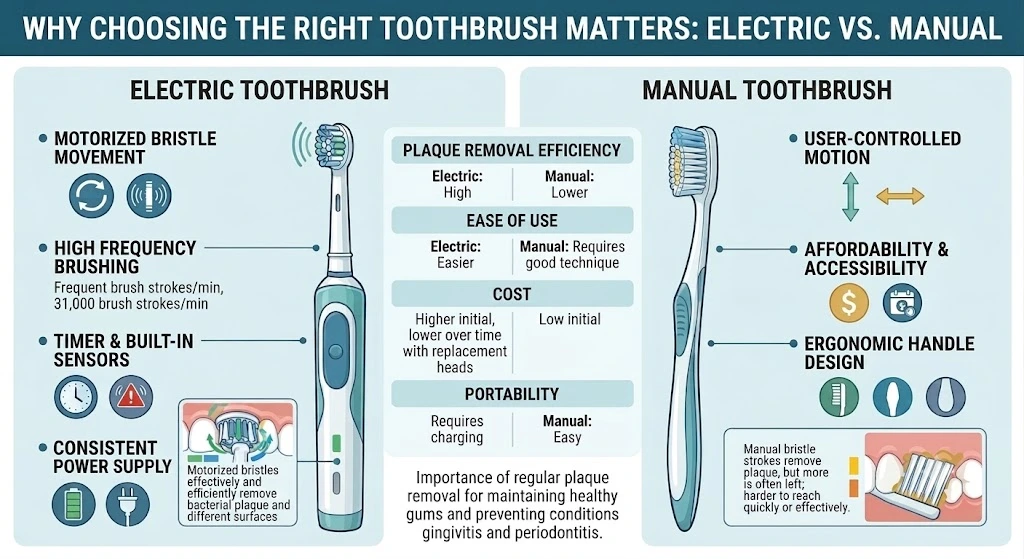
A powered brush moves the head for you, either by oscillating and rotating, where a small round head turns back and forth, or by sonic vibration at very high frequency.
Sold in India as electric, power or automatic toothbrushes; they are the same category and the research applies to all of them.
Most add timers, pressure sensors, several modes, app connectivity and head-replacement reminders. Two of those do nearly all the work: the timer and the pressure sensor. The rest is convenience you are paying for.
Electric vs manual toothbrush: what the research actually shows
This is one of the most studied questions in preventive dentistry.
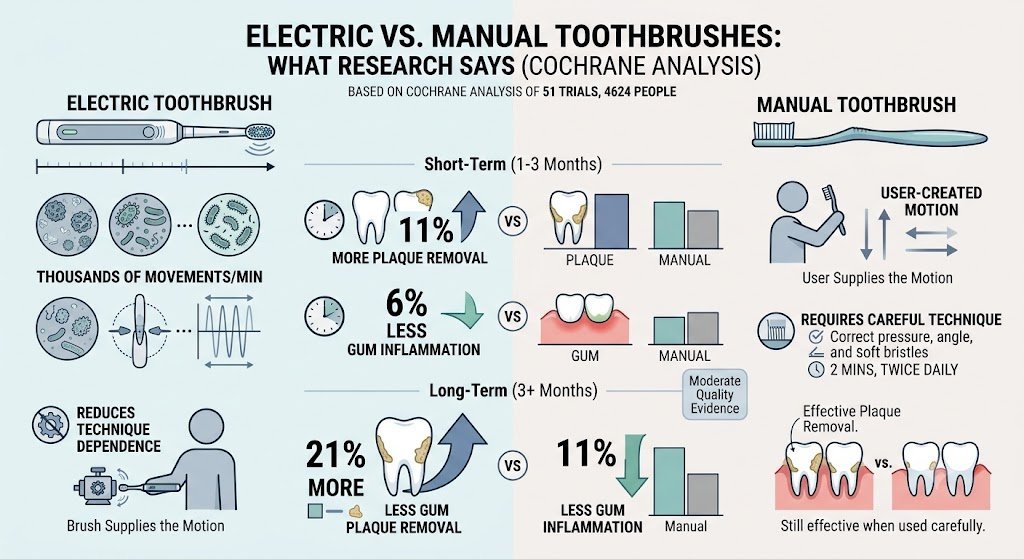
The largest review, a Cochrane analysis of 51 trials and 4,624 people, found powered brushes removed 11% more plaque at one to three months and 21% more after three months, with 6% and 11% less gum inflammation over the same periods. The evidence was rated moderate quality.
The reason is mechanical. A powered brush makes thousands of movements a minute, so less depends on your technique. You guide it slowly around the mouth instead of generating the motion yourself.
None of this shows manual brushes are ineffective. Someone brushing carefully with a soft manual brush for two minutes twice a day achieves excellent results.
The long-term study, which is the one that matters
Most trials run a few weeks, and less plaque today does not prove you keep your teeth in twenty years. A German study followed 2,819 adults for eleven years and closed that gap.
Powered-brush users showed 22% less progression in gum pocket depth, about 18% less decay progression, and kept roughly 0.36 more teeth.
Newer reviews point the same way: a 2024 review found the advantage held in adults over 55, and a 2025 meta-analysis found it in children. The pattern is consistent. The more trouble you have brushing well by hand, the more the powered brush is worth.
Gum health, which is where India has the bigger problem
Gum disease starts at the gumline, where plaque settles first. Gum disease is very common in Indian adults, and it usually arrives without pain, which is why it goes unnoticed until teeth loosen.
A powered brush helps because it maintains consistent movement and pressure at that margin. Pressure sensors matter too: hard brushing causes gum recession, sensitivity and enamel wear, and recession does not grow back.
For gingivitis and early gum disease, better cleaning at the gumline is what reverses the inflammation, and a powered brush makes that easier to do every day. It is not a treatment on its own. Established gum disease needs a dentist.
What it costs in India
This is where the international version of this comparison stops being useful.
| Manual toothbrush | Electric toothbrush | |
|---|---|---|
| Where you buy it | Any chemist, kirana or supermarket | Online, or larger stores in cities |
| Handle | Very cheap | Several thousand rupees for a good one |
| Recurring cost | A new brush every three months | Replacement heads every three months, and they are not cheap |
| Availability of refills | Everywhere | Mostly online, harder outside cities |
| Charging | None | Needs a socket, and matters in areas with power cuts |
| Travel | Excellent | Extra charger, extra bulk |
The replacement heads are the real cost, not the handle, and this is the point most people miss when they buy one. A brush whose heads you cannot easily buy becomes a manual brush with a battery in it.
And a mid-range brush with a timer and a pressure sensor gives you nearly all the measured benefit. The evidence is for powered brushing as a category, not for premium models. Paying more buys app connectivity and extra modes, not better gums.
Winner on cost: the manual brush, clearly.
So is it worth the money?
For some people, yes. For others it is the wrong thing to spend on.
Buy the electric brush if: you struggle to control plaque, you have gingivitis or early gum disease, you wear braces, you have arthritis or limited hand movement, or you know you brush for well under two minutes and a timer would change that.
Stay with the manual brush if: your technique is good, you brush the full two minutes, your dentist is happy with your gums, or the money is better spent on the dental check-up you have been postponing.
That last one is the honest Indian answer. If you have a fixed budget, a scaling and a check-up at a dentist will usually do more for your mouth than a powered toothbrush will.
Toothpaste matters more than the brush, and two Indian notes on it
Use a fluoride toothpaste. This is the part with the strongest evidence in all of dentistry, and it is far more important than which brush moves it around.
Herbal and charcoal toothpastes are heavily marketed in India. Many contain no fluoride at all. Charcoal pastes are abrasive and can wear enamel over time, and the whitening they promise is mostly the removal of surface stain. Check the pack for fluoride content before you buy.
⚠️ And one thing specific to parts of India: fluorosis. In districts where the groundwater is naturally high in fluoride, including areas of Rajasthan, Gujarat, Haryana, Andhra Pradesh, Telangana, Karnataka and Tamil Nadu, children can get too much fluoride from drinking water alone. That shows up as white or brown mottling on permanent teeth.
If you live in such an area, use only a pea-sized amount of toothpaste for a child, teach them to spit rather than swallow, and ask your dentist whether your water is a concern. This does not mean avoiding fluoride toothpaste. It means not adding a swallowed extra on top of what the water already provides.
Children and braces
Children brush for too short a time and miss surfaces. An electric brush helps, because the timer enforces the duration, the motion does more of the work, and a brush a child enjoys is a brush a child uses.
A soft manual brush under supervision also works perfectly well. Supervision is the active ingredient, not the motor.
Braces create many more surfaces where plaque collects, and orthodontists often recommend a powered brush for that reason. Either way, use a soft-bristled head, because the gum tissue around brackets is already irritated.
Mistakes no brush can fix
Brushing under two minutes. Pressing too hard. Missing the gumline entirely. Keeping a splayed brush for a year.
And the big one: assuming brushing cleans between the teeth. It does not. Brushing and interdental cleaning are two separate jobs and a brush only does one of them.
When to replace it
The bristles do the cleaning and they wear out. Replace a manual brush or an electric head every three to four months, or sooner if the bristles have splayed.
A worn brush cancels the electric advantage entirely. A three-month-old manual brush out-cleans a year-old electric one, every time.
| What you are replacing | How often | Why |
|---|---|---|
| Manual toothbrush | Every 3-4 months | Bristles soften and splay, and stop lifting plaque off the tooth |
| Electric brush head | Every 3 months | Shorter bristles wear faster under powered motion |
| Any brush with flared bristles | Straight away | Splayed bristles slide over the gumline instead of into it |
| After a cold, flu or throat infection | Straight away | A sensible precaution while you recover |
| Children’s brushes | Every 3 months or sooner | Children press harder and chew the bristles |
Look at the brush, not the calendar. Bristles that have fanned out have already lost most of their cleaning ability.
One thing no toothbrush can do
Brushing is half the story. In a randomised trial, people with gingivitis who ate more fibre, vitamin C, antioxidants and plant nitrates had significantly less gum bleeding after four weeks, even though their plaque barely changed.
For an Indian diet that translates into more vegetables, fruit and whole grains and less refined flour, sugar and fried food. The same changes that help everything else.
The bottom line on electric vs manual toothbrush
For most people, an electric toothbrush is modestly better, because it makes good brushing easier to do consistently. A manual brush used correctly is still excellent.
In India, three things beat the brush question outright: stopping tobacco, using a fluoride toothpaste, and seeing a dentist before something hurts.
The best toothbrush is not the most expensive one. It is the one you use correctly, gently, twice a day.
Key takeaways
On the evidence, electric vs manual toothbrush comes out narrowly in the electric brush’s favour: modestly more plaque removed and slightly healthier gums, and the advantage is largest for children, older adults, people with braces and anyone with limited hand movement.
A manual brush used for two minutes with correct technique keeps teeth and gums healthy. The technique matters more than the motor.
In India the recurring cost is the replacement head, not the handle, and refills are hard to buy outside larger towns. A mid-range brush with a timer and pressure sensor gives nearly all the benefit.
Use a fluoride toothpaste and check the pack, because many herbal and charcoal pastes sold here contain none, and charcoal is abrasive. In fluorosis-prone districts, use a pea-sized amount for children and teach them to spit.
No brush offsets tobacco. Gutkha, khaini, zarda and paan quid are the largest single threat to Indian mouths, and stopping is worth more than any device in this article.
Frequently asked questions
1. Electric vs manual toothbrush: is the electric one worth buying in India?
It depends on where your money is best spent. If you struggle with plaque, have gum disease, wear braces or have limited hand movement, yes. If your technique is good and you have been postponing a dental check-up, the check-up is the better purchase.
2. Are the replacement heads easy to get?
Mostly online, and less easily outside larger cities. This matters more than the price of the handle, because a brush whose heads you cannot replace every three months stops giving you any advantage at all.
3. Is a datun as good as a toothbrush?
Not as a replacement. Neem has genuine antibacterial properties, but a twig cannot clean the gumline reliably, can abrade gums and enamel over years, and carries no fluoride. Use it alongside a soft brush and fluoride toothpaste if you like it, not instead of them.
4. Are herbal or charcoal toothpastes better?
Generally no. Many contain no fluoride, which is the ingredient with the strongest evidence in dentistry, and charcoal is abrasive enough to wear enamel over time. Check the pack for fluoride before you buy.
5. We have high fluoride in our water. Should we avoid fluoride toothpaste?
Do not stop it on your own; ask your dentist. In fluorosis-prone districts the usual advice is a pea-sized amount for children, teaching them to spit rather than swallow, and being careful about additional fluoride supplements rather than about the toothpaste itself.
6. Can brushing harder clean better?
No, and it causes harm. Sustained heavy pressure wears back the gum margin, and receding gums do not grow back. Angle the bristles into the gumline and let the brush do the work.
7. Do I still need to clean between my teeth?
Yes. No toothbrush of any kind reaches between teeth properly. Floss or interdental brushes do a job the brush cannot, and gum disease usually starts exactly where the brush does not go.
8. Is an expensive electric brush better than a cheaper one?
Not meaningfully. The evidence is for powered brushing as a category. A model with a two-minute timer and a pressure sensor captures nearly all the measured benefit.
Glossary
- Oscillating-rotating: an electric brush with a small round head that turns back and forth.
- Sonic toothbrush: an electric brush that cleans by very high-frequency vibration rather than rotation.
- Gingivitis: early, reversible gum inflammation.
- Dental fluorosis: mottling of tooth enamel caused by too much fluoride while the permanent teeth were forming.
References
- Yaacob M, Worthington HV, Deacon SA, et al. Powered/electric toothbrushes compared with manual toothbrushes for maintaining oral health. Cochrane Database of Systematic Reviews. 2014.
- Pitchika V, Pink C, Volzke H, et al. Long-term impact of powered toothbrush on oral health: an 11-year cohort study. Journal of Clinical Periodontology. 2019.
- Saroya S, et al. Powered versus manual toothbrushes amongst individuals aged 55 and older. Special Care in Dentistry. 2024.
- Dagdeviren D, et al. Power versus manual toothbrushes on plaque removal and gingival health in children. International Journal of Dental Hygiene. 2025.
- Gupta PC, Ray CS. Smokeless tobacco and health in India and South Asia. Respirology.
- Indian Council of Medical Research. National Cancer Registry Programme report.
- Susheela AK, et al. Fluorosis in India: an overview. Indian Journal of Environmental Health.
- Woelber JP, et al. The influence of an anti-inflammatory diet on gingivitis: a randomised controlled trial. Journal of Clinical Periodontology. 2019.
Disclaimer
This article is for general information only and is not a substitute for advice from a qualified dentist who knows your history. If you have bleeding gums, persistent pain, loose teeth, or any non-healing patch or ulcer in the mouth, see a dentist promptly.