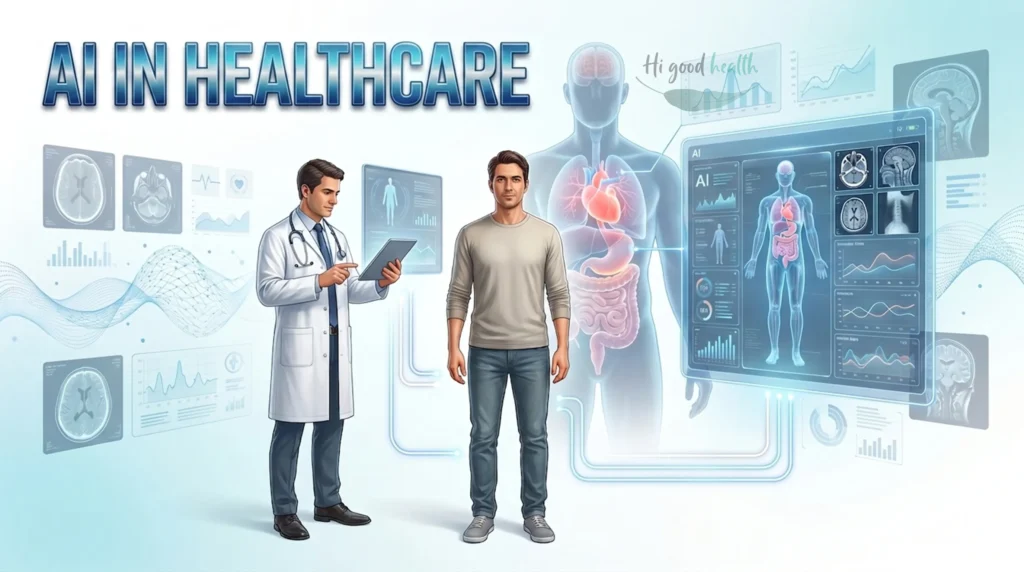
AI in Healthcare is already transforming your doctor’s office. Your doctor may already be using artificial intelligence to read your scans, predict your health risks, and write up your visit notes — and you might not even know it. In 2026, AI isn’t a futuristic concept in American healthcare. It’s already here, and it’s both impressive and worth watching carefully.
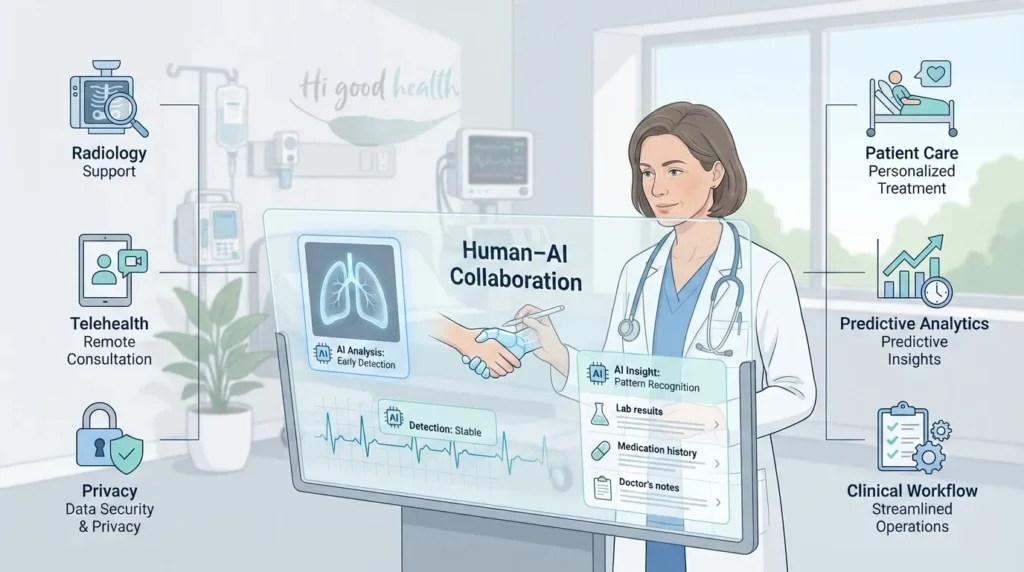
How AI in Healthcare Is Improving Patient Care
The promise is real. AI tools analyzing mammograms and CT scans have matched — and in some cases exceeded — radiologist performance for specific tasks when used as an assistive second set of eyes. A landmark 2026 Lancet study showed a 12% reduction in cancers missed between scheduled screenings when AI was involved. Predictive algorithms now flag patients at risk of heart failure or sepsis before symptoms spiral. Doctors using AI-powered documentation tools are reclaiming up to 25% of their time previously lost to paperwork.
But the pitfalls are just as real. Algorithms trained primarily on data from one population group can fail others — some AI tools have underestimated kidney disease severity in Black patients, delaying critical treatment. Privacy breaches are a growing concern, with millions of patient records exposed in recent cyberattacks. There’s also the quieter risk of automation bias — where a doctor trusts an AI result even when their clinical judgment says something different.
Perhaps the most human concern of all: as chatbots handle more triage and AI drafts more notes, patients — especially seniors, non-English speakers, and those with complex conditions — risk losing the empathy and personal connection that makes healthcare feel safe.
What Patients Should Ask About AI in Healthcare
The right question isn’t whether AI belongs in healthcare. It clearly does. The right question is: is it being used transparently, equitably, and with your best interests first?
You have the right to ask your doctor:
- “Was AI involved in my diagnosis?”
- “How is my data being protected?”
Those two questions alone can change everything.
All reference links valid and accessible on 15 MaY 2026
FDA – AI in Medical Devices:
U.S. Food and Drug Administration – Artificial Intelligence and Machine Learning in Software as a Medical Device
AMA – Responsible AI Principles:
American Medical Association – Principles for AI in Healthcare
Want to know exactly how to protect yourself, what questions to ask, and which AI tools are genuinely useful versus overhyped? The full guide walks you through it all — AI in Healthcare: Promise vs Pitfalls for Patients in 2026
