
About this series. Reverse Ageing is a ten-part series on what ageing science can do today, what it cannot do yet, and what longer, healthier lives would mean for work, money and family. This is Part 4: whether longer working lives crowd younger people out of the job market.
“If people remain healthy enough to work into their seventies or even eighties, will there still be room for the next generation to build successful careers?”
For decades, each generation has expected to inherit opportunities from the one before it. As older employees retired, younger workers stepped into leadership positions, bringing fresh ideas, new technologies, and different ways of thinking.
Retirement was not simply a personal milestone. It was also part of the natural rhythm of the labour market.
But what happens if retirement is delayed by ten, twenty, or even thirty years?
At a Glance
- The “lump of labour fallacy” is the mistaken belief that an economy contains a fixed number of jobs. Most economic evidence does not support it.
- Cross-country evidence does not show a simple trade-off in which more older workers means fewer younger ones. It depends on growth, labour demand, institutions and skills.
- Automation is likely to reshape employment far more profoundly than longer careers will.
- The sharper risk is not fewer jobs but slower promotion, where a limited number of senior roles are held for many more years.
- Longer careers will not be open to everyone equally. Physically demanding occupations may still end earlier.
- A longer working life should be an opportunity, not an obligation.
Why This Matters More Than Ever
Many countries are experiencing two powerful trends simultaneously.
First, populations are ageing. Improvements in healthcare and declining birth rates mean that the proportion of older adults is steadily increasing.
Second, advances in longevity science are raising the possibility that people may remain healthier for much longer than previous generations.
Traditionally, societies assumed that older workers would eventually retire, making room for younger employees. However, if millions of people choose or need to continue working beyond the age of 60, existing employment structures could come under pressure.
Young adults already face challenges entering competitive job markets. Rising education costs, rapid technological change, housing affordability, and economic uncertainty have made career progression less predictable than it was for previous generations.
It is understandable, therefore, that many wonder whether longer careers for older adults might delay opportunities for younger workers.
Fortunately, economic evidence suggests that the situation is far more encouraging than many headlines imply.
The “Lump of Labour” Myth
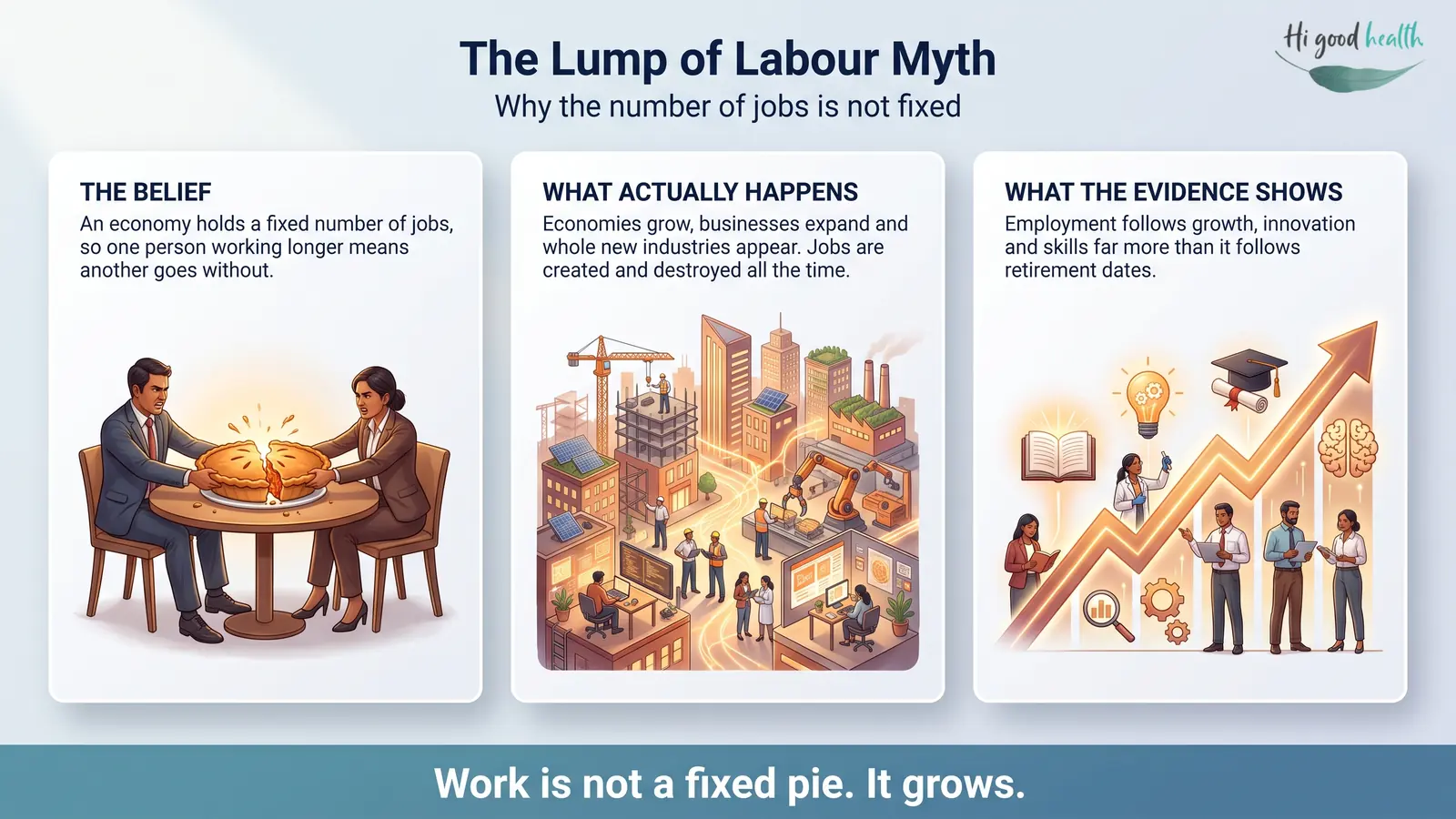
One of the biggest misconceptions in economics is the idea that there are only a fixed number of jobs available in society.
Economists refer to this belief as the “lump of labour fallacy.”
According to this assumption, if older people remain employed for longer, fewer jobs will be available for younger workers.
In reality, labour markets are far more dynamic.
Jobs are continuously created as economies grow, businesses expand, technologies emerge, and entirely new industries develop. A century ago, professions such as app developers, cybersecurity specialists, data scientists, AI engineers, renewable energy consultants, and social media managers simply did not exist.
Similarly, many jobs that future generations will perform have yet to be invented.
Research from organisations such as the OECD, the World Economic Forum, and the International Labour Organization consistently shows that employment levels are influenced far more by economic growth, innovation, productivity, and education than by the retirement decisions of older adults.
Cross-country evidence does not support a simple trade-off in which higher employment among older people necessarily produces lower employment among younger people. The relationship depends on broader economic conditions, labour demand, institutions, skills, and the structure of individual labour markets.
Rather than competing directly, different age groups frequently complement one another.
Experience and Innovation Need Each Other
Modern workplaces increasingly depend on collaboration between generations.
Longer careers could also reduce the loss of expertise that occurs when experienced employees leave organisations. If experienced employees remain active for longer, organisations may have more time to transfer that knowledge to younger colleagues.
Older employees contribute institutional knowledge, professional networks, leadership experience, strategic thinking, and crisis management skills developed over decades.
Younger employees often bring digital fluency, familiarity with emerging technologies, adaptability, and fresh perspectives.
The most successful organisations recognise that innovation rarely comes from one generation alone.
Consider healthcare. An experienced surgeon may possess decades of clinical judgment that cannot be learned from textbooks, while younger colleagues introduce robotic surgical techniques, AI-assisted imaging, and digital patient management systems.
Together, both generations improve patient care. The same principle applies across engineering, education, finance, scientific research, manufacturing, and technology.
Instead of replacing one another, generations increasingly solve different parts of the same problem.
The opportunity is not simply to keep older workers in the workforce. It is to make their experience transferable, so that each generation strengthens the next rather than occupying the same positions for longer.
Automation May Be a Bigger Threat Than Longevity
Ironically, the greatest challenge facing future employment may not be older workers at all. It may be automation.
Artificial intelligence, robotics, machine learning, and advanced software are transforming workplaces at an unprecedented pace.
Routine administrative tasks, repetitive manufacturing processes, basic accounting functions, customer service, and even some aspects of medical diagnosis are increasingly supported or partially replaced by intelligent systems.
The World Economic Forum’s Future of Jobs Report predicts that while millions of existing roles may disappear during the coming decade, millions of entirely new jobs are also expected to emerge.
The challenge will not simply be finding employment. It will be developing the skills needed for rapidly evolving occupations.
In this environment, age becomes less important than adaptability. Whether someone is 28 or 68, the ability to learn continuously may become the most valuable professional skill of all.
What Skills Will Matter Most in a Longevity Economy?
If careers become longer, the traditional idea of learning once and working forever will gradually disappear. Instead, successful professionals are likely to update their knowledge repeatedly throughout life.
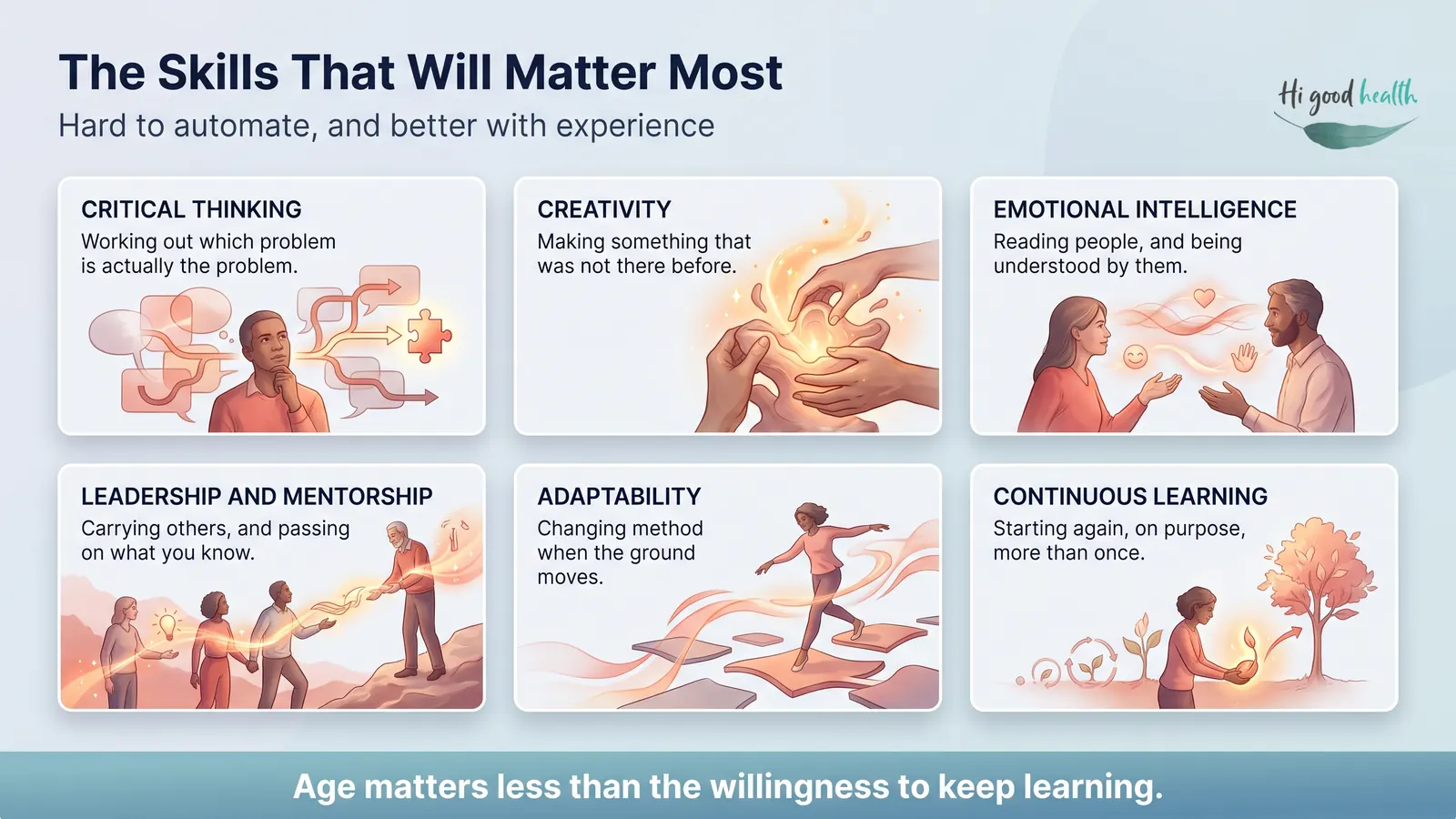
Technical skills will remain important, but many experts believe that uniquely human capabilities will become even more valuable as artificial intelligence becomes more capable.
These include:
- Critical thinking and complex problem-solving.
- Creativity and innovation.
- Emotional intelligence and interpersonal communication.
- Leadership and mentorship.
- Ethical decision-making.
- Adaptability and resilience.
- Continuous learning.
These skills are difficult to automate and tend to improve with experience.
Ironically, this means that healthy ageing could increase the value of experienced professionals rather than reduce it.
The Reality Check: Longer Careers Won’t Automatically Mean Fewer Jobs
Although fears about job competition are understandable, the future is unlikely to be a simple battle between younger and older workers.
Not everyone will be able or want to work into their seventies or eighties. Health status, financial circumstances, family responsibilities, and the physical demands of different occupations will continue to vary widely.
In some knowledge-based professions, experienced workers may be able to remain productive through consulting, remote work, mentoring, or flexible schedules.
In other fields, the number of positions may be more constrained, and physical demands may make very long careers difficult. Construction workers, nurses, firefighters and factory workers may need to retire earlier because of what their jobs ask of the body.
Similarly, not every older employee will choose to remain in full-time work. Many may prefer flexible schedules, consulting roles, mentoring, entrepreneurship, or volunteer work rather than traditional employment.
Economic cycles will also continue to influence job availability far more than demographics alone. Recessions, technological innovation, government policies, and global events have historically created much larger shifts in employment than changes in retirement patterns.
The future of work will therefore depend less on how old people are and more on how effectively societies adapt to longer, healthier lives.
Fewer Jobs — or Slower Career Progression?
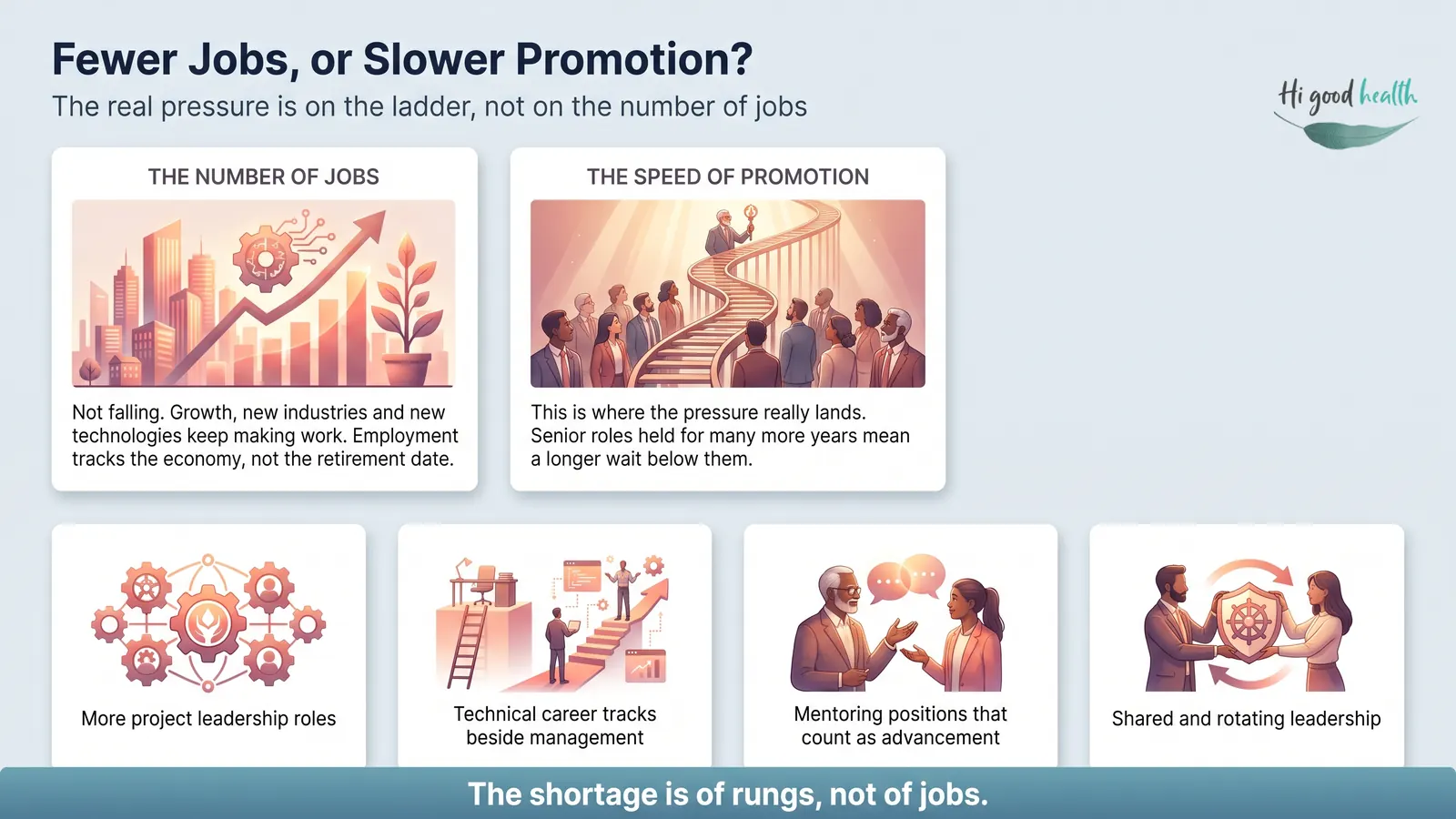
There is an important distinction between the total number of jobs in an economy and the speed at which people move through their careers.
Longer working lives may not reduce the number of jobs available to younger workers, but they could affect how quickly younger employees reach senior positions.
In organisations with a limited number of leadership roles, experienced employees who remain in those positions for many additional years could slow the rate of promotion below them.
This does not mean older workers should be pushed out to create vacancies. Instead, companies may need to rethink what career progression looks like.
More project leadership roles, technical career tracks, mentoring positions, shared leadership, and opportunities to move between management and specialist roles could allow experienced employees to keep contributing while creating new pathways for younger workers.
The challenge may therefore be less about creating a job for every generation and more about creating enough opportunities for people at different stages of their careers to grow.
How Companies Will Need to Adapt
If longer working lives become common, employers cannot simply expect people to work another twenty years under the same conditions. Workplaces themselves will have to evolve.
One of the most important changes will be greater flexibility. Hybrid work models, part-time roles, project-based employment, and phased retirement are already becoming more common.
These arrangements allow experienced employees to remain productive while balancing changing health needs and personal priorities.
Companies will also need to invest much more heavily in lifelong training.
In the past, professional development was concentrated during the early years of a career. In the future, employees may require regular reskilling every decade, or even every few years, as artificial intelligence, automation, and digital technologies continue to reshape industries.
Forward-thinking organisations are already creating continuous learning programmes that support employees of all ages. Rather than viewing education as a one-time investment, businesses increasingly recognise that learning must become an ongoing process throughout working life.
Another important shift will involve workplace design. Age-friendly offices, ergonomic equipment, preventive health programmes, mental well-being initiatives, and flexible scheduling may become standard features of organisations that hope to retain experienced talent.
Supporting healthy ageing at work will no longer be an employee benefit. It will become a business strategy.
A Multigenerational Workforce Could Become the New Normal
For perhaps the first time in history, workplaces may soon include four or even five generations working side by side. A young graduate in their twenties could collaborate with colleagues in their forties, sixties, and even eighties.
While this diversity may initially seem challenging, it also presents remarkable opportunities.
Older professionals often excel at strategic thinking, negotiation, mentorship, and long-term decision-making. Younger employees frequently bring expertise in emerging technologies, digital communication, and rapidly evolving consumer trends.
Organisations that successfully combine these complementary strengths are likely to become more innovative and resilient.
Mentorship may become particularly valuable. Instead of knowledge flowing only from senior employees to junior staff, workplaces could increasingly embrace reverse mentoring, where younger professionals teach digital skills and new technologies while experienced colleagues share leadership experience, industry knowledge, and critical thinking.
Learning, in other words, may become genuinely bidirectional.
Health Will Influence How Long People Can Work
Longer life expectancy does not automatically create longer careers. What matters is whether people remain healthy enough to participate in work if they choose to.
In the twentieth century, careers often lasted 35 to 40 years. If future careers extend to 50 or even 60 years, maintaining physical and cognitive health becomes essential for long-term employability.
This will vary greatly by occupation. Someone in a physically demanding job may face very different limits from someone whose work is primarily cognitive or office-based.
That makes healthy ageing increasingly relevant to the future of work. It also reinforces an important principle: longer careers should be an opportunity, not an obligation.
Your body and brain are not separate from your career. They are your career infrastructure.
What This Could Mean for Society
If people remain healthier for longer, societies may experience one of the largest workforce transformations since the Industrial Revolution.
Governments may redesign retirement policies to encourage flexible retirement rather than fixed age limits. Universities may increasingly offer lifelong education instead of focusing primarily on young adults.
Employers could prioritize continuous learning over recruitment based solely on age or experience. Economic productivity may increase as experienced professionals remain active contributors for longer periods.
At the same time, policymakers must ensure that younger generations continue to access meaningful opportunities. Supporting entrepreneurship, innovation, emerging industries, and workforce mobility will be essential to prevent stagnation.
Importantly, longer careers should not become an obligation. The ultimate goal is freedom of choice.
Some individuals may wish to continue working because they enjoy their profession. Others may prioritize travel, family, volunteering, research, or creative pursuits. A successful longevity society should provide opportunities, not expectations.
What You Can Do Today
Although the future workplace is still evolving, several practical lessons are already clear.
- Adopt a lifelong learning mindset. The ability to continually acquire new skills may become more valuable than any single qualification.
- Develop uniquely human skills. Creativity, communication, leadership, emotional intelligence, and ethical judgment are increasingly difficult for artificial intelligence to replace.
- Invest in your health. Exercise, nutrition, quality sleep, and preventive healthcare protect not only your well-being but also your long-term professional potential.
- Stay technologically curious. Understanding emerging technologies allows you to adapt rather than compete against them.
- Build professional relationships across generations. Diverse networks provide new perspectives, mentoring opportunities, and career resilience.
Preparing for a longer career begins long before retirement.
The Reverse Ageing Series
Ten articles on what longer, healthier lives would actually change.
- How Close Are We to Reversing Ageing in Humans? — the biology of ageing, and what has actually been reversed
- Will We Really Live to 100+ and Stay Young While Doing It? — lifespan, healthspan and what the evidence supports
- If Ageing Slows Down, Will Retirement Even Exist? — work, pensions and the hundred-year life
- Will Longer Lives Take Away Jobs from the Younger Generation? — work, promotion and the multigenerational workforce (you are here)
- If Parents Stay Healthy Till 90, Will Children Feel Less Responsibility?
- Will We Have Two or Three Careers in One Lifetime?
- Can Science Really Make 80 the New 40?
- Who Will Benefit — Everyone, or Only the Wealthy?
- The Longevity Economy
- The Future of Being Human
Key Takeaways
- Longer healthy lives do not necessarily reduce employment opportunities for younger generations.
- The idea that older workers “take” jobs from younger people is not supported by most economic evidence.
- Automation and artificial intelligence are likely to reshape employment more profoundly than longevity itself.
- The more realistic pressure is on the speed of promotion, not on the number of jobs.
- Future workplaces will increasingly value lifelong learning, adaptability, and collaboration between generations.
- Personal health may become one of the most important investments for sustaining long-term career success.
- The goal of longevity is not to work forever. It is to have greater freedom to choose how we spend longer, healthier lives.
Frequently Asked Questions
1. Will older workers reduce job opportunities for young people?
Current economic evidence suggests that employment is not a fixed resource. Innovation, economic growth, and new industries create jobs over time, allowing different generations to contribute simultaneously.
2. What is the “lump of labour fallacy”?
It is the mistaken assumption that an economy contains a fixed number of jobs, so that one person working longer must mean another person going without. Labour markets create and destroy jobs continuously.
3. Is automation a bigger challenge than longevity?
Most economists believe that artificial intelligence and automation will reshape the labour market more significantly than delayed retirement. Continuous learning and adaptability will therefore become essential career skills.
4. If there are still enough jobs, what is the real risk?
Slower promotion. Where an organisation has a limited number of senior roles and those roles are held for many more years, younger employees may wait longer to reach them, even though the total number of jobs has not fallen.
5. Can everyone work into their seventies?
No. Health, finances, family responsibilities and the physical demands of the job all vary. Construction workers, nurses, firefighters and factory workers may need to stop earlier than people in office-based roles.
6. What skills will matter most in the future?
Critical thinking, creativity, communication, leadership, emotional intelligence, digital literacy, and lifelong learning are expected to remain highly valuable across changing industries.
7. What should employers change first?
Flexibility and training. Hybrid models, part-time roles, project-based work and phased retirement keep experienced people productive, while regular reskilling keeps employees of every age current.
8. How should young professionals prepare?
Invest in continuous education, maintain good physical and mental health, embrace new technologies, and develop skills that complement rather than compete with artificial intelligence.
References
All references checked 21 September 2026.
- Organisation for Economic Co-operation and Development (OECD). OECD Employment Outlook 2024: The Net-Zero Transition and the Labour Market. Paris: OECD Publishing; 2024.
- World Economic Forum. The Future of Jobs Report 2025. Geneva: World Economic Forum; January 2025.
- International Labour Organization. World Employment and Social Outlook: Trends 2025. Geneva: ILO; January 2025.
- United Nations Department of Economic and Social Affairs, Population Division. World Population Prospects 2024: Summary of Results. New York: United Nations; 2024.
- Gratton L, Scott A. The 100-Year Life: Living and Working in an Age of Longevity. London: Bloomsbury Publishing; 2016.
- Scott AJ. The longevity economy. The Lancet Healthy Longevity. 2021;2(12):e828–e835. doi:10.1016/S2666-7568(21)00250-6
Disclaimer
This article is for general information and is not career, financial or medical advice. Decisions about your career, when to retire or your health should be taken with a qualified adviser or doctor who knows your circumstances.
