About this series. Reverse Ageing is a ten-part series on what ageing science can do today, what it cannot do yet, and what longer, healthier lives would mean for work, money and family. This is Part 3: what longer working lives would do to retirement, pensions and the shape of a career.
Ask a farmer in Bihar when he plans to retire and the question does not really land. Ask the woman who irons clothes at the corner, or the man who has driven an auto for thirty years, and you get the same blank look.
Retirement, as an event with a date, applies to a minority of Indians. Most people here work until their body stops them, and then they depend on their children.
So the question this article asks in the West, whether retirement at 65 still makes sense, has to be asked differently here. In India the question is not when you stop working. It is whether you will still be able to work at 70, and what happens to you if you cannot.
At a glance
Retirement ages were set for a world with shorter lives and different work. India’s own ages, generally 58 or 60, are administrative decisions, not biological ones.
The formal retirement system covers a minority of Indians. Most work in the informal economy, where there is no retirement age, no employer pension and no fixed exit.
The West wants longer working lives to fill a labour shortage. India has the opposite problem, a large young workforce and not enough jobs, so the same argument does not transfer.
The state old-age pension for a person below the poverty line is 200 rupees a month from the centre, rising to 500 after 80, with states adding what they choose. Family support, not the state, is the real Indian pension.
For most Indians the retirement plan is health. Staying physically able to earn into your late sixties is worth more than any investment product, which is why the previous two articles in this series matter more here than anywhere.
Where the retirement age actually came from
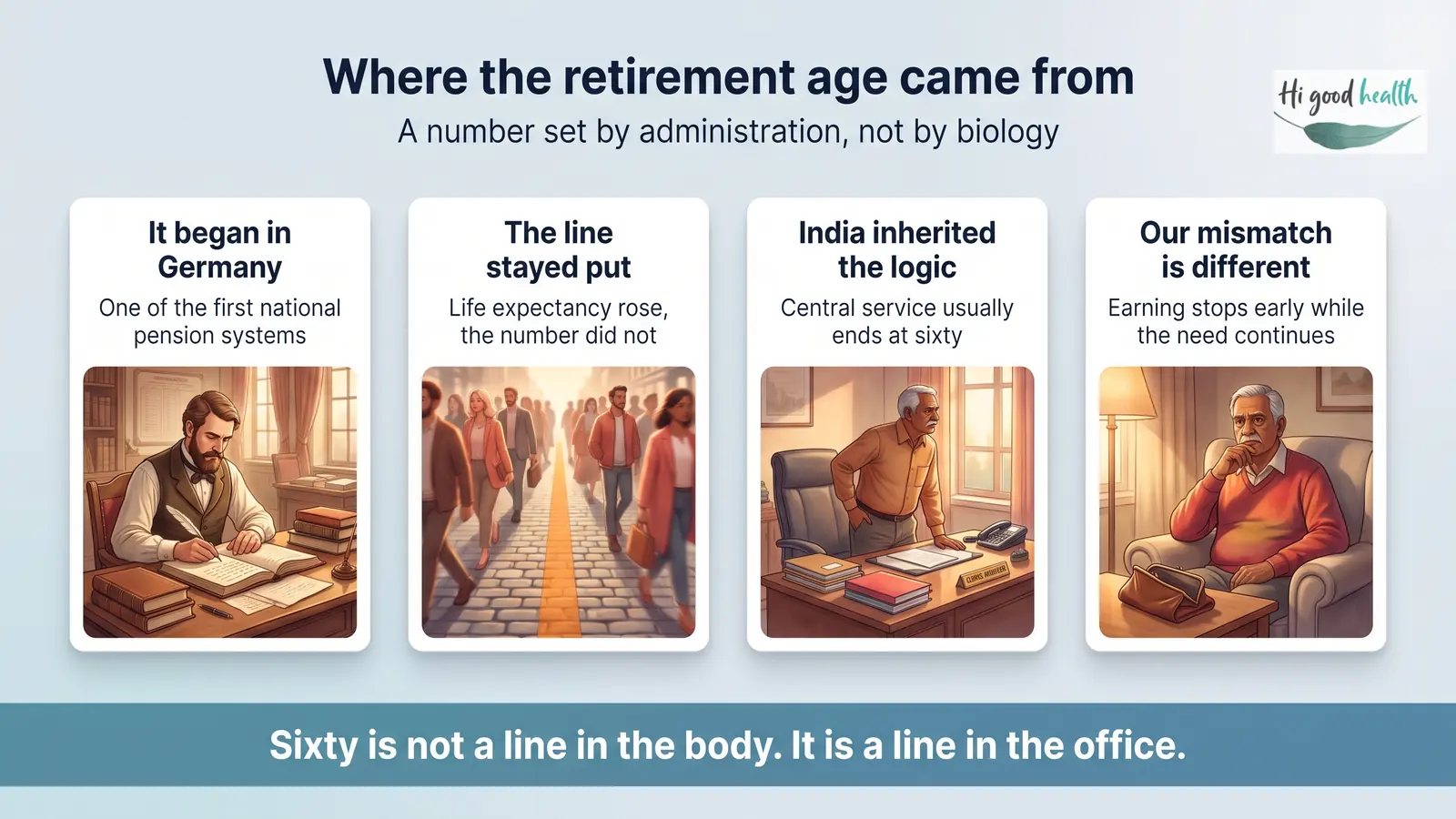
Most people assume 60 is a biological line. It is an administrative one.
Germany introduced one of the first national pension systems in the 1880s under Chancellor Otto von Bismarck. Benefits began at an age most citizens never reached. The point was to support people too old to work, not to fund twenty years of leisure.
Other countries copied the idea as industry grew, because a fixed age made pensions and staffing easy to plan. Life expectancy then rose for decades while the age mostly stayed put.
India inherited the same logic. Central government service generally ends at 60, several state services at 58 or 60, and most private employers set 58 or 60 by contract. None of those numbers came from medicine.
The mismatch in rich countries is now obvious: people spend twenty to thirty years drawing a pension that was designed for five.
India’s mismatch is a different shape. We do not mostly have people drawing long pensions. We have people who stop being employable long before they stop needing an income.
Who in India actually retires?
This is the fact the international version of this article does not have to deal with.
The great majority of Indian workers are in informal employment, without a written contract, an employer pension or paid leave. There is no retirement age in that world because there is no retirement.
The people who do retire in the way the word implies are a minority: government servants, public-sector staff, employees of larger private firms with EPF, and the professional middle class.
For everyone else, work tapers rather than ends. A shopkeeper hands more of the counter to a son. A mason moves from carrying to supervising, then to occasional days. A farmer keeps going with less land under his own hand.
That is already phased retirement. It was not designed, it is not paid for, and nobody calls it that.
The 100-year life, and whether it applies here
Researchers describe the coming era as the 100-year life, in which reaching a hundred becomes ordinary rather than remarkable.
The economists Lynda Gratton and Andrew Scott argued that longer lives break the three-stage structure of education, work, retirement, and replace it with several overlapping stages: study, career, study again, a second career, then part-time or advisory work into the seventies.
It is a persuasive model, and it is built for a country where most people have a career in the first place.
Applied to India honestly, it splits in two.
For the urban, salaried, degree-holding minority it fits well, and is already visible: the banker who becomes a consultant at 55, the engineer who teaches, the doctor who moves into administration.
For the majority it describes a life they do not have access to. Returning to university at 50 assumes there was a university at 20, and savings to live on while studying.
Longevity will not distribute itself evenly here, and pretending otherwise is how policy for India gets written for somebody else’s country.
From one career to many, and the Indian version of that
Longer, healthier lives are already changing how careers run.
Earlier generations often stayed with one employer or one trade. Now skills date within a decade. Automation and AI keep reshaping what work exists.
AI may also help older workers stay productive, by taking over repetitive tasks and letting experience go into judgement, mentoring and decisions.
Someone starting at 25 and staying well until 85 could work for six decades. Very few trades stay recognisable for that long.
So several careers rather than one becomes normal. A software engineer teaches. A doctor moves into hospital management. A businessman spends his sixties on boards and mentoring.
The Indian pattern today usually runs the other way, and that is worth naming.
A great many Indians change work in their fifties not because they chose to, but because the first job went or the body gave out. The second job pays less and carries no security. Career change here is more often a fall than a step.
Turning that around needs something India mostly lacks: affordable, credible retraining for adults who are past the age employers advertise for.
Which brings up the thing everybody in India knows and few articles mention. Age discrimination in Indian hiring is open. Job advertisements routinely carry age caps, government recruitment has them formally, and a candidate over 45 is often filtered before anyone reads the experience. A longer working life is meaningless if nobody will hire you at 52.
Phased retirement, and what India has instead
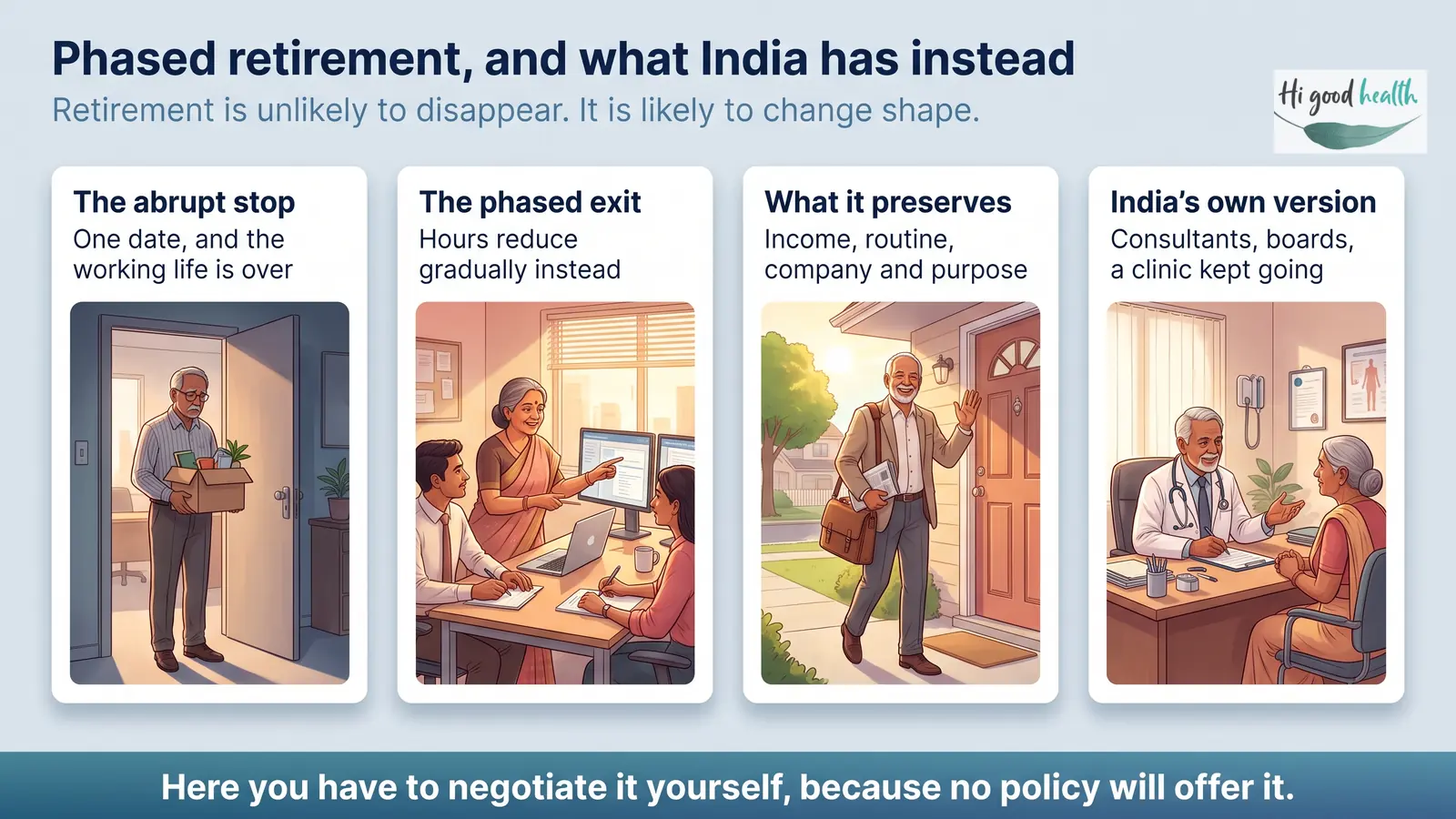
Retirement is unlikely to disappear. It is likely to change shape.
Employers elsewhere are experimenting with phased retirement: reducing hours gradually rather than ending on one date. It keeps institutional knowledge in the building and gives younger colleagues someone to learn from.
For the person retiring it is not only a financial change, it is an identity change. Part-time work preserves income, routine, company and a reason to leave the house, and all four are associated with better cognitive and emotional health in later life.
India has a version of this, though it is rarely formalised. Retired government officers return as consultants. Professors take extension or move to private colleges. Executives join boards. Doctors keep a clinic going after the hospital job ends.
What is missing is any of it being available below the professional class, and any of it being planned. If you want a phased exit in India, you generally have to negotiate it yourself, before you need it, because no policy will offer it to you.
The reality check, and it is harsher here
Before imagining everyone working into their eighties, separate what is possible from what is likely.
Longevity science is moving, but most people still develop heart disease, diabetes, arthritis and dementia as they age, and in India those arrive earlier than in the West.
Healthy life expectancy has improved more slowly than life expectancy everywhere. We are living longer without being well for all of it.
That distinction decides this whole question. The future of retirement depends less on how long we live than on how long we stay well enough to work.
And work is not one thing. A software developer, an architect, a professor or a consultant may comfortably continue past 70. A construction worker, a farmer, a nurse on shifts, a factory hand or a delivery rider will not, and in India that is most of the workforce, not a minority of it.
So a general increase in the retirement age would be neither practical nor fair here. It would extend working life for people who sit down to work and simply remove support from people who do not.
The useful conversation is not about compelling anyone to work longer. It is about making it possible for people who want to stay engaged, and making sure the people who physically cannot are not left with 200 rupees a month.
The money, stated plainly
This is where Indian reality and the international discussion part company completely.
The formal arrangements, EPF and the Employees’ Pension Scheme, NPS, and government pensions, cover the organised sector. They are real and they matter, and they reach a minority of Indian workers.
Outside that, the state’s provision is the National Social Assistance Programme. Under the Indira Gandhi National Old Age Pension Scheme, a person aged 60 or above and below the poverty line receives 200 rupees a month from the central government, rising to 500 rupees a month after 80. States may add to it, and several do, by varying amounts.
Two hundred rupees a month is not a retirement income. It is not intended as one. India’s actual pension system is the family, and it has always been the family.
That is the part longevity puts under strain. The system assumed children living nearby, one household, and a parent needing support for perhaps ten years. Migration has spread families across cities, and a parent may now need support for twenty-five years, often with medical costs attached.
So the Indian longevity question is not how to fund a longer retirement. It is what happens to a family when two generations of it are old at the same time.
What longer working lives would mean for India specifically
Here the international argument reverses, and it is worth being blunt about it.
In Europe, Japan and increasingly China, the case for longer working lives is a labour shortage. Birth rates have fallen, the workforce is shrinking, and older workers staying on helps fill the gap.
India does not have that problem. We have a young population and a well-documented shortage of good jobs, not of people to fill them. So the same policy lands differently: every older worker who stays on occupies a position a younger entrant wanted.
The honest answer is that this is not a straight competition. Work is not a fixed number of jobs shared out, and an experienced worker who earns and spends creates demand for other work. Economists generally reject the fixed-quantity idea.
But the political reality here is that youth unemployment is the live issue, and any argument for longer careers has to answer it rather than ignore it.
What probably fits India better is not “work longer” but “work differently after 60”: advisory, teaching, training, part-time and self-employed work that uses experience without occupying an entry-level post.
Healthcare would also have to change, from treating advanced disease to catching it early. That is a much bigger shift for India than for a country with strong primary care, and it is the same shift the rest of this series keeps arriving at.
And age diversity is a genuine asset. Older workers bring judgement and institutional memory; younger ones bring current skills and fresh approaches. Indian workplaces are unusually hierarchical by age, which cuts both ways, and mostly wastes both.
What you can do today
Whether you stop at 58, 60 or 70, planning starts far earlier than the date.
Treat your health as the retirement asset it is. For most Indians it is a bigger determinant of income after 60 than any mutual fund, because the ability to keep earning is the plan. Blood pressure, blood sugar, weight and daily walking are, in that sense, financial decisions.
Assume you will need to be employable at 55. Keep one skill current that somebody would pay for outside your present job. Given how Indian hiring treats age, having something to sell independently matters more here than a CV does.
Negotiate a phased exit before you need it. Consultancy, retainer or part-time arrangements are normal in India for people who ask early and have a relationship. They are almost impossible to arrange the month after you leave.
Plan money for a longer life than your parents had. If you retire at 60 and live to 85, the savings have to cover twenty-five years, and a large share of Indian medical spending still comes straight out of pocket. Health insurance bought young is cheaper than health insurance bought at 55.
Have something that is not the job. Work in India often carries a person’s entire identity and social circle. Losing it at 60 with nothing arranged is a health event as much as a financial one. Teaching, volunteering, a trade association, a temple committee, a family business, anything with a role in it.
And if you support ageing parents, look at the arithmetic now. Longer lives mean longer support, and it is easier to plan for at 40 than to absorb at 55.
The Reverse Ageing Series
Ten articles on what longer, healthier lives would actually change.
- How Close Are We to Reversing Ageing in Humans? — the biology of ageing, and what has actually been reversed
- Will We Really Live to 100+ and Stay Young While Doing It? — lifespan, healthspan and what the evidence supports
- If Ageing Slows Down, Will Retirement Even Exist? — work, pensions and the hundred-year life (you are here)
- Will Longer Lives Take Away Jobs from the Younger Generation?
- If Parents Stay Healthy Till 90, Will Children Feel Less Responsibility?
- Will We Have Two or Three Careers in One Lifetime?
- Can Science Really Make 80 the New 40?
- Who Will Benefit — Everyone, or Only the Wealthy?
- The Longevity Economy
- The Future of Being Human
Key takeaways
Retirement in India is a minority experience. Most people work in the informal economy where there is no retirement age, no employer pension and no exit date, and the taper happens whether or not anyone plans it.
The state old-age pension is 200 rupees a month for a person below the poverty line, 500 after 80, with state top-ups. The real Indian pension system is the family, and migration and longer lives are both straining it.
The Western case for working longer rests on a labour shortage India does not have. The Indian version of the argument has to answer youth unemployment, and “work differently after 60” fits better than “work longer”.
For most people here the retirement plan is health. Staying well enough to earn into your late sixties is worth more than any product sold as retirement planning.
Frequently asked questions
1. What is the retirement age in India?
There is no single one. Central government service generally ends at 60, state services at 58 or 60, and private employers set their own, usually 58 or 60, by contract. For the informal sector, which is most of the workforce, there is no retirement age at all.
2. How much is the government old-age pension in India?
Under the Indira Gandhi National Old Age Pension Scheme, the central contribution is 200 rupees a month for a person aged 60 to 79 living below the poverty line, and 500 rupees a month from 80. States may top this up, and the amounts vary considerably between states.
3. Will Indians have to work longer as life expectancy rises?
Many already do, without calling it that. Formal retirement ages may rise gradually, but the bigger question for India is whether people stay healthy enough to keep earning, and whether employers will hire anyone over 50.
4. Does an older person working longer take a job from a younger one?
Economists generally reject the idea that a country has a fixed number of jobs to share out, and an older worker earning and spending supports demand for other work. In India, where youth unemployment is high, the political concern is real even where the economics does not support it, which is why advisory and part-time roles fit better than blocking entry-level posts.
5. What is the 100-year life?
The idea, from the economists Lynda Gratton and Andrew Scott, that as living to 100 becomes common the three-stage structure of education, work and retirement gives way to several overlapping stages, with repeated periods of learning and more than one career.
6. How much should I save if I retire at 60 in India?
That depends on your costs and is a question for a qualified financial adviser, not an article. What is worth knowing is the shape of the problem: a retirement at 60 with a life expectancy in the eighties has to fund twenty-five years, and a large share of Indian medical spending is still paid out of pocket.
References
- Gratton L, Scott A. The 100-Year Life: Living and Working in an Age of Longevity. London: Bloomsbury Publishing; 2016.
- Ministry of Rural Development, Government of India. National Social Assistance Programme: Indira Gandhi National Old Age Pension Scheme.
- International Institute for Population Sciences. Longitudinal Ageing Study in India (LASI), Wave 1. Mumbai: IIPS; 2020.
- United Nations Population Fund. India Ageing Report 2023.
- Ministry of Statistics and Programme Implementation, Government of India. Periodic Labour Force Survey (PLFS) Annual Report.
- World Health Organization. Decade of Healthy Ageing 2021-2030. Geneva: WHO; 2021.
- World Health Organization. World Report on Ageing and Health. Geneva: WHO; 2015.
- United Nations, Department of Economic and Social Affairs. World Population Prospects 2024.
Disclaimer
This article is for general information and is not financial or medical advice. Decisions about retirement, savings, insurance or your health should be taken with a qualified adviser or doctor who knows your circumstances.
