
In Part 1 we covered the seven hidden reasons balance gets worse with age. In Part 2 we set out a 17-exercise protocol to rebuild stability. Those two build the defences inside the body.
This part builds the ones outside it, and this is where an Indian home differs from the homes most fall-prevention advice is written for.
Our bathrooms are wet by design. Our floors are polished stone. Our elders sit on the floor, use squat toilets, keep the puja room up a step, and wear back-less chappals indoors all day. None of that is wrong. All of it changes what a safe house looks like.
At a glance
The bathroom is the highest-risk room in an Indian house, and it is riskier here than the international version of this article assumes, because the whole floor gets wet rather than a separate shower tray.
The single most valuable change for many Indian families costs less than a device: a commode. Getting up from a squat toilet is one of the commonest ways an older person here falls or strains.
Footwear indoors matters more than most people expect. The open, back-less rubber chappal that almost every Indian elder wears at home is one of the least stable things they could have on their feet.
Technology is covered honestly. Smartwatch fall detection exists here; the monitored emergency pendant that international guides assume largely does not, and in most Indian households the alert system is a family member in the next room.
There is an action plan broken into today, this week, this month and this quarter, and a section written for sons, daughters and daughters-in-law rather than for the elder.
Where falls actually happen
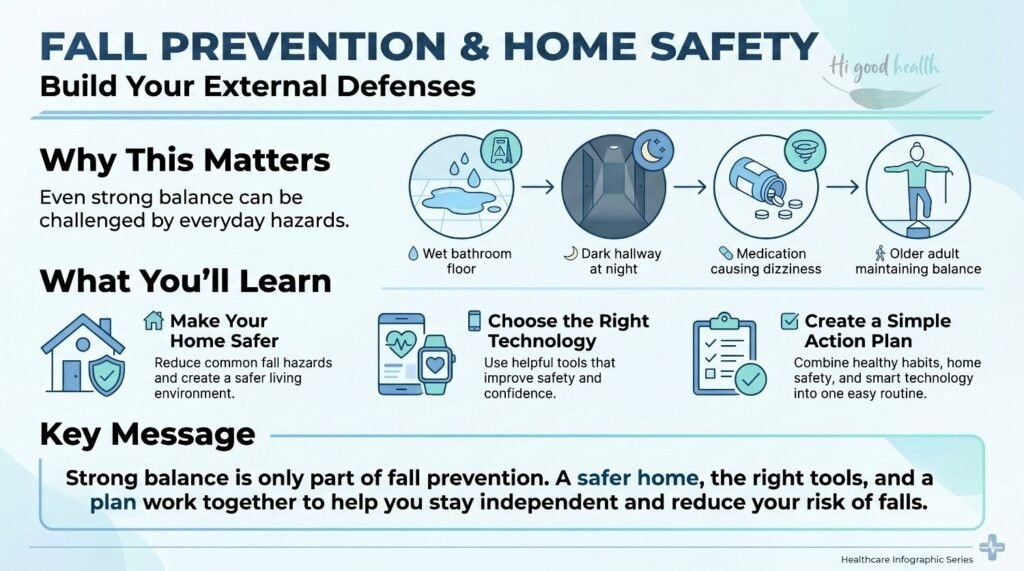
Most falls in older people happen in and around the home, and most are caused by things that take minutes to fix.
In India there are three that come up again and again: the wet bathroom floor, the unlit passage at 2 AM, and the step nobody thinks of as a step, at a doorway, a threshold, or the entrance to the puja room.
There is also a quieter one. A fall in an Indian family is often not reported. An elder who slips and gets up is embarrassed and says nothing, and the family only learns about it after the second one, which is the one that breaks a hip.
A near-fall is information, not a shame. If a parent tells you they slipped, that is the moment to act, not the moment to reassure them.
Room by room
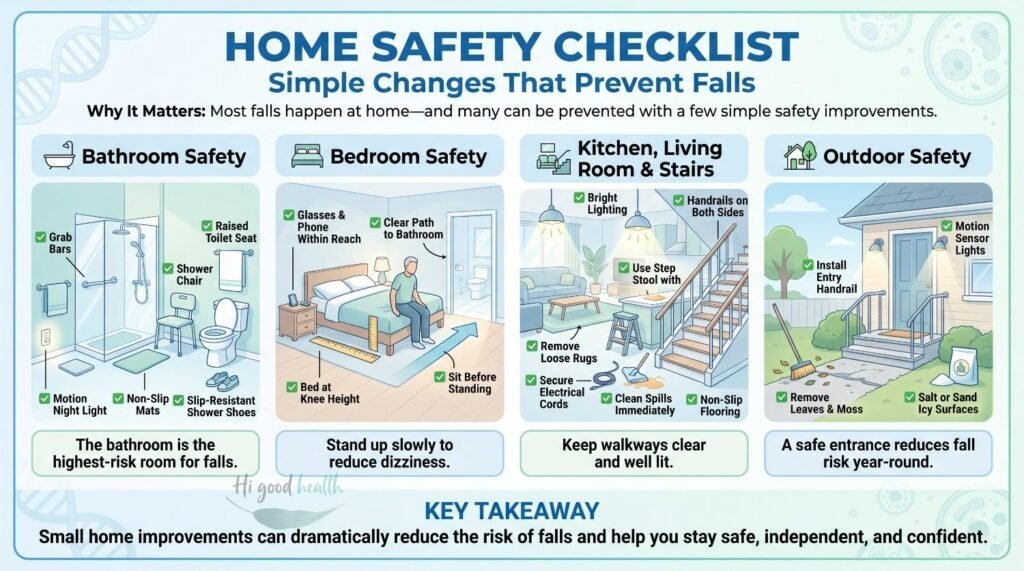
The bathroom
This is the room to fix first, and in an Indian house it needs more than the standard advice.
- Grab bars beside the toilet and in the bathing area. Bolted into the wall, never suction cups. A carpenter or plumber can fit them in an hour. This is the single highest-value fitting in the house.
- The wet floor is the whole problem. Indian bathrooms are wet-area design: the floor gets soaked every time anyone bathes, and it stays wet. Anti-skid tiles, a liquid anti-slip coating, or rubber matting in the bathing area all help. Polished granite or vitrified tile that shines is the worst possible bathroom floor.
- Squeegee the floor after every use and keep the drain clear. This costs nothing and works.
- A plastic bathing stool. Sitting to bathe, rather than standing on a wet floor with soap on the feet and eyes closed while pouring water, removes the most dangerous moment of the day.
- A commode, or a commode chair over the squat pan. For an older person with knee trouble, getting up from a squat is both hard and unsteady. A western commode conversion is a plumbing job. A commode chair that stands over the existing pan costs a fraction of that and needs no plumber.
- A raised seat if a commode is already there and standing up is an effort.
- A light that works, and a nightlight on the way there. The bathroom trip in the dark is the single most common fall scenario there is.
The bedroom
- Bed height. Sitting on the edge, the feet should rest flat on the floor with the knees at about 90 degrees. Many Indian beds are high, and a diwan or a mattress on the floor is low. Both are harder to get out of than a bed at the right height.
- Beside the bed: phone, spectacles, torch, water. Spectacles go on before the feet go down, every single time.
- A clear path to the bathroom. No chappals in the walkway, no bags, no charging cables, no stool.
- How to get up. Roll onto the side, push up to sitting with the arms, sit for ten to fifteen seconds, then stand. That pause is not laziness. It lets the blood pressure catch up, and skipping it is why people feel the room swim when they stand.
- Inverters and power cuts. In a house that loses power, an emergency light on the bedside table is a safety fitting, not a convenience. So is keeping the torch charged.
Living room, kitchen and passages
- Loose mats and durries. Take them up, or fix them down with double-sided tape. A curled edge on a polished floor is the classic trip.
- Floor-level living. Many Indian elders sit on the floor to eat, pray or work. That is fine and often good for the joints, but getting up from the floor is a high-risk moment. A low sturdy stool or a chair with arms placed nearby, used to push up from, makes it safe. A plastic chair that slides does not.
- Thresholds and door sills. The raised sill at a bathroom or balcony door, and the single step up into a puja room or a kitchen, are the steps people trip on because they do not register them as steps. Paint or tape the edge in a contrasting colour.
- Cables. Along the walls, never across a walking line. Extension boards for coolers and fans are a common culprit.
- Reaching up. Move the daily-use things down to between waist and shoulder. A stool with a handrail if something high is needed, never a plastic chair and never a stack of anything.
- Spills, and the kitchen floor. Oil on a stone floor is dangerous in a way water is not. Wipe it at once, and keep a cloth within reach.
- Slippery floors generally. If the floor shines, it is a problem. Matte or anti-skid tiles, kota or textured stone, or an anti-slip coating on the existing floor all reduce the risk. Smaller tiles are safer than large ones, because more grout lines means more grip.
Stairs
- A handrail on both sides, which very few Indian houses have. If only one is possible, put it on the side the person uses going down, because down is when falls happen.
- Mark the edge of every step with contrasting tape or paint. Marble stairs with no visual edge are hard to judge, especially in poor light.
- Light at the top and the bottom, with a switch at both ends.
- Terrace and rooftop stairs deserve special attention. They are often steep, often open, often unlit, and elders use them daily for drying clothes and for the sun.
Outside the house
- Uneven approach paths, the open drain at the gate, and broken paving are the usual hazards. So is the gap between the gate and the road.
- The monsoon changes everything. Wet stone steps, moss on the north wall, a slippery ramp. Clean moss off before the rains, not after someone slips.
- A handrail at the entrance, and a light that comes on when someone approaches.
- Crowded, uneven Indian footpaths are a real risk for an elder walking outside. Walking in the morning when the streets are quieter is safer than walking in the evening.
Footwear, and the chappal problem
The feet are where the body meets the ground. Bad footwear sends the brain bad information about the surface.
The default Indian house shoe is the worst one available. An open rubber chappal with no back strap has to be gripped with the toes to stay on, offers no heel support, and is exactly the wrong thing on a wet bathroom floor or a polished passage.
Wear instead: a flat, firm-soled slipper or shoe with a back strap, a non-slip rubber sole, and a snug fit. Velcro is easier than laces for stiff hands, and lets the fit be adjusted when the feet swell in the afternoon.
For the bathroom specifically, a slip-resistant bathroom slipper with deep rubber treads and a back strap. This is a small purchase that removes a large risk.
Avoid: walking barefoot on a wet or polished floor, walking in socks on stone, worn-out slippers with a smoothed sole, and any slipper the wearer has to shuffle to keep on.
Technology, honestly
Smartwatch fall detection
Apple Watch, Series 4 and later, detects hard falls using its motion sensors and, if there is no response within a minute, places an emergency call and sends the location to emergency contacts. Several Android and Indian-market watches now offer something similar, with more variable reliability.
Two Indian caveats. The emergency number the watch dials must be set correctly for India, and the family contacts must be filled in, because that is the part that actually works here.
A watch calling an emergency line is only useful if someone answers and can reach the house, which varies a great deal between a metro and a small town.
Fall detection of this kind works best for a hard, fast fall. It often misses a slow slide down a wall, which is a common way older people go down.
Medical alert systems
The pendant with a 24-hour monitoring centre behind it, which most international fall-prevention advice takes for granted, barely exists as a consumer product in India. It is worth knowing that before you go looking for one.
What replaces it here is a family and a phone. A simple mobile with large keys and two or three speed-dial contacts, kept on the person rather than in another room, does most of the job. So does a house where somebody is usually within earshot.
Some Indian hospital chains and home-healthcare providers offer emergency response subscriptions in the larger cities. If you are considering one, ask two questions before paying: how long does the ambulance actually take to your address, and which hospital does it go to.
Emergency numbers worth putting on the fridge
112 is the single national emergency number and works across India from any phone.
108 is the ambulance number in most states, and in many places it is the faster route to an actual vehicle.
The nearest hospital with an orthopaedic emergency, written down, not looked up during a crisis. In a fracture, where the ambulance takes the person matters as much as how fast it comes.
Write all three on paper and stick them where they can be seen. A number saved only in a phone is no use to a neighbour who arrives first.
Smart insoles and gait monitoring
Sensor insoles that sit in an ordinary shoe track walking all day and can flag a change in gait speed or stride weeks before a fall. It is a genuinely promising idea, still in validation, and not yet meaningfully available in India.
Prediction rather than detection
The direction of the field is away from telling you a fall happened and towards warning that one is becoming likely, by learning a person’s normal walk and noticing when it changes. Reported accuracy in controlled studies is high; real-world validation is still thin. Treat it as coming, not arrived.
Cheap things that work
- Motion-sensor lights in the passage and outside the bathroom. Inexpensive, no wiring in the plug-in versions, and they remove the fumbling for a switch in the dark.
- A smart speaker, if the elder is comfortable with it, for hands-free calls and medicine reminders. Both the common ones understand Hindi.
- A video doorbell, so the door does not have to be answered in a hurry.
- An emergency light or a charged torch at the bedside, for power cuts.
For sons, daughters and families
If you are reading this because you are worried about a parent, the difficulty is usually not the grab bar. It is the conversation.
Lead with independence, not with fear. “I want you to be able to manage on your own for as long as possible” lands very differently from “you’re going to fall”.
Fix the house, not the person. “Let’s make the bathroom safer” is not an accusation. “You need help” is.
Do it together. Walk through the house with the list. Let them decide the order.
Start with one thing. One grab bar. One nightlight. One pair of proper slippers. The first change makes the next one easier.
Ask about the near-falls. Directly, and without alarm. “Have you slipped at all recently?” Many elders will not volunteer it.
If you live in another city, the two things that help most are a bathroom that has been made safe and a neighbour or relative who checks in. Both are more useful than any device you can post home.
The action plan
Everything from all three parts, in order.
Today
- Do the five-minute daily set from Part 2: single-leg stance, calf raises, tandem walk.
- Put a light on the bedroom-to-bathroom path.
- Remove one loose mat or one obstacle from that path.
- Write 112 and 108 on paper and stick it where it can be seen.
This week
- Take the five balance self-tests from Part 2 and write down the scores.
- Walk through the whole house looking for wet floors, thresholds, cables and unlit corners.
- List every medicine, supplement and over-the-counter tablet being taken.
- Replace the indoor chappals with something that has a back strap and a grippy sole.
This month
- Get the medicines reviewed by a doctor, particularly blood pressure and sleep medication, which are common causes of dizziness on standing.
- Get the eyes checked if it has been over a year. Cataract is very common here and is a major fall risk.
- Get vitamin D and B12 checked. Deficiency of both is widespread in India, including in people who spend time outdoors.
- Fit the bathroom grab bars and a bathing stool.
- Decide about the commode or commode chair.
- Begin Phase 1 of the Part 2 exercises.
This quarter
- Work through all four exercise phases.
- Re-test the balance and compare with the baseline.
- Fix the floors that shine, starting with the bathroom.
- Improve the diet: enough protein, calcium and fibre, which matter for bone and muscle as much as for the gut.
- Seven to eight hours of sleep. Poor sleep and night-time confusion contribute to night falls.
The last word
Across three articles we have covered the biology of balance, a 17-exercise protocol with real evidence behind it, and now the house and the tools.
The house is the cheap part, and in India it is also the part that is most often ignored, because a slippery bathroom floor is so normal that nobody sees it as a hazard.
Start with one thing. One grab bar, one light, one pair of slippers with a back strap, one conversation about the medicines.
Balance is not decided by age. It is decided by what is under your feet and what you do every day.
Read this first: this is part 3 of the falls series. Part 1 covers why older people fall and what a doctor should review, in Fall Prevention for Seniors.
Key takeaways
Changing the house is cheaper and works better than buying a device. In India it is also the step most often skipped.
The bathroom is the room to fix first, because the whole floor is wet by design. Grab bars, a bathing stool, anti-skid flooring and a squeegee.
A commode or a commode chair over the squat pan is one of the highest-value changes for an older person with weak knees.
Back-less chappals are a fall risk, indoors and especially in the bathroom. A back strap and a grippy sole change the odds.
Thresholds, door sills and the single step into the puja room are the steps people trip on, because they do not read as steps. Mark them.
A near-fall that nobody mentions is the warning that gets wasted. Ask directly.
112 and 108 on paper, and the nearest orthopaedic emergency written down before it is needed.
Review the plan after any fall, near-fall, new medicine or change in eyesight.
Frequently asked questions
What is the single most useful change in an Indian house?
Making the bathroom safe: grab bars, a bathing stool, an anti-skid floor and a light on the way there. The wet floor and the night-time trip to it account for a large share of falls in older Indians.
Should we convert the squat toilet to a commode?
For an older person with knee or hip trouble, usually yes. If the plumbing work is not practical, a commode chair that stands over the existing pan does most of the same job for a fraction of the cost and needs no plumber.
Are anti-skid tiles worth the cost of redoing a floor?
In the bathroom, usually yes. Elsewhere, a liquid anti-slip coating or rubber matting on the worst patch is a cheaper first step. The rule of thumb is simple: if the floor shines, it is slippery when wet.
Do medical alert pendants exist in India?
Not in the monitored, subscription form they take abroad. Some hospital chains and home-healthcare providers in larger cities offer emergency response services. For most families a simple phone kept on the person, with speed-dial contacts, does more.
Is a fall-detection smartwatch worth buying?
It can help for someone who lives alone and will actually wear and charge it. Set the emergency contacts and check the emergency number is right for India. It detects hard falls well and slow slides poorly, so it is one layer, not a solution.
Which number should we call after a fall?
112 works everywhere in India. 108 is the ambulance service in most states and is often the faster route to a vehicle. Keep both written down, along with the nearest hospital that has an orthopaedic emergency.
My mother slipped once but says she is fine. Should I do anything?
Yes. One slip is the best warning you will get, and it is the one most often dismissed. Check the bathroom, the footwear, the lighting and the medicines, and mention it to her doctor.
Should we remove all the mats and durries?
The loose ones on hard floors, yes. If one is being kept, tape it down and make sure the edges lie flat. Curled edges on polished stone are a classic trip.
Is walking barefoot at home safer or riskier?
Barefoot on a dry, non-slippery floor is fine and gives good sensory feedback. Barefoot on a wet bathroom floor or a polished stone passage is one of the riskiest things an older person does at home.
Glossary
Fall detection: technology that recognises a fall has happened and raises an alert.
Fall prediction: technology that tracks changes in walking over time and warns that risk is rising, before a fall.
Accelerometer: the sensor in a phone or watch that measures movement, and the basis of fall detection.
Orthostatic hypotension: a drop in blood pressure on standing up, which causes dizziness. A common side effect of blood pressure medicines.
Anti-skid or matte tile: floor tile with a textured surface that keeps grip when wet, as against polished vitrified or granite floors, which do not.
Commode chair: a chair with a seat and an opening, placed over an existing squat pan, so that an older person does not have to squat.
Disclaimer
This article is for general education only and is not a substitute for individual medical advice. Talk to a doctor before changing a health routine, and get any fall, dizziness on standing, or new unsteadiness assessed. In an emergency call 112, or 108 for an ambulance.
Sources
- Fall Detection Technologies, 2026 scoping review, 243 studies. Frontiers in Public Health.
- Longitudinal Ageing Study in India (LASI), International Institute for Population Sciences.
- Innovative Fall Prevention Approaches. Medical Journal of Australia, 2025.
- iSeFallED Trial: ED-Based Fall Prevention. BMC Geriatrics, 2026.
- AI for Fall Detection Survey. ScienceDirect, 2025.
- Ministry of Health and Family Welfare, National Programme for Health Care of the Elderly.
- National Health Mission. Emergency Response Service 108.
