Part of the HiGoodHealth peptides series.
- Our pillar guide, Peptides in India: What They Are, Which Ones Are Real Medicines, and What Is Being Sold to You, covers the science and the landscape.
- Are Peptides Legal in India? What the Law Actually Says covers the law in full.
- This article carries the compound-specific picture for BPC-157.
At a glance
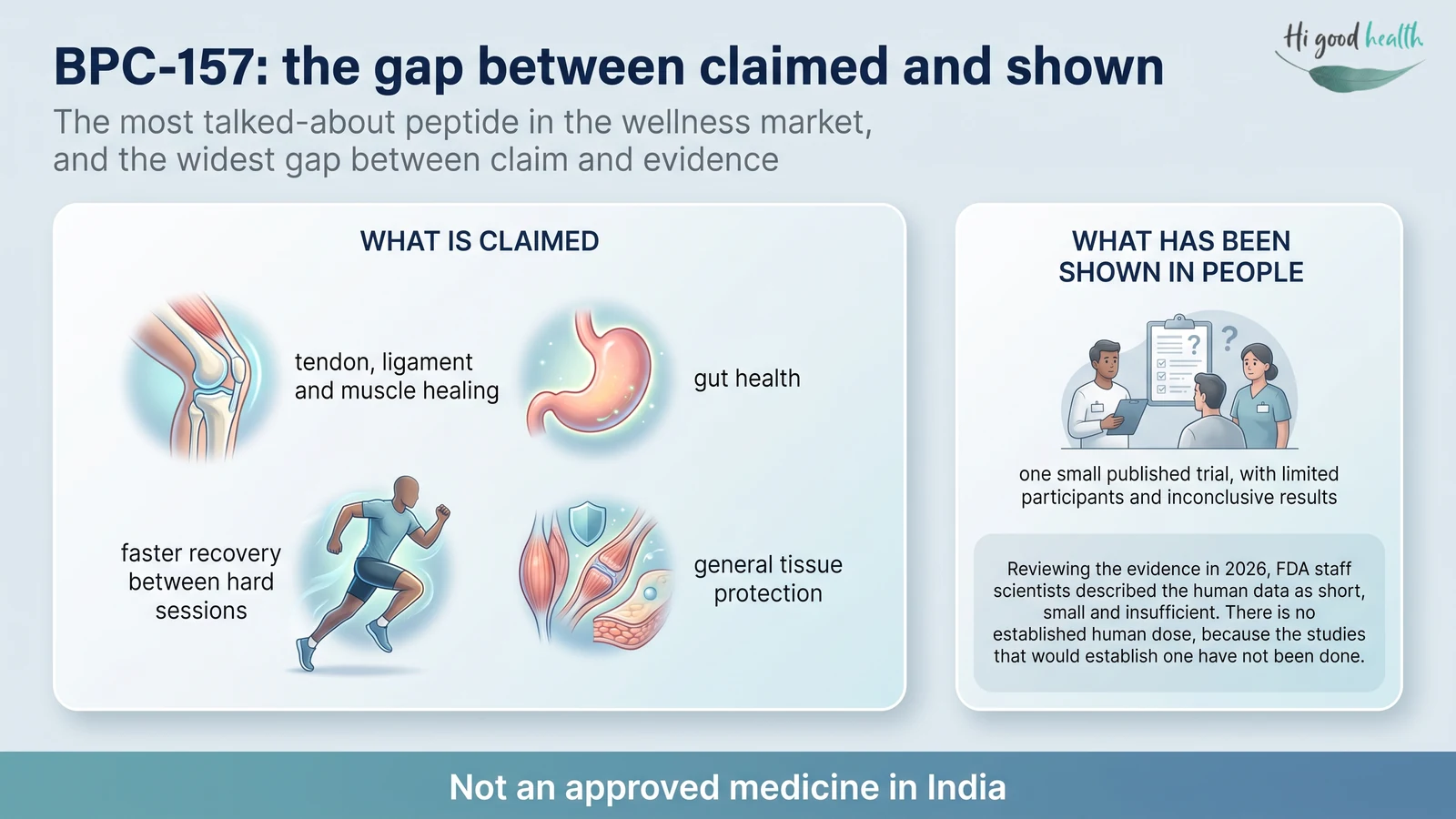
BPC-157 is the most talked-about compound in the wellness peptide market, and the one with the widest gap between what is claimed and what has been shown. It is sold online for tendon injuries, gut problems and general recovery. It is not an approved medicine in India.
The research behind it is real, and it is almost entirely in animals. Rodent studies have reported faster healing of tendon, muscle and gut tissue, and they are the source of nearly every claim made for the compound. The FDA’s own staff scientists, reviewing the evidence in 2026, described the human data as short, small and insufficient.
BPC-157 does not appear in CDSCO’s published lists of new drugs approved in 2025 or 2026, and CDSCO has issued no alert or public notice about it either way.
You will nonetheless find it on sale in India today, in rupees — as a “research use only” chemical on one vendor’s site, and as an injection on business marketplaces. Neither makes it a medicine.
If you compete in sport, the approval question is beside the point. NADA India adopts the WADA Prohibited List, and the 2026 list names BPC-157 explicitly under S0, prohibited at all times.
Reported side effects in the available research have been mild — but the research is almost entirely in animals, and no long-term human safety data exists. That is the honest state of it.
This article does not give dosing information for BPC-157, and no reputable source should. There is no established human dose, because the studies that would establish one have not been done.
Why BPC-157 is getting so much attention
Peptide clinics, podcasts and biohacking forums have made BPC-157 into something close to a household name among people who train hard or manage a long-running injury. The appeal is easy to understand.
Conventional medicine has little to offer for a stubborn tendon problem beyond rest, load management and time. A compound that promises to speed up healing is answering a real frustration.
Two things then amplified it. The first was the volume of positive animal research, which reads impressively if you do not look at what species it was done in. The second was a July 2026 vote by a US regulatory advisory committee, widely reported in a way that suggested BPC-157 had been approved.
It had not. But the reporting moved the compound from the fringes into mainstream conversation, and the market followed.
What BPC-157 actually is
BPC-157 is a synthetic peptide — a short chain of amino acids — based on a fragment of a protein found in human gastric juice. The initials stand for Body Protection Compound. It does not exist in the body in the form that is sold.
That distinction matters more than it first appears. “Naturally occurring” is one of the most common claims made for BPC-157, and it is doing a lot of work that it has not earned.
The parent protein occurs naturally. The compound sold in vials is a laboratory-made fragment, at concentrations and by routes that have nothing to do with how the body encounters the original. A fragment of a natural molecule is a new molecule, and it has to be studied as one.
How BPC-157 is studied
BPC-157 research has mainly focused on preclinical models rather than the kinds of clinical studies used to establish a medicine for patients.
Researchers have examined outcomes such as tissue repair, inflammation, blood-vessel formation and gastrointestinal injury in laboratory and animal models. These studies can help identify biological effects and possible mechanisms, but they do not establish whether the same effects occur in people.
For a compound being considered for human treatment, researchers would also need reliable information on absorption, distribution, metabolism and elimination, followed by studies designed to determine whether the compound produces a meaningful clinical benefit without unacceptable risk.
This is the distinction our pillar guide draws between the two worlds of peptide medicine. An approved peptide medicine such as insulin or semaglutide went through years of human trials. BPC-157 has not entered that process.
What it is claimed to do
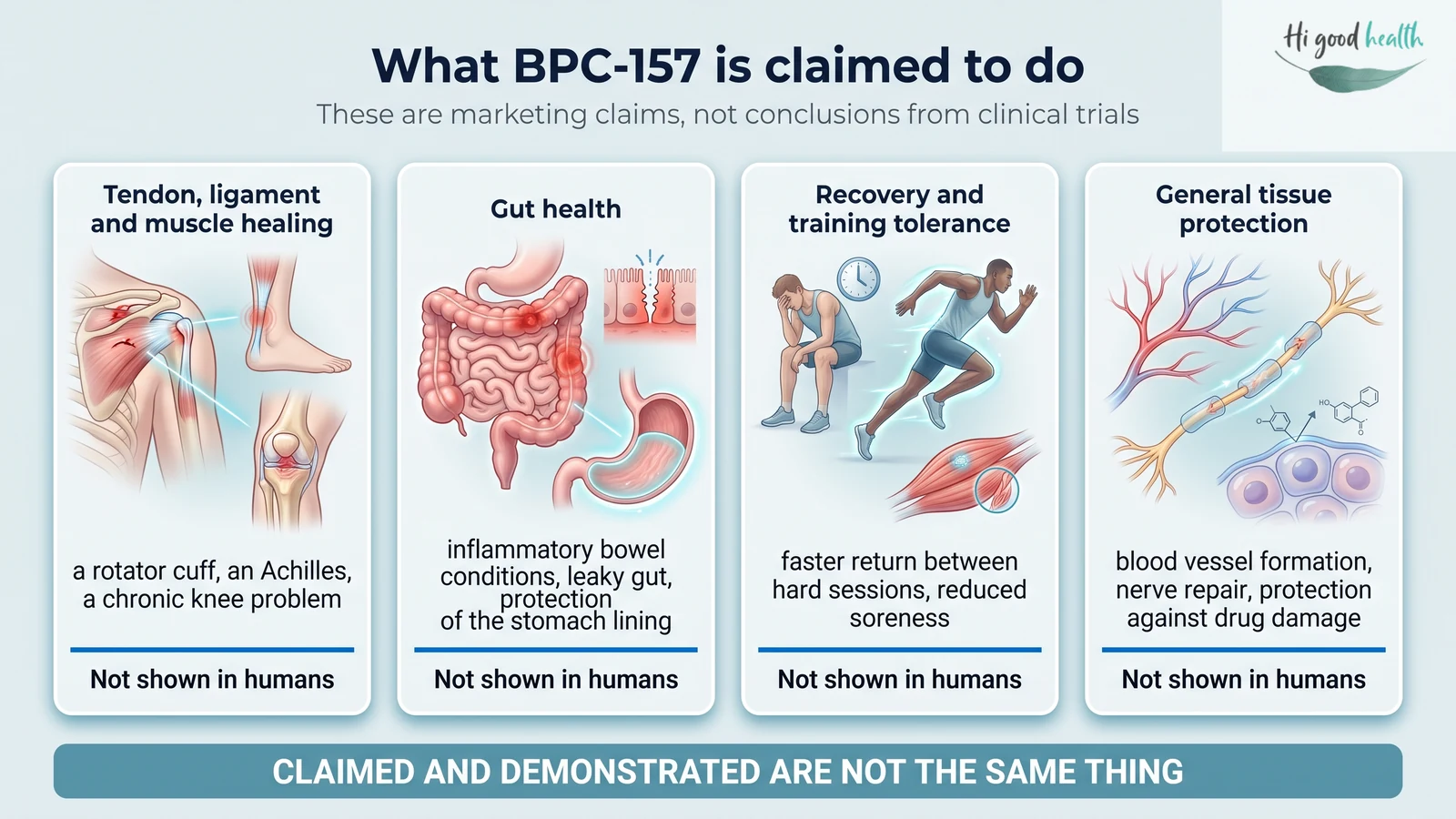
The marketing claims cluster into four areas, and they are worth stating plainly before examining the evidence for each.
Tendon, ligament and muscle healing. The most common reason people seek it out — a rotator cuff, an Achilles, a chronic knee problem that has not responded to physiotherapy.
Gut health. Claims around inflammatory bowel conditions, leaky gut and protection of the stomach lining, which trace back to the compound’s origin in gastric juice.
Recovery and training tolerance. Faster return between hard sessions, reduced soreness, less downtime.
General tissue protection. A broader set of claims about blood vessel formation, nerve repair and protection against damage from other drugs.
Note carefully: these are claims made in marketing, not conclusions from clinical trials. The rest of this article is about the difference.
What the evidence actually shows
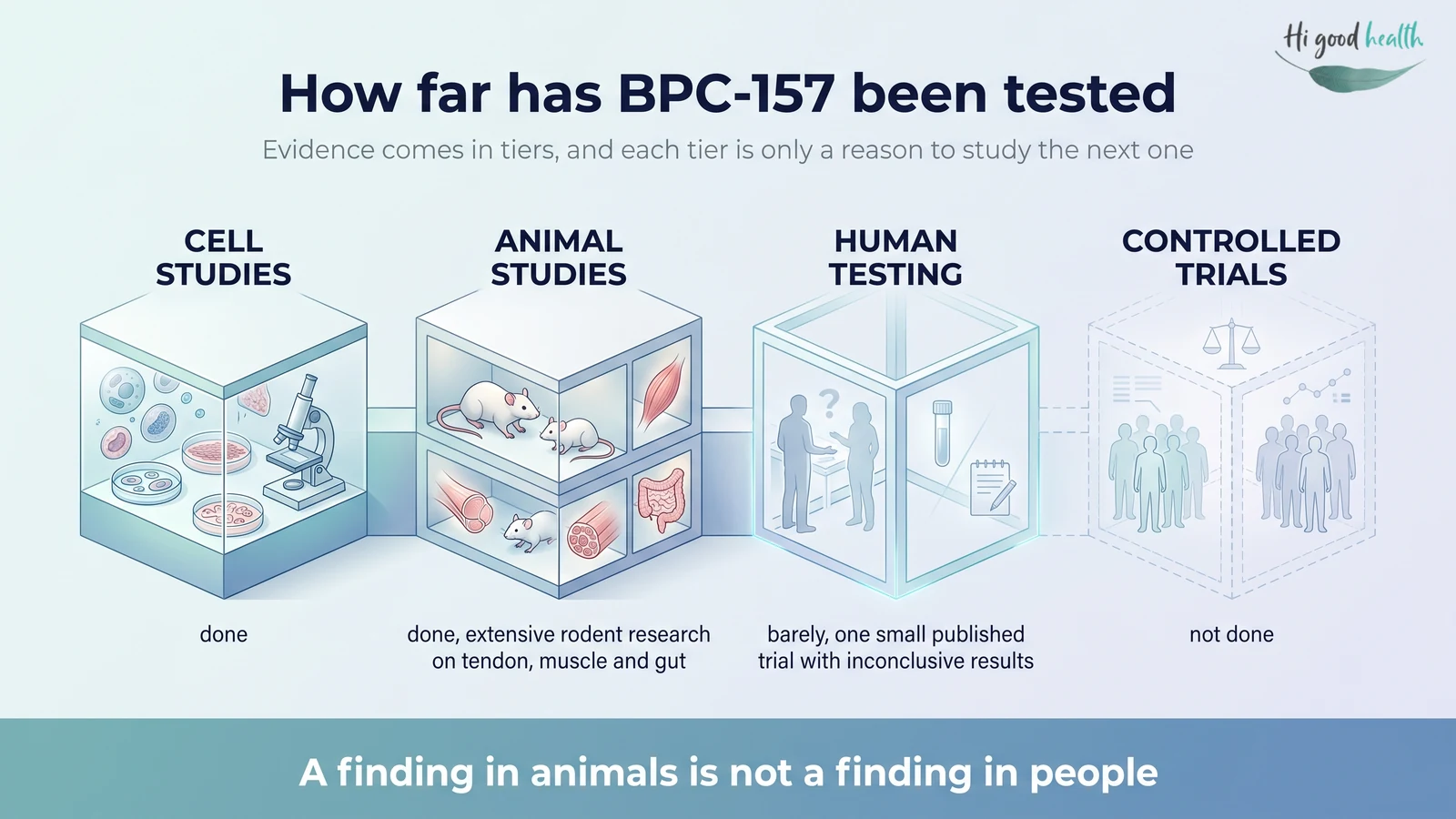
Evidence in medicine comes in tiers, and the tier matters as much as the result. A finding in cells is a reason to study animals. A finding in animals is a reason to study people. Only a finding in people, in a properly controlled trial, tells you what a treatment does to a patient.
Most compounds that look promising in animals fail in humans. That is not a cynical view — it is the ordinary attrition rate of drug development, and it is why the tiers exist.
The animal research
This is where BPC-157’s reputation comes from, and it is a genuine body of work. Rodent studies have reported accelerated healing across tendon, ligament, muscle, bone and gut tissue, along with effects on blood vessel formation and protection of the stomach lining.
Proposed mechanisms include the promotion of new blood vessel growth (angiogenesis) and interaction with growth-factor and nitric-oxide signaling pathways, both of which are important in tissue repair. However, these mechanisms alone do not prove clinical benefit in humans.
Two caveats travel with all of it. The research is concentrated in a small number of laboratories rather than replicated broadly across independent groups. And rodent healing is not human healing — species differ in tissue repair in ways that have repeatedly defeated translation.
The human research
This is the part the marketing does not discuss.
What the human evidence cannot tell us yet
Reviewing the evidence submitted in support of BPC-157 in 2026, FDA staff scientists found the supporting studies short, small and insufficient to establish safety or effectiveness. The human evidence amounts to a single small published trial, with limited participants and inconclusive results.
There is no published pharmacokinetic profile in humans that would tell you how much reaches the bloodstream, how long it lasts, or what happens to it. There is no dose-finding study. There is no long-term safety data of any kind.
The lack of adequate human trials leaves several basic clinical questions unanswered. We do not know which conditions, if any, BPC-157 can reliably treat in humans. We do not know whether an apparent effect would be clinically meaningful rather than simply measurable.
We also do not know which patients might benefit, who might be at greater risk of adverse effects, or whether repeated exposure changes the safety profile.
These are not minor gaps. They are the questions clinical trials are designed to answer.
That is not a claim that BPC-157 does not work. It is a statement that current evidence is insufficient to determine effectiveness, and marketing claims go beyond what has been scientifically established.
Why promising mechanisms are not proof
A mechanism explains how something could work. It does not establish that it does work in a person, at a tolerable dose, with acceptable risk.
The history of medicine is full of compounds with elegant mechanisms and animal data that failed the moment they met a human trial — some by not working, some by causing harm nobody had anticipated.
BPC-157 side effects: what is known, and what is not
What we know
- Synthetic peptide
- Extensive preclinical research
- Biological effects reported in animal models
- Very limited human research
- Not approved by CDSCO
What we don’t know
- Effective human dose
- Long-term human safety
- Reliable clinical benefit
- Which patients benefit
- Clinically important drug interactions
- Long-term effects of repeated exposure
Several specific unknowns are worth naming.
Immunogenicity. Regulators have repeatedly raised the possibility that peptide products trigger unwanted immune responses. This was the FDA’s stated concern in keeping ipamorelin acetate in its restricted category.
Effects on tissue growth. A compound that promotes blood vessel formation and tissue repair raises an obvious question about tissue you would not want to grow — including, at the extreme, tumor tissue. That question has not been answered either way in humans, and its absence from marketing material is conspicuous.
Interactions. No systematic work exists on how BPC-157 interacts with prescription medicines.
Injection risk. Most products are injected, by people at home, using materials of unverified sterility. Infection and abscess are ordinary consequences of that, independent of the compound itself.
The American Medical Association has urged caution on injectable peptides marketed for anti-aging or performance, on the grounds that most of the evidence comes from animal studies.
The product itself is a separate risk
Even setting aside what BPC-157 does, there is the question of what is in the vial.
In India, BPC-157 is sold under a “research use only” label. One India-facing vendor lists it at ₹3,999 for 10 mg, with the disclaimer “Not for human or veterinary use.” That phrasing is a marketing workaround rather than a legal category.
On Indian business-to-business marketplaces even that disclaimer disappears. Sellers in Gurugram, Nagpur, New Delhi, Bathinda and Vasai-Virar list BPC-157 as an injection, and BPC-157 with TB-500 as a recovery injection pen, priced from roughly ₹3,000 to ₹10,800.
Purity, identity, sterility and effectiveness are separate issues. A product can meet one standard without meeting the others.
A label can describe what a seller says a product contains, but it cannot establish clinical effectiveness.
Even if a product were correctly identified and free of contamination, that would answer a quality question — not the medical question of whether BPC-157 improves healing or treats disease in humans.
This is not hypothetical. Gray-market peptide products have tested positive for testosterone, a controlled substance, and international regulators have documented contamination and mislabelling in peptide products.
A buyer in that position faces two problems at once: an unstudied compound, and a product that may not contain what the label says.
Athletes: the answer does not depend on approval
For anyone subject to anti-doping rules in India, BPC-157 is settled, and it has been for years.
NADA India adopts the WADA Prohibited List and hosts the 2026 edition on its own government site. There is no separate Indian list to check.
On that list BPC-157 appears under S0 — non-approved substances — and is prohibited at all times. There is no off-season allowance.
The National Anti-Doping Act, 2022 made NADA a statutory body and gives it power to set the Prohibited List by regulation. It did not change which substances are banned — NADA continues to adopt the WADA list.
NADA’s own guidance to athletes is blunt: they are “solely accountable for prohibited substances in their system”, and “no supplement is 100% risk free”.
Important safety note: “not on the drug-screening panel” is not the same as “permitted.” Standard employment panels do not test for peptides. Anti-doping bodies do, using targeted methods, and they prohibit substances regardless of how routinely they screen for them.
Where BPC-157 stands legally in India
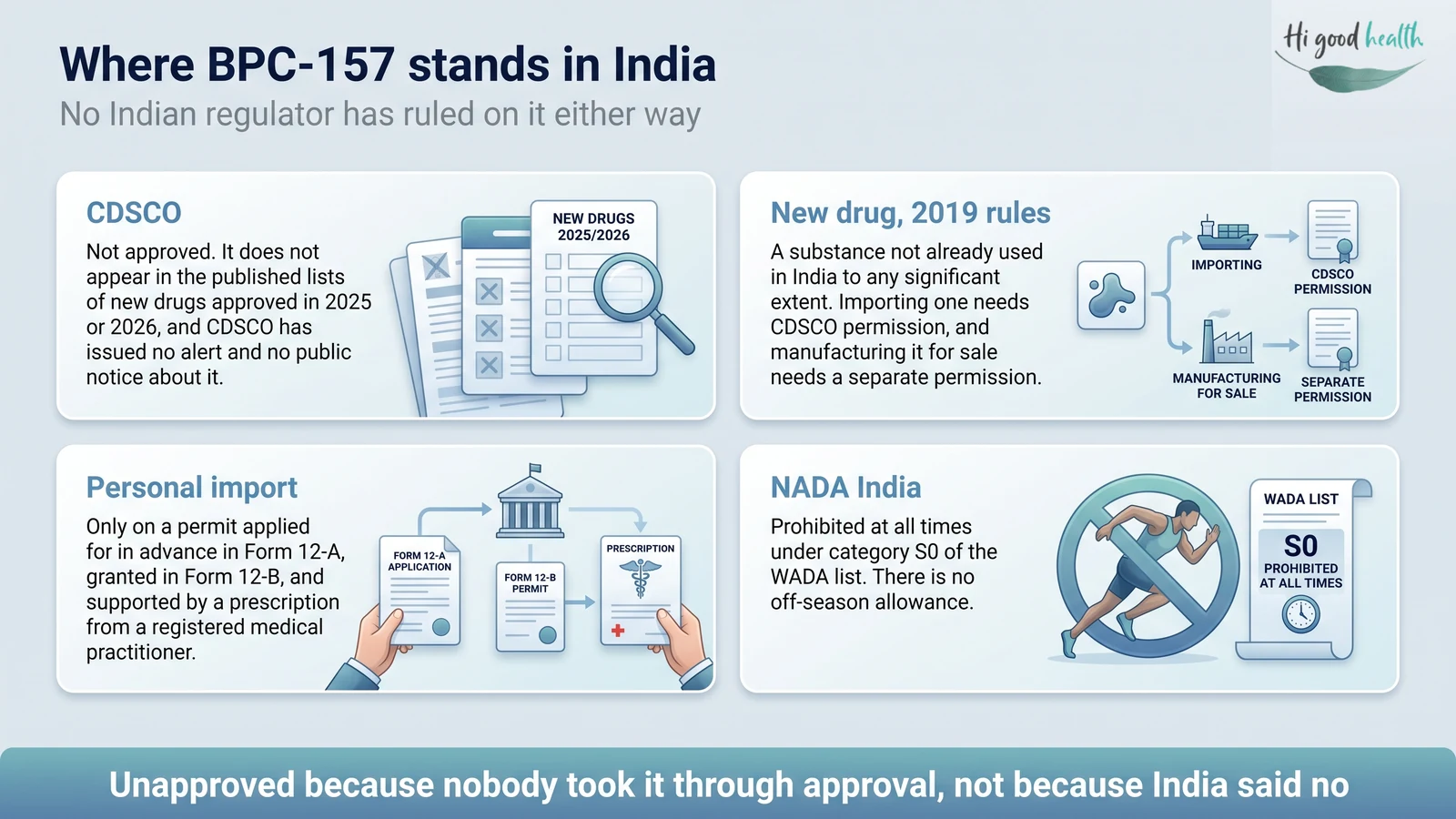
Status in India: not approved by CDSCO. No Indian regulator has ruled on it either way.
BPC-157 does not appear in CDSCO’s published lists of new drugs approved in 2025 or 2026, and CDSCO has issued no alert and no public notice naming it.
So the honest answer is that India has no stated legal position on BPC-157. It is unapproved because nobody has taken it through approval, not because India examined it and said no.
Under the New Drugs and Clinical Trials Rules, 2019, a substance not already used in India to any significant extent is a “new drug”. Importing one requires CDSCO permission; manufacturing it for sale requires a separate permission. BPC-157 has neither.
Where the only clear rules are American ones, we say so. Most writing about BPC-157 describes US law, because that is where the regulatory activity has happened. In July 2026 a US FDA advisory committee voted 8–6 to recommend it for pharmacy compounding there, against the advice of the FDA’s own staff scientists. The FDA has not acted on that vote.
It has no Indian equivalent — India has no counterpart to the US compounding-bulks list. Read that coverage as news about the United States.
Personal import is not a loophole. India allows small quantities of an unapproved drug to be imported for personal use under Rule 36 of the Drugs Rules, 1945 — but only on a permit applied for in advance in Form 12-A, granted in Form 12-B, and supported by a prescription from a registered medical practitioner.
A compound with no approved indication has no basis for such a prescription.
The law in full is covered in our guide to peptide legality in India. This article carries the compound-specific status only.
What would turn BPC-157 into a real medicine
It is worth being clear that this is a question of evidence, not of ideology. The path exists and BPC-157 has not walked it.
- Pharmacokinetic studies in humans — what the body does with it, at what exposure, over what period.
- Dose-finding studies — establishing a range that is both active and tolerated.
- Randomised controlled trials against a defined condition, with outcomes that matter to a patient rather than markers that move.
- Long-term safety monitoring, with particular attention to immunogenicity and tissue growth.
- Manufacturing standards, so that the product in the vial is reliably the product that was studied.
None of this is exotic. It is what every approved peptide medicine has been through.
Key takeaways
- BPC-157 is not approved by CDSCO, and cannot lawfully be sold in India for human use. No Indian regulator has ruled on it either way.
- The evidence is overwhelmingly from animals. FDA staff scientists described the human data as short, small and insufficient.
- There is no established human dose, because no dose-finding study has been done. Any source giving you one is inventing it.
- Long-term safety is unknown, and the open questions include immunogenicity and effects on tissue growth.
- Product quality is a separate risk from the compound. Gray-market peptides have tested positive for testosterone.
- Indian athletes are governed by the WADA list, which NADA India adopts. BPC-157 sits under S0, prohibited at all times.
- It is already on sale in India, in rupees, as both a “research use only” chemical and an injection. Neither makes it a medicine.
Frequently asked questions
1. Does BPC-157 work, and is it a regenerative medicine?
In rodents, the research reports faster healing of tendon, muscle and gut tissue, which is why it is described online as regenerative. In humans the evidence is very thin, and BPC-157 has not been shown to regenerate tissue or treat injuries in people.
2. Is BPC-157 legal in India?
It is not approved by CDSCO and cannot lawfully be sold here for human use. No Indian regulator has ruled on it either way, so the position is unstated rather than settled.
3. Can you take BPC-157 every day?
There is no established dosing schedule for BPC-157 in humans, daily or otherwise, because no dose-finding study has been done. We do not publish dosing for unapproved compounds, and neither should anyone else.
4. Is BPC-157 hard on your liver?
No human safety data exists that would answer this. That is the honest position: not reassurance, and not a warning about a specific documented harm, but an absence of the studies that would tell you either way.
5. Does BPC-157 work immediately?
Claims about rapid results come from marketing and from personal reports, not from controlled trials. Without human studies there is no established time course, and personal reports cannot separate a treatment effect from ordinary healing.
6. Will BPC-157 show up on a drug test?
Not on a standard employment panel, which does not test for peptides. Anti-doping testing is different: NADA India adopts the WADA list, which prohibits BPC-157 at all times under category S0.
7. Is research-use-only BPC-157 safer because it is pure?
No. The label is a marketing disclaimer, not a quality standard. It carries no guarantee of purity, sterility or concentration, and gray-market peptide products have been found contaminated with controlled substances.
8. Can animal studies tell us what a safe human dose is?
No. Animal studies help researchers understand how a compound behaves and guide future research, but they cannot establish a safe and effective dose for people. That requires properly designed human studies.
Glossary
- BPC-157: Body Protection Compound 157, a synthetic peptide based on a fragment of a protein found in gastric juice.
- CDSCO: the Central Drugs Standard Control Organisation, India’s national drug regulator.
- New drug (NDCT Rules, 2019): a substance not already used in India to any significant extent. Importing or manufacturing one requires CDSCO permission.
- Angiogenesis: the formation of new blood vessels, one of the proposed mechanisms behind BPC-157’s reported effects.
- Immunogenicity: the risk that a substance provokes an unwanted immune response.
- Pharmacokinetics: what the body does to a drug — absorption, distribution, breakdown and elimination.
- RUO (“research use only”): a labeling disclaimer, not a legal exemption and not a quality standard.
- NADA India: the National Anti-Doping Agency, which adopts the WADA Prohibited List for Indian sport.
- S0: the WADA category for substances not approved by any government health authority. Prohibited at all times.
References
All reference links checked and confirmed live on 21 September 2026.
- NADA India — 2026 WADA Prohibited List, hosted by the National Anti-Doping Agency: https://nadaindia.yas.gov.in/wp-content/uploads/2026list_en_final_clean_september_2025.pdf
- CDSCO — Procedure for permission to import small quantities of drugs for personal use (Rule 36, Form 12-A / 12-B): https://cdsco.gov.in/opencms/resources/UploadCDSCOWeb/2018/UploadConsumer/ProcedureforpermissiontoImportSmallQuantitiesofDrugsForPersonalUse_link.pdf
- NADA India — Supplements and athletes, on strict liability and contamination risk: https://nadaindia.yas.gov.in/supplements-and-athletes/
- WADA — 2026 Prohibited List: https://www.wada-ama.org/en/resources/2026-prohibited-list
- STAT — BPC-157: the science, safety and regulatory questions (3 February 2026): https://www.statnews.com/2026/02/03/bpc-157-peptide-science-safety-regulatory-questions/
- FDA — Certain Bulk Drug Substances for Use in Compounding That May Present Significant Safety Risks: https://www.fda.gov/drugs/human-drug-compounding/certain-bulk-drug-substances-use-compounding-may-present-significant-safety-risks
- FDA — Pharmacy Compounding Advisory Committee, 23–24 July 2026 meeting: https://www.fda.gov/advisory-committees/advisory-committee-calendar/july-23-24-2026-meeting-pharmacy-compounding-advisory-committee-07232026
- STAT — FDA panel backs peptides for compounding pharmacies (23 July 2026): https://www.statnews.com/2026/07/23/fda-panel-okays-peptides-compound-pharmacies-bpc-157-kpv/
- NBC News — FDA panel recommends BPC-157; scientists raise concerns: https://www.nbcnews.com/health/health-news/peptides-restrictions-ease-fda-panel-recommend-bpc-157-scientists-rcna588879
- AJMC — FDA panel backs 6 peptides for compounding: https://www.ajmc.com/view/fda-panel-backs-6-peptides-for-compounding
- FDA — Warning letter, Wholesale Peptide (17 June 2026): https://www.fda.gov/inspections-compliance-enforcement-and-criminal-investigations/warning-letters/wholesale-peptide-729447-06172026
Medical disclaimer
This article is for general education and is not medical advice. BPC-157 is not an approved medicine in India, its long-term effects in humans are unknown, and nothing here should be read as a recommendation to use it. Speak to a registered medical practitioner about any injury or condition, and about any substance you are considering.