The most useful health clues often aren’t on a standard test. To know more about advanced health screening tests, click here (Hidden Blood Tests for Peak Health: Complete Guide)
At a Glance
- Comprehensive testing does not have to cost $1,800 — the article shows three routes.
- Pathway 1 works through your doctor, with a conversation script and insurance pre-authorisation steps.
- Pathway 2 is direct-to-consumer testing, which costs 60–75% less and the article explains why.
- A starter panel is specified with real price ranges.
- HSA and FSA reimbursement applies to more of this than most people assume.
The $1,847 Bill vs. The $487 Solution
Marcus ordered comprehensive testing through his doctor. Hospital bill: $1,847. Insurance denied as “not medically necessary.”
His colleague Sarah ordered identical tests through Quest Direct: $487. Same labs. Same accuracy. 74% savings.
You’re about to learn exactly how Sarah did it—and how you can too.
Three Pathways to Comprehensive Testing
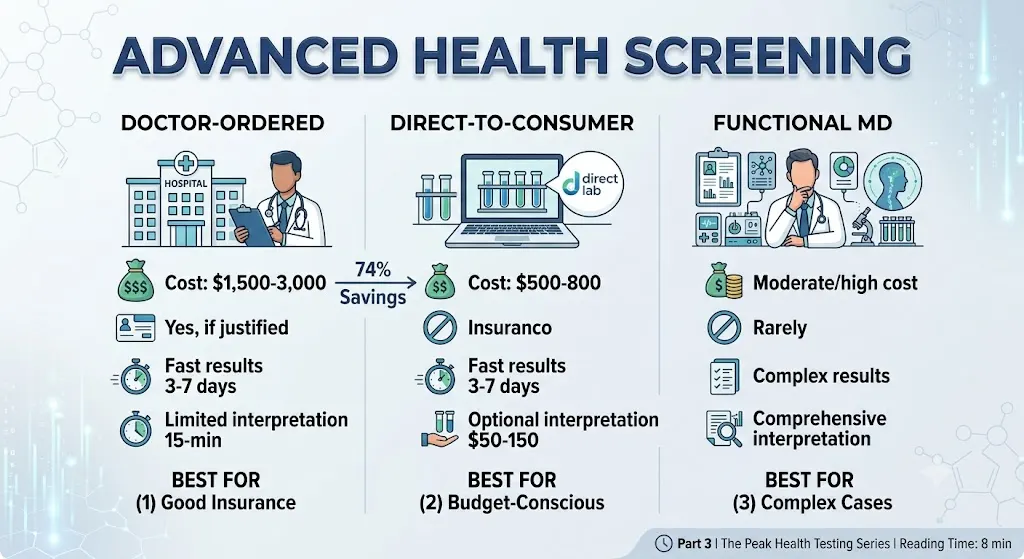
Factor | Doctor-Ordered | Direct-to-Consumer | Functional MD |
|---|---|---|---|
Cost (Uninsured) | $1,500-3,000 | $500-800 | $800-2,000 |
Insurance Possible? | Yes (if justified) | No | Rarely |
Results Speed | 3 -7 days | 3-7 days | 2 -3 weeks |
Interpretation | Limited (15-min) | Optional ($50-150) | Comprehensive |
Best For | Good insurance | Budget-conscious | Complex cases |
Pathway 1: Working With Your Doctor
Best For: Good insurance, established relationships, want tests in medical record.
The Strategy: Making Your Case
Step 1: Prepare Documentation
Create symptom timeline with:
- Specific symptoms + duration (fatigue: 8 months, brain fog: 6 months)
- Impact on daily life (can’t finish workouts, afternoon crashes)
- What you’ve tried (more sleep, diet changes, exercise)
- Family history (thyroid disease, diabetes, heart disease or any other genetic diseases)
Why: Insurance covers “medically necessary” tests. Documented symptoms establish necessity.
Step 2: The Doctor Conversation Script
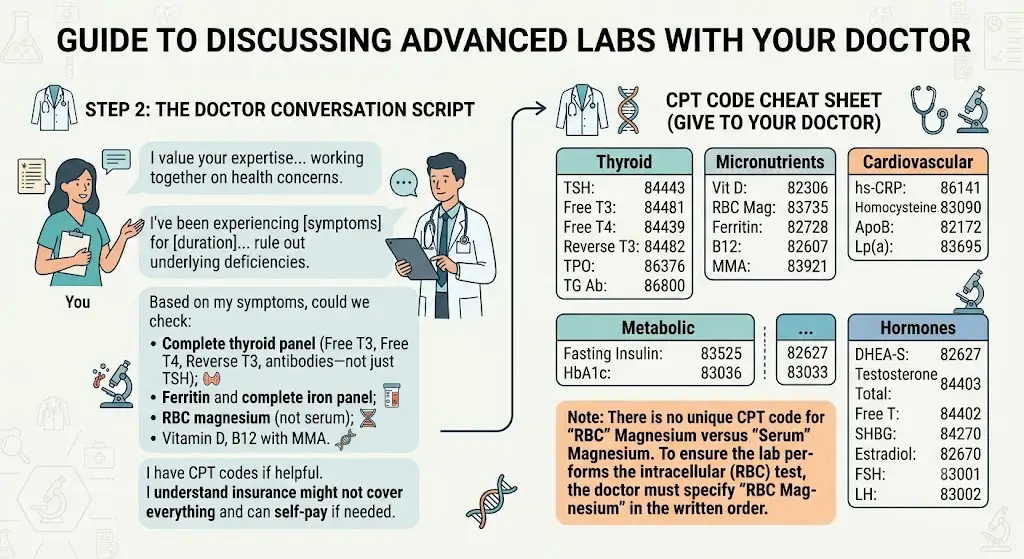
“I value your expertise and want to work together on health concerns I’m having. I’ve been experiencing [symptoms] for [duration], significantly impacting my quality of life. Before considering medications or assuming it’s stress, I’d like to rule out underlying deficiencies.
Based on my symptoms, could we check:
- Complete thyroid panel (Free T3, Free T4, Reverse T3, antibodies—not just TSH)
- Ferritin and complete iron panel
- RBC magnesium (not serum)
- Vitamin D, B12 with MMA
I have CPT codes if helpful. I understand insurance might not cover everything and can self-pay if needed.”
CPT Code Cheat Sheet (Give to Your Doctor):
Thyroid: 84443 (TSH), 84481 (Free T3), 84439 (Free T4), 84482 (Reverse T3), 86376 (TPO), 86800 (TG Ab)
Micronutrients: 82306 (Vit D), 83735 (RBC Mag), 82728 (Ferritin), 82607 (B12), 83921 (MMA)
Cardiovascular: 86141 (hs-CRP), 83090 (Homocysteine), 82172 (ApoB), 83695 (Lp(a))
Metabolic: 83525 (Fasting Insulin), 83036 (HbA1c)
Hormones: 82627 (DHEA-S), 84403 (Testosterone Total), 84402 (Free T), 84270 (SHBG), 82670 (Estradiol), 83001 (FSH), 83002 (LH)
Note: There is no unique CPT code for “RBC” Magnesium versus “Serum” Magnesium. To ensure the lab performs the intracellular (RBC) test, the doctor must specify “RBC Magnesium” in the written order.
Step 3: Insurance Pre-Authorization
Call insurance BEFORE testing for expensive panels:
“I’m verifying coverage for tests my doctor is ordering. Diagnosis codes: [R53.83-Fatigue, E55.9-Vit D deficiency]. CPT codes: [list]. Will these be covered?”
Common Helpful ICD-10 Codes:
- R53.83: Fatigue
- R41.840: Brain fog/difficulty concentrating
- E55.9: Vitamin D deficiency
- E61.2: Magnesium deficiency
- D50.9: Iron deficiency anemia
- E03.9: Hypothyroidism
- M79.1: Muscle pain/weakness
- E66.9: Obesity, unspecified.
Document everything: rep name, date, reference number.
Step 4: Appealing Insurance Denials
First-Level Appeal Letter (Template):
[Your Info + Policy Number]
[Insurance Company Appeals Dept]
Re: Appeal of Claim Denial – Claim #[Number]
I’m appealing the denial for medically necessary testing ordered by Dr. [Name] on [Date].
Tests Denied: [List with CPT codes]
Medical Justification:
I’ve experienced [symptoms] for [duration], significantly impacting daily functioning. My physician ordered these tests to rule out deficiencies before pharmaceutical interventions.
Clinical Rationale:
[Include 2-3 sentences citing medical guidelines. Example: “Endocrine Society guidelines recommend comprehensive thyroid testing in patients with fatigue and cold intolerance, as TSH alone has insufficient sensitivity.”]
Early detection prevents progression to serious conditions requiring expensive long-term treatment. These preventive tests ($[amount]) cost far less than managing chronic diseases.
I request reconsideration.
Sincerely,
[Your Signature]
Success Rate: 30-40% first-level, additional 20-30% second-level.
Pathway 2: Direct-to-Consumer (DTC) Testing
Best For: High-deductible plans, insurance denials, want control and speed.
Why DTC Costs 60-75% Less
- No hospital markup (hospitals charge 200-400% above lab costs)
- No insurance billing overhead
- Transparent pricing (Zero Facility or Doctor Markup Fees)
- Competition drives prices down
- Wholesale volume purchasing
The Major Players: 2025 – 2026 Pricing
Quest Direct (2,200+ locations)
- Vitamin D: $75
- Complete Thyroid: $185-210
- Iron Panel:
$59 - Women’s Hormone Panel:
$385$289
LabCorp OnDemand (2,000+ locations)
- Vitamin D: $54
- Comprehensive Wellness Panel: $199
- Iron Panel: $65-75
- Women’s/Men’s Health: $199
Third-Party Resellers (15-40% Cheaper)
- Ulta Lab Tests (Quest reseller): 15-30% discount
- Request A Test (Quest or LabCorp): 20-35% off
- Life Extension (LabCorp): 20-40% off for members ($75/year)
Membership Services (All-Inclusive)
- Function Health: $365/year, 100+ biomarkers tested twice yearly
- Levels: The $499 price for “Levels Core” only includes two essential lab panels per year. The quarterly or more frequent testing is usually reserved for the “Levels Complete” tier, which is significantly more expensive (~$1,499–$1,999/year).
The $500 Comprehensive Strategy
Smart Starter Panel ($470-520 via resellers):
- Vitamin D – $45-50
- RBC Magnesium – $65-70
- Complete Iron Panel – $65-75
- B12 + MMA – $80-90
- Complete Thyroid (6 markers) – $175-190
- hs-CRP – $40-45
Total: ~$495
Covers: Energy (iron, B12, thyroid, vitamin D), metabolism, inflammation, foundation micronutrients
The $750 Comprehensive Panel (add): 7. Fasting Insulin – $35-40 8. HbA1c – $28-35 9. Homocysteine – $50-60 10. ApoB – $55-65 11. Basic Sex Hormone Panel – $120-160
Total: ~$780
Compare to Hospital: $2,200-3,000 | Savings: $1,420-2,220 (60-75%)
State Restrictions
Fully Restricted (Need Physician): New York, New Jersey, Rhode Island, Maryland
California remains restrictive for “patient-initiated” testing outside of five specific categories (Pregnancy, Glucose, Cholesterol, Occult Blood, and HIV).
Solution: Use telemedicine services ($25-50 fee): PWNHealth, Health Labs Consult
All other states: Full DTC access
HSA/FSA Reimbursement
Good News: Most diagnostic testing qualifies for HSA/FSA reimbursement.
How:
- Pay with regular payment method
- Request itemized receipt with CPT codes
- Submit to HSA/FSA administrator
- Reimbursement in 5-14 days
Success Rate: 85-95% for legitimate diagnostic tests. To ensure reimbursement, the receipt must include the Provider’s NPI number and the specific ICD-10 codes for a “symptom” (like R53.83 for Fatigue) rather than just a “screening” Z-code.
Pathway 3: Functional Medicine Practitioner
Best For: Complex health issues, want comprehensive interpretation, can afford higher costs.
What You Get:
- 90-120 min initial consultation
- Customized testing panel
- Detailed results interpretation
- Personalized protocol (diet, supplements, lifestyle)
Modern food fills you up. That doesn’t always mean it fills the gaps. To know more about supplements, click here (60+ Essential Minerals That Protected Our Ancestors — but Are Missing from Your Multivitamin)
- Ongoing support
Investment:
- Initial: $350-600
- Labs: $600-1,500
- Follow-ups: $150-300
- First Year: $1,100-2,400
Worth It If: Multiple systems affected, tried everything, want education not just prescriptions, need accountability.
Find Practitioners:
- Institute for Functional Medicine: ifm.org/find-a-practitioner
- Academy of Integrative Health & Medicine: aihm.org
When sharing logs with a US healthcare provider, use the standard P-Q-R-S-T format to match their electronic medical records.
P (Provokes/Palliates): Triggers or relief factors.
Q (Quality): Specific feeling (sharp, dull).
R (Region/Radiation): Location and movement.
S (Severity): Pain scale rating (1–10).
T (Timing): Exact date, time, and duration.
Your 90-Day Implementation Plan
Weeks 1-2: Preparation
✅ Review symptoms, identify priority tests
✅ Check insurance benefits
✅ Decide pathway (doctor, DTC, or functional MD)
✅ Set budget ($500-800)
Week 3: Ordering
✅ Doctor: Schedule appointment with symptom docs + CPT codes
✅ DTC: Order tests online, locate Quest/LabCorp location
✅ Functional MD: Attend consultation
Week 4: Testing
✅ Fast 10-12 hours (water allowed)
✅ Morning appointment (7-9 AM for hormones)
✅ Hydrate well (easier blood draws)
✅ Avoid strenuous exercise 24 hours before
Weeks 5-6: Results & Analysis
✅ Create results spreadsheet (test, result, lab range, optimal range, status)
✅ Identify priorities (which markers furthest from optimal?)
✅ Research or schedule consultation
Weeks 7-12: Intervention
✅ Food-first approach (4-6 weeks):
- Low vitamin D: 20-30 min midday sun
, fortified foods - Low ferritin: Daily lentils + vitamin C, cast iron cooking
- Low magnesium: Pumpkin seeds, spinach, quinoa, dark chocolate
- Low B12: Fortified nutritional yeast, plant milk, supplements
✅ Strategic supplementation (if food insufficient):
- Vitamin D: If <30 ng/mL, supplement 1,000–2,000 IU daily.
- Iron: 25-50mg bisglycinate on alternate days with vitamin C if ferritin <50
- Magnesium: 300-400mg glycinate if RBC deficient
- B12: 1,000-2,000µg if <500 pg/mL
Week 13: Retest & Refine
✅ Retest all suboptimal markers
✅ Verify protocol worked
✅ Adjust dosing based on results
Expected Changes (3 Months):
- Vitamin D: Should reach 50-80 ng/mL
- Ferritin: 10-30 ng/mL improvement (slow to rise)
- RBC Magnesium: Should reach 5.0-6.5 mg/dL
- B12: Should exceed 500 pg/mL, MMA normalize
[⚠️ Disclaimer – Dietary modification is a baseline strategy for general wellness, not a treatment for underlying medical conditions. If optimal nutritional adjustments fail to improve your laboratory biomarkers, it indicates an underlying clinical issue that requires professional diagnostic evaluation and care from a licensed physician rather than self-management]
Real Success Stories
Marcus: Hospital quoted $1,847. Used Ulta Lab Tests for $487. Saved $1,360. Found low testosterone (320 ng/dL), vitamin D deficiency, low magnesium. Six months later: testosterone 680 ng/dL, gained 12 lbs muscle, lost 4% body fat.
Lisa: Insurance denied comprehensive thyroid panel. Appealed with symptom timeline and Endocrine Society guidelines. Appeal approved in 23 days. Found Hashimoto’s thyroiditis (TSH “normal” but Free T3 low, antibodies positive). Would’ve been missed with TSH alone.
Priya: Function Health membership $499/year vs. $750-900 individual testing. Caught ferritin declining from 68→42 ng/mL and fasting insulin creeping up. Addressed issues 5-10 years early.
David: Hospital quote: $2,340. Request A Test (LabCorp reseller): $615. Saved $1,725 (74%).
Key Takeaways
- Ask for the test by name; a general request gets declined more often.
- Direct-to-consumer results still need a clinician to interpret them.
- Bundled panels are usually cheaper than the same tests ordered singly.
- Common mistakes to avoid are listed in their own section.
- This article is for information only and does not replace medical advice.
Frequently Asked Questions
1. Can I order my own blood tests without a doctor?
Yes, in most states you can use Direct-to-Consumer (DTC) services to order tests independently. However, residents of New York, New Jersey, and Rhode Island must use services that include a telemedicine physician consultation due to state restrictions.
2. Will health insurance cover these comprehensive tests?
Insurance typically covers “medically necessary” tests for documented symptoms like fatigue, but often denies preventive panels without specific diagnosis codes. Always verify coverage with your insurer using CPT codes before your appointment.
3. How much do these tests cost out-of-pocket?
Hospital testing can cost $1,500–$3,000 without insurance. By using Direct-to-Consumer sites or resellers, you can get the same comprehensive panel (including thyroid and vitamins) for approximately $470–$500, saving you 60–75%.
4. Are online lab tests as accurate as doctor-ordered ones?
Yes. DTC services use the exact same labs (like Quest and LabCorp) as doctors. The testing equipment, safety standards, and accuracy are identical; the only difference is that you order and pay for them directly.
5. How should I prepare for my blood test?
Fast for 10–12 hours (water is allowed) and schedule your appointment for 7–9 AM, which is best for hormone accuracy. Avoid strenuous exercise for 24 hours before your draw, as it can affect inflammation markers.
6. Can I use my HSA or FSA to pay for this?
Yes. Most diagnostic testing qualifies for HSA or FSA reimbursement. Pay with your regular method, request an itemized receipt containing CPT codes, and submit it to your administrator for reimbursement within 5–14 days.
7. What if my insurance denies the claim?
File an appeal citing medical necessity and specific symptoms like fatigue or brain fog. First-level appeals succeed 30–40% of the time. Alternatively, use DTC services to bypass insurance billing entirely for lower costs.
8. How long does it take to see results from supplements?
Significant changes typically take about 3 months. For example, Vitamin D levels should rise to 50–80 ng/mL and Ferritin should improve. Retest at week 13 to verify your protocol worked and adjust if needed.
9. Can we trust online symptom docs?
The most trusted online symptom checkers in the US are expert-vetted platforms like the Mayo Clinic and WebMD, alongside advanced AI assistants like Ada and Buoy Health. These tools use interactive body maps or conversational AI chat prompts to analyze your signs and safely guide you to the right level of medical care. They are highly accurate educational resources for health triage, but they cannot replace a formal diagnosis from a licensed doctor.
Common Mistakes to Avoid
❌ Wrong: Test everything without symptom context
✅ Right: Prioritize based on symptoms
❌ Wrong: Compare to lab “normal” only
✅ Right: Use optimal ranges from Part 2
❌ Wrong: Supplement without retesting
✅ Right: Test → Supplement → Retest at 3 months
❌ Wrong: Order $2,000 panel as beginner
✅ Right: Start with $500 foundation panel
❌ Wrong: Show up fed, after workout, wrong time
✅ Right: Fasted, morning, no exercise 24 hrs prior
❌ Wrong: Don’t track results over time
✅ Right: Maintain biomarker spreadsheet
Key Resources & Links
Testing Services:
- Quest Direct: questhealth.com
- LabCorp OnDemand: ondemand.labcorp.com
- Ulta Lab Tests: ultalabtests.com
- Request A Test: requestatest.com
- Function Health: functionhealth.com
Finding Practitioners:
- Institute for Functional Medicine: ifm.org/find-a-practitioner
- AIHM: aihm.org
Insurance Help:
- Healthcare.gov Appeals: healthcare.gov/appeal-insurance-company-decision
- Patient Advocate Foundation: patientadvocate.org [NEW LINK: https://www.npaf.org/] [REPLACEMENT LINK: National Patient Advocate Foundation]
About Our Mission
At Higoodhealth.com, we dismantle healthcare gatekeeping through accessible, evidence-based information.
This 3-part series represents 120+ research hours, reviewing 100+ peer-reviewed studies, comparing 20+ testing services—all to empower you with knowledge.
We don’t profit from:
- Lab companies
- Supplement sales
- Practitioner referrals
Our only goal: Your health optimization on your terms.
Your Next Steps (This Week):
Day 1-2: Choose pathway (doctor, DTC, or functional MD)
Day 3-4: Schedule appointment OR order tests online
Day 5-7: Execute—get blood drawn this week
Week 13: Retest to verify protocol worked
The Bottom Line
Standard physicals test 10-15 markers. Peak health requires 80-100+.
The investment: $500-800 comprehensive testing vs. $1,800-3,000 hospital pricing.
The ROI: Priceless when you calculate energy restored, performance optimized, diseases prevented, quality of life transformed.
Peak health isn’t accidental. It’s not genetic luck. It’s not reserved for the wealthy.
Peak health is measured, understood, and optimized.
Sarah, Michael, Jennifer, David, Lisa, Priya, Marcus—all tested. All discovered treatable issues behind “normal” labs. All transformed within 3-6 months.
What will your testing reveal?
The labs are open. The knowledge is yours. All that’s missing is your decision.
Test. Optimize. Thrive.
Medical Disclaimer
This article is for educational purposes only and does not constitute medical advice. Always consult qualified healthcare providers before ordering tests, starting supplements, or making health decisions.
Individual needs vary based on age, sex, genetics, medical history, and medications. Lab results must be interpreted within complete health context by qualified practitioners. Never self-diagnose. Medical emergencies require immediate attention regardless of lab values.
Insurance coverage varies by plan. Costs are estimates based on recent 2025 – 2026 data. We have no financial relationships with mentioned companies. Verify lab accreditation (CLIA, CAP) before using services. State regulations vary.
The authors, contributors, and publishers disclaim liability for adverse effects from use of information herein.
References
- Quest Diagnostics. “Direct-to-Consumer Testing.” 2025.
- LabCorp. “OnDemand Lab Testing.” 2025.
- Healthcare.gov. “Appeals Process.” 2025.
- Patient Advocate Foundation. “Insurance Appeals Guide.”
- Institute for Functional Medicine. ifm.org
- National Institutes of Health. nih.gov
Complete Series Navigation
📖 Part 1: [Why Your ‘Healthy’ Labs Mean Nothing: Tests Doctors Skip]
📖 Part 2: [Hidden Blood Tests for Peak Health: Complete Guide]
📖 Part 3 (Current): [How to Get $2,000 Blood Tests for Under $500]
Previous: Part 1 – Why Your ‘Healthy’ Labs Mean Nothing] | [Part 2 – Hidden Blood Tests Complete Guide
Your health. Your data. Your optimization.
Start today. Test within 7 days. Transform within 90 days.
