
At a glance
Most adults do well aiming for 7,000 to 10,000 steps a day. The steepest health gains appear between roughly 4,000 and 8,000 steps — after that the benefit keeps rising but more gently, so 10,000 is a good target rather than a threshold you have failed to meet.
Roughly 2,000 steps make a mile, so 10,000 steps is about five miles, or 75 to 100 minutes of walking for most people.
Walking alone leaves two gaps. It does little for upper-body and core strength, and after a few months your body adapts to a steady pace, so the same walk delivers less than it used to.
The fix is not to walk more. Add two short strength sessions a week and some faster intervals, and keep the walk for what it is genuinely excellent at — daily movement you will actually keep doing.
Are you wondering if your daily stroll is truly enough for optimal well-being? In a world buzzing with fitness trends, it’s easy to question if walking, the seemingly simple act, is genuinely delivering all the health benefits it promises. While undeniably beneficial, is it the only answer to holistic well-being?
This in-depth blog post dives into the science behind walking, explores its limitations, and guides you toward a more comprehensive approach to exercise that nourishes your entire being. Discover how to create a truly holistic exercise routine for lasting health.
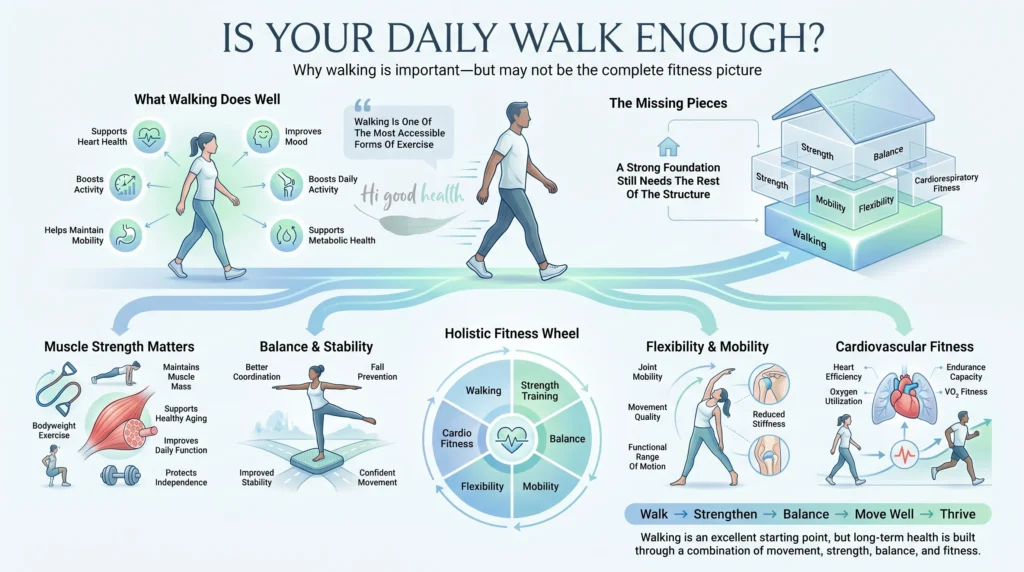
The Ancient Footsteps to Modern Health: Is Walking Truly a Panacea?
For centuries, walking has been instinctively linked to good health. From the daily routines of hunter-gatherers to the leisurely constitutional walks of yesteryear, consistent movement has always been fundamental to human existence.
This inherent connection often leads us to believe that walking alone is the cornerstone of a healthy life.
And while it offers a myriad of benefits, from cardiovascular health to mood elevation, the question remains: is it truly sufficient for optimum well-being in our modern, often sedentary, lives? The answer, as we’ll explore, is nuanced, particularly when considering holistic physical fitness.
The Scientific Stroll: What Research Says About Walking’s Benefits
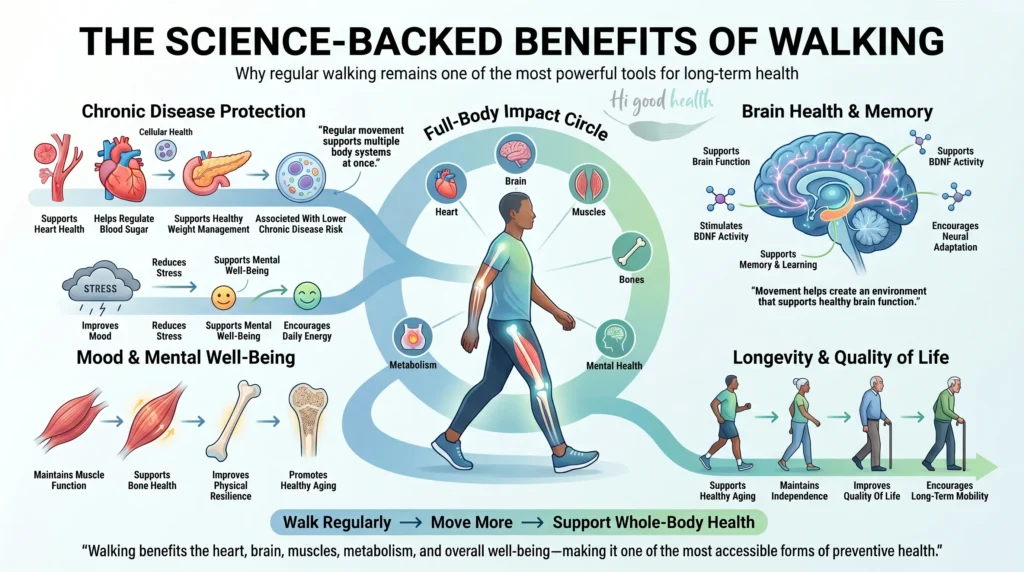
Numerous scientific studies unequivocally establish the link between regular walking and improved health outcomes. Research consistently demonstrates that consistent walking can significantly reduce the risk of chronic diseases such as heart disease, type 2 diabetes, and certain cancers. It aids in weight management, strengthens bones and muscles, and even boosts cognitive function and mood.
Walking does more than just burn off a meal; it actually triggers a chemical called BDNF. This protein helps fix damaged brain cells and even builds new ones in the hippocampus which is the specific part of your brain that handles your memory and learning.
Organizations like the American Heart Association and the Centers for Disease Control and Prevention (CDC) actively promote walking as a readily accessible and effective form of physical activity, citing its positive impact on longevity and overall quality of life. These findings underscore why walking for health is so widely recommended.
Beyond the Pavement: Explaining the Healthy Non-Walkers
We all know someone who rarely seems to walk but appears to be in excellent health. How do these exceptions fit into the narrative? The truth is, while walking is incredibly beneficial, it’s just one piece of the wellness puzzle. These individuals often engage in other forms of physical activity such as
- Resistance or strength training
- Sports or high-intensity exercise
- Physically demanding occupational tasks
Their overall lifestyle, including diet, stress management, and genetics, also plays a significant role. The key isn’t necessarily walking itself, but consistent, varied movement that challenges the body in different ways, forming a truly balanced exercise routine.
How Many Steps Should I Take a Day?
The honest answer to how many steps should I take a day is that 10,000 was never a medical recommendation. It came from a 1965 Japanese pedometer called the manpo-kei — literally the ten-thousand-step meter — and the number was chosen because it was memorable and the character for 10,000 resembles a walking figure.
What the research since has found is more encouraging than the myth. The sharpest reduction in mortality risk appears between roughly 4,000 and 8,000 steps a day. Beyond that the curve keeps improving but flattens, and in most studies the benefit plateaus somewhere around 8,000 to 12,000.
So if you are asking how many steps should I take a day and you currently manage 3,000, the most valuable steps you will ever add are the next 2,000. You do not need to reach 10,000 to get most of the benefit.
A reasonable target by situation:
- Currently sedentary (under 4,000): aim for 5,000–6,000. This is where the returns are steepest.
- General health: 7,000–8,000 captures nearly all of the mortality benefit.
- Steps a day for weight loss: 10,000–12,000, but only alongside diet — walking burns roughly 40–50 calories per 1,000 steps, so steps alone rarely move the scale.
- Over 60: 6,000–8,000 is associated with most of the benefit; chasing 10,000 is not necessary.
One last point on how many steps should I take a day: the number is a floor, not a ceiling, and it is worth revisiting as your fitness changes rather than setting once and forgetting.
Pace matters as much as the total. A brisk stretch where holding a conversation becomes an effort does more than the same number of steps taken slowly, which is the single easiest upgrade to an existing walk.
How Many Steps in a Mile? A Quick Conversion Table
Around 2,000 steps make a mile for an average adult, though it varies with height and stride — roughly 2,200 for a shorter walker and 1,800 for a taller one. Running covers more ground per step, so a running mile is nearer 1,400 to 1,700.
Steps | Approx. miles | Approx. km | Walking time |
|---|---|---|---|
1,000 | 0.5 | 0.8 | 8–10 min |
2,000 | 1 | 1.6 | 15–20 min |
5,000 | 2.5 | 4 | 40–50 min |
10,000 | 5 | 8 | 75–100 min |
15,000 | 7.5 | 12 | 2–2.5 hr |
20,000 | 10 | 16 | 2.5–3.5 hr |
The times assume a steady 3 to 4 mph. They are worth knowing because they turn an abstract target into a scheduling decision — 10,000 steps is not a number, it is somewhere between an hour and a half of your day.
Pacing Yourself: Optimizing Your Walking Routine
So, what’s the sweet spot for walking, and how many steps should I take a day to reach it? Current guidelines suggest aiming for at least 150 minutes of moderate-intensity aerobic activity, or 75 minutes1 of vigorous-intensity activity, per week.
For walking, this often translates to 30 minutes of brisk walking most days of the week. “Brisk” means you can talk but not sing.
While any time of day is beneficial, some studies suggest that morning walks can boost metabolism and mood, while evening walks might aid sleep. Ultimately, consistency is more crucial than specific timing. The optimal duration and pace can also vary based on individual fitness levels and health goals, making effective walking strategies personal.
The Perils of Pounding the Pavement: When Too Much Walking Becomes Detrimental
While walking is largely beneficial, it’s crucial to acknowledge that excess of anything, even a good thing, can have drawbacks.
For some individuals, particularly those engaging in ultra-long distances or with pre-existing conditions, excessive walking can lead to specific concerns.
Think of historical athletes who pushed their bodies to extremes.
Overuse injuries like stress fractures, shin splints, and plantar fasciitis are common in scenarios of high-volume, repetitive impact.
In some cases, extreme tiredness or fatigue becomes a chronic issue, signaling that the body is not adequately recovering, which can ultimately detract from overall well-being rather than enhance it.
Listening to your body and ensuring proper rest and recovery are just as important as the activity itself. This highlights the importance of moderation in exercise and avoiding walking overuse injuries.
Expensive creams cannot fix sagging skin because the real problem is a specific type of muscle loss that starts after you turn 35.
To learn more about how muscle loss contributes to visible aging, read:
“Sagging Face or Breasts After 35? It Might Be Muscle Loss—Not Just Aging.”
Does Walking Build Muscle? The Leg-Centric Dilemma
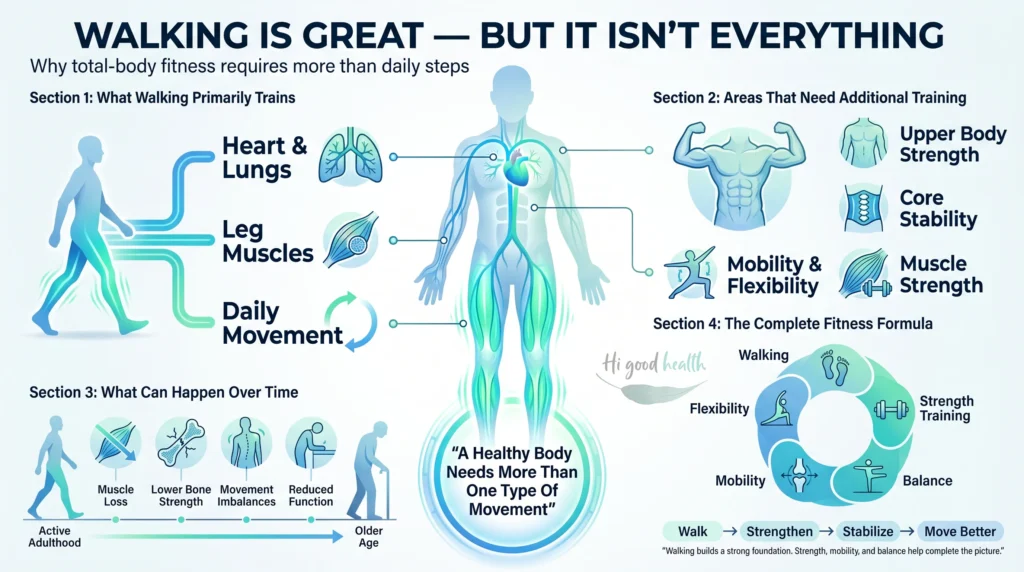
Walking primarily engages the lower body and cardiovascular system. However, it provides limited stimulus for:
- Upper body strength
- Core stability
- Muscle hypertrophy and strength development
- Flexibility and joint mobility
Relying solely on walking may lead to:
- Reduced muscle mass over time (especially with aging)
- Decreased bone density
- Muscular imbalances
- Reduced functional capacity
A holistic approach acknowledges that every part of your body deserves attention for optimal health and injury prevention, emphasizing the need for full body exercise.
The Sedentary Toll: Ailments Beyond Leg Day
Neglecting a comprehensive exercise routine can lead to a cascade of health issues beyond simply weaker upper body muscles
Insufficient engagement in full-body physical activity may contribute to:
- Poor posture and spinal discomfort
- Increased risk of musculoskeletal pain, particularly in the neck and lower back
- Reduced joint mobility and flexibility
- Higher likelihood of injury due to muscle imbalances and weak stabilizing muscles
Importantly, prolonged sedentary behavior—even in individuals who meet basic exercise targets such as daily walking—is independently associated with increased risk of:
- Overweight and obesity
- Metabolic abnormalities (including insulin resistance and dyslipidemia)
- Cardiovascular disease
- Certain cancers (e.g., colon and breast cancer)
To explore the importance of the soleus muscle in leg health and metabolism, read:
“The Soleus: A Key Muscle for Circulation, Endurance, and Lower-Body Health.”
Yoga and Other Holistic Practices: Ancient Wisdom, Modern Wellness
Many ancient disciplines, such as Yoga, Tai Chi, and Pilates, offer profound health benefits without focusing on traditional “walking” as their primary form of exercise.
These practices emphasize flexibility, strength, balance, and mindful movement, often incorporating breathing exercises and meditation.
They offer a comprehensive approach to physical well-being, engaging the entire body and mind. The centuries of practice and growing scientific evidence supporting their efficacy demonstrate that a holistic, intentional movement practice can be equally, if not more, beneficial than simply logging steps. These are excellent examples of mind-body exercise and alternative fitness methods.
Beyond the Stride: Why Your Body Adapts to the Same Walk
If your primary exercise regimen doesn’t involve walking, such as a dedicated yoga practice, is there a harmful effect on your legs or overall body?
The answer is generally no, provided your chosen activities are sufficiently challenging and diverse.
The human body is remarkably adaptable. While yoga, for instance, excels at building strength, flexibility, balance, and core stability.
What it may not provide the same level of cardiovascular conditioning as sustained walking or running, nor the high-impact bone-loading benefits. However, individuals who consistently engage in vigorous yoga, cycling, swimming, or other non-walking activities will develop excellent cardiovascular fitness and muscular strength.
A 2026 study published in BMJ Medicine found that people who engaged in the broadest range of physical activities had a 19% lower risk of all-cause mortality compared with those who did the least varied exercise, even after adjusting for total physical activity levels.
Regarding the ability to run or walk long distances if need be, it largely depends on the specific demands of their non-walking regimen.
A person who cycles regularly will have fantastic leg endurance for cycling.
That same cyclist might find a long run challenging due to different muscle recruitment patterns and impact forces. Similarly, a dedicated yogi will possess incredible body control and flexibility, but might need to gradually introduce walking or running to build up the specific endurance and impact tolerance required for those activities.
The key is specificity of training. If you need to perform a particular activity, some level of practice in that activity will always be beneficial, even if your primary fitness base comes from other sources. Your body will adapt to the demands you place upon it, showcasing the power of adaptable exercise programs.
Mind, Body, Breath: Integrating Mental and Physical Harmony
The connection between mental and physical health is well established.
Practices like Yoga and Tai Chi inherently integrate breathing exercises and mindfulness, fostering a profound connection between the body and mind.
This isn’t just about stress reduction; controlled breathing can improve cardiovascular health, reduce inflammation, and enhance cognitive function.
Incorporating practices that balance mental and physical health – whether it’s through meditation, conscious breathing techniques, or mindful movement – is crucial for achieving true holistic well-being and resilience in the face of modern stressors. This emphasizes the importance of mental wellness exercises alongside physical activity.
Your Blueprint for Holistic Health: A Weekly Exercise Chart
Achieving optimal health requires a well-rounded approach that addresses all aspects of physical fitness: cardiovascular endurance, strength, flexibility, and balance. Here’s a general guide for holistic exercises, with the understanding that individual needs may vary. Always consult with a healthcare professional before starting any new exercise program.
[H3] Holistic Exercise Chart (General Guidelines):
Age Group | Focus Areas & Recommended Activities | Notes |
Children (6-17) | Cardio: Play, running, swimming, cycling (60+ mins daily), Strength: Bodyweight exercises, climbing, active play (3x/week), Flexibility & Balance: Stretching, gymnastics, dance | Emphasize fun and variety. |
Adults (18-64) | Cardio: Brisk walking, jogging, cycling, swimming, dancing (150 mins moderate or 75 mins vigorous/week), Strength: Weight training, resistance bands, bodyweight exercises (2-3x/week, full body), Flexibility & Balance: Yoga, Pilates, stretching, Tai Chi (daily/most days) | Aim for a mix of activities. |
Seniors (65+) | Cardio: Walking, swimming, water aerobics (150 mins moderate/week), Strength: Light weights, resistance bands, chair exercises (2x/week), Flexibility & Balance: Tai Chi, Yoga, gentle stretching (daily) | Focus on maintaining mobility, preventing falls. |
Body Part Focus: Integrating It Into Your Routine
- Legs: Walking, squats, lunges, cycling, stair climbing.
- Core (Abs & Back): Planks, crunches, bird-dog, Pilates, Yoga.
- Upper Body (Arms, Chest, Shoulders): Push-ups, pull-ups (assisted if needed), rows, overhead press, resistance band exercises.
- Full Body & Flexibility: Yoga, Tai Chi, swimming, dynamic stretching, dancing.
- If you are an absolute beginner you can start with “exercise snacks” which are bursts of activity lasting 1 to 5 minutes (like stair climbing or very brisk walking) performed throughout the day. These are now recognized as effective tools for maintaining fitness without dedicated gym time.
Summary: Beyond Steps – Embracing a Holistic Health Journey
While walking remains an accessible and effective tool for health, it’s crucial to understand its place within a broader spectrum of physical activity.
Overrating walking and neglecting other forms of exercise can leave significant gaps in your overall well-being.
True holistic health comes from a balanced approach.
That means cardiovascular exercise, strength training for all major muscle groups, flexibility work, and practices that integrate mental and physical harmony. By embracing a diverse and mindful movement routine, you can unlock your body’s full potential, prevent ailments, and cultivate a truly vibrant and resilient life. Start your journey towards comprehensive well-being today!
Key Takeaways
- 7,000 to 10,000 steps a day suits most adults. The steepest gains are between 4,000 and 8,000, so the next 2,000 steps matter far more if you are currently sedentary than if you are already at 9,000.
- 10,000 was a 1965 pedometer brand name, not a medical finding. Treat it as a target, not a pass mark.
- About 2,000 steps make a mile, so 10,000 steps is roughly 5 miles and 75 to 100 minutes of your day.
- Pace is the cheapest upgrade available. A brisk stretch where talking becomes an effort beats the same step count taken slowly.
- Walking builds almost no muscle and nothing above the waist. Two short strength sessions a week cover the gap.
- Your body adapts to a steady routine within a few months, so the same walk gradually delivers less. Vary pace, terrain or distance.
- For weight loss, steps alone rarely move the scale — roughly 40 to 50 calories per 1,000 steps. It works alongside diet, not instead of it.
Frequently Asked Questions
Here are some common questions people ask about walking and exercise:
Is walking 30 minutes a day enough exercise?
Walking 30 minutes a day meets cardiovascular guidelines, but it isn’t a complete fitness solution. It focuses primarily on the legs, so you must add upper body strength and flexibility work for a truly balanced, holistic routine.
Can walking help me lose weight?
Yes, walking aids in weight management and reduces chronic disease risks. However, for significant results, it works best when combined with a healthy lifestyle and varied movements that challenge the body beyond simple steps.
Does walking count as cardio?
Yes, as long as it is “brisk”—meaning you can talk but not sing. This moderate-intensity activity effectively strengthens the heart and lungs, meeting the standard recommendation of 150 minutes of aerobic activity per week.
How do I turn a walking routine into holistic exercise?
To make your fitness holistic, address what walking misses: upper body strength, core stability, and flexibility. Incorporate activities like Yoga, Pilates, or resistance training alongside your walks to prevent muscle imbalances and injury.
What are the risks of walking too much?
While beneficial, excessive walking without recovery can cause overuse injuries like stress fractures, shin splints, and plantar fasciitis. If you experience chronic fatigue or pain, your body needs rest and more varied, low-impact movement.
What are the best alternatives if I cannot walk?
If walking hurts or isn’t for you, try swimming, cycling, or Yoga. These low-impact activities build cardiovascular fitness and strength without the repetitive pounding of pavement, offering a comprehensive approach to physical well-being.
Do I need special shoes for walking?
Yes, proper footwear is essential to prevent discomfort and conditions like plantar fasciitis. Wear comfortable athletic shoes with good support. If you walk long distances or have foot issues, consult a specialist for specific recommendations.
Is daily walking safe for seniors?
Absolutely. Walking improves longevity and quality of life for seniors. To prevent falls and maintain mobility, seniors should strictly combine walking with balance and flexibility exercises, such as Tai Chi or gentle stretching
How many steps should I take a day?
Aim for 7,000 to 10,000 if you are generally active. The steepest health gains appear between about 4,000 and 8,000 steps, and the benefit flattens after roughly 8,000 to 12,000. The 10,000 figure came from a 1965 Japanese pedometer name, not from research, so treat it as a good target rather than a threshold you have failed to meet.
How many steps are in a mile?
About 2,000 steps for an average adult walking, varying from roughly 1,800 for taller people to 2,200 for shorter ones. Running covers more ground per stride, so a running mile is nearer 1,400 to 1,700 steps.
How many miles is 10,000 steps?
Roughly 5 miles, or 8 kilometers, which takes most people between 75 and 100 minutes at a steady walking pace.
Does walking build muscle?
Barely, and only in the legs. Walking maintains lower-body endurance but provides too little resistance to build meaningful muscle, and it does almost nothing for the upper body or core. Two short strength sessions a week cover what walking cannot.
Walking vs running for weight loss: which is better?
Running burns roughly twice the calories per minute, but walking is far easier to sustain and much gentler on the joints. The better exercise is the one you will still be doing in six months. For weight loss specifically, neither works well without changes to what you eat.
To discover evidence-based ways to prevent falls in later life, read:
“Fall Prevention That Actually Works: Protecting Seniors in 2026 ”
External Sources for Authentic Information:
- American Heart Association (AHA): A leading resource for cardiovascular health, offering guidelines and research on physical activity.
American Heart Association Recommendations for Physical Activity in Adults and Kids
- Centers for Disease Control and Prevention (CDC): Provides comprehensive information on physical activity guidelines and health benefits.
- National Institutes of Health (NIH): A vast resource for scientific research on various health topics, including exercise and its effects.
- Harvard Health Publishing: Offers evidence-based articles and advice on a wide range of health and wellness topics.
Regular exercise changes the brain to improve memory, thinking skills
- “Yoga: The Path to Holistic Health” by B.K.S. Iyengar: A classic text on the philosophy and practice of Yoga.
- “Spark: The Revolutionary New Science of Exercise and the Brain” by John J. Ratey, MD: Explores the profound impact of exercise on cognitive function and mental well-being.
- Journal of the American Medical Association (JAMA): A reputable medical journal publishing peer-reviewed research, including studies on exercise and health outcomes.
- The Lancet: Another highly respected medical journal featuring significant research in public health and medicine.
- Physical activity types, variety, and mortality: results from two prospective cohort studies
