About this series. Oral Hygiene is an eleven-part series on looking after teeth and gums at every age, from brushing and flossing to children’s teeth, gum disease and toothache.
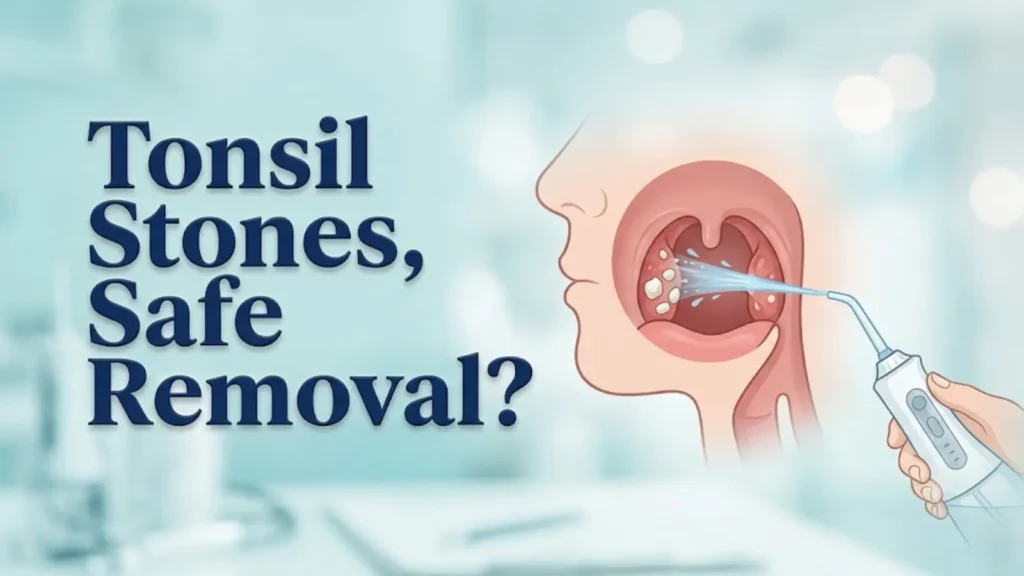
This is Part 5: Water Flosser for Tonsil Stones.
Tonsil stones, also known as tonsilloliths or simply throat stones, are small, hard deposits that form in the crevices of the tonsils. While they are usually harmless, they can cause unpleasant symptoms such as bad breath, throat discomfort, difficulty swallowing, and a sensation of something being stuck in the throat.
As awareness of tonsil stones has grown, many people have turned to home-removal techniques. Searching for a water flosser for tonsil stones has become one of the most common ways people look for a solution. However, the safety and effectiveness of water flossers for tonsil stone removal remain subjects of debate.
This article explains what tonsils are, how tonsil stones form, the advantages and disadvantages of using a water flosser, alternative removal methods, and situations in which medical attention is necessary.
At a glance
- A water flosser can remove small, loosely attached tonsil stones, and it is gentler than poking at your tonsils with a sharp object. It is not a cure, and it will not shift stones that are deeply embedded.
- The single most important rule is pressure: use the lowest setting your device has. The tonsils are delicate lymphoid tissue, and high-pressure irrigation can cause pain, bleeding, and swelling.
- And the answer many people do not expect: if your tonsil stones are not bothering you, you do not need to remove them at all.
What are tonsils?
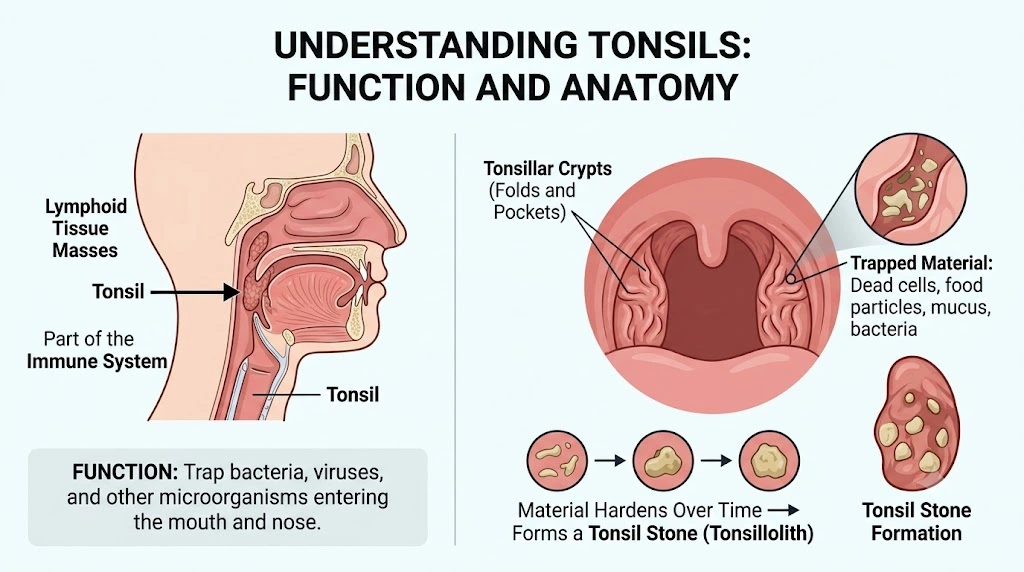
The tonsils are two masses of lymphoid tissue located at the back of the throat, one on each side. They are part of the body’s immune system and help trap bacteria, viruses, and other microorganisms that enter through the mouth and nose.
The surface of the tonsils contains small folds and pockets known as tonsillar crypts. These crypts increase the surface area of the tonsils, helping them interact with pathogens and support immune function. However, these same crypts can also trap debris such as dead cells, food particles, mucus and bacteria. When this trapped material accumulates and hardens over time, it can form a tonsil stone.
What are tonsil stones?
Tonsil stones are calcified deposits that develop within the tonsillar crypts. A tonsillolith is the same thing under its medical name, and people also call them throat stones or tonsil rocks. They can vary in size from tiny white or yellow specks to larger masses visible at the back of the throat. A tonsil stone the size of a small pea is uncommon but not rare, and larger ones are the ones most likely to need a doctor rather than a home method.
They are far more common than most people realise. Many people have tonsil stones without ever knowing it, and stones frequently fall out on their own while eating, coughing, or gargling.
Common symptoms
Many tonsil stones cause no symptoms at all. However, some people may experience:
- Persistent bad breath (halitosis)
- Sore throat
- Ear pain
- Difficulty swallowing
- A metallic or unpleasant taste in the mouth
- Chronic throat irritation
- A feeling that something is stuck in the throat
- Visible white or yellow deposits on the tonsils
Bad breath is one of the most common complaints, because bacteria within the stones produce sulfur-containing compounds that create unpleasant odours. This is also why tonsilloliths smell so strongly when one is dislodged; the smell comes from those sulfur compounds, not from the stone itself being dirty.
Who gets tonsil stones? Common risk factors
Tonsil stones are not caused by poor hygiene alone, and getting them does not mean you have done something wrong. Some people are simply more prone to them because of the shape of their tonsils. Recognised risk factors include:
- Deep or enlarged tonsillar crypts — the more surface folds, the more places debris can lodge
- A history of frequent tonsillitis, which can scar and deepen the crypts
- Chronic dry mouth or dehydration, since saliva helps wash debris away naturally
- Post-nasal drip from ongoing sinus or allergy problems
- Being a teenager or young adult — tonsil stones are more common in this age group
- Smoking or tobacco use
If you have several of these, stones are likely to recur even after removal. That is worth knowing before you invest in a device: prevention and professional treatment matter more than repeated home removal.
Can a water flosser remove tonsil stones?
A water flosser is a device that uses a pressurised stream of water to clean between teeth and along the gumline. Some people use water flossers to dislodge tonsil stones from the tonsillar crypts.
How it works
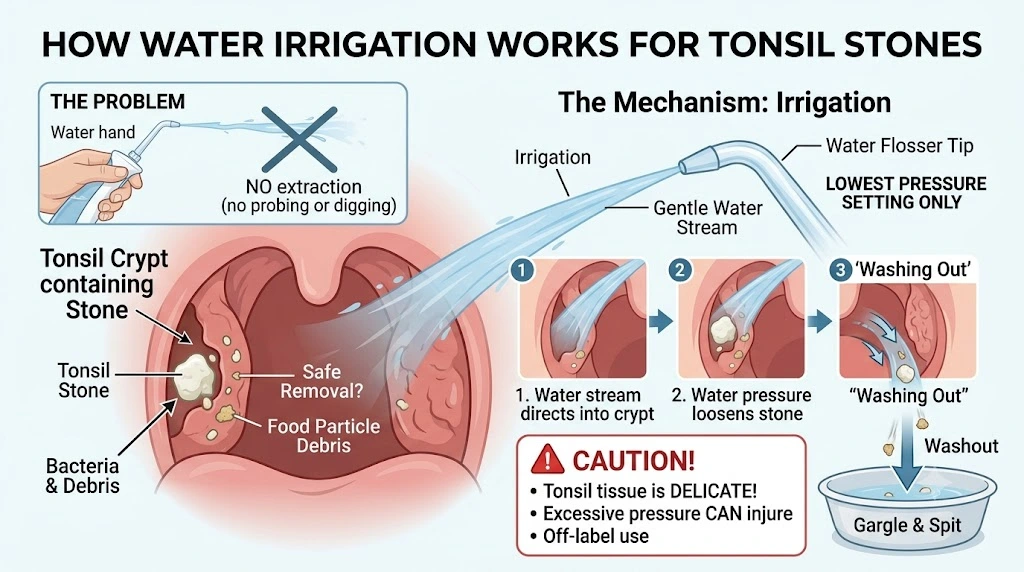
The stream of water is directed toward the tonsil crypt containing the stone. If the stone is small and loosely attached, the water pressure may help wash it out. That is the whole mechanism: it is irrigation, not extraction.
Although many users report success, healthcare professionals often recommend caution, because the tonsils are delicate tissues that can be injured by excessive pressure.
It is worth being clear about what a water flosser is and is not. It was designed to clean between teeth, and using it on your tonsils is an off-label use. Major clinics do list it among home options, but no manufacturer markets a device for this purpose, and there is no clinical trial evidence establishing how well it works.
Advantages of using a water flosser
- Non-invasive. It does not require inserting tools deep into the throat, reducing the risk of puncturing tissue compared with sharp objects.
- May remove small stones effectively. Small and superficial stones can often be loosened with gentle irrigation.
- Improved oral hygiene. Regular use for dental hygiene may help reduce oral bacteria and food debris, potentially lowering the likelihood of future stone formation.
- Easy to perform at home. Water flossers are widely available and can be used without a medical appointment.
- Less mechanical trauma than probing. A gentle stream of water is less traumatic than scraping at the tonsils with improvised tools.
Disadvantages and risks
The risks are real but mostly avoidable, and almost all of them come back to pressure and technique.
- Tonsil tissue injury. High-pressure settings can damage delicate tissue, leading to pain, irritation, inflammation or bleeding.
- Incomplete removal. Deeply embedded stones often cannot be removed with water alone.
- Pushing debris deeper. Improper technique may force debris further into the crypts, potentially worsening the problem.
- Gag reflex. Directing water toward the back of the throat may trigger gagging in sensitive individuals.
- Infection risk. An unclean device may introduce bacteria into irritated tissue.
- Choking or inhaling water. Work slowly, keep your head tilted forward over the basin, and stop between bursts to swallow or spit.
- Not suitable for everyone. Avoid this method entirely if you have a bleeding disorder, take blood-thinning medication, have had recent throat surgery, or have an active tonsil infection. It is not appropriate for young children.
Safety tips for water flosser use
- Start with the lowest pressure setting. If your device has a numbered dial, stay at the bottom of the range. This is the single most important precaution, and a low-pressure oral irrigator is safer than a powerful dental unit turned down.
- Use clean, lukewarm water.
- Aim beside the stone rather than blasting it directly.
- Stop immediately if pain or bleeding occurs.
- Clean the device thoroughly according to the manufacturer’s instructions.
- Avoid repeated aggressive attempts. If a stone has not shifted after two or three gentle attempts, leave it alone and let it work itself out, or see a doctor.
- Never use a sharp or pointed object — a pin, toothpick, tweezers or fingernail — to dig at your tonsils. This is how most serious home-removal injuries happen.
Other methods for how to get rid of tonsil stones
If a water flosser is not for you, there are several other options, ranging from doing nothing at all to surgery. Here is how the main ones compare.
| Method | Best for | Risk level | Notes |
|---|---|---|---|
| Doing nothing | Stones with no symptoms | None | Often the correct choice — many stones dislodge naturally |
| Saltwater gargle | Small stones, throat irritation | Very low | Safest first step; also eases discomfort |
| Gentle coughing | Loose, superficial stones | Very low | No equipment needed |
| Water flosser, lowest setting | Small, visible, loosely attached stones | Low to moderate | Pressure is the whole risk; off-label use |
| Oral irrigation syringe | People who want more control | Low | Gentler and cheaper than a powered device |
| Cotton swab | A single visible stone | Moderate | Gag reflex and bleeding risk; be gentle |
| ENT removal | Large or embedded stones | Low, professionally managed | Also identifies underlying causes |
| Laser or coblation cryptolysis | Frequent recurrence | Procedural | Reduces crypt depth to prevent recurrence |
| Tonsillectomy | Severe, recurrent cases | Surgical | Permanent, but reserved for significant cases |
Saltwater gargles
Gargling with warm salt water is one of the safest home remedies. It loosens debris, eases throat irritation and reduces bacterial growth — and it is the sensible first thing to try.
Gentle coughing
Some small stones become dislodged naturally through coughing.
Oral irrigation syringe
A low-pressure oral syringe can provide more controlled irrigation than some water flossers. It is also considerably cheaper than a powered device, which matters if you are buying something purely for this.
Cotton swab removal
A cotton swab may sometimes be used to gently nudge a visible stone from the tonsil surface. The risks are bleeding, tissue injury and a strong gag reflex, so care should be taken not to press forcefully.
Professional removal by an ENT specialist
An ear, nose and throat (ENT) specialist can safely remove problematic stones using specialised instruments. This is the right route for a large tonsil stone, for anything deeply embedded, and for finding out why they keep forming.
Laser and coblation cryptolysis
Laser cryptolysis reduces the depth of the tonsillar crypts, making future stone formation less likely. Coblation cryptolysis uses radiofrequency energy to smooth the tonsil surface and reduce crypt formation.
Tonsillectomy
A tonsillectomy is the surgical removal of the tonsils. It is the only permanent answer, but it is real surgery with real recovery, and it is reserved for severe or genuinely recurrent cases.
How to prevent tonsil stones coming back
If you want to know how to prevent tonsil stones rather than just remove them, this is the more useful half of the article — because for most people the stones will return.
- Brush teeth twice daily.
- Floss regularly. Cleaning between the teeth reduces the bacterial load in the mouth overall — see our guide to flossing correctly.
- Clean the tongue.
- Use an antibacterial mouthwash when appropriate.
- Stay hydrated. Saliva is the body’s own rinse; a dry mouth lets debris sit.
- Avoid tobacco products.
- Treat chronic sinus or allergy problems.
- Maintain regular dental checkups.
When should you see a doctor?
Most tonsil stones are harmless and can be managed conservatively. Seek medical attention if you have:
- Frequent or recurring tonsil stones
- Persistent bad breath despite good oral hygiene
- Significant throat pain, or difficulty swallowing
- Recurrent tonsil infections
- Bleeding from the tonsils
- Large stones that cannot be removed safely
- Fever or signs of infection
- Symptoms that interfere with daily activities
⚠️ Swelling of one tonsil in particular deserves prompt attention. Persistent one-sided swelling has other possible causes and should always be assessed rather than assumed to be a stone.
The Oral Hygiene Series
Eleven articles on looking after your teeth and gums, at every age.
- Complete Oral Hygiene Guide for Every Age — the whole routine, age by age
- Brushing Technique: Bass, Modified Bass and Fones — which method suits which mouth, and how long two minutes really is
- Electric vs Manual Toothbrush — what the evidence shows, rather than what the manufacturers claim
- How to Floss Correctly — step by step, including the C-shape wrap and how far below the gumline to go
- Water Flosser for Tonsil Stones — what pressure is safe, and when not to try it at all (you are here)
- Interdental Brushes and Bleeding Gums — choosing the right size, and why bleeding usually stops within two weeks
- Early Childhood Caries — causes, symptoms, prevention and treatment in children under six
- Milk Teeth Falling Out — the age, order and timeline, and what parents should know
- Pyorrhea (Gum Disease) — causes, symptoms, treatment and prevention
- Gum Swelling, Bleeding and Dry Mouth — how underlying diseases affect your gums and oral health
- Medicine for Toothache — what to take, what causes the pain, and how it is treated
Key takeaways
- A water flosser can dislodge small, loosely attached stones, but it will not remove deeply embedded ones and it is not a cure for recurrence.
- Use the lowest pressure setting your device has. Pressure is where the real risk lies.
- Never use sharp objects to dig at your tonsils.
- If stones cause no symptoms, no treatment is needed.
- Recurrence is driven by tonsil anatomy, not by hygiene failure, so frequent stones are worth discussing with an ENT.
- Stop and seek advice if there is pain, bleeding, fever, difficulty swallowing, or swelling on one side.
Can a Waterpik remove tonsil stones?
Yes, sometimes. A Waterpik is simply one brand of water flosser, so everything here applies to any oral irrigator. It can work for small, visible stones sitting loosely in a crypt. Use the lowest pressure setting, aim beside the stone rather than at it, and stop if there is any pain or bleeding. Waterpik does not market its devices for this purpose, so this is an off-label use of a dental product.
What pressure setting should I use on a water flosser for tonsil stones?
The lowest one available. Dental units are built for the pressure the gums can take, and tonsil tissue is more delicate than gum tissue. If your device starts higher than you are comfortable with, a simple low-pressure oral irrigation syringe is a gentler alternative.
Is it safe to remove tonsil stones at home?
For small, visible stones, gentle methods such as saltwater gargling, coughing, or low-pressure irrigation are generally considered safe. What is not safe is digging with pins, toothpicks or fingernails, or using high-pressure water. Avoid home removal altogether if you take blood thinners, have a bleeding disorder, or have an active throat infection.
Do tonsil stones go away on their own?
Frequently, yes. Many dislodge naturally during eating, coughing or gargling, and many people have them without ever noticing. If they are not causing symptoms, leaving them alone is a reasonable choice.
Why do I keep getting tonsil stones?
Usually because of the shape of your tonsils rather than anything you are doing wrong. Deep or enlarged tonsillar crypts, a history of tonsillitis, chronic dry mouth and post-nasal drip all make recurrence more likely. If stones keep returning, an ENT can discuss cryptolysis or other options that address the cause rather than the symptom.
Do tonsil stones cause bad breath?
They can. Bacteria within the stones produce sulfur compounds, which is why halitosis is one of the most common reasons people discover them. If bad breath persists after a stone is removed and your oral hygiene is good, there may be another cause worth investigating.
Why do tonsilloliths smell so bad?
The bacteria living inside the stone produce volatile sulfur compounds, the same family of compounds behind rotten-egg odours. That is why a dislodged stone can smell far stronger than its size suggests, and why halitosis is often the first sign anyone notices.
Can tonsil stones be dangerous?
Rarely. They are generally harmless. Seek medical attention if you have fever, severe throat pain, difficulty swallowing or breathing, bleeding, or swelling on one side of the throat; these point to something that needs assessment rather than home management.
Glossary
- Tonsillolith — the medical term for a tonsil stone, a calcified deposit in a tonsillar crypt.
- Tonsillar crypts — the natural folds and pockets on the tonsil surface where debris can collect.
- Halitosis — persistent bad breath.
- Cryptolysis — a procedure that reduces the depth of tonsillar crypts, using laser or radiofrequency energy, to make stones less likely to re-form.
- Oral irrigator — another name for a water flosser.
Read next
- How to Floss Correctly — the technique that reduces the bacterial load behind most oral-odour problems
- Complete Oral Hygiene Guide for Every Age — where daily routine fits in
- Electric vs Manual Toothbrush — choosing the tool that suits you
Conclusion
A water flosser for tonsil stones is a reasonable thing to try, on the lowest setting, for a small stone you can see. It is not a cure, and it is not the only option. Anyone experiencing persistent symptoms, recurrent stones, or signs of infection should seek evaluation from a healthcare professional.
Disclaimer
This article is for general education only and is not a substitute for individual medical advice, examination or treatment from a qualified doctor. If you have persistent throat symptoms, recurrent stones, or any of the warning signs listed above, see a doctor or an ENT specialist rather than managing it at home.
References
- Cleveland Clinic. Tonsil Stones: Symptoms, Causes, Removal and Treatment. my.clevelandclinic.org
- Mayo Clinic. All about tonsil stones. Mayo Clinic News Network. newsnetwork.mayoclinic.org
- National Health Service (NHS). Tonsil stones (tonsilloliths).
- American Academy of Otolaryngology — Head and Neck Surgery Foundation. Tonsils and Adenoids. enthealth.org
- Ferguson M, Aydin M, Mickel J. Halitosis and the tonsils: a review of management. Otolaryngology–Head and Neck Surgery, 2014. doi:10.1177/0194599814544881
- Mesolella M, Cimmino M, Di Martino M, et al. Tonsillolith: case report and review of the literature. Acta Otorhinolaryngologica Italica. PubMed 15871614
- Bhat V, Hegde KS. Tonsillolith: a rare clinical entity. Journal of Oral and Maxillofacial Pathology.
- American Dental Association (ADA). Brushing Your Teeth. MouthHealthy. mouthhealthy.org
