At a Glance
- Use your hands, not the scale. Vets score body condition out of 9, and 5 is ideal — ribs easily felt under a thin layer of fat, a waist visible from above, a belly that tucks up in profile. Each point above 5 is roughly 10% over ideal weight, so a 7 out of 9 means about 20% too much.
- India’s published data is thin and the two figures in circulation measure different things. A survey of 500 dogs in Ludhiana found 14% overweight or obese; urban clinic impressions run closer to 30%. A waiting room is not a neighbourhood.
- Lean dogs live longer, and this is one of the few things in pet nutrition with controlled evidence behind it. 48 Labradors followed for 14 years: the half fed 25% less lived a mean 13 years against 11.2, and finished with half as much hip arthritis.
- If you have a Labrador that is always hungry, that may be real. About a quarter of Labradors carry a POMC gene deletion that leaves them hungrier between meals and burning around 25% fewer calories at rest. It makes the job harder, not impossible — feed by measurement, and spread the ration out.
- Never crash-diet a cat. Rapid weight loss in cats can cause hepatic lipidosis, a liver failure that overweight cats are most at risk of. Safe loss is 0.5–2% of body weight per week, and a cat that has not eaten for about 24 hours needs a vet rather than another day of waiting.
- Expect this to take a year. Safe loss in dogs is 1–2% of body weight a week. For a 40 kg dog that is 400–800 g — so shifting 7 kg is a nine-to-twelve month project, not a summer one.
Introduction: More Than Just a “Healthy” Pet
Have you ever looked at a slightly overweight dog and thought, “He looks healthy and well-fed”? In many Indian households, a chubby pet is often seen as a sign of love and good care. However, this perception can be misleading.
Dog obesity is an emerging concern in India, particularly in cities. Veterinarians in urban practice report seeing a large share of overweight animals — one widely quoted clinical impression puts it near 30% of dogs presented at urban clinics [1] — and the pattern they describe is consistent: indoor pets, sterilised animals, and popular breeds such as the Labrador Retriever.
Limited activity, calorie-rich food and simple overfeeding drive it. How that clinical impression compares with the published Indian data is worth setting out properly, and it is covered further down this page.
Beyond appearance, excess body weight predisposes pets to serious health issues, increases veterinary expenses, and can negatively affect behaviour and quality of life. A major contributing factor is “normalcy bias,” where overweight pets are perceived as normal, and a healthy body condition is often mistaken for being underweight.
Thus, increasing awareness about ideal body condition and preventive care is essential to safeguard the long-term health and well-being of companion animals in India.
Beyond the Belly: The Diseases Caused by Pet Obesity
- Diabetes mellitus (especially in cats): Excess adipose tissue contributes to insulin resistance, leading to persistent hyperglycemia and eventual pancreatic dysfunction.
- Osteoarthritis (especially in dogs): Increased body weight places abnormal stress on joints, accelerating pain, inflammation, and progressive cartilage degeneration.
- Cardiovascular strain and heart disease: Obesity increases cardiac workload, potentially leading to reduced cardiac efficiency and exercise intolerance.
- Respiratory compromise: Fat deposition around the thorax and abdomen can restrict lung expansion, leading to difficulty in breathing and reduced stamina.
- Endocrine disorders exacerbation: Conditions like hypothyroidism in dogs accelerate weight gain, which aggravates the metabolic imbalance in obese dogs—creating a vicious cycle.
- Higher anesthetic and surgical risk: Obese animals have higher anesthetic risk, difficult airway management, and increased post-operative complications.
- Increased risk of cancer: Obesity has emerged as a significant health concern in companion animals, with growing evidence linking it to increased cancer risk, progression, and poorer outcomes [2].
Weight is not the only appetite signal worth watching. If your pet suddenly starts eating less, that is a different problem with its own urgency — our guide to why pets stop eating, and when it becomes an emergency sets out the timelines, which are far shorter for cats than for dogs.
The Financial Weight of Pet Obesity in India
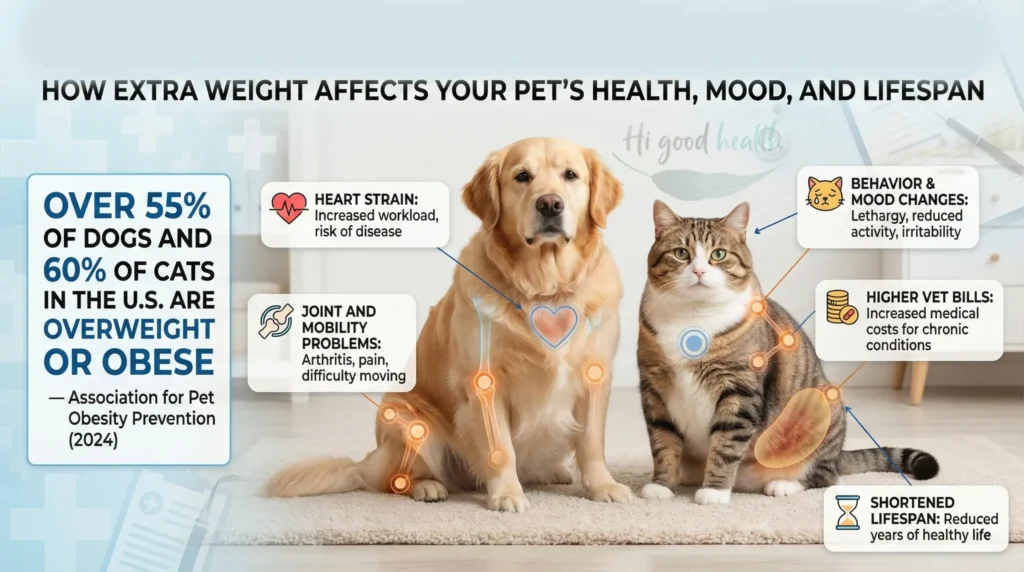
Chronic Disease Management: Conditions like Diabetes (Cats) and Osteoarthritis (Labs/Goldens) can cost between ₹30,000 to ₹1.5 Lakh annually for insulin, monoclonal antibody injections (Librela), and specialised physiotherapy.
The “Surgical Surcharge”: Expect a 25–40% premium on any surgery, which can range from ₹ 40,000 to ₹ 4,50,000. Overweight pets require more anesthesia, advanced monitoring, and longer surgical time, leading many Indian surgeons to charge “high-risk” fees.
Emergency & Lifestyle Costs: Obese pets are prone to expensive heat stroke treatments (₹10k–₹25k per episode) and require prescription diets that can cost up to ₹9,000 per bag.
Emotional and Behavioural Costs: The Hidden Happiness Factor
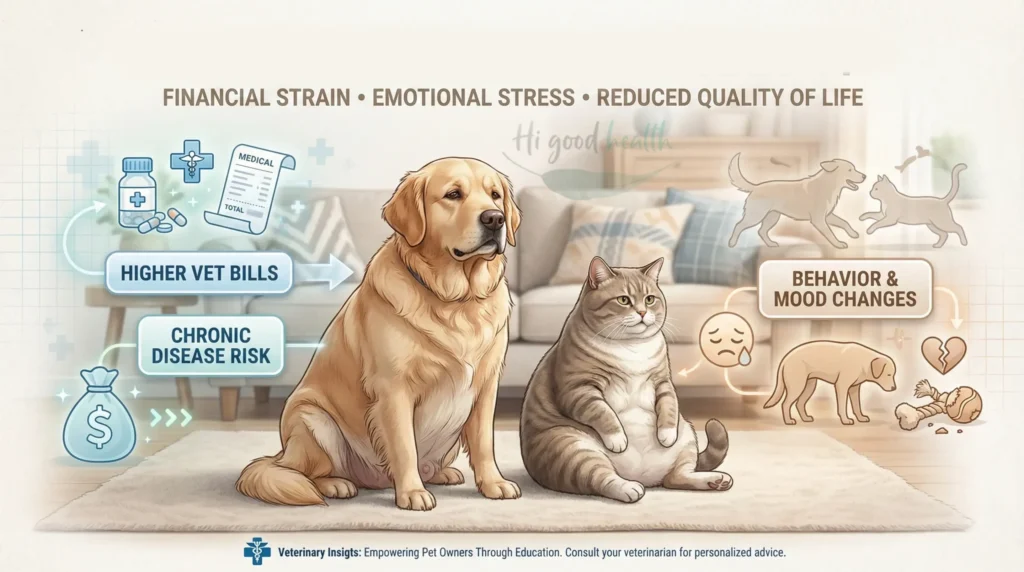
Here’s something many owners don’t realise: obesity doesn’t just slow your pet physically—it may impact their emotional well-being and behaviour. Research in veterinary behaviour science suggests that pets who maintain healthy activity levels tend to show more positive behavioural patterns.
Activity and Behaviour: What Changes When a Pet Gains Weight
- Active pets often demonstrate calmer temperaments, increased playfulness, and reduced aggression.
- As weight increases, pets often exhibit decreased willingness to move, reduced play behaviour, exercise intolerance and quicker fatigue.
- Overweight pets with reduced activity may also show signs of frustration, irritability and increased aggression a response to chronic joint discomfort and pain caused by excess weight.
- Weight loss and return to healthy activity levels can restore more positive personality traits.
This doesn’t just affect your pet. A stressed or unhappy dog is more likely to bark excessively, show aggression, or develop destructive habits—behaviours that ripple into family stress. By contrast, lean and active pets bring more joy, playfulness, and bonding moments to the entire household.
The clearest evidence on this comes from a study of 50 obese dogs enrolled in a veterinary weight-loss programme, of whom 30 completed it. In those 30, owner-reported vitality rose, emotional disturbance fell and pain scores fell, all strongly significant, and the improvement in vitality tracked how much weight was actually lost [3].
One result is worth reporting alongside the good news: anxiety did not change. Weight loss made these dogs livelier and more comfortable — it did not make an anxious dog a calm one, and it should not be sold as a behaviour cure.
Root Causes of Pet Obesity in India
1. Overfeeding and improper diet: Pet obesity in India is largely driven by excessive feeding and nutritionally imbalanced diets. Many pets are given high-carbohydrate home foods such as rice, chapati, and table scraps, along with frequent treats. Owners often associate overfeeding with affection, leading to excess calorie intake.
2. Lack of physical activity: Urban living conditions, particularly apartment lifestyles, limit opportunities for exercise. Dogs often receive inadequate walks, while indoor cats have minimal physical stimulation, contributing to weight gain.
3. Post-sterilisation effects: Neutering leads to reduced metabolic rate and increased appetite. Without proper dietary adjustments, this hormonal change predisposes pets to obesity.
4. Owner awareness and normalcy bias: Many owners fail to recognise obesity and perceive overweight pets as healthy. This misperception delays intervention and allows weight gain to progress unnoticed.
5. Feeding of human food and treats: Regular feeding of calorie-dense food cooked for humans, snacks, and emotional feeding habits further increases caloric intake.
6. Lack of preventive veterinary guidance: Infrequent health check-ups and absence of structured diet or weight management plans contribute to poor monitoring and control of body condition.
Dog Obesity in India: How Common Is It, and Which Dogs Are Most at Risk?
Honest answer first: India does not have good national data on this. The published work that exists is small and local. A survey of 500 dogs in Ludhiana, Punjab found 14% overweight or obese [9]. Studies from other countries over the past fifteen years report anywhere between 15% and 65%, depending on the population sampled and who did the scoring.
So how does that sit with vets in Indian cities describing something closer to a third of their caseload? Both can be true at once, and the reason matters. A clinic population is not the general dog population — dogs come to a clinic because something is wrong, and overweight dogs come more often.
A door-to-door survey and a waiting-room count are measuring different things. Treat the clinic figure as a signal about urban pet dogs seen by vets, not as a national prevalence rate, and be sceptical of any single number offered without saying which of the two it is.
What the research agrees on far more firmly is who is at risk. Reviews of canine obesity consistently identify the same factors: neutering, which in one analysis raised risk roughly 2.2-fold; middle and older age, with obesity peaking around eight to eleven years; apartment living rather than a house with a yard; regular table scraps and free access to treats; and certain breeds — Labrador Retrievers, Pugs, Beagles, Spitz, German Shepherds and Dachshunds [9].
Read that list against a typical Indian metro household and the picture is not reassuring: a neutered Labrador in a flat, fed roti and leftovers alongside its regular meals, sits on almost every risk factor at once.
Why Labradors Are Different: The POMC Gene
The Labrador is one of the most commonly kept breeds in Indian homes, and there is a specific biological reason it keeps appearing at the top of obesity lists. Roughly 25% of Labradors carry a deletion in a gene called POMC, which sits in the brain pathway that signals fullness. In flat-coated retrievers, a closely related breed, the figure is about 66% [10].
The effect is not what most owners would guess. Affected dogs do not necessarily eat more at a given meal — they are hungrier in between meals, and they work noticeably harder for food when tested. On top of that, dogs carrying the variant appear to burn around 25% fewer calories at rest than dogs without it. A harder-begging dog with a slower engine is a difficult combination in a household that reads begging as hunger.
This is not a licence to give up, and the researchers are explicit about that. Dr Eleanor Raffan, who led the work, puts it plainly: it is very difficult to keep these dogs slim, but it can be done.
The practical advice that comes out of it is specific — feed by measurement rather than by appetite, and spread the daily ration out using puzzle feeders or by scattering food so the dog spends longer getting it.
The aim is to close the gap between meals when the hunger actually bites, without adding calories. If you have a Labrador who seems permanently starving, the dog is probably not being greedy and you are probably not imagining it.
How to Tell if Your Dog Is Overweight: Body Condition Score and Ideal Weight
The first step in helping an overweight dog is recognising and admitting there is a problem. Overweight dogs appear so often in photographs and advertising that most people have lost the reference point for what a fit dog looks like. Your veterinarian can settle it in a minute [4].
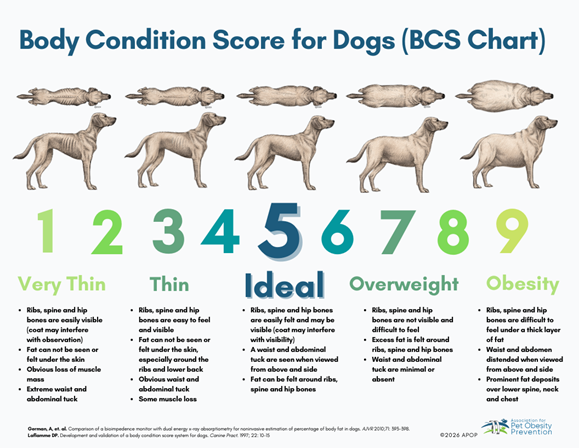
The number on the scale is useful, but vets rely mainly on the Body Condition Score (BCS) — a hands-on assessment scored out of 9, where 5 out of 9 is ideal: ribs easily felt under a thin layer of fat, a visible waist, a tucked-up belly in profile.
The scale is more informative than it looks, because the points are calibrated. Each point above 5 corresponds to roughly 10% over ideal body weight. So a dog scored at 7 out of 9 is about 20% overweight, and a dog at 8 out of 9 is about 30% overweight.
That is what makes BCS usable at home in a way a bathroom-scale reading is not: it converts a vague impression into a number you can act on, and it tells you roughly how much weight has to come off before you start.
- 1. The Rib Test (Feel): You should easily feel the ribs under a thin layer of fat, similar to feeling the knuckles on the back of your hand. If you have to press hard, there is excess fat.
- 2. The Overhead View (Shape): Looking down from above, the dog should have a clear “hourglass” figure with a noticeable waist. A rectangular or oval shape is a red flag.
- 3. The Profile View (Tuck): Looking from the side, the belly should slope upward toward the back legs (an “abdominal tuck”). A flat or sagging belly indicates internal fat.
Clinical Warning Signs: Watch for stubborn fat pads at the base of the tail or a thick crest on the neck, as these are indicators of chronic weight gain and inflammation.
The BCS chart standardised by the Association for Pet Obesity Prevention is given below [4].
Why a Breed Weight Chart Is the Wrong Tool
Searching for a breed weight chart is the most common next step, and it is the least useful one. A breed range tells you what an average dog of that breed weighs, not what your dog should weigh. The published range for a Labrador spans something like 25–36 kg, which covers a small light-framed female and a large heavy-framed male — two animals whose correct weights differ by more than ten kilos.
A dog can sit comfortably inside its breed range and still be carrying 20% too much, and a lean dog with a big frame can sit above the range and be exactly right.
The useful number is your own dog’s ideal weight, and there is a simple way to establish it: if your dog was ever at a BCS of 5 as a young adult, that weight is the target.
If you do not have that figure, your vet can estimate it from the current weight and the current score — a dog at 7 out of 9 weighing 48 kg is carrying about 20% too much, which puts the target somewhere near 40 kg.
Write the target down. A weight-loss plan without a defined endpoint tends to stop as soon as the dog looks a bit better, which is usually well short of where it needed to get to.
The Obese Cat Is a Different Problem — and a More Dangerous One
Almost everything written about pet obesity is written about dogs, this article included until now. Cats are not small dogs, and on this subject the difference is not cosmetic.
An obese cat in an Indian flat is arguably in a worse position than an overweight dog in the same household: it is more likely to be indoors permanently, more likely to be free-fed dry food left out all day, less likely to be walked or played with daily, and far less likely to have anyone notice, because a fat cat mostly just looks like a cat.
The hands-on checks work on cats too — you should be able to feel the ribs without pressing, and looking down from above there should be a visible waist behind the ribs.
One thing catches people out. Most cats have a loose flap of skin and fat hanging along the lower belly called the primordial pouch. It swings when the cat trots and it looks exactly like a weight problem. It is normal anatomy and it is present on lean cats.
Judge a cat by its ribs and its waist, not by its belly flap — and do not put a healthy cat on a diet because of it.
Never Crash-Diet a Cat: Hepatic Lipidosis
This is the single most important paragraph on this page for cat owners. When a cat loses weight too quickly, or stops eating altogether, its body mobilises fat faster than the liver can process it. Fat accumulates in the liver cells and liver function fails.
The condition is called hepatic lipidosis, or fatty liver disease, and it is serious, expensive and sometimes fatal. Overweight cats are the ones most at risk — precisely the animals whose owners are most likely to decide it is time to cut the food right back.
Two rules follow from that, and neither is optional. First, weight loss in cats should run at about 0.5–2% of body weight per week [8] — for a 6 kg cat that is 30–120 g a week, which will feel absurdly slow and is meant to. Aggressive calorie restriction is what causes the problem.
Second, a cat that stops eating for more than about 24 hours needs a vet, not another day of waiting. This is the opposite of the advice for a dog, where a missed day is usually not urgent. Any cat weight-loss plan should be set up with your vet rather than improvised, and the food reduced in steps rather than in one cut.
What works for cats, once the plan is safe:
- Measured meals instead of a bowl left out — the single biggest change in most households.
- Wet food, which carries far fewer calories per mouthful because so much of it is water, so the cat gets a normal-sized meal for fewer calories.
- Puzzle feeders and food scattered around the house, which turn eating back into hunting and add movement to an indoor day.
- Feeding cats separately in a multi-cat home, because otherwise the confident one eats the dieting one’s food and both plans fail.
Weight loss also matters more in cats than most owners realise for one specific reason: obesity drives insulin resistance, and diabetic cats that lose weight can sometimes come off insulin entirely. That is a realistic outcome worth working for, and one your vet can tell you whether your cat is a candidate for.
Practical Solutions for Healthier, Happier Pets
These daily play sessions burn calories, support healthy activity levels, and prevent boredom Over time, you may notice your pet not only losing weight but also becoming more affectionate, calmer, and happier.
Portion Control and Smarter Treats
- Use measuring cups instead of guessing portions.
- Swap calorie-heavy treats for carrot sticks, apple slices, or pumpkin cubes (consult your veterinarian first, as some human foods may not be suitable for all pets).
Daily Exercise Routines and Playtime
- Dogs: Aim for 2 brisk walks + short play sessions daily like backyard games- Fetch, tug-of-war, or agility setups using simple obstacles (adjust based on breed, age, and health status).
- Cats: Stimulate with laser toys, feather wands, or climbing trees.
Engage Their Minds
- Obesity is often linked to boredom. Puzzle feeders, snuffle mats, and training games keep pets mentally sharp and satisfied. Even if you’re busy, encourage your spouse or kids to join in. Pets love routine, and shared activity strengthens the pet-family bond.
Regular Weight Monitoring
Weigh monthly at home or during vet visits. Small adjustments early may help prevent costly medical issues later. Always consult your veterinarian before starting any weight loss programme.
Important: Always consult your veterinarian before beginning an exercise programme, especially for overweight pets or those with existing health conditions.
Weight is one drain on a pet’s energy; parasites are another, and the two are easy to confuse. Our 2026 guide to preventing tick-borne disease in Indian pets covers the prevention side.
Strategic Diets That Fight Pet Obesity
Dietary management is the cornerstone of treating and preventing obesity in companion animals. Calorie restriction alone is insufficient, which can lead to hunger, poor compliance, and muscle loss. Specialised diets help to control obesity-related comorbidities and improve satiety, reducing begging and food-seeking behaviour [5]. Always consult your veterinarian before making any dietary changes, as introducing a new diet should be tailored to your pet’s specific health needs.
- High-fibre diets: Increase food bulk without adding calories, promoting fullness and reducing hunger-driven behaviours; commonly used in dogs for better satiety and compliance.
- High-protein, low-carbohydrate diets: Support lean muscle preservation and improve metabolic efficiency; ideal for cats to enhance satiety and regulate glucose levels.
- Wet/canned diets: High moisture content lowers calorie density while maintaining portion size, helping control intake and improve satiety, especially useful in cats.
- Prescription veterinary weight-loss diets: Scientifically formulated with controlled calories, high protein, and functional nutrients to ensure safe fat loss while maintaining overall nutritional balance. These formulated diets should be used only under veterinary guidance, as they are carefully prescribed based on your pet’s individual health status, weight, and underlying medical conditions to ensure safe and effective outcomes.
A pet that has become slow and reluctant to move is not always simply overweight. Find out how to recognise the signs of tick-borne disease and what the diagnostic standards are before putting lethargy down to weight alone.
What Science Says: The Research on Dog Obesity and Lifespan
• Lifespan, the observational evidence: A study of more than 50,000 neutered dogs in a large veterinary hospital network, covering 12 popular breeds, found that overweight dogs had a shorter median lifespan in every breed examined. The size of the gap varied enormously — from roughly five months in male German Shepherds to roughly two and a half years in male Yorkshire Terriers [6]. Small breeds appear to lose proportionally more. This is an association drawn from clinical records, not proof of cause.
• Lifespan, the controlled evidence: The stronger study is older and much smaller. 48 Labrador Retrievers were followed for 14 years in paired littermates, with one of each pair fed 25% less food than its sibling.
The lean-fed dogs lived a mean of 13 years against 11.2 — a difference of 1.8 years, about 15%. By the end of the study, 83% of the full-fed dogs showed radiographic signs of hip osteoarthritis, against 50% of the lean-fed group [7].
Two things are worth knowing about it: it was run by a pet-food company, and nothing like it has been repeated, because a 14-year controlled feeding trial in dogs is close to impossible to fund twice. It is still the best causal evidence that exists.
The two findings say slightly different things and both matter. The large study tells you what actually happens in ordinary clinical life. The small one tells you that the effect is unlikely to be an artefact of sicker dogs simply weighing more.
• Behavioural Changes: Research indicates that obese dogs often show reduced activity levels, more stress-related behaviour, and poorer overall quality of life.
• How fast weight should come off: Current veterinary weight-management guidance puts safe loss at about 1–2% of body weight per week in dogs and 0.5–2% per week in cats [8]. That is deliberately slow. For a 40 kg Labrador it is 400–800 g a week, so a 7 kg reduction is roughly a nine-month to a year-long project, not a summer one. High-fibre and high-protein calorie-controlled diets exist mainly to make that year tolerable for the animal by keeping it feeling full.
Overall, these findings support what veterinarians in India commonly observe: pet obesity affects not just physical health, but also behaviour, lifespan, and the bond between pets and their owners.
Real-Life Story: From Lazy to Lively Companion
Bruno, a 6-year-old Labrador from Pune, had become overweight at 42 kg and was showing signs of joint pain and low activity. On his veterinarian’s advice, his family started a structured weight management plan—measured home-cooked meals, daily walks in the park, and healthy low-calorie treats like carrots and cucumber.
Within 10 months, Bruno lost 7 kg. Today, he runs around happily, plays fetch with the children, and sleeps more peacefully at night. His owner says, “It feels like we got our energetic Bruno back.”
Note: Individual results may vary. Always consult your veterinarian to create a safe and suitable weight-loss plan for your pet.
Frequently Asked Questions on Pet Obesity
Glossary
• Obesity: Excess body fat accumulation that negatively affects health.
• Body Condition Score (BCS): A simple veterinary method to assess body fat and ideal weight.
• Free-feeding: Leaving food available all day instead of fixed meal times.
• Satiety: Feeling of fullness after eating.
• Calorie-controlled diet: A balanced diet designed to manage calorie intake while meeting nutritional needs.
Key Takeaways
- Score the animal before you change anything. Ribs, waist, tuck — and write down a target weight. A plan without a defined endpoint tends to stop when the pet looks slightly better, which is usually well short of ideal.
- Ignore breed weight charts. They describe an average dog of that breed, not yours. Your dog’s weight as a lean young adult is a far better target than any published range.
- Measure the food. Almost every household that fixes this fixes it here — a measuring cup, fixed meals, and treats counted as part of the day’s ration rather than added to it.
- Cats need a plan made with a vet. Slower loss, no sudden cuts, wet food, separated feeding in a multi-cat home — and an appointment, not a wait, if a cat goes off its food.
- Sterilisation and age both shift the sums. A neutered dog needs less food than it did before, and a seven-year-old needs less than it did at three. Weight gain after sterilisation is not inevitable; it follows from feeding the same amount afterwards.
- What you get back is not cosmetic. In dogs that completed a weight-loss programme, owners reported more vitality, less emotional disturbance and less pain. Anxiety, notably, did not change — this buys comfort and years, not a different personality.
How do I know if my pet is overweight?
You should be able to feel your pet’s ribs without excessive pressure. A visible waistline from above is ideal. If your pet has a round belly or ribs are hard to feel, consult your veterinarian for a Body Condition Score (BCS) assessment.
Can obesity affect my pet’s behaviour and happiness?
Yes. Overweight pets may become less active, irritable, or stressed. With proper weight management under veterinary guidance, pets often become more playful, calm, and affectionate.
What can I feed instead of high-calorie treats?
Healthy options include carrot sticks, cucumber slices, pumpkin, or apple pieces (without seeds). Avoid oily leftovers and spicy Indian foods. Always check with your vet before introducing new foods.
How much exercise does my pet need?
Most dogs need at least 30 minutes of daily activity like brisk walks or playtime. In Indian conditions, prefer early morning or evening walks to avoid heat stress. Needs vary by breed, age, and health.
What are the financial costs of an overweight pet?
Obesity can lead to costly conditions like diabetes, arthritis, and heart disease. Long-term treatment, medications, and vet visits can become expensive over time.
Proactive protection is always more economical than emergency medical interventions. Review comparing the costs of tick prevention versus the high price of emergency treatment, for detailed information, read our article.
Does obesity shorten a pet’s lifespan?
Yes. Overweight pets may live up to two and a half years less than healthy-weight pets, and the size of the gap varies a lot by breed. In a study of more than 50,000 dogs it ranged from about five months in male German Shepherds to about two and a half years in male Yorkshire Terriers. A separate 14-year controlled study in Labradors found the lean-fed group lived 1.8 years longer on average.
How fast should my dog lose weight?
About 1–2% of body weight a week. For a 40 kg dog that is 400–800 g, so a 7 kg reduction is roughly a nine-month to year-long project. Faster than that usually means losing muscle rather than fat, and it rarely holds. Weigh monthly and adjust in small steps rather than making one large cut.
Is it safe to put my cat on a diet?
Yes, but never quickly, and not without your vet. Cats that lose weight too fast can develop hepatic lipidosis, a liver failure that overweight cats are the most at risk of. Safe loss in cats is about 0.5–2% of body weight a week. And a cat that has not eaten for around 24 hours needs to be seen rather than waited on — that timeline is far shorter than it is for a dog.
My Labrador is always hungry. Is that normal?
For a Labrador, quite possibly yes. About 25% of Labradors carry a deletion in the POMC gene, which leaves them hungrier between meals and burning roughly 25% fewer calories at rest. It makes weight control harder, not impossible. Feed measured portions rather than responding to appetite, and spread the daily ration out with puzzle feeders or scatter feeding so it lasts longer without adding calories.
Does sterilisation make pets fat?
Sterilisation lowers a pet’s energy requirement and tends to increase appetite, so an animal fed the same amount afterwards will gain. The weight follows from the feeding, not from the surgery. The fix is to reduce the portion at the time of the operation rather than waiting for the weight to appear — ask your vet for the new amount at the same appointment.
Can I use a breed weight chart to find my dog’s ideal weight?
It is the least useful tool available. A breed range describes the average dog of that breed, not yours — the published range for a Labrador covers animals whose correct weights differ by more than ten kilograms. Use the body condition score instead, and if you know what your dog weighed as a lean young adult, that figure is your target.
Which Indian household foods should I stop giving my pet?
The routine culprits are roti, rice and leftover sabzi added on top of regular meals — not harmful in themselves, simply calories nobody counts. Fried food and sweets are worse. Separately, several common kitchen items are genuinely unsafe: onion and garlic, which are in almost every Indian gravy, along with chocolate, grapes and raisins, and xylitol in sugar-free products. If you cook for your pet, cook separately rather than sharing.
Conclusion and Call-to-Action
Pet obesity is not just about weight—it directly affects your pet’s health, comfort, and happiness. With small, consistent changes and proper veterinary guidance, you can help your pet live a longer, healthier, and more active life.
Encourage responsible pet care by sharing awareness among fellow pet owners. Your effort today can make a big difference in your pet’s future.
Medical Disclaimer
This content is for general educational purposes only and is not a substitute for professional veterinary advice, diagnosis, or treatment.
Always consult a qualified veterinarian before making changes to your pet’s diet, exercise, or health routine. If your pet shows signs of illness or emergency, seek immediate veterinary care.
The authors are not responsible for any consequences arising from the use of this information.
References
All citations checked and links verified on 4 August 2026.
- Chan, C., Obesity and Cancer in Dogs & Cats. https://vetscienceweek.com.au/Microsite/pdf/full-paper_277.pdf
- German, A.J., Holden, S.L., Wiseman-Orr, M.L., Reid, J., Nolan, A.M., Biourge, V., Morris, P.J. & Scott, E.M. (2012). Quality of life is reduced in obese dogs but improves after successful weight loss. The Veterinary Journal, 192(3), 428–434. DOI: 10.1016/j.tvjl.2011.09.015. 50 obese dogs enrolled, 30 completed weight loss; vitality, emotional disturbance and pain all improved significantly, anxiety did not.
- Association for Pet Obesity Prevention. Body Condition Score charts. View the 9-point BCS chart for dogs.
- Cline, M.G., Burns, K.M., Coe, J.B., Downing, R., Durzi, T., Murphy, M. & Parker, V. (2021). 2021 AAHA Nutrition and Weight Management Guidelines for Dogs and Cats. Journal of the American Animal Hospital Association, 57(4), 153–178. Read the guidelines.
- Salt, C., Morris, P.J., Wilson, D., Lund, E.M. & German, A.J. (2019). Association between life span and body condition in neutered client-owned dogs. Journal of Veterinary Internal Medicine, 33(1), 89–99. DOI: 10.1111/jvim.15367. Over 50,000 dogs across 12 breeds, Banfield hospital records 1994–2015.
- Kealy, R.D., Lawler, D.F., Ballam, J.M., Mantz, S.L., Biery, D.N., Greeley, E.H., Lust, G., Segre, M., Smith, G.K. & Stowe, H.D. (2002). Effects of diet restriction on life span and age-related changes in dogs. Journal of the American Veterinary Medical Association, 220(9), 1315–1320. DOI: 10.2460/javma.2002.220.1315. The 14-year paired-littermate Labrador study; funded by Nestlé Purina.
- Brooks, D., Churchill, J., Fein, K., Linder, D., Michel, K.E., Tudor, K., Ward, E. & Witzel, A. (2014). 2014 AAHA Weight Management Guidelines for Dogs and Cats. Journal of the American Animal Hospital Association, 50(1), 1–11. Read the guidelines. Source of the 1–2%/week (dogs) and 0.5–2%/week (cats) safe weight-loss rates.
- Meena, Y.K., Gupta, S., Mohammed, N., Meena, B.P., Meena, M.K., Devendra, Meena, Y. & Meena, S.K. (2022). Canine obesity — prevalence, risk factors and management: a review. The Pharma Innovation Journal, SP-11(7), 662–667. Full review (PDF). The 14% figure from 500 dogs in Ludhiana originates in an M.V.Sc thesis (Gurpreet, 2019, GADVASU Ludhiana) cited within this review, not in peer-reviewed primary literature — which is why this page treats it as indicative rather than definitive.
- Raffan, E., Dennis, R.J., O’Donovan, C.J. et al. (2016). A deletion in the canine POMC gene is associated with weight and appetite in obesity-prone Labrador Retriever dogs. Cell Metabolism, 23(5), 893–900. DOI: 10.1016/j.cmet.2016.04.012. University of Cambridge.
