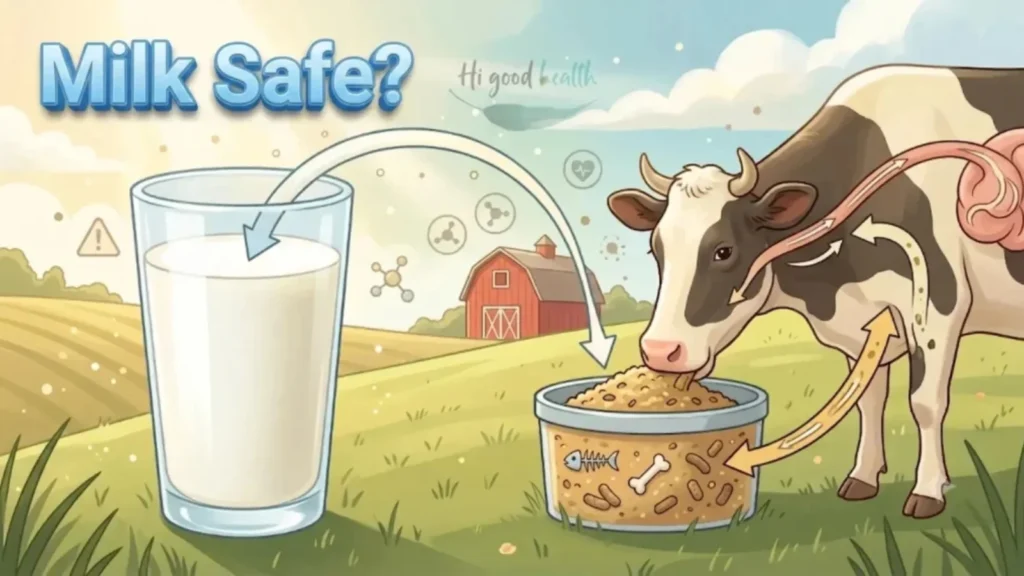
India drinks more milk than any country on earth, and worries about it more than almost any other food.
The worry is usually about adulteration: the doodhwala adding water, the stories about detergent and urea, the packet milk that tastes different this week.
Some of that worry is well founded and some of it is not, and the parts that are founded are mostly not the parts people talk about.
At a glance
Deliberate adulteration is less common than most people believe. The government’s own national milk survey found that most Indian milk, packet milk included, meets safety standards, and that the bigger problem is contamination rather than someone tipping in detergent.
The two real contaminants in Indian milk are aflatoxin M1 and antibiotic residues. Both come from how the animal is fed and treated, not from anything added to the milk afterwards.
Boiling does not fix them. Boiling kills bacteria, which is worth doing with loose milk. It does nothing to aflatoxin, antibiotic residues, pesticide or metals.
The animal-byproduct question that dominates this debate abroad barely applies here. Indian cattle feed is overwhelmingly plant material: crop residue, oil cakes, brans and green fodder.
Oxytocin injection to force letdown is illegal in India and still happens, particularly in small urban dairies. It is a genuine welfare problem and a reason to know where your milk comes from.
Packaged pasteurised milk from an established brand is, for most households, the safer default than loose milk of unknown origin.
What Indian dairy animals actually eat
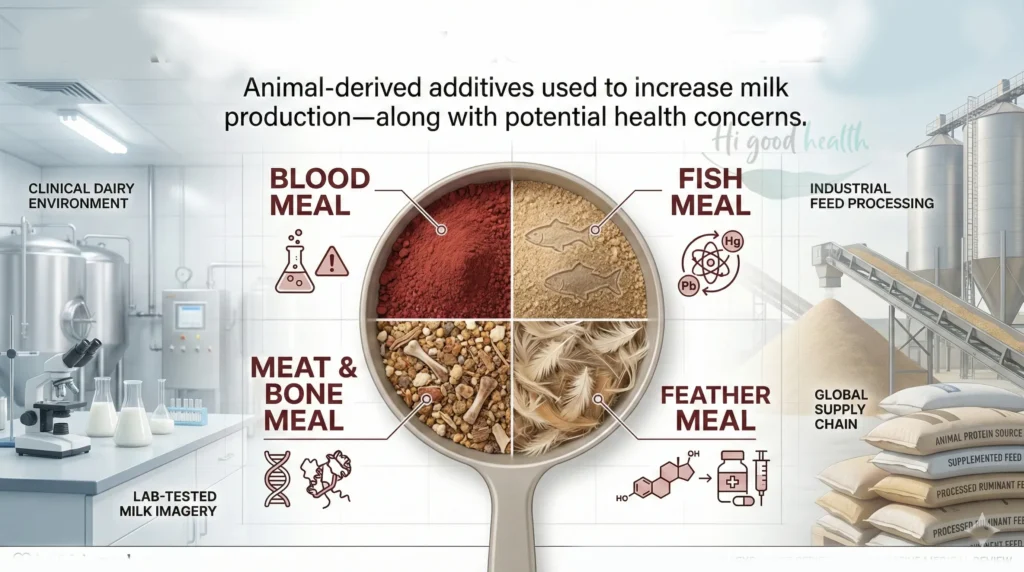
The international version of this article is largely about animal byproducts in cattle feed: blood meal, fish meal, feather meal, poultry litter. That is a real debate in industrial dairy systems elsewhere.
It is largely not the Indian situation. The typical Indian dairy animal eats:
- Crop residue: wheat straw (bhusa), paddy straw, sugarcane tops, maize stover.
- Green fodder: berseem, lucerne, napier, jowar.
- Concentrates: oil cakes from mustard, cotton seed and groundnut, along with wheat bran, rice bran and de-oiled cakes.
- Mineral mixture and salt.
That is a plant-based ration, and it is that way for economic and cultural reasons rather than regulatory ones.
So the Indian version of the question “what is my milk animal eating?” has a different and more useful answer. The problem with Indian feed is not what species it came from. It is whether it was stored dry.
Aflatoxin M1: the contaminant nobody talks about
This is the one that matters most and gets the least attention.
Aflatoxins are toxins produced by moulds that grow on groundnut cake, maize, cottonseed and other feed ingredients when they are stored damp. India’s climate, and particularly the monsoon, makes that easy.
When a dairy animal eats mouldy feed, a form of the toxin called aflatoxin M1 passes into the milk. It is a known liver carcinogen, and infants and small children, who drink the most milk relative to their size, are the most exposed.
Government testing has repeatedly found aflatoxin M1 to be the most common reason Indian milk samples fail safety limits.
Two things follow.
Boiling does not destroy it. Aflatoxin is heat-stable. The Indian habit of boiling milk is genuinely useful against bacteria and useless against this.
It is a feed storage problem, which means it is fixable. Dry storage, no mouldy cake, and proper testing at collection are what solve it, which is why milk from a large organised dairy with a testing lab is generally safer on this measure than milk from a single animal fed on whatever was cheapest.
Antibiotic residues
Dairy animals in India get antibiotics, often for mastitis, and often without a prescription because the drugs are easy to buy.
The problem is the withdrawal period, the days after treatment during which the milk should not be sold. In a small dairy where the milk of one animal is the day’s income, that period is frequently ignored.
The result is low-level antibiotic residue in the milk supply, and it matters for two reasons: it contributes to antibiotic resistance, which is already a serious problem in India, and pasteurisation and boiling do not remove it.
Large processors test for it. An informal supply chain does not.
Adulteration: what is actually true
This is where India’s public conversation is loudest, and it deserves a careful answer rather than either reassurance or alarm.
Water is the common one. Adding water is the most frequent form of adulteration by a wide margin. It is dishonest and it dilutes the nutrition, particularly for a child whose milk is a main food. It is not directly poisonous.
Starch, glucose, maltodextrin and skim milk powder are added to hide that dilution and restore the thickness and the reading on a lactometer.
Detergent, urea, caustic soda, formalin and “synthetic milk” are the frightening ones, and they are real but far rarer than the forwarded messages suggest. Government surveys have generally found these in a small minority of samples rather than routinely.
The honest summary: the risk of drinking milk in India is real but it is not the horror story that circulates on WhatsApp, and the everyday risk is dilution and contamination rather than poison.
Oxytocin
Injecting oxytocin to force milk letdown is banned in India, and it continues in parts of the unorganised sector, particularly in urban and peri-urban dairies.
It is primarily an animal welfare problem, and it is painful for the animal. Its direct effect on the person drinking the milk is much less clear than the alarming versions suggest, because oxytocin is a protein and is broken down in digestion.
It is still a good reason to prefer a supply chain that can be held to account.
Loose milk or packet milk, and is tetra pack milk safe?
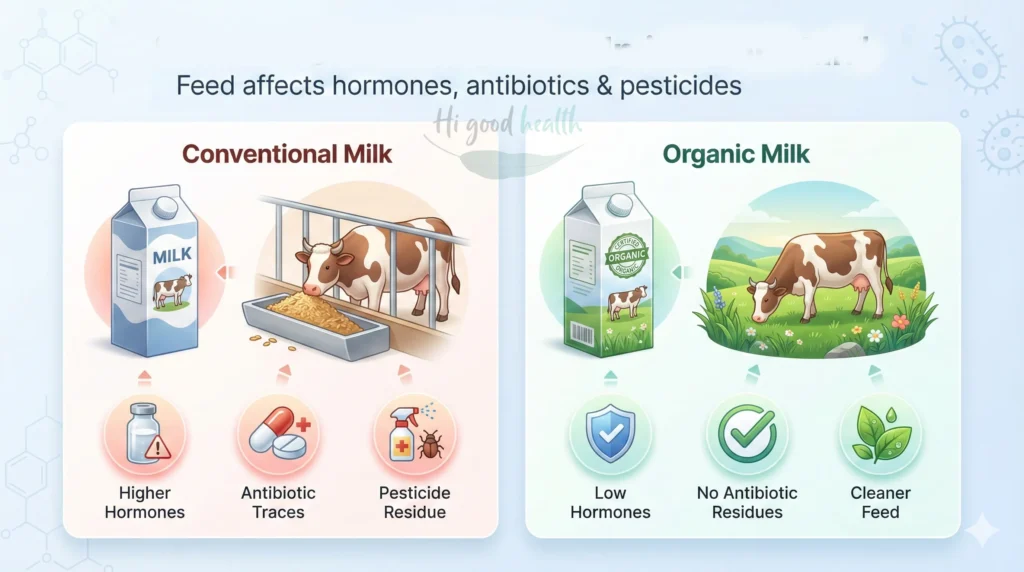
This is the practical decision most Indian households actually face, and the answer is less romantic than the “fresh from the cow” instinct.
| Loose milk from a doodhwala | Packet pasteurised milk | |
|---|---|---|
| Bacterial safety | Depends entirely on handling. Must be boiled. | Pasteurised at the plant. Boiling is optional but usual here. |
| Dilution and adulteration | The main place it happens | Rare in established brands, which test at collection |
| Aflatoxin and antibiotic testing | Effectively none | Routine at organised dairies |
| Cold chain | Often absent | Maintained, though the last stretch to your house is on you |
| Traceability | You know the person, not the animal’s feed or treatment | The batch is traceable |
| Cost | Usually cheaper | Somewhat more |
| Freshness and taste | Many people prefer it | Consistent |
Loose milk is not automatically bad, and a known dairy with clean handling and healthy animals can be excellent. But “I know him” is not the same as “it is tested”, and most of the contamination risk in Indian milk sits in the part of the chain that nobody tests.
If you buy loose milk: boil it, refrigerate it promptly, and buy from a source that keeps the animals well and the vessels clean.
What boiling does and does not do
Boiling milk is an Indian habit worth keeping, and worth understanding.
It does: kill bacteria, including the ones that cause tuberculosis and brucellosis, which is genuinely important for unpasteurised milk. It extends keeping time in a hot climate.
It does not: remove aflatoxin, antibiotic residues, pesticide residues, heavy metals, urea or detergent. None of those are destroyed by heat.
It also slightly reduces some vitamins, though not enough to matter in a normal diet.
So boiling handles the acute risk and none of the chronic one. Both matter; they need different answers.
Cow, buffalo, and the A2 question
India is unusual in that a large share of its milk is buffalo milk, which the international debate ignores entirely.
Buffalo milk is higher in fat and in calories, thicker, and preferred for curd, paneer and mithai. Cow milk is lighter and often preferred for children and for tea. Neither is contaminated more or less by nature; that depends on the feed and the handling.
A2 milk deserves a plain answer, because it is heavily marketed in India at a large premium.
A1 and A2 refer to two forms of a milk protein. Most Indian indigenous cattle and all buffaloes produce the A2 form; many exotic and crossbred cows produce A1.
The claim is that A1 milk causes digestive discomfort and worse. The evidence for meaningful health differences in ordinary people is weak, and food safety authorities have not accepted the health claims.
If A2 milk from a desi cow suits you and you can afford it, there is no harm in it.
But it is sold at several times the price of ordinary milk on a claim that is not established, and it says nothing about aflatoxin, antibiotics or hygiene, which are what actually determine whether milk is safe.
What is actually worth doing
- Prefer packaged pasteurised milk from an established brand, or a large cooperative, for everyday use, particularly for children. The testing behind it is the thing you are buying.
- If you use loose milk, boil it, cool it and refrigerate it within a couple of hours, and know the dairy.
- Do not leave milk out in an Indian summer. More illness comes from a warm vessel than from anything in this article.
- Check the pouch. Sealed, not leaking, within date, and cold when you buy it. A pouch that has been sitting in the sun outside a shop has lost part of its point.
- Look for the FSSAI licence number on packaged milk and dairy products.
- Boil for a few minutes, not for twenty. Long, repeated boiling is a habit, not a safety measure.
- If you buy from a single household dairy, ask what the animals are fed and whether the feed and cake are stored dry. That is the aflatoxin question, and almost nobody asks it.
- For an infant under one, milk is not the main food anyway. Follow a paediatrician’s advice rather than a milk brand’s.
Testing your packet milk at home
The Food Safety and Standards Authority of India publishes a set of simple home tests, and the water test in particular is worth knowing.
Water: a drop of milk on a polished slanting surface should flow slowly and leave a white trail. Diluted milk runs straight down and leaves nothing.
Starch: a few drops of iodine or tincture of iodine in a boiled and cooled sample. A blue colour means starch has been added.
Detergent: shake a small equal quantity of milk and water. A dense, persistent lather suggests detergent; ordinary milk gives a thin froth that settles.
These tests are rough. They tell you nothing about aflatoxin, antibiotics or pesticide, which need a laboratory, and that is precisely why the tested supply chain matters more than the kitchen test.
Key takeaways
The everyday Indian milk risks are aflatoxin M1, antibiotic residues and dilution, in that order of health importance, and none of them are what the WhatsApp forwards are about.
Boiling kills bacteria and does nothing about the chemical contaminants. Both parts of that sentence matter.
The animal-byproduct feed debate is largely not an Indian problem. Our cattle feed is plant material. The Indian feed problem is mould in badly stored cake and grain.
Packet milk from a known brand or a large cooperative is the safer default, because of the testing behind it rather than the packet.
Loose milk is not automatically unsafe, but it must be boiled, kept cold, and bought from a dairy you actually know.
A2 milk is sold on a claim that is not established, and it tells you nothing about the contaminants that matter.
Oxytocin use is illegal and still happens. It is mainly a welfare problem, and a reason to prefer an accountable supply chain.
Milk is a good food. None of this is an argument for giving it up, and for many Indian households it is the main source of protein, calcium and B12.
Frequently asked questions
Is tetra pack milk safe to drink in India?
For the most part yes, particularly packaged pasteurised milk from an established brand. The government’s national survey found most samples within safety limits, with contamination rather than deliberate adulteration as the main reason for failures.
Does boiling milk make it safe?
It makes it bacteriologically safe, which matters a great deal for loose milk. It does nothing to aflatoxin, antibiotic residues, pesticide or urea, because none of those are destroyed by heat.
What is aflatoxin M1 and should I worry?
It is a toxin that passes into milk when the animal eats mouldy feed, and it is the commonest reason Indian milk samples exceed safety limits. It is a reason to prefer milk from a dairy that tests, especially for young children.
Is loose milk from the doodhwala better than packet milk?
Fresher, often tastier, and less tested. The main adulteration and the absence of any contaminant testing sit in that part of the chain. If you use it, boil it and know the dairy.
How can I check if milk has water added?
Let a drop run down a polished slanting surface. Pure milk flows slowly and leaves a white trail; diluted milk runs off and leaves nothing. It is a rough test and tells you nothing about contaminants.
Is A2 milk worth the extra money?
The health claims made for it are not well established, and food safety authorities have not accepted them. If it suits you and you can afford it, there is no harm, but it is not a safety upgrade.
Is buffalo milk or cow milk better?
Buffalo milk is richer and higher in fat and calories; cow milk is lighter. Neither is safer by nature. What matters is the feed, the handling and the testing, not the species.
Do Indian dairy animals get fed animal byproducts?
Very largely not. Indian rations are crop residue, green fodder, oil cakes and bran. The animal-byproduct debate that dominates this subject abroad has little purchase here.
Is oxytocin used in Indian dairies, and does it affect me?
It is banned and still used in parts of the unorganised sector. It is primarily an animal welfare problem; the direct effect on a person drinking the milk is much less clear than the alarming claims suggest.
Should I give my child packaged or fresh milk?
For a child, the testing behind packaged pasteurised milk from an established brand is worth more than freshness. Children drink the most milk relative to their size, which is exactly why contaminant testing matters most for them.
Glossary
Aflatoxin M1: a toxin that appears in milk when the animal eats mould-contaminated feed. Heat-stable, and a liver carcinogen.
Antibiotic residue: traces of medicine left in milk when an animal is milked before the withdrawal period has passed.
Withdrawal period: the number of days after treatment during which an animal’s milk should not be sold.
Pasteurisation: controlled heating that kills harmful bacteria without boiling. It does not remove chemical contaminants.
Adulteration: adding something to milk that should not be there, most often water, and less often starch, urea or detergent.
Oxytocin: a hormone injected illegally in some dairies to force milk letdown.
A1 and A2: two forms of a milk protein. Indian indigenous cattle and buffaloes generally give the A2 form.
FSSAI: the Food Safety and Standards Authority of India, which sets and enforces food standards here.
Disclaimer
This article is for general education only and does not replace medical or veterinary advice. Feeding decisions for infants and young children should follow a paediatrician’s advice, and anyone with a suspected milk allergy or lactose intolerance should be assessed rather than self-diagnosing.
References
- Food Safety and Standards Authority of India. National Milk Safety and Quality Survey.
- Food Safety and Standards Authority of India. DART: Detect Adulteration with Rapid Test, household testing booklet.
- Department of Animal Husbandry and Dairying, Government of India. Basic animal husbandry statistics.
- Prevention of Cruelty to Animals Act and the Drugs and Cosmetics Act provisions on oxytocin.
- World Health Organization and International Agency for Research on Cancer. Aflatoxins monograph.
- Indian Council of Agricultural Research, National Dairy Research Institute. Feed and fodder quality research.
