Most of the world is still asking whether people can live well without meat and fish. India has been running the experiment for centuries, at the scale of hundreds of millions of people.
So the useful question here is not the hypothetical one. It is: which protein rich indian food Indians already eat does the job, and what has this country’s own experience actually shown?
The honest answer has two halves. Yes, people live long, healthy lives on a vegetarian diet, and India proves it. And no, it does not happen automatically, because India also has some of the world’s highest rates of anaemia and vitamin B12 deficiency, in exactly the population that eats this way.
This article is about both halves.
At a glance
India already answers the headline question. Hundreds of millions of Indians have never eaten meat or fish and are perfectly healthy. The question worth asking is what the diet needs in order to work.
What it needs is protein in real quantity, B12, iron and vitamin D. The protein rich indian food households already keep – dal, rajma, chana, curd, paneer, soya – cover it, but only in quantities most plates fall short of. These are not theoretical gaps here. Anaemia and B12 deficiency are widespread in Indian vegetarians, and both are preventable.
Indian vegetarian is not the same as plant-based. Our version leans heavily on milk, ghee, paneer and curd, and dairy carries a land, water and methane footprint of its own. India has the largest cattle herd in the world.
India’s diet problem is not too much meat. Per-person meat consumption here is among the lowest anywhere. The health problem on Indian plates is refined carbohydrate, sugar and oil, not steak.
And the environmental question here is not mainly about meat either. It is about rice and sugarcane, groundwater, and what has happened to millets and pulses.
The question India has already answered
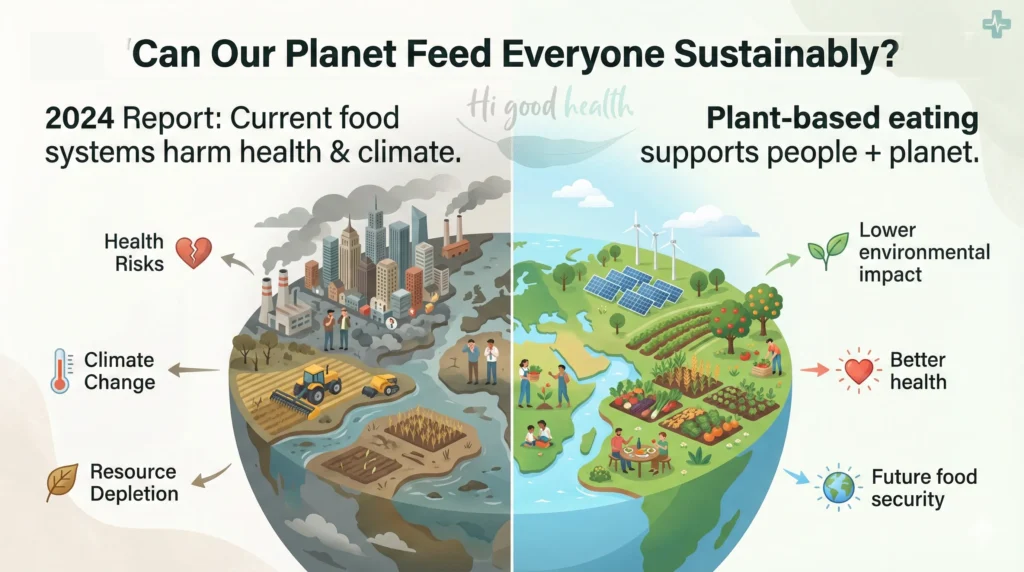
Vegetarianism in India is not a diet choice made in adulthood for health or ethics. It is inherited, regional, and tied to community and religion. That makes India the largest and longest-running natural experiment anywhere in whether people can thrive without meat and fish.
On the headline question the verdict is settled. Indian vegetarians live, work, raise families, run marathons and reach old age. Where the diet is varied and adequate, it is a good diet, and large studies elsewhere find lower rates of heart disease, type 2 diabetes and some cancers in people eating this way.
But the Indian data also shows the failure modes clearly, and it would be dishonest to write this article without them.
Anaemia
Anaemia is extremely common in Indian women and children, and iron from plant sources is absorbed far less efficiently than iron from meat.
Two Indian habits make it worse. Tea and coffee with or just after a meal cut iron absorption substantially, and that is exactly when most Indians drink chai. And phytates in cereals and pulses bind iron, which is why soaking, sprouting and fermenting matter more here than in a diet that gets its iron from meat.
The fix is not complicated. Move the chai an hour away from the meal. Add something with vitamin C to the plate, which lemon, amla, tomato, guava and capsicum all do. Sprout and ferment where the cuisine already does, as with idli, dosa and dhokla.
Vitamin B12
This is the one genuine non-negotiable in a vegetarian diet anywhere, and India is where it shows up most.
B12 is not reliably present in any plant food. Indian lacto-vegetarians get some from milk and curd, which is why the situation here is less severe than for vegans, but intakes are still commonly low, and deficiency is very widespread among Indian vegetarians.
It matters because the damage is neurological and can be permanent: numbness in the feet, unsteadiness, memory trouble, and a fatigue everyone puts down to something else. It also builds over years, so nothing warns you.
Get it tested. If it is low, treatment is cheap and simple, and the dose is a doctor’s decision rather than a guess.
Vitamin D
Deficiency is widespread across India, including among people who are outdoors every day. Skin pigment, covered clothing, air pollution and indoor work all reduce what the sun actually produces. This is not a vegetarian problem specifically, but it stacks on top of the others.
Protein, in the amount actually eaten
The usual Indian vegetarian plate is built around cereal. Rice or roti carries most of the calories, and dal appears in flavouring quantities.
One katori of dal is about four to five grams of protein. That is the number that surprises people, and it is why “we eat dal every day” and “we get enough protein” are two different statements.
Where the protein actually is: protein rich indian food India already eats
Protein figures are approximate and vary with variety and preparation.
| Food | Usual serving | Protein |
|---|---|---|
| Soya chunks, dry | 30 g, one katori soaked | 15-16 g |
| Paneer | 100 g | 18-20 g |
| Rajma or chana, cooked | one katori | 7-9 g |
| Dal, cooked | one katori | 4-5 g |
| Sattu | two tablespoons | 8-9 g |
| Sprouted moong | one katori | 7-8 g |
| Curd | one katori | 4-5 g |
| Milk | one glass, 200 ml | 6-7 g |
| Peanuts, roasted | small fistful | 7-8 g |
| Tofu | 100 g | 8-10 g |
| Egg, for those who eat it | one | 6 g |
| Roti | one medium | 3 g |
| Rice, cooked | one katori | 2-3 g |
Most adults need about 0.8 grams of protein per kilogram of body weight a day, so roughly 48 grams for a 60 kg person. Older adults, and anyone doing resistance training, need 1.0 to 1.2 grams per kilogram.
Soya chunks are the cheapest high-protein food in an Indian market, and the single easiest way to close the gap without changing how the food tastes.
On combining proteins: the old advice about carefully pairing at every meal has been retired. The body pools amino acids across the day, so a varied diet does the job.
Which is fortunate, because dal-chawal and rajma-chawal were already doing it, long before anyone had a word for it. Cereal is short on lysine, pulses are short on methionine, and eating them together fixes both. That is what most traditional cuisines converged on.
The eggetarian question
A large number of Indian households are vegetarian but eat eggs, and a large number are strictly vegetarian and will not.
It is worth being plain about this rather than tiptoeing. An egg is the cheapest complete protein available in India, it carries B12, and for a household worried about a child’s or an elder’s nutrition it solves several problems at once.
If eggs are not acceptable in your home, that is a settled matter and not something a health article should argue with. In that case milk, curd, paneer, soya, pulses in real quantity, and a B12 check do the same job with more planning.
Fish, and the part global advice gets wrong about India
International articles on this subject tend to treat fish as an indulgence to be given up.
For coastal India, Bengal, Kerala, Goa, Odisha and much of the north-east, fish is not an indulgence. It is the cheapest available source of complete protein, omega-3 EPA and DHA, iodine, and vitamin B12, and it has been the backbone of those diets for as long as anyone can trace.
Small fish eaten whole, with bones, are among the best sources of calcium in the Indian diet.
Advising a fishing community in Kerala to give up fish for the planet is not the same advice as asking a European to eat less beef, and it is not supported by the same evidence. The environmental case against meat is strongest for cattle. It is much weaker for small fish caught locally.
The thing Indian vegetarianism does not solve: dairy
This is where the Indian version of this conversation has to be honest.
Indian vegetarianism is lacto-vegetarian. Milk, curd, paneer, ghee and butter are in almost everything, and for many households dairy is what makes the diet nutritionally work at all.
But dairy is animal agriculture. India has the world’s largest cattle population and is the world’s largest milk producer. Cattle produce methane whether they are raised for milk or for meat, and feed and fodder need land and water.
So a plate that is vegetarian in the Indian sense is not the same thing as a plate with a small environmental footprint. The two ideas are often used as if they were interchangeable here, and they are not.
None of that is an argument for giving up dairy, which for most Indian households would make the diet worse rather than better. It is an argument for being accurate about what our vegetarianism does and does not achieve.
What is actually on Indian plates, and what is actually wrong with it
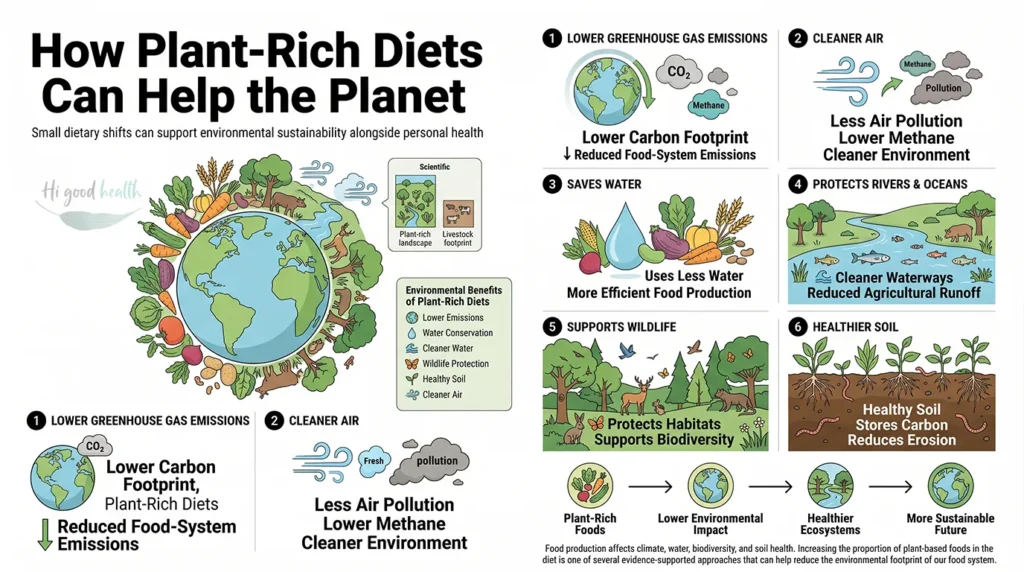
The global version of this article is largely a case against eating too much meat. In India that case has very little to bite on, because we do not eat much.
The problems on Indian plates are different.
Refined carbohydrate dominates. White rice and refined wheat make up the bulk of calories, and the diet is short on the fibre and micronutrients that whole grains carry.
Sugar and oil have climbed steeply. Packaged snacks, biscuits, sweetened drinks and deep-fried food have entered ordinary daily eating, not just festivals.
Pulses have not kept pace. Per-person pulse availability in India has not grown the way cereal availability has, and dal is expensive relative to rice and wheat, so the protein part of the plate is the part that shrinks when money is tight.
Millets, which are drought-tolerant, nutritious and were the traditional grain across much of India, were pushed aside by rice and wheat for decades and are only now coming back.
Anyone in India reading a plant-based-eating article and concluding “I should eat less meat” is probably solving the wrong problem. Eat more pulses, more millets, more vegetables and less refined carbohydrate and sugar. That is the Indian version of the same advice.
The environmental question, in Indian terms
Globally, food systems account for roughly a quarter to a third of greenhouse gas emissions, and animal agriculture is a large share of that. Cattle are the biggest single item, and land cleared for grazing and feed is a leading cause of deforestation worldwide.
All of that is true. But the environmental pressure points in Indian agriculture are not the same as the global ones.
Water is the first one. Rice and sugarcane are the two most water-hungry crops grown here, and both are grown at scale in states where groundwater is falling fast. Punjab, Haryana and western Uttar Pradesh grow paddy on pumped groundwater. That is India’s largest food-and-environment problem, and it has nothing to do with meat.
Millets are the counter-move. Jowar, bajra, ragi and the small millets need a fraction of the water rice does, grow on poorer soil, tolerate heat, and carry more fibre, iron and calcium than polished rice. India led the international year of millets in 2023 for exactly this reason.
Dairy is the second. As above, it is the animal-agriculture footprint that Indian vegetarianism does not remove.
Food waste is the third. A large share of Indian fruit, vegetables and grain is lost between the field and the plate, to poor storage, poor cold chain and poor transport. Fixing that produces more food with no change in what anyone eats.
Processed meat, for those who do eat meat
For Indian readers who eat meat, the evidence is much clearer about processed meat than about fresh meat, and that distinction is the useful one.
The World Health Organization’s cancer agency classifies processed meat, which means sausages, salami, ham, bacon and most packaged cold cuts, as a Group 1 carcinogen. That category describes how confident the evidence is, not how big the risk is.
The usual figure is about an 18 percent higher relative risk of bowel cancer for every 50 grams of processed meat eaten daily. On a low baseline that is a modest absolute increase, but it applies to something people eat regularly.
Fresh, unprocessed red meat sits in the weaker category, probably carcinogenic.
The Indian reading of that: cooked-fresh mutton or chicken once or twice a week is not the thing to worry about. Packaged salami, sausages and cold cuts, which have grown fast in Indian cities, are.
Doing it well, practically
- Make the protein deliberate at every meal. Dal in real quantity, or rajma, chana, soya, paneer, curd, sprouts or an egg. A grain and a sabzi alone is not a meal with protein in it.
- Get B12 checked once, and treat it if it is low. This is the highest-value test in a vegetarian household.
- Move the chai away from the meal by an hour, and put something sour and fresh on the plate to help iron absorption.
- Soak, sprout and ferment. Idli, dosa, dhokla, sprouted moong. The traditional techniques exist because they work.
- Bring millets back into the week, two or three meals of jowar, bajra or ragi. Better for you, and better for the groundwater.
- Watch the oil and the sugar, which are doing more damage on Indian plates than anything on this page.
- Do not assume a vegan packaged product is a healthy one. Plant-based on a label describes what is absent, not what is good.
- Pregnancy, infancy, and old age need planning, not improvisation. These are the stages where a vegetarian diet needs a dietitian rather than a guess.
Key takeaways
India has already shown that people thrive without meat and fish. It has also shown that a vegetarian diet needs attention to work, and where it goes wrong.
Anaemia and B12 deficiency are the two Indian failure modes, and both are preventable and testable.
One katori of dal is four to five grams of protein. Build the plate from the protein rich indian food kitchens already stock, in real quantity.
Indian vegetarian and low-footprint are not the same thing. Dairy is animal agriculture, and India has the world’s largest cattle herd.
Fish is not an indulgence in coastal India. It is the cheapest complete protein and micronutrient source many families have, and global advice on this subject usually ignores that.
India’s food problem is refined carbohydrate, sugar and oil, not meat. Per-person meat consumption here is among the world’s lowest.
The Indian environmental pressure points are water, dairy and waste, with paddy and sugarcane on falling groundwater the biggest of them. Millets are the practical answer.
Processed meat is the clear evidence case, not fresh mutton or chicken once a week.
Frequently asked questions
Can Indians get enough protein without meat or fish?
Yes, but not by accident. The protein rich indian food Indians rely on is all here; the usual plate is simply cereal-heavy, and dal appears in flavouring quantities. It works when every meal has a real protein: dal in quantity, rajma, chana, soya chunks, paneer, curd, sprouts or an egg.
Is Indian vegetarian food already a plant-based diet?
Not quite. It is lacto-vegetarian, and it leans heavily on milk, ghee, paneer and curd. That is fine nutritionally, but dairy is animal agriculture, so an Indian vegetarian diet does not carry the small environmental footprint people often assume.
Why are so many Indian vegetarians anaemic?
Iron from plants is absorbed less efficiently than iron from meat, phytates in cereals and pulses bind it further, and tea or coffee taken with the meal cuts absorption again. All three are addressable.
Do I need a B12 supplement if I drink milk daily?
Milk and curd supply some B12, which is why Indian lacto-vegetarians are usually better off than vegans. Intakes are still often too low, and deficiency is common. Get it tested rather than assuming either way.
Should coastal Indians give up fish for the environment?
The environmental case is strongest against cattle and weakest against small, locally caught fish. For coastal households fish is often the cheapest complete protein, omega-3 and B12 source available, and dropping it usually makes the diet worse.
Are soya chunks safe to eat regularly?
For most people, yes, in ordinary food quantities. Rinse them because they are salty as sold, and anyone on thyroid medication should leave a few hours between the tablet and a soya meal.
Are millets really better than rice?
For fibre, iron, calcium and blood sugar, generally yes. They also need far less water to grow, which matters in the states where paddy is grown on falling groundwater. Two or three millet meals a week is a realistic change.
Is mutton or chicken once a week harmful?
The evidence against fresh, unprocessed meat eaten occasionally is weak. The clear evidence is against processed meat: salami, sausages, ham and packaged cold cuts. That is the one to cut first.
Is a vegan diet safe for Indian children and pregnant women?
It can be, but these are the stages where planning matters most, and B12, iron, vitamin D, calcium and omega-3 all need to be deliberate. Plan it with a doctor or dietitian rather than improvising.
Are packaged vegan foods healthy?
Not automatically. Plant-based on a label tells you what is absent, not whether the food is good. Many are high in salt, refined starch and fat.
Glossary
Lacto-vegetarian: a vegetarian diet that includes dairy but not eggs, meat or fish. The common Indian pattern.
Eggetarian: the widely used Indian term for a vegetarian who eats eggs.
Complete protein: a protein containing all nine essential amino acids. Soy, milk, eggs and quinoa are examples; dal with a grain does the same job in combination.
Phytates: compounds in cereals and pulses that bind iron and zinc and reduce their absorption. Soaking, sprouting and fermenting reduce them.
Anaemia: too little haemoglobin in the blood, most often from iron deficiency in India.
Millets: jowar, bajra, ragi and the small millets. Drought-tolerant traditional grains with more fibre, iron and calcium than polished rice.
Processed meat: meat preserved by curing, salting, smoking or the addition of preservatives. Sausages, salami, ham, bacon and packaged cold cuts.
Disclaimer
This article is for general education only and does not replace medical advice. Anyone who is pregnant, feeding an infant, managing a chronic illness, or planning a major change in diet should talk to a doctor or a dietitian, and anyone who has eaten a vegetarian diet for years should have vitamin B12 and haemoglobin checked rather than assumed.
References
- National Family Health Survey, Ministry of Health and Family Welfare, Government of India. Anaemia prevalence data.
- Indian Council of Medical Research, National Institute of Nutrition. Nutrient Requirements for Indians and Indian Food Composition Tables.
- World Health Organization, International Agency for Research on Cancer. Monograph on the consumption of red meat and processed meat, 2015.
- Food System Economics Commission, 2024. Global Policy Report.
- Berners-Lee M, et al. Current global food production is sufficient to provide enough food for the projected global population of 9.7 billion in 2050 with a vegan diet. Environmental Research Letters, 2018.
- Food and Agriculture Organization. India country profile, livestock and milk production.
- Central Ground Water Board, Ministry of Jal Shakti. Groundwater assessment reports.
- Ministry of Agriculture and Farmers Welfare. International Year of Millets 2023, national campaign material.