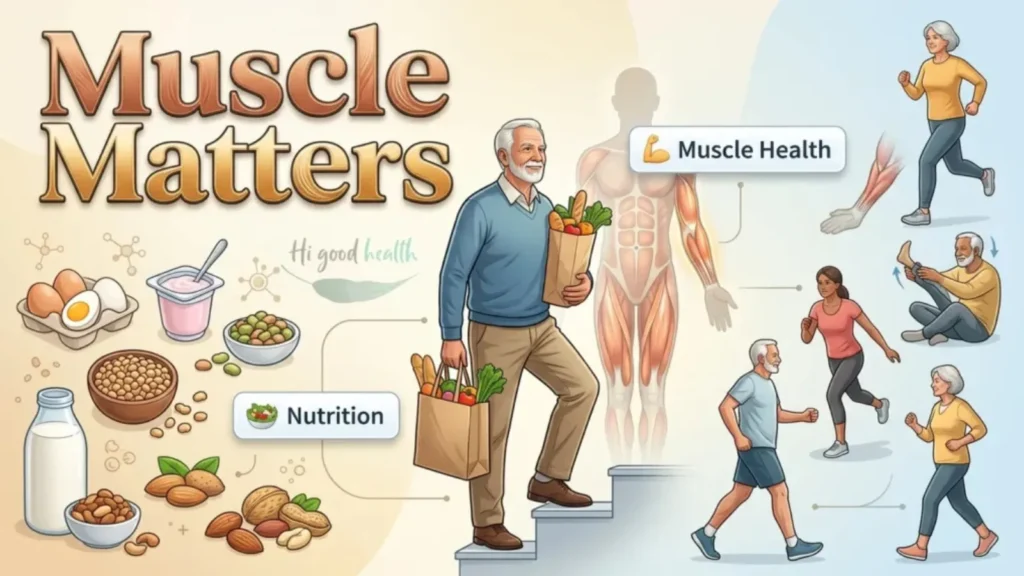
An Indian vegetarian thali looks healthy, and mostly it is. What it usually is not is high in protein.
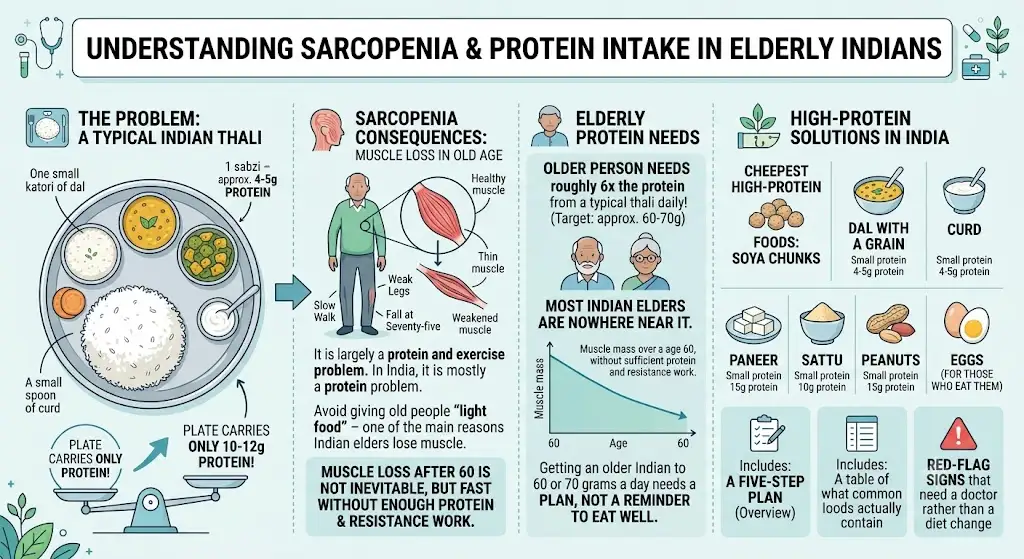
Rice or roti, one small katori of dal, a sabzi, a spoon of curd. That plate might carry ten or twelve grams of protein. An older person needs roughly six times that in a day, and most Indian elders are nowhere near it.
This is the gap that turns into weak legs, a slow walk, and a fall at seventy-five. The condition has a name, sarcopenia, and it is not an inevitable part of getting old. It is largely a protein and exercise problem, and in India it is mostly a protein problem.
At a glance
Muscle loss after 60 is not inevitable, but it is fast without enough protein and some resistance work. The Indian diet is the harder half of that equation.
One katori of dal is not a protein serving. It is about four to five grams. Getting an older Indian to 60 or 70 grams a day needs a plan, not a reminder to eat well.
The cheapest high-protein food in India is soya chunks, and after that dal with a grain, curd, paneer, sattu, peanuts and eggs for those who eat them.
Cut the protein, not the elder. The habit of giving old people “light food” is one of the main reasons Indian elders lose muscle.
There is a five-step plan, a table of what common Indian foods actually contain, and the red-flag signs that need a doctor rather than a diet change.
Why this is an Indian problem, specifically
The international version of this article argues for eating more plant protein. In India that argument is already won, and it is the wrong argument.
Most Indians already eat a plant-based diet. What they do not eat is enough protein within it, because the plate is built around cereal. Rice and wheat make up the bulk of the calories, and dal is a flavouring quantity rather than a protein serving.
Three habits make it worse in older people.
Elders are served last and served least in many households, and “light food” is treated as respect. Khichdi and thin dal for weeks after an illness is exactly the wrong prescription for someone losing muscle.
Fasting is common and frequent among older Indian women in particular, and several fasts a month with no protein at all adds up over a year.
Teeth. A large share of Indians over 60 have lost teeth or wear ill-fitting dentures, and the foods that get dropped first are the chewy ones, which are the protein ones.
And the consequence is not abstract. A hip fracture in India is paid for out of pocket, often means surgery in another town, and a long recovery in a house with no handrails. Muscle is what keeps that from happening.
What is actually happening in the muscle
With age the muscle stops responding to protein the way it used to. This is called anabolic resistance. The same katori of dal that would have built muscle at thirty does very little at seventy.
Two things follow. The total amount of protein has to go up, and it has to arrive in large enough amounts at a time to cross a threshold, rather than being spread thin across the day.
The trigger is an amino acid called leucine. A meal needs roughly 2.5 to 3 grams of leucine to switch muscle-building on, which in practice means about 25 to 30 grams of decent protein in that meal.
This is why “I eat dal every day” does not translate into muscle. The dose per meal is too low to cross the line.
How much protein
Expert groups including the PROT-AGE study group recommend:
- 1.0 to 1.2 grams per kilogram of body weight per day for a healthy older adult
- 1.2 to 1.5 g/kg/day for someone who is active, or recovering from an illness, surgery or a fracture
- Less, on medical advice, for anyone with chronic kidney disease. This matters in India, where kidney disease is common because diabetes is common.
| Body weight | Protein per day, healthy | Protein per day, active or recovering |
|---|---|---|
| 50 kg | 50-60 g | 60-75 g |
| 55 kg | 55-66 g | 66-83 g |
| 60 kg | 60-72 g | 72-90 g |
| 65 kg | 65-78 g | 78-98 g |
| 70 kg | 70-84 g | 84-105 g |
If you have kidney disease, do not use this table. Protein targets in chronic kidney disease are set by a doctor and are usually lower, not higher.
What that looks like on an Indian plate
This is the part that is usually missing. Protein figures are approximate and vary with the variety and how it is cooked.
| Food | Usual serving | Protein |
|---|---|---|
| Soya chunks (nutrela), dry | 30 g, about one katori soaked | 15-16 g |
| Paneer | 100 g | 18-20 g |
| Dal, cooked | one katori, 150 ml | 4-5 g |
| Rajma or chana, cooked | one katori | 7-9 g |
| Curd | one katori, 150 g | 4-5 g |
| Milk | one glass, 200 ml | 6-7 g |
| Egg | one | 6 g |
| Sattu (roasted chana flour) | 40 g, two tablespoons | 8-9 g |
| Peanuts, roasted | a small fistful, 30 g | 7-8 g |
| Roti, wheat | one medium | 3 g |
| Rice, cooked | one katori | 2-3 g |
| Sprouted moong | one katori | 7-8 g |
| Tofu | 100 g | 8-10 g |
| Idli | two | 4-5 g |
Look at that list next to the target and the problem becomes obvious. A day of rice, roti, one katori of dal and a little curd is around 25 to 30 grams. The target is double that.
The Indian portion table: what is actually on the plate
Almost every protein number online is per 100 grams of the raw ingredient. Nobody eats 100 grams of raw dal. That single mismatch is why people who think they are eating well are still short.
So this table gives both: the per-100-gram figure people look up, of which paneer protein per 100g is the most searched, and the amount in a serving as it actually reaches an Indian plate.
| Food | IFCT code | Protein per 100 g | A normal serving here | Protein in that serving |
|---|---|---|---|---|
| Paneer | L003 | 18.86 | 50 g, two small cubes | ~9 g |
| Moong dal, dry (green gram dal) | B010 | 23.86 | 1 katori cooked, from ~20 g dry | ~5 g |
| Arhar / toor dal, dry (red gram dal) | B021 | 21.70 | 1 katori cooked, from ~20 g dry | ~4 g |
| Chana dal, dry (Bengal gram dal) | B001 | 21.55 | 1 katori boiled, from ~40 g dry | ~9 g |
| Rajma, brown, dry | B019 | 19.50 | 1 katori cooked, from ~40 g dry | ~8 g |
| Soybean, brown, dry | B024 | 35.58 | — | — |
| Milk, cow | L002 | 3.26 | 1 glass, 200 ml | ~6.5 g |
| Milk, buffalo | L001 | 3.68 | 1 glass, 200 ml | ~7 g |
| Egg, whole, raw | M001 | 13.28 | 1 egg | ~6 g |
| Wheat flour, atta | A019 | 10.57 | 1 roti, 30 g atta | ~3 g |
| Rice, raw, milled | A015 | 7.94 | 1 katori cooked, from ~40 g raw | ~3 g |
| Curd (dahi) | ⚑ not in IFCT | ~3.5 | 1 katori, 150 g | ~5 g |
| Soya chunks | ⚑ not in IFCT | ~52 | 25 g dry, 1 katori soaked | ~13 g |
Paneer protein per 100g, and why everyone looks that number up
Paneer is the one vegetarian food that holds up on the per-100-gram figure, which is why it gets searched more than any other. At 18.86 grams in the ICMR-NIN tables, paneer protein per 100g does what a serving of meat does.
But the serving is the catch. Two small cubes in a sabzi is about 50 grams, so about 9 grams of protein, not 19. Doubling the paneer in one meal a day is one of the easiest changes on this list.
The dal trap
Dry dal is 21 to 24 grams of protein per 100 grams in the ICMR-NIN tables, which sounds excellent. A katori of cooked dal as it is normally served in an Indian home is mostly water, and lands at four to five grams.
That is the whole gap in one line. Dal is not failing you; the quantity is. A thicker dal, or two katoris instead of one, changes the day’s total more than any supplement.
The five steps
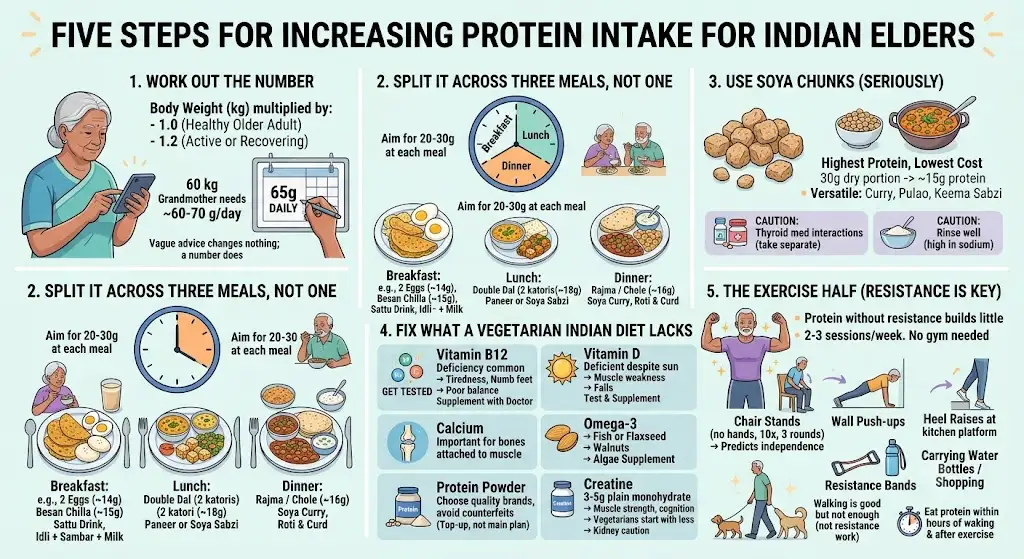
Step 1. Work out the number
Body weight in kilograms, multiplied by 1.0 for a healthy older adult, or 1.2 if they are active or recovering. Round it. A 60 kg grandmother needs about 60 to 70 grams a day.
Write the number on the kitchen wall. Vague advice to “eat more protein” changes nothing; a number does.
Step 2. Split it across three meals, not one
Aim for 20 to 30 grams at each of three meals rather than most of it at dinner. Each meal has to cross the leucine line on its own.
In practice that means every meal needs a protein anchor, not just a grain and a sabzi:
- Breakfast: two eggs, or a besan chilla, or sattu in water or milk, or idli with an extra serving of sambar and a glass of milk, or curd with soaked peanuts.
- Lunch: a proper serving of dal, two katoris rather than one, plus curd, plus either soya chunks or paneer in the sabzi.
- Dinner: rajma, chole or soya chunk curry with roti, and curd.
Step 3. Use soya chunks. Seriously.
Soya chunks are the highest-protein, lowest-cost protein available in an Indian kirana shop. A 30 gram dry portion, which soaks up to a full katori, carries around 15 grams of protein, roughly the same as three katoris of dal, for a fraction of the price and effort.
They take on whatever masala they are cooked in and work in a curry, a pulao or a keema-style dry sabzi. For a household trying to raise an elder’s protein without changing the food culture or the budget, this is the single most useful change.
Two cautions. Soya has been debated for thyroid and hormone effects; the evidence in normal food quantities is reassuring, but anyone on thyroid medication should take it a few hours apart from the tablet. And chunks are salty as sold, so rinse them well.
Step 4. Fix what a vegetarian Indian diet reliably lacks
Vitamin B12. Deficiency is very common in Indian vegetarians, and it causes exactly the things people blame on age: tiredness, numb feet, poor balance, memory trouble. Get the level tested. Supplementation is cheap and safe, and doses are set by the result, so this is a doctor conversation rather than a self-prescription.
Vitamin D. Widespread deficiency here, including among people who are outdoors daily, and it is directly linked to muscle weakness and falls. Test it; supplement on the result.
Calcium. Intake in Indian diets is often low once milk and curd drop off the menu, and it matters for the bone the muscle is attached to.
Omega-3. Fish for those who eat it; otherwise flaxseed, walnuts, or an algae-based supplement.
Protein powder, if used, needs care. The Indian supplement market has a documented problem with mislabelled and adulterated products, including powders that contain far less protein than the label claims.
If you buy one, choose a well-known brand from a seller you trust, and treat it as a top-up rather than the plan.
Creatine. Three to five grams a day of plain creatine monohydrate is one of the better-evidenced supplements for muscle strength in older adults, and there is reasonable evidence for cognition too.
There is an Indian angle here. Vegetarians start with lower body creatine stores, because creatine comes from meat, so Indian vegetarians may have more to gain from it than the average person in these studies. Anyone with kidney disease should not take it without a doctor’s agreement.
Step 5. The exercise half, which is not optional
Protein without resistance work builds very little. The muscle has to be asked for.
Two or three sessions a week is enough. It does not need a gym.
- Standing up from a chair without using the hands, ten times, three rounds. This one exercise predicts independence better than almost anything else.
- Wall push-ups.
- Heel raises holding the kitchen platform.
- Carrying the water bottles or the shopping, deliberately, as an exercise rather than a chore.
- Resistance bands, which cost very little and are easy to keep at home.
Eat protein within a couple of hours of waking, and again after the exercise session.
Walking is good and is not enough. It is not resistance work, and a great many Indian elders who walk every morning are still losing muscle.
A day that actually reaches the target
For a 60 kg person, using ordinary Indian food and no powders.
- Breakfast: two idlis with sambar, one glass of milk, a small fistful of roasted peanuts. About 18 g.
- Mid-morning: one katori of curd. About 5 g.
- Lunch: two rotis, two katoris of dal, soya chunk sabzi, one katori of curd. About 27 g.
- Evening: sattu in water, or roasted chana. About 9 g.
- Dinner: rice, rajma, a little paneer in the sabzi. About 18 g.
That is roughly 75 grams, from food anyone can buy in any Indian market, and it does not look like a diet plan. It looks like slightly more dal and one new ingredient.
Practical problems and what to do about them
“They have no appetite.” Appetite falls with age. Make the food denser rather than larger: paneer in the sabzi, milk instead of water in the sattu, ghee for calories, peanuts as the snack. Small, frequent, dense.
“They cannot chew.” Get the teeth or dentures looked at, because that is the fixable cause. Meanwhile: dal, curd, paneer, soaked and mashed soya, egg, sattu, milk. Protein does not have to be chewy.
“They fast often.” If fasting matters to them, do not argue with it. Work around it: milk, curd and fruit are allowed on most fasts, and the meal before and after can carry more protein.
“Too expensive.” It is not, in India. Soya chunks, dal, chana, peanuts, curd and eggs are among the cheapest food in the market. Protein powder and whey are expensive; the cheap options are the ones on the list.
“They live alone.” Batch-cook dal and rajma. A week of protein in the fridge is more reliable than a plan that needs cooking three times a day.
When it is not a diet problem
Get a doctor involved rather than adjusting the food if there is:
- Unintentional weight loss of more than 5 percent in six months
- Difficulty rising from a chair without pushing up with the arms
- A walk that has become noticeably slow
- Frequent infections or wounds that heal slowly
- New swelling of the legs or feet
- Known kidney disease, in which case protein targets are a medical decision
Unexplained weight loss and weakness in an older adult in India need a proper workup, not a protein shake. Tuberculosis, thyroid disease, undiagnosed diabetes, cancer and anaemia all present this way, and all are common here.
What the research says
Protein needs are higher than the old recommendations. The PROT-AGE group recommends about 1.0 to 1.2 g/kg/day for older adults to preserve muscle and function, and more for those who are active or recovering.
Per-meal dose matters as much as the daily total. Meals providing about 2.5 to 3 g of leucine, roughly 25 to 35 g of good protein, are what trigger muscle protein synthesis in older adults.
Creatine helps muscle, and probably the brain. Reviews and trials show creatine monohydrate improves muscle performance and may help memory and processing speed.
Plant protein is not a handicap. Large cohort studies link higher plant-protein intake in midlife with healthier ageing and less frailty later, provided the meals are planned rather than assumed.
Hydration matters more than people think. Muscle cells signal growth when they are well hydrated and shift towards breakdown when they are not, and older people drink too little, particularly in an Indian summer.
The wider picture: this article is the protein chapter. For the full senior-nutrition guide, including B12, supplements and plant-based eating after sixty, read Sarcopenia After 60: Protein, B12 and Senior Nutrition.
Key takeaways
One katori of dal is four to five grams of protein. That single fact changes how the plate is built.
Aim for 1.0 to 1.2 grams per kilogram per day, split as 20 to 30 grams across three meals rather than piled into dinner.
Soya chunks are the cheapest way to close the gap in an Indian kitchen, followed by dal in real quantity, curd, paneer, sattu, peanuts and eggs.
“Light food” for elders is the habit doing the damage. After an illness in particular, protein goes up, not down.
Get B12 and vitamin D tested. Both are commonly low in Indian vegetarians and both cause exactly what people put down to old age.
Protein alone does not build muscle. Two or three sessions a week of resistance work, starting with standing up from a chair.
If there is kidney disease, none of this applies without a doctor, and protein is usually restricted rather than increased.
Unexplained weight loss and weakness is a medical problem first, not a nutrition problem. Get it investigated.
Frequently asked questions
How much protein does an Indian senior actually need?
About 1.0 to 1.2 grams per kilogram of body weight a day, so roughly 60 to 72 grams for a 60 kg person, and more if they are active or recovering from illness. Anyone with kidney disease needs a doctor’s number instead.
Is a vegetarian Indian diet enough for muscle?
It can be, but not by accident. The usual Indian plate is cereal-heavy and short on protein. It works when every meal has a protein anchor: dal in real quantity, soya, paneer, curd, sattu or eggs.
How much protein is in one katori of dal?
About four to five grams. That surprises most people, and it is the single most useful number in this article.
Are soya chunks safe to eat daily?
For most people, yes, in ordinary food quantities. Rinse them well because they are salty as sold. Anyone on thyroid medication should leave a few hours between the tablet and a soya meal.
Is protein powder necessary?
No. Food does the job more cheaply in India. If one is used, buy a well-known brand from a trusted seller, because mislabelled and adulterated supplements are a documented problem in this market.
Is creatine safe for older Indians?
For people with normal kidney function, three to five grams a day of plain creatine monohydrate is well studied and generally safe. Vegetarians start with lower stores, so they may benefit more. Anyone with kidney disease must ask a doctor first.
Will more protein damage the kidneys?
Not in someone with normal kidney function. In chronic kidney disease it can, and CKD is common in India because diabetes is. If kidney function is not known, get it checked before raising protein a lot.
My father has no teeth. What can he eat?
Dal, curd, paneer, mashed soaked soya, egg, sattu and milk all carry protein without chewing. Also get the dentures looked at, because the teeth are the fixable part.
Does walking every morning protect muscle?
It is good for the heart and for balance, but it is not resistance work and it does not stop muscle loss on its own. Add two or three short strength sessions a week.
Is ghee or a rich diet the answer for a weak elder?
Calories help if someone is underweight, but calories are not protein. A weak, thin elder needs protein and a medical check, and more ghee alone will not do it.
Glossary
Sarcopenia: age-related loss of muscle mass and strength.
Anabolic resistance: the muscle becoming less responsive to protein with age, so that the same meal does less than it used to.
Leucine: the amino acid that acts as the trigger for muscle building. Roughly 2.5 to 3 grams a meal is the working threshold.
Creatine monohydrate: a supplement that supports short bursts of energy in muscle and brain, and one of the best studied in older adults.
Katori: the small bowl used in an Indian meal, roughly 150 ml, used throughout this article as the serving measure.
Disclaimer
This article is for general education only and does not replace medical advice. Talk to a doctor before starting supplements or making a large change in diet, particularly if there is kidney disease, diabetes, thyroid disease, or unexplained weight loss.
References
- PROT-AGE Study Group. Evidence-based recommendations for optimal dietary protein intake in older people.
- Frontiers in Nutrition. Per-meal leucine and protein distribution reviews, 2024.
- Systematic reviews of creatine supplementation and muscle and cognitive outcomes in older adults, 2024.
- Harvard T.H. Chan School of Public Health. Plant protein and healthy ageing, 2024.
- Indian Council of Medical Research, National Institute of Nutrition. Nutrient Requirements for Indians and Indian Food Composition Tables.
- Longitudinal Ageing Study in India (LASI), International Institute for Population Sciences.
- The Role of Water Homeostasis in Muscle Function and Frailty: A Review.