
17 Exercises to Rebuild Stability — At Any Age, At Home, No Equipment
You Know Why. Now Here’s How.
In Part 1, we uncovered seven hidden reasons your balance gets worse with age — from brain shrinkage to gut inflammation. If you haven’t read it yet, start there. Understanding the why makes the exercises below far more effective.
At a Glance
- A structured 12-week protocol in four phases, not a random list of exercises.
- Phase 1 is static stabilisation; by Phase 4 you are combining movement with a mental task.
- Test where you are now before starting — the article gives the self-test.
- Five minutes a day is the non-negotiable minimum.
- Fear of falling is itself a risk factor, and the article addresses it directly.
- Nutrition supports balance work; it does not replace it.
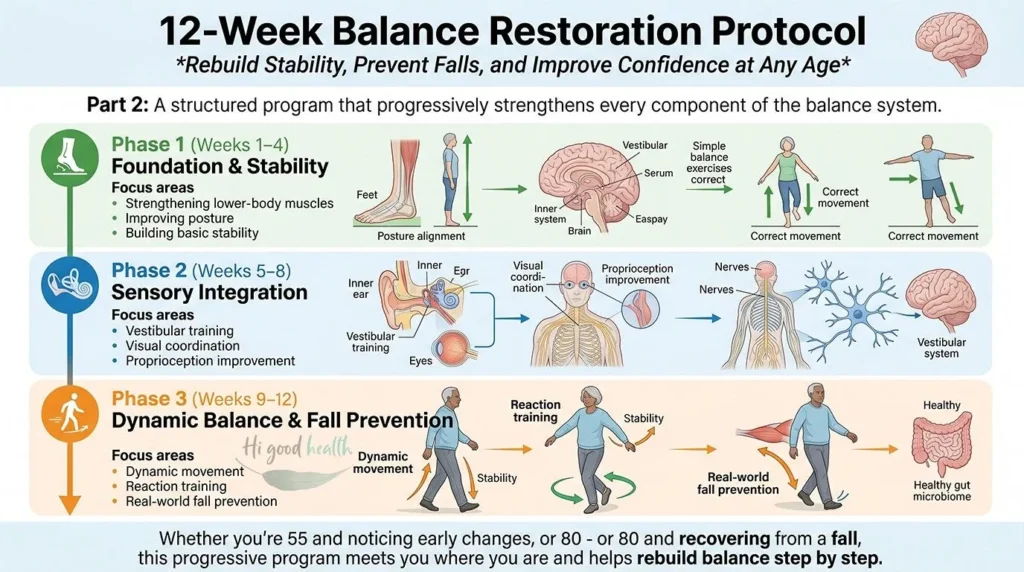
What follows is not a random list of exercises. It’s a structured, 12-week protocol where each phase targets different parts of your balance system, and each one builds on the last. Whether you’re 55 and noticing the first changes, or 80 and recovering from a fall, this meets you where you are.
First: Test Where You Are Now
Before you start, take these quick tests and write down your scores. Re-test every 4 weeks to track progress.
- Single-Leg Stance: Stand on one leg near a counter (for safety). Time it. If you are under 50: aim for 30 seconds. Ages 60–69: 15–25 seconds is normal. Ages 70–79: 10–15 seconds. If the time noted is under 5 seconds at any age? That’s a red flag.
- Timed Up and Go (TUG): Sit in a chair, stand up, walk 10 feet, turn around, come back, sit down. Under 12 seconds = normal. Over 20 = talk to your doctor.
- Tandem Stance: Stand heel-to-toe like a tightrope. Try for 30 seconds. Can’t hold 10? Your balance needs work.
- Functional Reach: Stand, extend one arm, reach forward without stepping. Less than 7 inches = elevated fall risk.
- 360-Degree Turn: Turn in a full circle in place. More than 8 steps = impaired rotational stability.
Before You Start Talk to your doctor first, especially if you have heart problems, joint replacements, or a history of serious falls.Always exercise near a sturdy counter or heavy chair you can grab. Remove rugs and clutter from your exercise area. Wear non-slip shoes or go barefoot on a non-slip surface. Have someone nearby for your first few sessions. Stop if you feel dizzy or have sharp pain. Ask your doctor to review your medications for any fall risk increasing drugs that might affect your stability. |
|---|
Phase 1: Static Stabilization (Weeks 1–3)
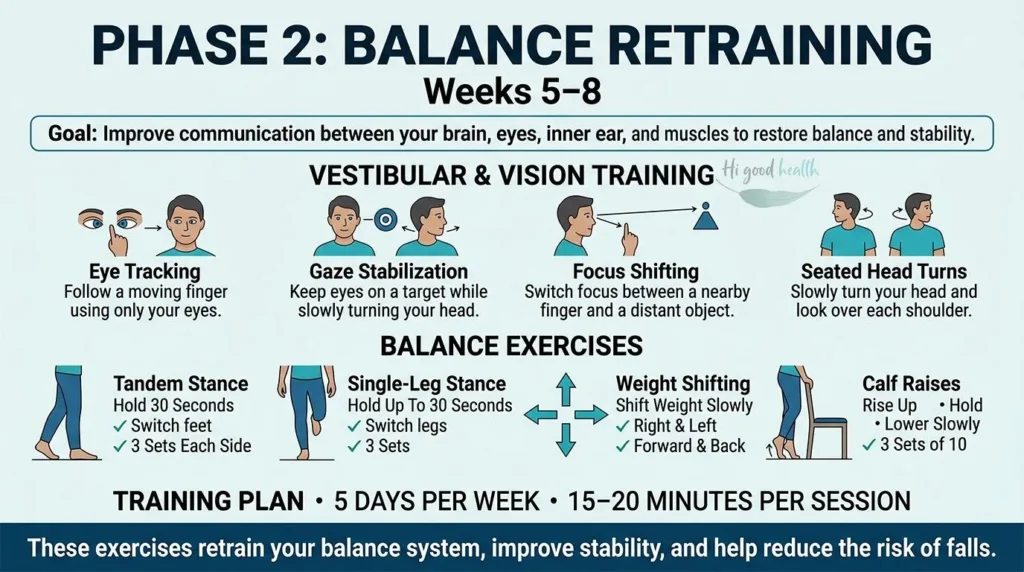
Goal: Retune your body’s position sensors by standing still in challenging positions. You’re rebuilding the brain-body connection
Visual Stabilization (Vestibulo-occular exercises): The Cawthorne-Cooksey protocol consists of specialized vestibular exercises designed to re-train the brain to process balance signals from the eyes and inner ears more accurately.
- Eye Tracking – Keep your head still and follow a finger moving up, down, and side-to-side with only your eyes.
- Gaze Stabilization – Stare at a fixed point on the wall while slowly nodding your head “yes” and shaking it “no.” These retrain the vestibulo-ocular reflex (VOR).
- Focus Shifting – Hold your finger close to your nose, then look at a distant object, switching your focus back and forth until both are clear.
- Seated Head Turns – While sitting tall, turn your head to look over each shoulder, then tilt your chin toward your chest and up toward the ceiling.
- Controlled Bending – While seated, lean forward to touch the floor and then slowly return to an upright position.
1. Tandem Stance Stand heel-to-toe. Hold 30 seconds, switch feet. 3 sets each side. Progress: counter support → no support → eyes closed. |
|---|
2. Single-Leg Stance Lift one foot a few inches off the floor. Hold up to 30 seconds, switch. 3 sets. Progress: fingertip on counter → hovering hand → free standing → eyes closed. |
|---|
3. Weight Shifting Feet hip-width. Slowly shift all your weight right, pause 3 seconds, then left. Then forward onto toes, back onto heels. 10 each direction, 2 sets. Progress: firm floor → carpet → eyes closed. |
|---|
4. Calf Raises with PauseBehind a chair, rise onto toes, hold 3 seconds, lower slowly (3-second descent). The slow lowering trains the exact muscle control you need for balance corrections. 3 sets of 10. Progress: single-leg → fingertip support only. |
|---|
Do these 5 days a week, about 15–20 minutes each session.
Phase 2: Dynamic Weight Shifting (Weeks 4–6)
Goal: Challenge your balance while actually moving — because real life isn’t about standing still.
5. Tai Chi Weight TransfersWide stance. Slowly pour your weight onto one bent leg while the other straightens. Add flowing arm reaches. Think “pouring water slowly from one cup to another.” 10 per side, 3 sets. |
|---|
Research backs this up: a 2025 meta-analysis of 21 studies in Frontiers in Public Health confirmed Tai Chi significantly improves balance, walking speed, and fall confidence in older adults.
6. Lateral LungesStep wide to the right, bend right knee, push back to center. 8 per side, 3 sets. Progress: hold a book while lunging → add a 3-second pause at the bottom. |
|---|
7. Tandem WalkingWalk heel-to-toe in a straight line, 10 steps forward, 10 back. Like a tightrope walk minus the drama. 3 laps. Progress: arms crossed on chest → eyes focused ahead (not on feet). |
|---|
8. Clock ReachesStand on right leg. Reach left foot toward 12 o’clock (front), tap floor, return. Then 3, 6, and 9 o’clock. Switch legs. 2 sets. Progress: hover instead of tapping. |
|---|
9. Sit-to-Stand Without Hands Sit in a sturdy chair, arms crossed. Stand up without using hands, pause 2 seconds, sit slowly (3-second descent). 3 sets of 8. Progress: pause 5 seconds at top → rise onto toes briefly before sitting. |
|---|
Do Phase 2 exercises 4–5 days per week, 20–25 minutes. Keep doing Phase 1 exercises 2–3 times per week for maintenance.
Phase 3: Perturbation & Reaction Training (Weeks 7–9)
Goal: Train your body to react to the unexpected. This is what actually prevents falls in real life — and it’s the phase almost nobody talks about.
Here’s a fact most fitness blogs won’t tell you: perturbation-based training reduces falls by 39–52% — nearly double the 24% from conventional exercise alone. A 2026 systematic review in the journal Life confirmed this. The key is training your reactive balance — how you recover from surprises — not just your ability to hold still.
10. Catch and RecoverStand on one leg near a counter. A partner tosses a soft ball from different angles. Catch it without putting your foot down. 10 catches per leg, 3 sets. Progress: stand on a towel → partner throws without warning. |
|---|
11. Gentle Push RecoveryStand normally. A partner gives gentle, unexpected pushes from different directions. Recover without stepping — or take one controlled step. Start very gently. 10 pushes, 2 sets. Progress: narrower stance → eyes closed (gentle side pushes only). |
|---|
12. Obstacle Course Walking Set up pillows to step over, chairs to walk around, a thick book to step onto. Walk through at normal pace, then reverse. 3 circuits. Progress: carry a tray → add head turns while walking. |
|---|
13. Surface Transitions Walk from hard floor to carpet to a folded towel, and back. Each surface change forces your position sensors to recalibrate fast. 5 transitions, 3 sets. Progress: carry an object → walk backward through the same changes. |
|---|
Do Phase 3 exercises 3–4 days per week, 25–30 minutes. Maintain Phase 2 exercises 2–3 times per week.
Phase 4: Cognitive-Motor Dual Tasking (Weeks 10–12+)
Goal: Train your brain to keep you balanced while doing something else. Real-world falls almost always happen during multitasking — talking while walking, carrying groceries on stairs, turning to answer someone.
14. Balance + Arithmetic Stand on one leg or in tandem stance. Count backward from 100 by 7s out loud. The math doesn’t need to be perfect — the point is splitting your brain’s attention. 2–3 minutes per leg, 2 sets. |
|---|
15. Walk and Talk Walk heel-to-toe while naming items in a category: animals, cities, foods starting with B. Change category every lap. 3 laps per category, 3 categories. Progress: walk backward → carry an object. |
|---|
16. Balance + Manual Task Stand on a folded towel. Sort playing cards, button a shirt, fold a small towel, or pour water between cups. 3–5 minutes, 2 sets. Progress: stand on one leg → add a conversation. |
|---|
17. Musical Balance Play music with a beat. Do weight shifts or tandem stance in rhythm. When music stops (someone pauses it randomly), freeze and hold 5 seconds. 3–4 minutes, 3 rounds with different tempos. |
|---|
Do Phase 4 exercises 3–4 days per week. Continue Phase 3 twice weekly. This phase can continue forever — you can always make it harder.
Keep It Going: Lifetime Habits
Tai Chi (2–3x/week): The gold standard. A 2024 meta-analysis of 22 studies (Frontiers in Medicine) confirmed it improves balance scores, single-leg standing time, and reduces fear of falling.
Yoga: Standing poses like Tree and Warrior are excellent proprioceptive training. Chair yoga works too.
Dance: Social dancing is dual-task training disguised as fun — rhythm, spatial awareness, and a partner to interact with.
Gardening: Squatting, reaching, uneven ground — nature’s obstacle course.
The 5-Minute Daily Minimum (Non-Negotiable)
On days you can’t do a full session, do this:
- 30-second Single-Leg Stance, each side (2 minutes)
- 10 Calf Raises with 3-second hold (1.5 minutes)
- 20-step Tandem Walk, forward and back (1.5 minutes)
Five minutes. Every day. This is your balance insurance premium.
Breaking the Fear of Falling
Up to 60% of seniors who’ve fallen develop a lasting fear of falling — and 20–40% who’ve never fallen feel it too. The fear itself causes inactivity, which causes weakness, which causes falls. Here’s how to break that cycle:
- Start easy and build: The progression in this protocol IS graded exposure therapy. Each small win proves your body can handle more.
- Track your numbers: When your Single-Leg Stance goes from 5 seconds to 15 seconds, that’s not a feeling — it’s a fact. Facts beat fear.
- Breathe through it: When an exercise feels scary, slow your breathing. Deep breaths calm the stress response that makes you tense and uncoordinated.
- Do it with others: Group classes (Tai Chi, yoga, water aerobics) show you that people your age are doing this safely. Community replaces isolation.
- Reframe the story: “I might fall” becomes “I’m building the strength to catch myself.”
Fuel Your Balance
Exercise is half the equation. Quick reminders from Part 1:
- Protein: 1.0–1.2 g/kg daily. Sources: Lentils, chickpeas, tofu, quinoa, nuts, seeds. This prevents Sarcopenia (age-related muscle loss).
- Vitamin D: Get tested. Supplement if deficient. As it doesn’t just help bones; it actually improve the speed of muscle contraction.
- Omega-3s: Walnuts, flaxseed, chia seeds, algae supplements. Helps in nerve insulation.
- Fermented foods: Yogurt, kefir, kimchi, sauerkraut — feed your gut-balance connection.
- Water: 6–8 glasses daily. Dehydration wrecks balance.
12-Week Overview
Weeks | Focus | Key Exercises | Frequency |
|---|---|---|---|
1–3 | Static Stabilization | Tandem Stance, SLS, Weight Shifts, Calf Raises | 5x/week, 15–20 min |
4–6 | Dynamic Movement | Tai Chi Transfers, Lunges, Tandem Walk, Clock Reaches, Sit-to-Stand | 4–5x/week, 20–25 min |
7–9 | Reaction Training | Catch & Recover, Push Recovery, Obstacle Course, Surface Transitions | 3–4x/week, 25–30 min |
10–12+ | Brain + Body | Balance + Math, Walk & Talk, Manual Tasks, Musical Balance | 3–4x/week, 25–35 min |
Ongoing | Lifestyle | Tai Chi, Yoga, Dance, Gardening, 5-Min Daily Minimum | Daily (min 5 min) |
Clinical Safety Warning & Red Flags
Stop Immediately If You Experience:
- Dizziness or Vertigo
- Chest Pain or Shortness of Breath
- Sudden Vision Changes (Blurred or Double vision)
- Slurred Speech
- Difficulty Swallowing
- Drop Attacks (Legs giving way suddenly)
- Severe or Radiating Pain
- Sudden Numbness or Weakness
- Profound Unsteadiness
Key Takeaways
- Little and often beats one long session a week.
- Start beside a support and never train balance alone at first.
- Progress by phase, not by ambition.
- Dizziness, chest pain or sudden vision change means stop and seek help.
- A medication review is one of the fastest ways to cut fall risk.
Frequently Asked Questions
1. How long until I see improvement?
Most people notice measurable gains in 3–4 weeks. Real-world confidence (fewer stumbles, easier stairs) usually appears by weeks 6–8.
2. Can I do this with arthritis or joint pain?
Yes. Many exercises have chair-based versions. Water-based exercise is excellent for painful joints. Ask a physical therapist for modifications.
3. Do I need equipment?
No. A chair, a counter, a towel, and a soft ball or rolled socks. A foam balance pad ($15–20) is nice but not required.
4. What’s the #1 balance exercise?
For ongoing practice: Tai Chi. For a single home exercise: the Single-Leg Stance — it challenges proprioception, ankle strategy, and hip stability all at once.
5. Is it safe to exercise alone?
Phases 1–2: yes, near a support surface. Phase 3 push recovery: use a partner. Phase 4: alone with modifications. Keep a phone nearby.
6. I’m over 80. Is it too late?
No. Research shows balance and strength improve with training at every age, even past 90. Start wherever you are, even if that’s seated weight shifts.
7. How is perturbation training different from regular exercises?
Regular exercises train your planned balance (holding steady). Perturbation training targets your reactive balance (recovering from surprises). Since real falls come from unexpected trips and slips, reactive training reduces falls by 39–52% vs. 24% for conventional programs.
Glossary
Term | Plain-Language Definition |
|---|---|
Ankle Strategy | Using ankle muscles to make small balance corrections. Your first line of defense. |
Dual-Task Bottleneck | When your brain can’t handle balance AND a mental task at the same time, leading to errors in one or both. |
Eccentric Control | Controlling a muscle as it lengthens under load (e.g., lowering slowly). Critical for catching yourself. |
Fast-Twitch Fibers | Muscle fibers for quick, powerful movements. Decline fastest with age. The ones you need to catch a stumble. |
Perturbation Training (PBT) | Controlled, unexpected balance challenges that train reactive recovery. Reduces falls by 39–52%. |
Proprioception | Your body’s sense of where it is in space without looking. Driven by sensors in joints and feet. |
Reactive Balance | The ability to recover after an unexpected trip, slip, or push. |
TUG (Timed Up and Go) | A clinical test: stand from a chair, walk 10 feet, turn, walk back, sit. Under 12 seconds is normal. |
Sources
1. Tai Chi and Balance (2025 meta-analysis) — Frontiers in Public Health
2. Tai Chi: 22-Study Meta-Analysis (2024) — Frontiers in Medicine
3. Balance & Strength Exercise Interventions (2026) — Life
4. Perturbation Training RCT — BMC Geriatrics
5. TRAIL Study: PBT for Cognitive Impairment (2025) — BMC Geriatrics
6. Innovative Fall Prevention Approaches — Medical Journal of Australia, 2025
7. Evidence-Based Fall Prevention — PMC, 2025
8. CDC STEADI Initiative — cdc.gov/steadi
9. NCOA Falls Prevention — ncoa.org
10. Cawthorne-Cooksey Exercise
Disclaimer
This article is for educational purposes only. Always consult your doctor or physical therapist before starting any exercise program. Stop any exercise that causes pain, dizziness, or discomfort. If you have a medical emergency, call 911 immediately.
About HiGoodHealth
HiGoodHealth helps communities make better health decisions through clean, credible, simple information. Explore more at HiGoodHealth.com — from brain health to gut health to wearable technology for seniors. Share your feedback and topic ideas — your voice helps us serve you better.
